Saturday, May 27, 2023

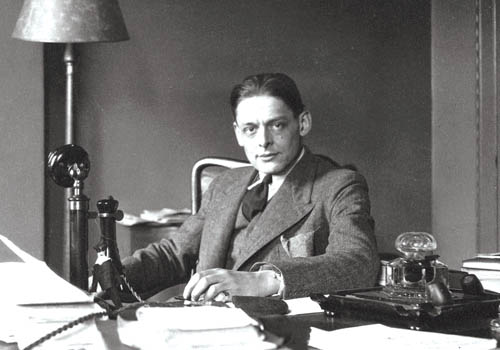
A cat must have three different names: Eliot as a young critic


Cynthia Ozick wrote a famous reckoning with  T.S. Eliot – and his problem with the Jews – for the New Yorker in  1989. The beginning of the essay is marred by the “impression journalism”that identifies Ozick with the proto-cultural warriors, always on the lookout, then, for the decline in Western Civ. Ozick claims, without any references whatsoever, that Eliot is no longer taught in the colleges and the universities, and that he is only remembered for Prufrock. This, at the end of a decade in which the longest running musical on Broadway was called Cats. Ozick, like her soulmates on  the conservative cultural magazine of that decade, the New Criterion, dispenses with providing evidence as though that, itself, were some persnickety politically correct trick. Thus,  there is no grubby looking through actual college catalogues to prove her point, or looking at Anthologies to see if Eliot has so palpably dwindled. In this kind of journalism,  impression quickly reduces to fact and one can move on to nostalgic evocations of better times. While Ozick did not  debase herself by going to actual anthologies, I did.  The 2003 Norton Anthology includes The Wasteland, Prufrock, and one of the Four Quartets. I am almost positive the edition in the 80s included the same material.

Cultural warrior stuff always turns out to be a dinner table impression among emeritus professors viewing the youth with the usual bitter eye.

However, Ozick, while ticking off the cultural warrior boxes – the decline of high art, the substitution of “equal opportunity for minorities” rather than canonical reading lists that include Shakespeare and Jane Austin, etc. – does see two things about Eliot: the anti-semitism and the Prufrock-ery of the “impersonality” urged on the poet – the latter a canonical motif among the New Critics. For coming out foursquare against Christian nationalism, Ozick probably earned some demerits from her rightwing comrades.

Good for her.

It is true, though, that English departments in the fifties and the sixties were crammed with people who thought “real” literary criticism began with Eliot’s collection, The Sacred Wood, 1920. However, the young bucks in the English departments in the seventies had access to and enthusiasm for a whole buncha translated material – and here I don’t just mean the French theory tribe. Bakhtin and Benjamin opened people’s eyes to the 20s. Bold spirits, who went on to found October Magazine, also discovered the Russian formalists and futurists. In the light of, say, Skhlovsky’s Art as Technique from 1917, T.S. Eliot’s once admired The Perfect Critic from 1920  looks positively provincial.

Partly, this is a matter of style. The great essayists of the 1920s, Wyndham Lewis, Virginia Woolf, D.H. Lawrence, all brought a voice to the essay. From Montaigne’s essays on down, the voice has made its uneasy truce with history (personal and suprapersonal) in the essay. Musil, at the time Eliot was writing, was brooding on how the essay was working its way into the novel.

Eliot brought into the essay his prestige as a great poet and his vocational uncertainty – or rather, the uncertainty of where, outside of poetry, he fit. He was not a teacher, but he adopted the teacher’s tics in the essay. Thus, there is a rumble of great names, often for effect; there are adages that would make good witticisms, but are poor proofs; there is Eliot’s conflicted sense of the modern, and his resolve to close down all those uncertainties with doctrine.

How unpleasant to meet Mr. Eliot. Indeed.

The Perfect Critic begins with a quotation from one of Eliot and Pound’s enthusiasms of the time: Remy de Gourmont.  de Gourmont’s heavy fan, Pound, made large claims for him that have no corresponding echo in France, or elsewhere. Eliot, like Pound, seems entirely oblivious of Mallarme. Gourmont was a member of the Mercure clique, until he fell out with Rachilde, the wife of the editor. Still, he was a considerable figure in the symbolist circle around the Mercure. The Mercure, In October, 1935, devoted most of an issue to Gourmont, while acknowledging that after World War I, he was not a much quoted man. “Remy de Gourmont, who had enchanted the friends of letters by the openness of his mind and because he joined boldness to clairvoyance and the sense of ideas to that of language, was soon cast aside. His name is not forgotten, but when young litterateurs cite him, they distance themselves from him with a summary judgment that shows that they know neither his work nor him.”

If I had world and time, perhaps I would know Remy de Gourmont and his work – but I know enough of it to know that Eliot’s yoking of Aristotle and Gourmont in his essay was, to say the least, ill-judged. Although since Eliot takes Aristotle on such general terms, perhaps it was the best he could do for Gourmont. Nothing, to me, is more embarrassing in Eliot’s essays of this time than his presentation of major “Western” figures in a sort of powerpoint way, evoking their greatness but forgetting to explain their pertinence. The pertinence of Aristotle to Eliot’s own sense of criticism seems to consist of the fact that Aristotle analysed tragedy. And you can too!

Such is the spirit.

Eliot was very concerned to exhibit his disaffection with the modern era, that age of disintegration, but his essays in the twenties bear the mark of the twenties. For instance, the decade’s appetite for record making: most homeruns hit, fastest Transatlantic plane time, etc. In that spirit, Eliot likes to begin by giving you the recordholders.

Coleridge was perhaps the greatest of English critics, and in a sense the

last. After Coleridge we have Matthew Arnold; but Arnold I think it will

be conceded was rather a propagandist for criticism than a critic, a popularizer

rather than a creator of ideas.

The paltering perhaps, the I think it will be conceded no wonder Eliot overlooks Hazlitt, or Ruskin, or the romantic critics de Quincey, the Keats of the letters, Shelley who would put down Coleridge was the greatest if they felt it was, and would dare to be damned assertively. I think it will be conceded is the kind of pleading one leaves to the family soliciter, fudging the will.

What Eliot is pleading for, in this essay, is a criticism that takes its objects objectively and without emotion. Now, it is true that the emotion of a geologist finding an unusual rock compound must be separated from the compound itself, though it may be a clue to its rarity or the surprise of its being where it is. But there is little reason to think cultural products are best viewed in that same light or even that they can be viewed in that same light. The argument that even texts with which one violently disagrees can be understood formally is true. But we distinguish criticism from a lesson in grammar by something other which is what I would call voice. Eliot knew his voices the Wasteland is full of them but he didnt know what voice to do literary criticism in. Woolf inherited her right to literature, and Lawrence fought for his. Eliot, on the other hand, writes as though he were turning it in for a grade.

Which is unkind. Eliot, like any other freelancer, had to make his way around a literary scene in England that was either avant-garde and run on the trust funds of some rich heirs and made by Wyndham Lewis types who were cadging drinks and dwelling places and counting their pence, without any retirement plan. Eliot, one feels (oh, I am doing it!) always had a retirement plan.

Eventually, of course, Eliot gave up the notion that criticism must, done right, be done without any passion and plumped for the sensibility, a word that can encompass instinct and intellection without too much question.

Whenever I think I am being too harsh on the T.S.E I love as a poet, I return to his essays and find things like the following, the first paragraph in an essay on Hamlet:

Few critics have ever admitted that Hamlet the play is the primary problem,

and Hamlet the character only secondary.  And Hamlet the character

has had an especial temptation for that most dangerous type of critic: the

critic with a mind which is naturally of the creative order, but which

through some weakness in creative power exercises itself in criticism

instead. These minds often find in Hamlet a vicarious existence for their

own artistic realization. Such a mind had Goethe, who made of Hamlet a

Werther; and such had Coleridge, who made of Hamlet a Coleridge; and

probably neither of these men in writing about Hamlet remembered that

his first business was to study a work of art. The kind of criticism that

Goethe and Coleridge produced, in writing of Hamlet, is the most misleading

kind possible. For they both possessed unquestionable critical

insight, and both make their critical aberrations the more plausible by the

substitution of their own Hamlet for Shakespeares which their creative

gift effects. We should be thankful that Walter Pater did not fix his attention

on this play.

That last line sticks its thumb in the whole massive buttocks of this opening. Poor Coleridge and Goethe, to be condescended to by such a prick! However, perhaps this made them laugh at the high table and Eliot so thirsted and hungered for the high table. Later, in the high Cold War, when Eliot men were nestled in their English departments, probably somebody who also wanted his seat at the high table made heavy weather of this Hamlet, Coleridge and Goethe business.

Eliot himself, to give him a bit of credit, latter cut his Hamlet article for an American edition of his essays, pronouncing it callow.

Callow, the fidgety flitigy filtering cat.


Thursday, May 25, 2023

defining hatred, deflating hatred


Yeats is the great poet of defining hatred – the hatred that makes the self definite to itself.  He is the great poet of the moods of this hatred: he understood, as well, what sacrifice it coerces from the heart, what a burden it is to perpetually carry around an enemy’s list. Of course, being a Tory of the ultra kind, he saw hatred as being a property of the Left. Being a poet, though, he suspected it was a property of being Yeats.

In the Prayer for his Daughter, there’s a marvelous, a legendary account of this:

My mind, because the minds that I have loved,
The sort of beauty that I have approved,
Prosper but little, has dried up of late,
Yet knows that to be choked with hate
May well be of all evil chances chief.
If there’s no hatred in a mind
Assault and battery of the wind
Can never tear the linnet from the leaf.

An intellectual hatred is the worst,
So let her think opinions are accursed.
Have I not seen the loveliest woman born
Out of the mouth of Plenty’s horn,
Because of her opinionated mind
Barter that horn and every good
By quiet natures understood
For an old bellows full of angry wind?

Of course, we know Yeats’s circus animals, and this loveliest woman born has a name and a habitation and a place in the revolt against the British and the Anglo-Irish elite. But it is Yeats’s grudging and not fully uttered sense that his love of a “sort of beauty” has become an excuse for a free-ranging hatred, a justification for failure and bitterness – the failure, indeed, to avoid the bitterness of age.

I’m of an age, myself, when many of my hatreds, at least in the realm of the beautiful and the ugly, are disappearing. Disappearing not through my conscious effort, but because…. Partly this is having a young son whose gothic tastes are so different from mine that I long ago gave up arguing, and partly this is because the nursing of hatred is a thing that goes counter to my bent. Or rather, if I hate, I want to do it enthusiastically. My hatreds are political and existential and pop out of me in that way. But as for aesthetic hatreds…

I remember, when I was in my twenties, that my Dad once said something about how he liked Dylan. This shocked me to my soul. My teens were devoted to Dylan’s music, partly out of love, and partly because my parents hated it. How can you like the music your parents like? That at least was the era of teenhood in which I grew up. Admittedly, helicopter parenting was unknown in the  suburbs of Atlanta at that time. The kids scattered and played and came home from the streets and the little bits of wood that the developers hadn’t gotten around to bulldozing, and the parents never kept a close tab on it all. An unimaginable laxity, from the p.o.v. of the 21st century.

As part of that teenworld, you expected complaints from your parents about the music you played. Those complaints helped define you.

I wonder if this happens anymore?

So, I was naturally shocked by my old man’s comment. How could such things be? Had it been a game?

Well, of course it was a game. Now I’m older than my Dad was then. And I surprise myself. When I was a teen, I had distinct and fierce hatreds, especially for the faddish music of my high school peers. Elton John? Are you kidding me? Z.Z. Top? Southern rock in general? Myself, I found this stuff hugely offensive to who I wanted to be. And yet, decades later, I am watching a movie, Almost Famous, about that seventies teen-rock scene, and the sound of some Elton John song slithers out on the soundtrack, and I have only, only … recognition. What a strange thing that is.

The teen I was is caught in the parent I am. And all I can say to the acned glare of that distant pup is: An intellectual hatred is the worst. And so they go, into the dark…

Wednesday, May 24, 2023

Wasted


I am oddly proud of the fact that I lived about a bicycle ride away from ground zero of the start of the second Drug War.

That war started in a birthday party in Decatur, Georgia. in his book about the drug wars of the Reagan era – which stretched into the Clinton era, until the pharmaceutical companies got seriously into getting Americans wasted -  Dan Baum makes the claim that it all started with  Ashley Schuchard, the thirteen year old daughter of an English prof at Emory, whose invitees to her birthday party in 1976 all got stoned, shocking her mother:: “During Ashley’s birthday party, Schuchard was amazed to see twelve and thirteen year olds stumbling around red-eyed, giggling, and obviously stoned. She saw the flicker of matches in dark corners of the back yard. She could smell burning reefer.”

Carter was elected president that year. As Baum puts it, drug enforcement was a low priority for the Carter administration. In general, the middle class, or the upper middle class that controls the discourse in the U.S., was generally unconcerned about marijuana and much more concerned about sex – watching it, getting it, reading about it, and undergoing a great long bubble of divorce that often involved it. Xavier Hollander, a D.C. madam, was the celebrity of the season.

Sex went with drugs. In 1976, for instance, when I was a freshman at Tulane, my entire dorm room floor was either stoned on weed, high on acid, or kicking back with cocaine. The speeches my roommate would make to me when he was snorting cocaine! Fortunately, I have forgotten them all.  I have a vague sense that they were about fucking while running on coke. Wasted and fucking. His suggestion for all mankind.

Schuchard went on to found a parents organization that lobbied politicians to do something about the spectacle of 12 and 13 year olds getting wasted, but for a while it looked like decriminalization of marijuana and a general relaxation about cocaine was in the works. This, as it happened, didn’t happen. Schuchard and other parents across the country began to organise against drug tolerance. This was picked up by the right – Reagan, among other things, had no tolerance for any libertarianism about marijuana or cocaine. Although, of course, once in office the country was flooded with cocaine, and a bit of the profit was siphoned off to the Contras. U.S. intelligence agencies have long carved out their own domain in the global commerce in drugs, for their own purposes.

They torture, they profit from drugsales, they overthrow governments. We don’t what they do, we don’t know what they did in Korea in 1951 or what they are doing now. American democracy, man.

In my high school, I was a pretty good buddy of the local “pusher” – although he was less of a pusher than a pothead who chose selling pot and cocaine – which was beginning to get popular, especially with the football team -  over a newspaper route, as he could never afford the amount of pot smoke he lived in  via working the latter.

The name for his usual condition, and the name for the condition every boy in my class aspired to at least on certain weekends, was wasted.

The term wasted existed long before the riotously funny ad, put out by the Just say no groups under Nancy Reagan, showed “your brain on drugs”.  It is a measure of the distance between the establishment (in its charity mood) and the rest that a play on the term wasted went right over their heads. Wasted was considered an honorable estate, an all around excuse, a modest brag. Man, I was wasted, was not the confession of a boy ashamed of the chemical injuries to which he had submitted his brain. There was no shame in wasted.

It did play the role of an excuse, though. Being too wasted meant that you could not be responsible for whatever shit you did.

I myself was never wasted. I never touched marijuana until I was almost nineteen. I went through high school a virgin.

But, as per my friendship with the school drug supplier, I was ever ready to extend my tolerance – or perhaps it was just an early display of my gift for enabling. Enabling, tolerance, two sides of the same coin? Always a big question.

Waste, etymologically, is part of a network of words having to do with devastation and spoiling. Words that have a menacingly military aspect. To lay waste. To be wasted and to kill – waste – someone track together in the common American tongue. To waste a village, such was the war in Vietnam, where being wasted and wasting were joined at the hip.

The time of “wasted” might be passed. The kids today might say trashed. Wasted has acquired a certain retro aura. At the same time, wasted is a pretty good macromood word for neolib culture, as it ends in heatwaves and fascism.

We were all wasted.


Thursday, May 18, 2023

The Romantic agony in a cocktail lounge lady’s room


I searched my heart, the street, my ex-‘s habits, my family

I searched them all for opportune  neuroses

That I could jot down for my poetry

And calm my nerves and hide the focus


Five fathoms deep in  something posy sounding.

For after all, don’t I claim to be

Some seashell bard, some grounding

Mama, some prophet of the salty sea


Minus the albatross around my neck

(come to tell you all)?

-          No?  I’m here to sample wreck

I’m here to smear the large and small


Until disproportion proposes

That we go for a little walk, you and I,

A little walk with pretty poses.

A little truism, a little lie,


Logos burning a hole  in my pocket

“Like her fair eyes, dude,  the day was fair”  

I was going up like a rocket

A perfect movement in the down and dirty  air


And heard myself gibbering like a bat

while the air grew ever more blind

and thick with those who  flew, shrieked and shat

panting for the breath we’d left behind


until at last I found the perfect  line,  filled with blood

and sucked it all dry and fell and understood.


-Karen Chamisso


Monday, May 15, 2023

What's next? A nostalgic look at 2007 bullshit, and where we are now (in the ongoing catastrophe)


In 2007, Prospect Magazine, always looking for hits, did a survey of big thinkers. Here’s the way they phrased their question:

“We asked 100 writers and thinkers to answer the following question: Left and right defined the 20th century. What's next? The pessimism of their responses is striking: almost nobody expects the world to get better in the coming decades, and many think it will get worse.”


Admittedly, the thinkers they asked seemed somewhat random. David Brooks gets his say, and Joe Boyd, a music producer, gets his, and apparently what qualifies one to have a view of the next one hundred years best is to work for a bank or business or write an opinion column. There were no H.G. Wells, that’s for sure, and few seemed to disagree with the premise of the question.

Well 16 years on, the answers seem all too predicably concentrated on what the 00s held to be the most important issue since some peasant invented bread: terrorism.

Nobody, oddly, questioned the premise. Left and right did not define the twentieth century. The century was defined, in our view, by two things: first, the treadmill of production – that system which is falsely defined as capitalist because one of its surface characteristics is the market system – which emerged in Europe in the 17th and 18th century, followed out its logic in all systems (communist, fascist, liberal capitalist) on a world wide basis, having laid the foundations in the 19th century (the development, for instance, of the terror famine in Ireland and India by the British  surely provided  models for Stalin's agricultural policy) and collapsed the agriculture-based culture that humans had lived under for the past 12,000 years. That was surely the most significant thing that happened in the 20th century, and no ideology led it, no ideology opposed it, and no ideology even envisioned it.

The anxiety naturally attendant on the end of civilization – which happened at speed in the early 20th century - created a macro feature, which I’d call the dialectic of vulnerability – basically, that process by which populations, feeling ever more vulnerable even as they became ever more affluent developed systems meant to render them invulnerable – that is, an ever more threatening war culture, with an ever greater destructive reach – which, of course, rendered them ever more vulnerable, an irony that was not rhetorical, but systematic. When we think back on that 9/11, which we do less and less, it  was so critical, in part, because it was a moment in which the nakedness of the system was revealed – a system that could, theoretically, respond to ICBMs traveling over the poles, couldn’t respond to 19 half educated men with box cutters and homemade bombs. And… of course it couldn’t.

Defense is a collective fiction, which is its function – being a fiction, there is never a limit on the amount of money one can spend on it. It is, theoretically, inifinitely expensive, while its payoff, as a defense system against all threats, is nearly zero – it will never defend against all threats. That’s ever, with a big fucking E.

The intersection between the treadmill of production and the war culture shaped the 20th century. The division between the right and the left were epiphenomena of that dynamic. It is, of course, impossible to predict the next five years … but in a sense it is probably easier to predict the next 100, since prediction here isn’t about particulars but long, long trends. H.G. Wells was so great because he had a novelist’s instinct for the life of those trends. LI doesn’t – in 1985, when we entered Grad school, we would never have predicted the cultural triumph of Reaganism, for instance. It would have seemed utterly implausible that the combination of endebtedness, meanness, and libertarian logic that flew in the face of reality would ever survive the end of the Gipper. From our inability to see what was in front of our nose, we took a lesson: never underestimate the Death Wish of a culture. It struck us in the 00S  as, frankly, insane to frame the next hundred years in terms of terrorism or the “battle of civilizations” between Islam and the west. For one thing, among threatening issues, terrorism ranks way below, I don’t know, highway safety as a real issue. And definitely, in America, below mass shootings. The instinct to make mass shootings terrorism – the terrorism of rebels without a cause – aligns them, I think, with a mission that provides a last second justification for what is really an act of despair. I’d align them with the rise in suicides and overdoses, and take the apotheosis of the gun, in American culture, as a gesture that points to the dead end of the treadmill of production – we can produce everything but a reason to live. And if you have no reason to live, others either don’t or, more enragingly, do.

The early 00s were a time where, in the States, there was a felt  need to feed the war culture; terrorism is an invention that has no enemies – it is a win win for all participants, giving an excuse to the war culture’s governors to continue doing what they want to continue doing anyway, and thus guaranteeing that a little place will always be set aside for terrorists – sort of like in the movie Network, where the tv network discovers the audience pull of terrorism, and puts the unorganized groups of guerillas on a business basis. As for Islam, again, the use value of Islam is not in Islam per se, but the way it operates as a wonderful two-fer – dark skins that aren’t Christian! Is there a more perfect enemy? Really, Milosovic should be hailed as a prophet – his ideology has now become standard on the Right, and will no doubt be more and more embedded in the policy of the American state as we drift from disaster to disaster.  

Yet the argument that wasn’t had in the 00s was decisively won by those who think America should spend in all around 800 billion a year on the military. For those who want to trace the consequences of that, look at Biden’s foreign policy – or in general the foreign policy of the US since the golden days of Bush.

Nobody, in 2007, had discovered that delightful distraction, AI, which is now the hottest thing ever to argue about as the climate goes seriously crazy. And as the inequality in wealth has become institutionalized to an extent that talk about democracy almost anywhere is absolutely hollow.

Never have the nabobs of the opinion racket been as bad at their business as they are today. As for me, I have taken stern measures not to believe what seems to be happening right before our eyes as a matter of spiritual health.I can’t believe the NYT is so bad, I can’t believe Twitter still exists, I can’t believe that, after all the bullshit, we are watching the rights of women to corporal sovereignty just go down the toilet, I can’t believe that peeps outside of France don’t understand that you don’t let the government destroy the more than half century legacy of social democracy because otherwise, you are heading towards serfdom.

Willed belief. I try to live like I’m reading a novel – instead of being in one.


Thursday, May 11, 2023

Critical criticism after my dejeuner


1.

There is a famous passage in Marx and Engel’s Germany Ideology, which was written in 1846, set aside, and published in 1932. It reads:

“For as soon as the distribution of labour comes into being, each man has a particular, exclusive sphere of activity, which is forced upon him and from which he cannot escape. He is a hunter, a fisherman, a herdsman, or a critical critic, and must remain so if he does not want to lose his means of livelihood; while in communist society, where nobody has one exclusive sphere of activity but each can become accomplished in any branch he wishes, society regulates the general production and thus makes it possible for me to do one thing today and another tomorrow, to hunt in the morning, fish in the afternoon, rear cattle in the evening, criticise after dinner, just as I have a mind, without ever becoming hunter, fisherman, herdsman or critic. “

There are two schools of interpretation about this passage. One reads it as a genuine attempt to imagine a society in which the bonds of the division of labor are lifted. The other reads it as satire.

Myself, being Mr. Split the difference, I read it as a comic bit with a serious nub. In other words, I view this as a typical example of Marx’s romantic humor – a post-Hegelian humor which he shares with other disillusioned romantics of the 1840s, like Kierkegaard and his future enemy, Herzen.

This humor is, above all, gleeful. It exaggerates. Exaggeration holds within itself a truth, or a fact – and in this it is opposed to the lie. The lie, to be successful, conforms to the informal rules of plausibility – while an exaggeration, to be successful, flouts those rules. In particular, it takes a fact out of the plausible and subjects it to a field in which we have lost our grip on proportion. Proportion, which we tend to assume, is of course only as good as the other assumptions with which it is bound. Although we all know now, from pop science books, that a butterfly flapping its wings can cause untold changes in the universe – one of those “truths” of complexity theory – this knowledge can’t really be felt, even by those who are at the extreme end of the paranoid spectrum. In this sense, the credo of the new atheist/rationalist crowd – that facts don’t care about your feelings – gets things completely backwards. Without feelings, a whole spectrum of them, facts would not make any sense – they’d be unavailable to you.

Glee, which was taken up by romantics like De Quincy – or even pre-romantics, like De Sade – is thematized as “agony” in Mario Praz’s famous book, The Romantic Agony – which is still worth reading, although I’d bet my De Quincey that it is not on the curriculum for most grad students in literary studies.  Anyway, Marx was fully conversant with that form of humor – like Heine, or like the Russians, Gogol and the early Dostoevsky.

There are complex truths stuck in Marx’s squib. One of the lesser ones is that criticizing is on the same plane as hunting or harvesting. It is one of the structures of a liberal, developed economy – although it is far more important in an underdeveloped, backwards economy like Germany’s in the 1840s than it is in a fully developed one. Still, in a fully developed economy, on its way to a social democracy that allows a certain equality of the quality of life – measured exactly by its freedom from the slavery of the division of labor – there is and must be room for speculation.

Or to sum this up in a good, 1950-ish way: Man is the speculative animal.

2.

I’m a fundamentally bad lego man. I always put my weightiest bits on the top of the column, and the lightest underneath.

So, sue me.

Anyway, I take criticism and literature as important functions in a “developed economy” – which may well be simply a self-justifying gesture that helps me think, well, I am doing my bit. Perhaps my bit is meant to be spent organizing demonstrations, etc.  After all, I am living in the slops of the twentieth century, in a society that seemingly hasn’t budged since the 1980s. The social neurosis is killing us.

However, it is at just such times – times much like the 1840s – that glee becomes charged with lightning. One has to have a strong streak of gleefulness to read today’s newspapers or social media, turning hatereading into exaltation, and one’s enemies into involuntary dance partners. Repulsion, to the gleefully morbid mind, is half of attraction.

This is, I think, where Marx as a dialectician sometimes outsmarted himself. As a publicist and writer, though, he knew his strengths – which is why he ultimately shoved the German Ideology project aside and went on to other projects. The importance of the German Ideology, to me, is that it presents a sort of stylistic key to Marx. Like all the 1840s romantics, glee and dialectics remained his rock n roll, but he was careful with them. He knew that they might open up the world – de-proportion the proportions – but that they were only steps to get back into the world as a struggle.

So I like to think that, through social media, we might, if we overthrow those social conditions that are handily summed up in the term “neoliberalism” – we just might – might – criticize after dinner. Or, as I am doing now, here, after lunch.

Wednesday, May 10, 2023

Institutional malingering: something is rotten in the States


In the British Medical Journal, September 13, 1913, John Collie, M.D., J.P., authored  a note on “Malingering”, which he connected, like any sensible English utilitarian, with the recent debate about the costs of some sort of National Insurance – just the kind of taxpayer fund that the working class would target with all their illnesses:

“The question of feigning or exaggerating illnesses has of late attraced considerable attention in this country, but it is a mistake to suppose that the condition is of recent origin. Those who have to advise insurance companies know that exaggerated and fraudulent claims are, at any rate, as old as the accident laws.”

Malingering became one of those twentieth century occasions to battle it out about what, exactly, we are to do with diseases of the soul, once we have painlessly and scientifically proven that the soul doesn’t exist. Tricky, that.

I think the twenty first century problem is not the malingering of individual patients: it is the malingering of institutions. In particular, the Democratic party in the U.S. seems to have come down with a nasty case of it. If feigned illness could lead to real death, the Democratic party would be dead by now. It isn't: it is merely zombified. Symptomatically, the party is now presenting its loyal voters with the cute notion that a senile Senator, in a state of health where her best option is to prepare her soul and stay in contact with her loved ones, has no special reason to resign her seat, even if she will never again be able to fill it properly or do her duty. Now, we must preserve her place in the committee that votes on judicial nominations because we don't know what else to do. Otherwise, we would have to work, which would mean appointing a bunch of judges which would destroy the millionaire order that has richly benefitted us all! Besides, really, is it that important, judges  – those petty things that can, for instance, decree the criminalization of the abortion pill. Which we shouldn’t worry our pretty little heads about!

Institutional malingering should be of as much interest to social psychologists as malingering has been to psychology in general. How is it that the twenty first century consists of chickenshit parties ruling over decayed republics and unable to do any useful thing to avert the catastrophes that are eating up the young and creating suicidal conditions for the old? How is it that the U.S.A., from which I sprang, that country which, while deathdealing on a global scale, also produced a culture within which civil rights movements actually produced change – that unevenly democracy-tending place – how is it that malingering and malice have become its face to the world? From the legalized lynching of the homeless to the tyranny of lunatic judges on the dumbest Supreme Court ever assembled from the hayseeds that invest our law schools, all we see is bad shit.  The political structure is crap, and everybody knows it. The energy to fix it seems to go, instead, into an infinitely self-satisfied establishmentarianism that is all about why we can’t fix it.

Things go bad in small ways at first, and then in large ways, and then all at once. Fortunes collapse, nations go rotten. And we go around with the taste of the institutional malingers in our mouths. This is not how life is meant to be lived.

Sunday, May 07, 2023

The gerontocratic spectacle


When Charles was on the brink of thirty, he made a speech to the Cambridge Union in which he said: My great problem in life is that I do not really know what my role in life is.’  The coronation, which I saw – to the length that any tv watcher could stand it – was in line with that statement.

I don’t think I have seen a tv spectacle that was at once so “spectacular” and so heart numbingly boring since the great OJ chase of the nineties, when television discovered that large numbers of people would watch hours of traffic as long as it was accompanied by commentary and celebrity. OJ, at least, in his prime, did experience beauty. Watching documentaries of his great time as a running back for the Buffalo Bills, even a non-fan of the game such as myself could see that here was twentieth century art, to put up against any ballet or modern dance. The OJ who was chased, the bloodstained golfer and future author of If I Did It, was the aftermath of that transcendence – a flat figure, a NPC.

Charles has brushed up against transcendence, but from his horrendous upbringing to his horrendous marriage to his crowning, at the age of fucking 300, he has always been a non-playing character. In Rosemary Hill’s LRB piece about Charles and Camilla, she notes that throughout his career, the word used about Charles is “sad”, or “terribly sad”. As she also notes, nobody pitied Charles as much as he pitied himself. In this, if in little else, he matched his first wife – a flat figure who was meant to race around with seedy Eurotrash trust funders, but ended up, much to her disgust and his, with a Euro-non-trash trust funder.

The ceremony we saw emphasized how very much we are run by a global gerontocracy. Their messenger boys – the Prime Minister of the U.K, the president of France – are greasy with the task of fucking us all over, which they engage in with business school discipline. From the doddering Archbishop of Canterbury (who, at one point, must kneel to pray some kind of prayer, creating the one drama of the whole tedious scene – would he manage to get up on his feet by himself?) to the closeups of Charles, peering seedily around him under those untrimmed eyebrows, this festival in the retirement home of Westminster Abby begged for some, any ironic counterpoint. Instead of getting what we should have had - a series of torch songs of increasing melancholy – we got a thousandth iteration of tween choral music. In order to retain the innocence of those angelic voices, one noticed that Prince Andrew was not present.

In the end, as much as I hate the monarchy and the spectacle of the monarchy, I ended up feeling sorry for Charles. What a waste of middle manager potential, this guy who, if he had not had a fascoid prince of a father and a mother who clearly didn’t like him and wouldn’t die, could have had a happy life as, say, the VP in charge of petrodollar accounts at some City bank! He’d be retired with Camilla in Spain by now, indulging himself with the local vintages and participating in the gentle art of tai chi!

The song that should have been performed, Ithink, is the cover of the Tears for Fears song from Donnie Darko. But it wouldhave spoiled Charles’ one happy day.


Saturday, May 06, 2023

The silly and the soulful

When Adam was in maternal – kindergarten for those of you in the States - in Santa Monica,  the teachers keep a running file on his moods that included such things as angry, interested, lethargic, etc. One of the great categories was silly.
 
Now Adam is in the fifth grade, and, alas, the seriousness of life is settling in. Not for him or his classmates, not yet. But the teachers now are down on silly like a gardner is down on weeds. Say what you will of the dandelion, we don’t want it among the carrots.
 
And isn’t life just carrots?
 
Well, no.
 
I’ve been silly my whole life, if nothing else. But I recognize the powers that be.
 
The oxford english dictionary comes down pretty harshly on silly. Their primary definitions are “Ridiculously trivial”, “lack of common sense” – such is the voice of the scold, disguised as a lexicographer. But some of the first instances of “seely” means worthy or holy. In the fifteenth century, “sylyman prob. has the sense ‘goodman, husband’.In “late Middle English (in the sense 'deserving of pity or sympathy'): alteration of dialect seely 'happy', later 'innocent, feeble', from a West Germanic base meaning 'luck, happiness.' “ Seele is of course soul in German. Now, the tarot of accidental etymological encounters is no positive science, as the German philosophers say, but one of the forms of pataphysics. Still, I like this now dead meaning, which connects having a soul with having fun. Artificial intelligence, such as is displayed by the newspaper opinion writer and the middle manager, does not recognize this connection. But, to be all radical and silly about it, there is no intelligence without fun.
 
Birds do it. Bees do it. Even educated fleas do it.
 
To have soul, in the colloquial sense, doesn’t mean being silly –or at least that is not one of the emphasized facets. However, anybody who has ever listened to Sun-Ra knows that there is a deep cousinship between silly and soul. There is a “deep silly”.
 
What does a man gain if he trades his silly for the world? Nothing. As Ralph Ellison once said, winner’s lose.


Thursday, April 27, 2023

corruptions of empire - the case of Sean McElwee


In his essay, The New York Gold Conspiracy, about the exploits of those great American rogues, Jay Gould and Jim Fiske – the former likened to a spider, the latter a comic giant who never told the truth (so as to keep in practice with the lying), Adams has some Gibbonesque fun with the Erie Railroad, the corporate entity that those two swindlers controlled. It employed 15,000 people, and 773 miles of road in all. And it was bound to the direct control of its owners: “Over all this wealth and influence, greater than that directly swayed by any private citizen, greater than is absolutely and personally controlled by most kings, and far too great for the public safety either in a democracy or in any other form of society, the vicissitudes of a troubled time placed two men in irresponsible authority ; and both these men belonged to a low and degraded moral and social type. Such an elevation has been rarely seen in modem history. Even the most dramatic of modern authors, even Balzac himself, who so loved to deal with similar violent alternations of fortune, or Alexandre Dumas, with all his extravagance of imagination, never have reached a conception bolder or more melodramatic than this…”

Adams  insight – that the extent of the control of wealth by private agents has a direct bearing on both public safety and democracy – has long been lost in the liberal logrolling that allows vast fortunes free range while extolling the republics in which these matters go down as “democratic.”

Yet the liberal is right in being, at least, relativistic – there are degrees of anti-democracy. Adams was describing the start of the Gilded Era – gilding being fake gold, a counterfeit value, bling that is always too showy – hence, bling bling. As counterfeit value becomes the standard of value, corruption becomes less a marginal inroad on the law and more the structure around which law is built.

The American 21st century is an amazingly resplendent blingheap of corruption, from a Supreme Court in which justices plea that they are not bribed when they receive bribes from the rich because they are congenital prostitutes for the wealthy anyway to war profiteers who are never punished for their mercenary crimes and use the money they make to buy media and politicos to crypto currency (pseudo currency) frauds who purchase key members of both parties to ram through legislation to legalize their systematic thievery. I recommend highly the Washington Post’sexcerpt of a book by Ben Terris, which concentrates on an operative named SeanMcElwee – a man who went from libertarian right to progressive radical to reactionarycentrist, a panoply of causes he would discard at will, in service ultimatelyto the one thing he cared about, gambling. This kid, for he has still not breeched his twenties, became, briefly, a powerful wheeler dealer among Dems in Biden’s first two years. Lord knows, he was a tyro of bad takes, which is powerfully attractive to the centrist mindset – but what set him apart is that he would take polls for his Dem clients and used them to make bets about the outcomes of elections. The latter was his passion. Perhaps in order to have more to gamble, he secretly set up a polling outfit for Sam Bankmen-Fried – and briefly went into the effective altruism cult. The polling outfit worked for a retired Republican senator.

The fun and games and mocking of legality here is all Sean McElwee’s business, but the opportunities were provided by the culture. America has as bad a political culture as you can have in a quasi-democracy. It is insanely dysfunctional, filled with passionate predators and egotists who race from think tank to cable news channel and generally try to make people unhappy and hateful. Unhappy and hateful people are great defences against doing anything about the malefactors of great wealth. That is what they are for. Corruption is not simply a perversion of a healthy system, it what the casino is built on.


Tuesday, April 25, 2023

situation comedy, the good, the bad, and the "allegedly" rapist

 All happy families are situation comedies. All unhappy families are situation comedies, too.

This is the wisdom of television, I have been impressed with this wisdom for about three, four years – which is when we started ending our nights with Adam by watching a television series. One series at a time. We started with the Office, the American version, and we have worked our way through Schitt’s Creek, Brooklyn 99, Fresh off the Boat, and Blackish. Each time we have completed the entire cycle – partly because Adam is, as he puts it, a completist.
I’ve been perfectly happy with our choices, even if we all have various complaints about this or that show, gag, character, etc.
But our last choice threw me: Scrubs. Right away the music made me grit my teeth – the bastard children of alternate radio’s obsession with the Hooty and the Blowfish sound, the bane of the nineties. But more, I was thrown by the racism and the sexism. The racism was pretty much in your face – it was white liberal racism, jokey and nervous. And the sexism was on all levels.
The show has a voice over by the chief protagonist. These shows tend to a form that combines skit and parable – the narrator ends the show, almost always, with some moralizing reflections. I find that format uncomfortable. Blackish, another show we saw, also took this form. The problem with the protagonist drawing the moral for the viewer is that the viewer has to trust the protagonist. If the protagonist is creepy, however – as was the father in Blackish and the doctor in Scrubs – the moralizing ending seems more self-congratulation and rationalizing than clever and witty.
Work comedy series, from what I have seen, impose the family image on the work environment, while family comedies often bring work into the family. In Scrubs, the hospital becomes both a hunting ground of romance and a “friends” network. The romance introduces an incestuous element into the family metaphor. The comedy of transgression is, of course, something comedians are enormously proud of, as if they all came out of Lenny Bruce’s thigh. Transgressive comedy coming from highly paid white dudes in America, however, is going to be … well, what highly paid white dudes in America conventionally think. It is convention in the offensive mode.
That is written all over the character development in this show. The characters are unrelievedly creepy. This began to puzzle me. Usually, these shows go through my mind like water through a sieve. A few laughs, Adam is entertained, then brushing of teeth, reading, lights out. But Scrubs seemed extraordinarily strange. Though, like the Office, it was about saying the unsaid, unlike the Office, which used formal devices to distance us from the characters, this show used devices to get us to identify with characters who were, well, creepy. In one typical show, a surgeon makes a sexist joke, operating on a teen, and slips up, thus somehow destroying the hand mobility of said teen, who is on a scholarship to Julliard. The show ends on the moralizing note, with the surgeon telling the teen that it was his fault there was the little blip in surgery – but not of course that he was telling a joke when he made his bad move. And the viewer is given a little morality about the surgeon taking responsibility.
I was like, What?
So we decided to switch to another show, although Adam still wants to watch the season through of Scrubs. And I looked up stuff about Scrubs to see if my reactions were shared. Which is how I stumbled on the story of the man who wrote Scrubs episodes and got fired for obscure reasons: Eric Weinberg. A man who went from sitcom writers room to sitcom writers room, while “allegedly” raping eighteen women. The story in Hollywood Reporter is fascinating and very depressing – a sort of look into how the sausage (joke) is made. The cultural products of America go crazy – cause they are made in just this way.
An excerpt:
Weinberg’s longevity raises questions about what kind of behavior was accepted not only by his agency but in certain writers rooms. Though it was a different time, legislation barring sexual harassment — including conduct that creates a hostile work environment — had long been on the books. The definition of harassment in a writers room, however, has never been clear. Entertainment is a creative business, and it is accepted that writers must have the freedom to express raunchy or off-color ideas — a principle reinforced by the dismissal of a 2004 sexual-harassment lawsuit filed by an assistant in the Friends writers room. Several women who worked with Weinberg after that decision say they believe that the ruling emboldened men who were inclined to harass women.
However murky the definition of harassment, Weinberg’s conduct was enough to get him fired from Scrubs more than a decade before reporting on Harvey Weinstein launched the #MeToo movement. When news broke of Weinberg’s arrest, many former colleagues expressed horror, but not surprise. One female writer says that of all the men she’s worked with, “he was the shittiest and he was the most brazen. When I found out, I was disgusted, and it explained so much.”

Monday, April 24, 2023

imaginary lives

 Marcel Schwob’s preface to his Vies imaginaires makes a plea for the vita as art, instead of history. History, Schwob writes, aims at the general, and puts the stress in the meaning of human lives in their connection with greater events. For history, “all individuals have value only because they have modified events or made them deviate.” Art, on the other hand, “doesn’t classify; it de-classifies.”

The preface carries out the argument, such as it is, with brio. But the imaginary lives do not all carry out that de-classifying imperative. The life of Herostratus, for instance, distinctly lacks a certain detail – or rather, Schwob lacks a certain wonder at this detail.
Herostratus was famous, or infamous, for having torched the temple of Artemis in Epheseus. Schwob does an interesting, proleptic thing about Herostratus by describing him from the beginning in terms of the tortures to which he was subjected after his act. This proleptic magic act is nice. I applaud it. But then, when we read the end of the life, we get this:

“The twelve cities of Ionia forbad, on penalty of death, the announcing of Herostratus name to future ages. But the murmur has come just as far as us. The night when Herostratus torched the temple of Epheseus, Alexander, kind of Macedonia, was born.”

For those of us more historian than artist – or who reject Schwob’s division – there is much lost in that “murmur.” How is it that, somehow, the agent of this particular fait divers was able to avoid a suppression that seems, given the time, the lack of news save by messenger and singer, and the penalty, to have more appropriately submerged that pyromaniac fameseeker?
How do secrets get passed along?

Pessoa wrote an essay on Erostratus in English, which was discovered, like much of Pessoa’s work, after his death. The English is a bit brushed up and too too British, but Pessoa makes a deep remark about Erostratus’s, so to speak, existential figuration.

“His act may be compared, in a way, to that terrible element of the initiation of the Templars, who, being first proven absolute believers in Christ – both as Christians, and in the general tradition of the Church, and as occult Gnostics and therefore in the great particular tradition of Christianity, had to spit upon the Crucifix in their initiation. The act may seem no more than humanly revolting from a modern standpoint, for we are not believers, and, when, since the romantics, we defy God and hell, defy things which for us are dead and thus send challenges to corpses. But no human courage, in any field or sea where men are brave with mere daring, can compare with the horror of that initiation. The God they spat upon was the holy substance of Redemption. They looked into hell when their mouths watered with the necessary blasphemy.”
Pessoa no doubt read Schwob. The Templar story was, of course, a legend transmitted by way of the trials of the Templars, who were overthrown in a power struggle that sought justification, as so many do, in a courtroom padded with lies and crooked lawyers. But secret calls to secret – the initiation of the Templars was a secret kept within the group, and yet it forced itself out – a necessary blasphemy – to future generations.
It is hard to keep a secret. And it is hard to say why it is hard to keep a secret.

Sunday, April 23, 2023

journalism and protocol

 
I was talking to a friend the other day, and she said something that opened my mind. She was talking about a meeting she had gone to, and remarked that one of her colleagues there was talking to everyone in a tone that was out of protocol. It hit me then, this thing I have been puzzling over. The style of Le Monde.
The lead articles on politics in Le Monde, even more than the political reporting in the New York Times, have a curious tone. I guess it is the tone of the servant who is following the rules of protocol at the court. In such ceremonies, as we know from countless movies, there is not much room for maneuver. The names and titles on the list must be read out distinctly and smoothly. They are communication of a sort, but to who? Sometimes to the king, or the master of the revels, and sometimes to the assorted guests. But mostly, these people know each others titles and names.
Here, communication is subsumed in pomp. It is just this surplus of information that is the point. Just as the sorting procedure that organizes the names is the point. The guests and the royals are not going to listen to the names and the titles: they are listening to the tone, the music. It is the music of deference and hierarchy.
This is exactly the music of Le Monde’s lead articles about President Macron.
Here’s the entry on protocol on  Brewer’s Phrase and Fable”
“Protocol (pro' t5 kol). The first rough draft or original copy of a dispatch, which is to form the basis of a treaty; from Gr. proto-koleon, a sheet glued to the front of a manuscript, or to the case containing it, and bearing an abstract of the contents and purport. Also the ceremonial procedure used in affairs of diplomacy or on state occasions.”
There’s an interesting movement between, on the one hand, the rough draft as a supplement, and the procedure as a ceremony. Protocol survived the French revolutions, the Republics, Vichy, DeGaulle, 1968, the sexual revolution, Mitterand and the neoliberal turn. The political reporting in Le Monde is much like the “echoes” social columns that used to appear in all the Paris newspapers, reporting this or that aristocrat’s or plutocrat’s ball. It fills a space in which the uninvited reader is definitely an intruder, and the tone is such that the reader should be happy just to have gawking rights.
Protocol in the U.S. is of a more rough and tumble variety, but in D.C. society it has definitely formed its own music, its own inner and outer circles.
Macron, unlike other recent French Presidents, is a highly protocol oriented boy-man. He’s been in this business since he was weaned on the silver spoon – a much different background than, say, Sarkozy’s. In this way, as in so many others, he is most like the despicable Giscard D’Estaing. This comfort with protocol is something that Le Monde’s writers are ultra down with.
Take, for instance, the big story about the leg of Macron’s “pacification” tour in Ganges. Elsewhere in the world, on Twitter and TV, the big story was about that antithesis of protocol, the banging pot. The prefect of Ganges had forbidden “l’usage des instruments sonores portatifs” – the kind of interesting detail that historians of the micro-history school die for. In Le Monde, though, under the headline MACRON AUGMENT LES PROFESSORS ET LES CRISPE – the kind of nudgework that Macronites and Le Monde’s editorialists love – the first paragraph is like unto a court announcement.
For his second trip [deuxieme deplacement] after the promulgatin of the very contested reform of retirements, Emmanuel Macron chose to speak of education. This was done in the middle of a little circle of fifteen professors, students and parents, sitting the sunny courtyard of a rural Herault establishment, the college Louise-Michel de Gange, where he himself put an end to the suspense on the promised measures on wages for teachers.|
The exact number of people in a circle about the President, who is “putting an end to the suspense” regarding the compensation of teachers, is an almost too perfect figure of court society and reporting. “Put an end” to whose suspense? Not really anybody’s. Neither the fifteen people, nor the reporter, nor the reader are in suspense over the compensation proposed, as this has long been batted around. The professors are on edge – crisper – because the proposal is actually Sarkozy’s work more and make more in the realm of the sadly underinvested realm of public education. However, the subject matter here is of less importance than the style of announcing and describing what the case is.
I am not a man  on whom protocol sits very well. I like it sometimes, but I find it boring most of the time, and I find it an absurd approach to what is happening in France at the moment. However, day after day Le Monde plays the role of the valet leading out the order of the dances and putting an end to the suspense: for tonight’s fete, his highness has ordered a waltz!
Even twitter is better than this.  

Dial 0 for the operator, 1 for billing


Dial O for the operator, 1 for billing


Who invents? We repair, or we have the man

Bring his tools for a look-see. We aren’t familiar

With the specs,  the codes, the at-hand

Or have anything at our fingertips.


We have to back up, we miss the appointment.

We talk to the secretaries of those who have secretaries

Wondering who is holding when we are put on hold.

Are they the holders, really? Is this a hold up


That the Lord has made, we in his hands

He in our hearts, the hold em and fold em

Of gross contingency? Are we being

Offered muzak and headache again,


Like when we were  little girls in the back seat

When we had to go so bad

And mom said hold it

And we couldn’t, we couldn’t?

Monday, April 17, 2023

The paradox of the heap and the effect of the real


It is said that Chryssipus the Stoic held that there were, for all problems, true solutions. But he also held that at times, we can’t see them – and those times called for a morally disciplined silence. It is in this spirit he approached the paradox of the heap – the sorites. The paradox is as follows: if we construct a heap from seeds, say, we can, by adding seeds successively, reach a point where we might say that we have a heap, and identify that with the number of seeds we have used – say, 200. And yet, when we subtract one seed, we are disinclined to say that we no longer have a heap. Given that fact, we might play the game by claiming that we haven’t reached a heap no matter how many seeds we use in order to avoid identifying the heap with a certain number of seeds – but then, paradoxically, we will never achieve a heap. In fact, we don’t really seem to be able to quantify a thing like a heap; neither do we want to say that the heap is a quality when clearly it can be analyzed into its separate parts. To borrow a term from contemporary logic,  there is no “heapmaker” – so how can there be a heap? Chryssipus, according to Sextus Empiricus, recommended that “when the Sorites is being propounded one should, while the argument is proceeding, stop and suspend judgement to avoid falling into absurdity.”  Analytic philosophers, such as Mario Magnucci, who wrote a seminal paper on the stoic response to the sorites, have attempted to incorporate Chryssipus’s response into standard Western logic. To me, the stoic response is closer to the notion of Mu in Rinzai Zen. The famous Mu Koan goes like this: a disciple of Zhaozhou, a Chinese zen master, asked him if a dog has the Buddha nature. Zhaouzhou answered Wu – Mu in Japanese – which means no, empty, vacant, and – it is said – applies in different ways to the question: that there is no dog, that there is no Buddha nature, that the dog does not have Buddha nature, and so on. In other words, the answer is meant to break the mental habit of thinking that the way of assembly – where distinct parts are put together – and the way of disassembly, where distinct parts are separated, are grounded in the real. Indetermination is neither a fact of the real nor not a fact of the real.


I believe the sorites paradox shows us something interesting, maybe deep, about the boundary between logic and structure. Structure, of course, is assemblage, inevitably, even as it pops out from various compositions in terms of motif, pattern, point of view. Logic deals with the structure of propositions, and in particular, the structure of variables and substitutions, but it cannot explain that structure. What substitution is cannot be explained by the logical use of substitution.

And, in turn, structure falls down helpless before the detail. What Barthes meant by the Reality effect concerns this moment.

“However, it seems that if analysis intends to be exhaustive (and what value could a method have that could not account for the completeness of its object, or in other words, here, the complete surface of the narrative text?) in looking to reach to the absolute detail, the indivisible unit, the fugitive transition,  in order to assign it to a place in the structure,  it must fatally encounter notations that no function (even indirectly) can  justify: these notations are scandalous (from the point of view of structure) or, what is still more disquieting, they seem to be accorded by a sort of narrative luxury, prodigal to the point of dispersing “useless” details and thus elevating the cost of narrative information.”

Barthes’ point is one that no reader of a text in a foreign language does not know well: the word – for me, in French or German, the languages I read in other than English – that I have to look up. Or skip looking up. Often, of course, skipping makes no difference – and here we are amidst luxury indeed.

Substitution – that unplumbed dimension of modernity!


Saturday, April 15, 2023

The Underground Reader


There is a certain type of reader – the Jew in Europe, the African-American in the States,etc. – whose relationship to literature, to the great novels, essays and poems, is mediated by the humiliations inflicted even by the so called great writers on the Jew and the African-American, etc. in image and abstract; humiliations that are often casual, often astonishing low points in their writing, byproducts of a certain conformism to social norms, an overlooking or blindness to historical injustices, of the thoughtless acceptance of accumulated capital’s accumulated suffering. Here is a puzzle: the author, that distant and yet intimate source of the text, becomes for the reader a problem of the reader’s own complicity in humiliation: hopeful that the higher liberalism will win out, the reader, this extraterritorial reader, this reader who finds, in the community of readers, that he or she is not included in the general “we” of the gentle reader, finds themselves in an ethical dilemma: are they to accept, even here, the all too familiar relationship of abused to abuser? And we know, we know too well, that abuse is not all lumps, that it is a labyrinth of generosity and violence. Like any of the humiliated and the wounded, the abused reader will take the course of becoming the best close reader – for in a life in which one is dodging blows, the humiliated party has to become, as a matter of survival, a great reader of physiognomy and the smallest signs and tics of the abuser.

One of these readers I am imaging existed in Czarist Russia. He is a figure who appears in the outskirts of Doestoevsky studies – his name is Avraam Uri Kovner. He fled the Jewish community in Czarist Russia when he was a young man, committing himself to the program of positivism, science and enlightenment – from which point of view he severely criticized the piety and practices of the Jews. At the same time, he was proud to be Jewish and he was a biting critic of anti-semites.
As this critic, he modelled himself on Pisarov – the scathing materialist whose essays were never translated, as wholes, in English, but who survives in the Anglosphere as the man who claimed that good pair of shoes had more value than the greatest poem. Yet Kovner had a vast respect for Pisarov’s opposite – Dostoevsky. And as he saw his life spoiled by a crime he committed, he also saw himself rather eerily doubled in the figure of Raskolnikov.
The fait divers goes like this: Kovner took a job at a bank as an accountant. He saw that the bank was making money through the squeezing process of usury and fraud. He also, at this point in his life, In Leonid Grossman’s “Confessions of a Jew”, his account of Kovner, he uses an epigraph from Crime and Punishment to entitle what happened: “that the extraordinary man has a right… to leap over certain obstacles, especially in cases where, for perhaps the fulfilment of an idea that is important for all mankind, this is necessary.” All mankind, of course, is always represented in this extraordinary man – he somehow received their votes.
The story begins like a good Dostoevsky story. In 1871, Kovner found himself on the outs with the Jewish community, for whose newspapers he used to write, and on the outs with the other journals he wrote for, which were being closed, in that year of the Paris commune, as being too radical. Pluse he – oh saints and martyrs@ - wanted to write a novel. I do know that feeling. So he found a lodging in Petersburg. To quote from Kovner’s letter to Dostoevsky:
“In the first months I rented a room in the household of the poor Kanngiesser family… They consisted of a mother, who was a poor widow, the elder daughter and two younger daughters and a son, who was apprenticed as a glovemaker’s assistant. When I learned that they were Jews, I thought about fleeing; but then I saw, that these people were poor and honorable, and I meant a certain income for them, so I stayed out of pity. Later I learned that Sophia Kanngiesser had lost her father four years ago, and that her mother through the course of things had gained some money. In a word, it was horrible misery. I strove with my energy to help them, as much as I could. Sophia could not yet read and write and asked me to teach her. Out of gratitude she, who had never let anyone near her, become affectionate to me. In a word, she fell in love with me.”
Of course, this novelistic situation was animated not just by love, but by sickness: Sophia suffered from some lung ailment. Everything falls horribly into place. Through an advertisement in a paper he used to write for – Voices – he finds a job in a bank. The job pays fifty rubles a month. For that, Kovner has to suffer the humiliation that the bank’s managerial staff consider him a pity hire and treat him as such. Imagine, Raskolnikov having to count out money and bow his head to a bunch of bank officials out of a novella by Gogol! And all the while the coughing of his girlfriend resounding in his ears. Between the miserable pay, the sickness of his girlfriend, and his earlier dreams of being a great writer, Kovner breaks down. The break comes, of course, after Sophia, gasping for breath, tells him: I can’t live without you! And faints.
How to pay for everything. This is the world of urban capitalism in which Kovner and Dostoevsky live. Dostoevsky became a gambler. Kovner, stepping over the barrier put up by lesser men to impede lesser men, defrauds the bank. As Grossman puts it: “The logic of Raskolnikov, cutting as sharply as a knife, bored through the thoughts of this unhappy reformer and hypnotized him even as that cursed illusion had bewitched the Petersburg student. In both cases the same persuasion that the planning is not a crime. In both cases the same calculation: on one side the senselessly squandered, irredeemably pent up sources of life and action, and on the other side young, fresh powers, that are unnecessarily destroyed, everywhere and in their thousands… In both cases the same moral temptation: isn’t a single, insignificant crime redeemed through thousand of good acts?”
Kovner stole. Kovner fled. Kovner disguised himself. Kovner was caught. Kovner was tried, and condemned. It was in his prison cell that Kovner wrote his first letter to Dostoevsky, challenging him as though he were a character come alive: and lo and behold, Raskolnikov is Jewish. As Kovner wrote: “First of all, I am a Jew – and you are not overly fond of Jews (I will speak about this later, however).”
A masterly, a Dostoevskian parenthesis, that one. A challenge on every level. Which will be carried onward in various of Kovner’s letters, to which Dostoevsky responded, in his ongoing column, Diary of a Writer, with a defence of anti-semitism that Kovner pretty easily tore apart – from the standpoint of being one of Dostoevsky’s great readers. In the response to Kovner’s letter, Dostoevsky indulged in the usual banalities of banking and evil Jews gulling innocent Russians ad nauseum, juxtaposing these passages with Dostoevsky’s ideal of the omni-human. The blatant contradiction was fingered by Kovner, and that must have hurt. But the sting did not wake Dostoevsky out of his anti-semitic trance.
Kovner’s standpoint, his existential point of view as a reader, fascinates me. I am a great reader of Dostoevsky myself. And of T.S. Eliot, and of Ezra Pound. But I am not a Jew, nor a Gypsy, nor black. I’m your standard white American, a mongel mix of German, Welsh and what have you picked up on the emigrant trail. I was patched and pealed in the suburbs of Atlanta, which sprang up in the sixties with an influx of white people from the North, although gradually, over the decades, becoming more multi-cultural, more interesting, less my facial white bread.. Somehow, though, through the years, I became a sensitive – which was the name given in the early twentieth century to certain paranormal freaks, mindreaders and telekinetics. I could, at least, see how the alien reader, the one written out – Jews in Dostoevsky, women in Bellow and Roth, blacks in the bulk of White American literary classics, gays from Shakespeare to Mailer, etc. – will and must stake their claim, and in doing so dive into the “written out” part, play the fool, here, erupt as the obscene and the censorious. This is called wokeness, now, by the readers and writers who pretend that a little hemming and hawing will make, has made it all better. Who want to go back to a suitably bandaged teaching. An exercise in tergiversation unworthy of the culture that is supposedly being defended.
Ah, but this is egotism on my part - how much of a sensitive am I, really? - and not of interest.

Tuesday, April 11, 2023

You say you wanna revolution - so stuff it up your ass


Liberation today has four or five pages about the situation of the opposition in France. Le Pen's fascists are gaining in the polls, the left, on the other hand, is doing their crumbling act. Macron's Apres moi le deluge is going to bear fruit, at this rate, in a French government much like Italy's. Fascism. In our screwy post cold war view of history, fascism was defeated in 1945. But actually, the U.S. helped fascism survive into the seventies, and it had a strong presence all around the Meditteranean the 60s, with Greece, Spain, Portugal and Turkey all having more or less fascist governments. Adenauer's government full of the far right or worse. One notices that this was also the time of the revival of the Left - in Germany and in France in the seventies - and the second wave of economic reforms that made life better for the working class majority.

Everybody has their diagnosis. Mine, to be brief, is that the "left" is caught in the rhetoric that successfully created a number of social democratic institutions from the 30s to the 80s. That rhetoric was heavy on change, revolution, and an avant gardiste position. In the face of neoliberalism, however, which as easily assimilated "revolution" to its lingo as its billionaires assimilated "revolutionary avant garde art" for their private collections or storage houses in Switzerland - it is time for the left to appeal to what has been gained. In short, to slip the yoke of the rhetoric of revolution and speak of maintaining the heritage of social democracy that has made life better for all. Not good enough for all, not equal enough given the current rebarbative circumstances, but a past to fight for, a heritage of hope instead of slavery and oppression. To extend this point to the frivolous "anti-woke"/woke" dichotomy - I think the woke culture, which I am absolutely for, needs to work on how to deal with massive shame. That shame is a lively thing - that shame is all over the current economic system, and the favoritism of an upper mostly white class that make it so blandly and blindly evil in the lives of the majority of people. Having never properly understood the shame of slavery in the U.S., having never really mourned it, the U.S. political system is stuck with shame in its gullet. The moment of shame and the moment of legacy - the legacy of resistance, of building up social democracy, of what was gained in the post-war period - are dialectically joined. This is the reason conservatives are so avid to destroy discussions around the 1619 project, or african-american history teaching in general. In France, the same elements are in the mix. The left - Nupes, the ecolo and socialist groups, etc. - have to present both a conservative program of retaining what we, the vast majority, have - for instance, the social security system - and what we need to preserve it - expanding it to serve all the people in france, immigrants and non-immigrants (who are often two generations, or even one, away from some immigrant ancestor). The forces of shame and glory - a glory that isn't reactionary, but progressive - have to be evoked constantly. Let the neolibs keep their "revolution". Make them eat it.

Vico: "a world of men who are composed of lines, of numbers, and of algebraic signs."

  Vico and us 1. In the preface to his translation of Vico’s Le Méthode des études de notre temps, Alain Pons notices that Vico, in contrast...