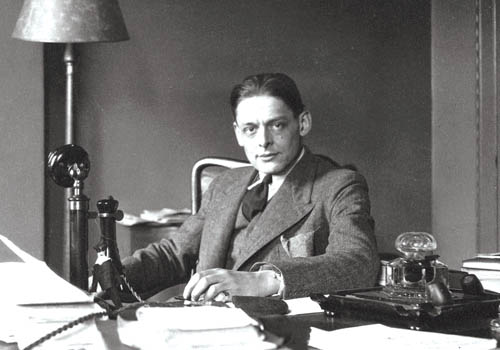
Cynthia Ozick wrote a
famous reckoning with T.S. Eliot – and his
problem with the Jews – for the New Yorker in 1989. The beginning of the essay is marred by
the “impression journalism”that identifies Ozick with the proto-cultural
warriors, always on the lookout, then, for the decline in Western Civ. Ozick
claims, without any references whatsoever, that Eliot is no longer taught in
the colleges and the universities, and that he is only remembered for Prufrock.
This, at the end of a decade in which the longest running musical on Broadway
was called Cats. Ozick, like her soulmates on
the conservative cultural magazine of that decade, the New Criterion, dispenses
with providing evidence as though that, itself, were some persnickety
politically correct trick. Thus, there
is no grubby looking through actual college catalogues to prove her point, or
looking at Anthologies to see if Eliot has so palpably dwindled. In this kind
of journalism, impression quickly reduces
to fact and one can move on to nostalgic evocations of better times. While Ozick
did not debase herself by going to
actual anthologies, I did. The 2003
Norton Anthology includes The Wasteland, Prufrock, and one of the Four
Quartets. I am almost positive the edition in the 80s included the same
material.
Cultural warrior stuff
always turns out to be a dinner table impression among emeritus professors
viewing the youth with the usual bitter eye.
However, Ozick, while ticking
off the cultural warrior boxes – the decline of high art, the substitution of “equal
opportunity for minorities” rather than canonical reading lists that include
Shakespeare and Jane Austin, etc. – does see two things about Eliot: the
anti-semitism and the Prufrock-ery of the “impersonality” urged on the poet –
the latter a canonical motif among the New Critics. For coming out foursquare
against Christian nationalism, Ozick probably earned some demerits from her
rightwing comrades.
Good for her.
It is true, though,
that English departments in the fifties and the sixties were crammed with
people who thought “real” literary criticism began with Eliot’s collection, The
Sacred Wood, 1920. However, the young bucks in the English departments in the
seventies had access to and enthusiasm for a whole buncha translated material –
and here I don’t just mean the French theory tribe. Bakhtin and Benjamin opened
people’s eyes to the 20s. Bold spirits, who went on to found October Magazine,
also discovered the Russian formalists and futurists. In the light of, say, Skhlovsky’s
Art as Technique from 1917, T.S. Eliot’s once admired The Perfect Critic from
1920 looks positively provincial.
Partly, this is a
matter of style. The great essayists of the 1920s, Wyndham Lewis, Virginia
Woolf, D.H. Lawrence, all brought a voice to the essay. From Montaigne’s essays
on down, the voice has made its uneasy truce with history (personal and
suprapersonal) in the essay. Musil, at the time Eliot was writing, was brooding
on how the essay was working its way into the novel.
Eliot brought into the
essay his prestige as a great poet and his vocational uncertainty – or rather,
the uncertainty of where, outside of poetry, he fit. He was not a teacher, but he
adopted the teacher’s tics in the essay. Thus, there is a rumble of great
names, often for effect; there are adages that would make good witticisms, but
are poor proofs; there is Eliot’s conflicted sense of the modern, and his resolve
to close down all those uncertainties with doctrine.
How unpleasant to meet
Mr. Eliot. Indeed.
The Perfect Critic
begins with a quotation from one of Eliot and Pound’s enthusiasms of the time:
Remy de Gourmont. de Gourmont’s heavy
fan, Pound, made large claims for him that have no corresponding echo in
France, or elsewhere. Eliot, like Pound, seems entirely oblivious of Mallarme.
Gourmont was a member of the Mercure clique, until he fell out with Rachilde,
the wife of the editor. Still, he was a considerable figure in the symbolist
circle around the Mercure. The Mercure, In October, 1935, devoted most of an
issue to Gourmont, while acknowledging that after World War I, he was not a
much quoted man. “Remy de Gourmont, who had enchanted the friends of letters by
the openness of his mind and because he joined boldness to clairvoyance and the
sense of ideas to that of language, was soon cast aside. His name is not
forgotten, but when young litterateurs cite him, they distance themselves from
him with a summary judgment that shows that they know neither his work nor him.”
If I had world and
time, perhaps I would know Remy de Gourmont and his work – but I know enough of
it to know that Eliot’s yoking of Aristotle and Gourmont in his essay was, to
say the least, ill-judged. Although since Eliot takes Aristotle on such general
terms, perhaps it was the best he could do for Gourmont. Nothing, to me, is
more embarrassing in Eliot’s essays of this time than his presentation of major
“Western” figures in a sort of powerpoint way, evoking their greatness but forgetting
to explain their pertinence. The pertinence of Aristotle to Eliot’s own sense
of criticism seems to consist of the fact that Aristotle analysed tragedy. And
you can too!
Such is the spirit.
Eliot was very
concerned to exhibit his disaffection with the modern era, that age of
disintegration, but his essays in the twenties bear the mark of the twenties.
For instance, the decade’s appetite for record making: most homeruns hit,
fastest Transatlantic plane time, etc. In that spirit, Eliot likes to begin by
giving you the recordholders.
“Coleridge was perhaps the greatest of English critics, and in a sense the
last. After
Coleridge we have Matthew Arnold; but Arnold – I think
it will
be conceded – was rather a propagandist for criticism than a critic, a
popularizer
rather than a creator of ideas.”
The paltering “perhaps”, the “I think it will
be conceded” – no wonder Eliot
“overlooks” Hazlitt, or Ruskin, or the romantic critics – de Quincey, the Keats of the letters, Shelley – who would put down ‘Coleridge was the
greatest” if they felt it was, and would dare
to be damned assertively. “I think it will
be conceded” is the kind of pleading one leaves
to the family soliciter, fudging the will.
What Eliot is pleading for, in this essay, is a criticism that takes its
objects “objectively” and without “emotion.” Now, it is true that the emotion of a geologist
finding an unusual rock compound must be separated from the compound itself,
though it may be a clue to its rarity or the surprise of its being where it is.
But there is little reason to think cultural products are best viewed in that
same light – or even that they can be viewed in
that same light. The argument that even texts with which one violently disagrees
can be understood formally is true. But we distinguish criticism from a lesson
in grammar by something other – which is what I
would call voice. Eliot knew his voices – the Wasteland
is full of them – but he didn’t know what voice to do literary criticism in. Woolf
inherited her right to literature, and Lawrence fought for his. Eliot, on the
other hand, writes as though he were turning it in for a grade.
Which is unkind. Eliot, like any other freelancer, had to make his way
around a literary scene in England that was either avant-garde and run on the
trust funds of some rich heirs – and made by Wyndham
Lewis types who were cadging drinks and dwelling places and counting their pence,
without any retirement plan. Eliot, one feels (oh, I am doing it!) always had a
retirement plan.
Eventually, of course, Eliot gave up the notion that criticism must,
done right, be done without any passion and plumped for the “sensibility”, a word that
can encompass instinct and intellection without too much question.
Whenever I think I am being too harsh on the T.S.E I love as a poet, I
return to his essays and find things like the following, the first paragraph in
an essay on Hamlet:
“Few critics have ever admitted that Hamlet the play is the
primary problem,
and Hamlet the
character only secondary. And Hamlet the character
has had an
especial temptation for that most dangerous type of critic: the
critic with a
mind which is naturally of the creative order, but which
through some
weakness in creative power exercises itself in criticism
instead. These
minds often find in Hamlet a vicarious existence for their
own artistic
realization. Such a mind had Goethe, who made of Hamlet a
Werther; and
such had Coleridge, who made of Hamlet a Coleridge; and
probably neither
of these men in writing about Hamlet remembered that
his first
business was to study a work of art. The kind of criticism that
Goethe and
Coleridge produced, in writing of Hamlet, is the most misleading
kind possible.
For they both possessed unquestionable critical
insight, and
both make their critical aberrations the more plausible by the
substitution – of their own Hamlet for Shakespeare’s
– which their creative
gift effects. We
should be thankful that Walter Pater did not fix his attention
on this play.”
That last line sticks its thumb in the whole massive buttocks of this opening.
Poor Coleridge and Goethe, to be condescended to by such a prick! However,
perhaps this made them laugh at the high table – and Eliot so
thirsted and hungered for the high table. Later, in the high Cold War, when Eliot
men were nestled in their English departments, probably somebody who also
wanted his seat at the high table made heavy weather of this Hamlet, Coleridge
and Goethe business.
Eliot himself, to give him a bit of credit, latter cut his Hamlet
article for an American edition of his essays, pronouncing it callow.
Callow, the fidgety flitigy filtering cat.


