Thursday, April 05, 2007

Chiquita bananas: now with plenty of colombian blood sprinkled on them


Colombia journal is one of those resources on the web one takes for granted, even though the people writing it are actually putting their lives at risk. Today’s article about Chiquita Banana company – you know, the banana company that pays paramilitary drug dealers to torture and murder union leaders so that it can pay its workers shit – is pretty good. Notice that the war on terrorism, for the Bush administration, certainly shouldn’t be interpreted to mean, like, war on terrorizing the working class. As always, wars are double pronged thing for the U.S. governing class – on the one hand, there is the positive of the military industry, that economic generator which has kept a generation of American engineers fat and happy on oceans of Pentagon welfare money; and on the other hand, there is the negative (which turns out to be a win-win) of targeting the working class. This is why the war on drugs is a model war, so appropriately given birth to during the cold war era. Find the small dealers, disrupt poor neighborhoods, enforce ethnic and racial bigotries, reverse civil rights laws, and at the same time – ally with big drug dealers, prop up corrupt U.S. allies, and shield, as always, upper class white people from ever having to face the consequences of the bogus laws that their paid reps have passed.

As for Chiquita, apparently the new slogan for their upcoming ad campaign is gonna be: ya want those bananas with or without blood?

Batboy on Iran


LI has been a little flabbergasted, flummoxed, depressed, ironed out, shaken up, titrated and itchified by the publicity surrounding the bribes raised by the current crop of presidential candidates. It seems to us, oh, slightly demented that our politically savvy writers are comparing the swag, like some ancient folly Gibbon would record, with marmoreal poise, about the screwier Cesaers in an imperial trough period. Except it is Hilary to Romney to Obama – whose price is right? Famously, the silver age of arty cinema in the U.S. – the seventies – was swept away by the packaged blockbuster, one of the symptoms of which was the sudden popular interest in grosses. The grosses are now part of the roll out package. And LI, crowlike, can only dirge and caw at these signs of the hypno-apocalypse.

Since the landsmarks separating the mad from the sane have been so swept away, LI turns, desperately, to those who can truly be considered barking mad for some extreme onto which we can throw an anchor and say: here, at least, is clear insanity. Which is why we like Ralph Peters, the man who toured Iraq last year and pronounced it safe and sound and ready for business – a triumph of an occupation, all things considered, and to only to be compared with some copious bowel movement by Winston Churchill; the man who published a joke map of the middle east showing it all cut up into the bits the Cheney-ites dream of; and the man who has a nice little column in the NY Post, yesterday, attacking the British navy. The style is the man:

“THE greatest shock from the Middle East this year hasn't been terrorist ruthlessness or the latest Iranian tantrum. It's that members of Britain's Royal Marines wimped out in a matter of days and acquiesced in propaganda broadcasts for their captors.
Jingoism aside, I can't imagine any squad of U.S. Marines behaving in such a shabby, cowardly fashion. Our Marines would have fought to begin with. Taken captive by force, they would've resisted collaboration. To the last man and woman.
You could put a U.S. Marine in a dungeon and knock out his teeth, but you wouldn't knock out his pride in his country and the Corps. "Semper fi" means something.

And our Aussie allies would be just as tough.”


At one point, after the glorious end of the Vietnam war, American militarism experienced a brief period of illegitimacy and ridicule. Ah, those were the days! A demoralized America – I’m doing my best to bring that back! The idea of an officer with his eyes popping out, his face red, yelling like a Tourette’s victim, was actually considered quite funny, instead of an idolon of emulation for today’s gamers and libertarians. Now, of course, such types are immediately slapped with a contract by one reactionary media company or another.

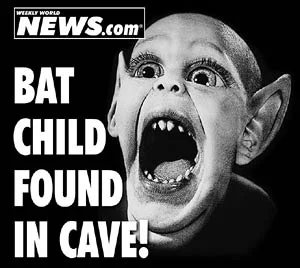
LI wonders why the true predecessor for the rightwing style of high cholesterol bollocks is never given his due. I’m talking, of course, of Ed Anger, the long respected columnist for the World Weekly News, who died in 2004. WWN, you will remember, is the only newspaper to focus on the alien and his presidential endorsements. It was due to Ed that the paper discovered that marvel that scientists are still wondering about: the bat boy. Anger was the author of “Let's Pave the Stupid Rainforests & Give School Teachers Stun Guns”, which I hope all of my readers have profitably perused.

This is a typical Ed Anger opening graf:

“I'm madder than Judge Judy with her mouth wired shut over a couple of stories I just read in my hometown paper. One was about a judge declaring a mistrial in a murder case just because a juror kept catching some Z's during the trial. Another high-and-mighty judge sentenced a courtroom spectator to two days in jail because she dozed off while waiting for a friend's traffic case to get over with. I've been on jury duty several times before, because I feel it's my civic duty, just like owning 37 firearms, for when I need to defend my home against an assault by Cuban, North Korean, Iraqi, Russian or U.N. paratroopers! I know how boring sitting in a court can be, because I had trouble staying awake there, too.”

The difference is that Ralph Peters seems much more unhinged. The idea of Crocodile Dundee laughing at those sand monkeys, though – that is straight up Ed Anger.

Poor Ed! He kept having to move the stakes, as his message, his ersatz anger, his insane political viewpoint, was mainstreamed. There is a nice scene in Robert Stone’s Dog Soldiers set in a tabloid like WWN in the early 1970s. The place is run, of course, by old communists from the days of the blacklist and such. The protagonist, or one of them, a writer on a downer, went to Vietnam as a freelance stringers, and – making a truly disastrous decision – has come back as a heroin entrepreneur, but of course a corrupt DEA man – if that isn’t a redundant phrase – is after his horse. As a former writer for the tabloid, and the son in law of the owner, he goes there for advice and is caught up in a discussion about the front page story. What should it be? A headline is needed – then the story will be fabricated for it. And he comes up with a stroke of genius: Skydiver Rapes, Kills Bride. The story would have everything - a marriage out in a field, a skydiver whose parachute won't open, a fatal fall into the bride, coinciding with a final sexual act, making it a murder/rape/fatal accident in one. Stone, in his recent biography, admits that he took swathes of the tabloid scene from his own life, for he worked for a couple of tabloids. His greatest headline, though, was: Skydiver devoured by starving birds, although Mad Dentist yanks Girl’s Tongue came in second.

Life has always been more tabloid than NYT. Ralph Peters proves it – surely he is the Batboy’s cousin once removed.

Wednesday, April 04, 2007

Aux armes citoyens! Formez vos bataillons!

Peter Watkins made his film, La Commune, which was a sort of recreation of the Paris Commune of 1870, with a cast of amateur actors. These were regular people, mostly unemployed, who had responded to his casting call, and they were supposed to not only play their parts in the film, but think about the action and, in a sense, re-animate the spirit of the Commune. The film shuttles back and forth between the reality of making the film, including interviews with the actors, and scenarios plucked from actual history.

At the end of the movie, as at the end of the Commune, the forces of order – the French army of the Third Republic – move into Paris, sweeping past barricades and massacring Communards, while the Communards massacre prisoners in turn. A contemporary reporter noted that the “last red flag that floated for the Commune was at a barricade at the Rue Fontaine au Roi, where, after a feeble defense it was surrendered at 11 a.m.” May 28, 1871. In a similar scene at the end of the film, the actors, who by this time seemed to be having difficulty distinguishing between their real life and their 1871 lives, are manning a barricade that is being attacked by troops, and they suddenly spontaneously start singing the Marseillais. It is an incredible moment, a moment of true terribilità – it is as though the scene in 1871 really did escape from the long chain of time to merge with the one being filmed.

Which brings me to the thread I’ve been threading re art and subversion. La Marseillaise, in 1871, had a certain dread power partly because it had been banned under Louis Napoleon. And yet, in 1870, when war was declared against Prussia – all those people streaming through the streets under Nana’s window, yelling “onto Berlin” – the song broke out spontaneously in crowds and in cafes. It was an indicator of the kind of patriotism that Napoleon III could ill afford – it pointed to a crack in the regime, which had always been dogged by an aura of illegitimacy.

So – if we are looking for the complex of art and subversion and censorship, this is one place to find it.

There’s a history of La Marseillaise by Michel Vovelle here. We are going to write more about this in our next post.

Tuesday, April 03, 2007

Did Noah know about simple suspended animation techniques?


The Werepoet has posted the conservopedia entry on kangaroos, which brought a tear to my eye – for in the end, if I am for anything, I am for surrealistic science. Apparently, the conservopedia operates like a huge vacuum, scouring the web for the most ridiculous information that it can find and putting it in presentable form, suitable for LGF commentors and the like. I am so into this!

So this post is dedicated to the latest scientific investigation of Noah’s ark. Science has always found Noah’s ark a puzzle. On the one hand, God’s word says Noah built an ark and assembled all the animals, two by two – so we have some firm facts to go on. But how did Noah feed the animals, and keep them from eating each other?

The answer may come from “S.A., crypto-suspended animation in inverterbrates by Dr. Axel Kroeger and Dr. Nicalaus Swiboda in the Acta Oto-Biblica Vol. 10, issue 4 (2006), the premier journal of Bible based natural science out of Uppsala, Poland. Kroeger and Swiboda reproduced ark-like conditions by sealing off the Olympic sized swimming pool at the Holiness Temple College (where they both work in the endosynchrology department) and building a beaverwood structure to float on the pool. The two captured insects, perhaps the most difficult animal Noah and his family had to deal with. Using a simple to construct dry ice machine, using lumber from Mount Arak’s famous balsa trees and a simple combination of ice, sulphur, copper, tooth enamel, dew and fire, Drs. Kroeger and Swiboda demonstrated conclusively that the insects could be put into a state of suspended animation for up to two weeks. This, incidentally, made them much easier to stack. These results have been confirmed by scientists at M.I.T., Harvard and Oxford.

Please, readers, pass this around. LI wants to add a little something to the Conservopedia. One tiny step for an idiot, but a giant leap for the idiocy of all mankind!

Monday, April 02, 2007

a killer style

In Wooden Eyes, Carlo Ginzberg begins his essay on Style with an exemplary story, a little trouvaille. In 1605, the Venetian Republic jailed two priests, thus setting off a long dispute with the Holy See. On the Venetian side, the main polemicist was a monk, Paolo Sarpi. In 1607, Sarpi was ambushed near his monastery by a number of men with knives, who stabled him repeatedly. ‘Sarpi, gravely wounded, whispered to the doctor who was tending him that, as everyone knew, the wounds have been caused ‘stylo Romanae cuiaa’ – that is, by the knife of the Roman curia, but also by the legal procedures [literally, by the stylus or pen] of the Roman Curia.”
Style kills. And what kills, in human affairs, usually falls under the category of the political, insofar as politics is war pursued by other means. LI has been thinking about this in relation to the topic we pursued in a couple of posts last week – subversion in art.

To reprise: Sociologically, it is funny that art’s subversiveness has become a critical commonplace and an unthinking plaudit in the same era that the official social mechanism recognizing subversiveness in art – censorship – has been reduced or transformed. Without a specific censor’s judgment to guide the critic, subversion in a piece of art – the Chocolate Jesus, V for Vendetta, etc. - now takes only the largest and vaguest objects – language, capitalism, patriarchy, while its subversive quality has become a sort of good housekeeping seal – as if there were something aesthetically positive about subversion itself. In fact, subversion has been seen as such an all encompassing good that I’ve read more than one critic say that all art is subversive. And who questions that? or that subversion is a good in itself?

One of the liberal commonplaces about censorship is that censorship is essentially dumb. That is, the censors are always censoring the trivial or the inconsistent, and never catching the clever, subversive things put in by artists that send out special messages to the audience. The implication is that art does not consist just of parts that can be blacked out or not. Rather, there are other things at work – like style. How does one censor a style?

Ezekial on the mortgage crisis

Because the Fed cleverly found a way to bypass accounting for the inflation in the housing market, we’ve been in a strange situation, econometrically speaking, in the last ten years: both dependent on that inflation (the Fed assiduously fed that bubble) and pretending, for official purposes, that it doesn’t exist. Now LI doesn’t necessarily think feeding a bubble is wrong. Cheney, that monster of depravity out of a theater of cruelty production, was right about one thing when he said, to some conservative bemoaning the fact that the Bush budget was awash in red ink, that deficits don’t matter. By which he meant that nobody has ever gotten voted out of office in these here states cause of a stinkin’ deficit. We were founded by bankrupts and we aren’t fooled by suits – we know the wild west lurks under the surface of Wall Street. Deficits are good things in times of recession. If there is one lesson in affluence we all learned in the 30s, it was to borrow to keep demand up when you have a classic depression: too many goods and services, too little demand. The reality of that is tiresome for economists, who believe, as Robert Lucas once put it, in Say’s law as a parameter of intelligibility. The problem, of course, is what the Bush administration borrowed for. It is one thing to go in debt to build a house; quite another to go into debt to burn a house down. Non-creative destruction is the Bushite creed.

The real difference, broadly speaking, between the EU’s economy and ours is that we employ Keynsian economics to prop up a conservative politics, while the EU employs a neo-classical fiscal policy to prop up legacy socialism. The EU fear of inflation overrides its good sense, and the American advice to the EU is always to … Americanize. Destroy the unions, create a vastly more unequal distribution of wealth, etc., etc. It is terrible advice, and we doubt that even Sarkozy, that menace, will take it, although he claims to be eager to sick Thatcherism on France. For both the EU and the US, policy is an expression of structure. The EU can actually afford more unemployment, having a perfectly good social welfare system. The U.S has a perfectly good social welfare system for unemployment too: it’s called jail. Between prison and education, the U.S. can keep a goodly numbered of the able bodied off the employment roles without anybody calling a foul. Still, having less, shall we say, strata of social welfare, and having a criminally weak labor sector, the U.S. has become, out of necessity, a sort of virtual economy – the first economy in which credit has so totally penetrated the economic mindset that it has erased longstanding definitional differences between savings and investment, along with the remnants, in the 19th century, of the need to make money correspond to some standard of value. Money is now simply an excuse for credit, secondary to it, a sidekick. As we have often emphasized, having no power to extract wage increases from capital, the mass of Americans just borrow their wage increase. This should make them ever alert for better paying jobs, but for all the talk about the mobility of Americans, the figures don’t show a lot more mobility now than there was twenty years ago. After all, to quit means quitting, among other things, your medical benefits.

Which is why a specter haunts U.S. capitalism: foreclosure.

We thought these grafs from this article in the NYT this weekend worth quoting:

“A study conducted by Kristopher Gerardi and Paul S. Willen from the Federal Reserve Bank of Boston and Harvey S. Rosen of Princeton, Do Households Benefit from Financial Deregulation and Innovation? The Case of the Mortgage Market (National Bureau of Economic Research Working Paper 12967), shows that the three decades from 1970 to 2000 witnessed an incredible flowering of new types of home loans. These innovations mainly served to give people power to make their own decisions about housing, and they ended up being quite sensible with their newfound access to capital.
These economists followed thousands of people over their lives and examined the evidence for whether mortgage markets have become more efficient over time. Lost in the current discussion about borrowers’ income levels in the subprime market is the fact that someone with a low income now but who stands to earn much more in the future would, in a perfect market, be able to borrow from a bank to buy a house. That is how economists view the efficiency of a capital market: people’s decisions unrestricted by the amount of money they have right now.
And this study shows that measured this way, the mortgage market has become more perfect, not more irresponsible. People tend to make good decisions about their own economic prospects. As Professor Rosen said in an interview, “Our findings suggest that people make sensible housing decisions in that the size of house they buy today relates to their future income, not just their current income and that the innovations in mortgages over 30 years gave many people the opportunity to own a home that they would not have otherwise had, just because they didn’t have enough assets in the bank at the moment they needed the house.”

“The size of house they buy today relates to their future income…” What a phrase! To unscrew the top of it, and peer inside, one definitely needs to be a poet or a prophet.

Sunday, April 01, 2007

a might have been

I think LI will be the first to point out the perhaps saddest part of the whole prosecutor scandal is a might-have-been. Just imagine: it is August, 2001. CIA operators have flown down to Crawford, Texas. They present the evidence they have that Al qaeda has representatives in the U.S. who are preparing to attack. Now, imagine that they had added – these al qaeda terrorists are so evil that they are prepared to help - listen to this part, please, no, don't start testing your power saw yet, Mr. President - they might - please, can you hear me over the noise of that thing? Please. Okay. They might be trying to help disenfranchised black males register to vote!

We know what would happen. We know how President Backbone leaps into action when the Republic is threatened. Like Superman emerging from Clark Kent, or Venus from the foam of the sea. Instead of writing in his diary, for that day, "Nuthin happned. Shure is ez being presnident. Bush Rulez! In the House” – there would, instead, have been midnight oil burned at the Justice department. The FBI director would have put out a memo. The search would be on. Say what you want, when the President wants something done, he knows how to shake up the bureaucracy to do it!

On the Hoodoo Man

  Just catchin' up with this London Review Book review of Hoodoo Man. I don't know much about Francis Gooding, but the review is a w...