“But I hear the voice of nature which cries out against me.” – Montesquieu
LI is a bit gloomy. Our quote, by the way, is from Montesquieu’s chapter on the question of torture in the Spirit of the Laws.
Here’s a bit of a Q and A, posted by In these Times, with Trevor Paglen and A.C. Thompson about their book, Torture Taxi: On the Trail of the CIA’s Rendition Flights.
“What did you learn from getting so close to the “black sites” in Afghanistan?
"Nobody was talking about or thinking about this issue. The Afghans would say, “Why are you so concerned with such a small number of prisoners from other countries that have been dragged here?” The justice system in Afghanistan is ad hoc. There are warlords who have secret jails in their houses. The U.S. military runs a network of 20 different detention centers that is essentially secret. These are jails that are publicly acknowledged, but the Afghan officials cannot get into them, the United Nations cannot get into them, the human rights groups cannot get into them, so they effectively operate in secret. A vast network of jails is holding hundreds of people. Really, when you talk about secrecy and indefinite detention, the problem is bigger than most people realize.
"In the book you describe all of Afghanistan as a black site. What do you mean by that?
"We checked out this facility that we believe is run by DynCorp. Afghan and jail officials could not tell us what goes on in there. The local police chief could not tell us what goes on there. This facility takes up the better part of a square block. It is guarded by huge heavy bomb barriers and row after row of guards with M-16s. The rumor is that prisoners are being held there. The most we could get out of one guy was that it was a center for counterterrorist activity. When you encounter these detention centers that nobody can get into, you realize the whole country is sort of this black site.”
And finally, going back to a question that I have been prodding at: what is Bush and Co. so afraid of? Following the satanic method recommended in Michelet’s La Sorciere, you have to find the reverse of that question to answer it. Namely, what do Bush and Co. want?
Bush and Co. didn’t come from Mars. Like the rest of us, they are shut up in this big prison house of white magic, In a previous post, I listed helter skelter the sheer magnitude of the power and the glory accruing to the triumphant American governing class in this year of Dow 12,000. That was just to set up the question Jack Nicholson asks John Houston in Chinatown: how much better can you eat? How much better can you live? Trying to plumb the millionaire motive for committing any crime to become an even richer fuck. In the series of moves made to remove the Executive branch from any constraint, which has been crowned by the detainee law(crime), we are watching CEO behavior. The appetite for power has its genesis here very clearly in the appetite for wealth.
As it happens, Silja Graupe’s book, The Basho of Economics, which I translated, presents a pretty clear systematic answer to the question of what Bush and Co. want, if we put them in the context of the unconstrained free market system. Graupe finds the moment of excess in neo-classical economics, that halfway house between natural theology and science, that operates as both a justification of the system’s effort (a la Polanyi) to reverse the relationship between economics and society (making society subservient to the market) and a symbol of a dilemma endogenous to the science.
The latter symbolic dimension needs a preliminary remark. Graupe, following Minkowski, grounds her critique of neo-classical economics on the latter’s attempt to make itself a science by absorbing terms and models from physics.
Here’s a long quote:
“Following utility theory, an increase of the quantity of commodities is automatically followed by an increase of the utility levels. This assumption is partly hidden in the neoclassical postulate that the slope of the indifference curve must be negative. But it is formulated explicitly in the assumption of non-satiation (as Arrow and Hahn call it). It is “typically assumed, that more is better”. “The individual is never completely satisfied, but can, in principle, always think of an improvement through another bundle of commodities. Simplifying this, we assume a rule stating that an individual prefers to get more of all commodities.”
Economic theory can’t countenance satiation without giving up the analogy to physics. If it did, a bundle of commodities could be found, by which the preference of the individuals should come to rest of itself, without being externally constrained. Such a resting or equilibrium point is unthinkable in physics, since in the latter every mass point is thought of as moving forward infinitely so long as it is not limited in its freedom of movement by outside forces. While this idea may work with physical bodies, its translation to the economic context would imply the following: it would not only presume an unlimited space of commodities, but also an unlimited effort directed at a surplus of commodities. But how could one possibly explain such an unlimited effort? This question is not answered unambiguously in economics. Generally however one begins by saying that it implies an infinity of human needs. This becomes somewhat clearer given that the neoclassical utility theory is formulated as a maximization of the collective satisfaction of needs.” Yet such an explanation remains, in itself, without content so long as the concept of need is ambiguous. In the course of further interpretation is should become clear, that the effort to obtain more and more commodities can really only be interpreted as striving to obtain an infinite amount of money.”
I’ll spell out the implications of this – and the foundations of zombie society, where things are in the saddle and ride mankind – in another post.
Thursday, October 05, 2006

Wednesday, October 04, 2006
a speech by my favorite terrorist
Another day in cornpone coup country. The fisher king’s dick has failed to rise again in Iraq (although ten Gis died this weekend, or to put it in Bushspeech – ten commas were added to history) and the fisher king’s subs all pretending like they heard different things at that meeting in 2001 – instead of Al Qaeda, they kept hearing Alky? Da, (Rice thought it was just an answeri to a question about the President's character) and like that. And we discover, today, the only joyous thing to happen in the house of representatives since the impeachment of the prez - Representative Foley quietly masturbating and messaging (multi tasker that he is) while voting for another scandalous piece of sleazy legislation. The world is so upside down that it is Foley who is resigning. It should be the rest of congress. The country would be safer today if all of our reps concentrated on messaging their lolitas, rather than divvying up the spoils and digging the pit in which to bury our liberties.
In LI’s last, we told a few ripe old bedtime tales from American history, to get us to the point where we can address the strange death of the love of liberty in this country. To measure that death means understanding, dialectically, how oppression and liberty have wrassled each other and learnt tricks from each other.
But – I’m just not up to following the ins and outs of this story in this post.
Instead, here’s a little break: terrorist inspiration brought to you from my favorite material enemy of the country, John Brown. I just wrote a review of a book about Brown. It should be google-able. Anyway, in researching that review, I was quite impressed with this speech he made in court, post Harpers Ferry. He’d killed a few men – seen two of his sons die, and a son in law. He was going to be hanged. The slaves had not risen up formed a guerilla army, mores the pity, although there is some indication that way out here , although there is some indication that way out here in Texas, some slaves might have been inspired to give it a go. http://www.utexas.edu/utpress/excerpts/exphiwhi.html But he was still sure that his plan to spark a black uprising in the South (about which he hedges a bit, admittedly) was a good one. Here’s what he had to say, or at least the first part of it:
I have, may it please the court, a few words to say. In the first place, I deny everything but what I have all along admitted -- the design on my part to free the slaves. I intended certainly to have made a clean thing of that matter, as I did last winter when I went into Missouri and there took slaves without the snapping of a gun on either side, moved them through the country, and finally left them in Canada. I designed to have done the same thing again on a larger scale. That was all I intended. I never did intend murder, or treason, or the destruction of property, or to excite or incite slaves to rebellion, or to make insurrection. I have another objection; and that is, it is unjust that I should suffer such a penalty. Had I interfered in the manner which I admit, and which I admit has been fairly proved (for I admire the truthfulness and candor of the greater portion of the witnesses who have testified in this case)--had I so interfered in behalf of the rich, the powerful, the intelligent, the so-called great, or in behalf of any of their friends--either father, mother, brother, sister, wife, or children, or any of that class--and suffered and sacrificed what I have in this interference, it would have been all right; and every man in this court would have deemed it an act worthy of reward rather than punishment.”
Brown's attack was financed, by the way, by good upstanding Northern businessmen - early Republican party adapters. How sad sad sad the trail from these upstanding liberal radicals to Bush's pioneers. Makes you want to weep.
In LI’s last, we told a few ripe old bedtime tales from American history, to get us to the point where we can address the strange death of the love of liberty in this country. To measure that death means understanding, dialectically, how oppression and liberty have wrassled each other and learnt tricks from each other.
But – I’m just not up to following the ins and outs of this story in this post.
Instead, here’s a little break: terrorist inspiration brought to you from my favorite material enemy of the country, John Brown. I just wrote a review of a book about Brown. It should be google-able. Anyway, in researching that review, I was quite impressed with this speech he made in court, post Harpers Ferry. He’d killed a few men – seen two of his sons die, and a son in law. He was going to be hanged. The slaves had not risen up formed a guerilla army, mores the pity, although there is some indication that way out here , although there is some indication that way out here in Texas, some slaves might have been inspired to give it a go. http://www.utexas.edu/utpress/excerpts/exphiwhi.html But he was still sure that his plan to spark a black uprising in the South (about which he hedges a bit, admittedly) was a good one. Here’s what he had to say, or at least the first part of it:
I have, may it please the court, a few words to say. In the first place, I deny everything but what I have all along admitted -- the design on my part to free the slaves. I intended certainly to have made a clean thing of that matter, as I did last winter when I went into Missouri and there took slaves without the snapping of a gun on either side, moved them through the country, and finally left them in Canada. I designed to have done the same thing again on a larger scale. That was all I intended. I never did intend murder, or treason, or the destruction of property, or to excite or incite slaves to rebellion, or to make insurrection. I have another objection; and that is, it is unjust that I should suffer such a penalty. Had I interfered in the manner which I admit, and which I admit has been fairly proved (for I admire the truthfulness and candor of the greater portion of the witnesses who have testified in this case)--had I so interfered in behalf of the rich, the powerful, the intelligent, the so-called great, or in behalf of any of their friends--either father, mother, brother, sister, wife, or children, or any of that class--and suffered and sacrificed what I have in this interference, it would have been all right; and every man in this court would have deemed it an act worthy of reward rather than punishment.”
Brown's attack was financed, by the way, by good upstanding Northern businessmen - early Republican party adapters. How sad sad sad the trail from these upstanding liberal radicals to Bush's pioneers. Makes you want to weep.
Monday, October 02, 2006
satanic historiography
De telles contradictions apparentes n’embarrassaient guère un jeune artiste, de foi arreteé, mais candide, and sans calcul, sentant peu le peril d’être tendre pour l’ennemi. – Michelet, preface to L’histoire de France
(Such apparent contradictions hardly embarrass a young artist, with his closed, but candid and uncalculating creed, barely feeling the danger of being tenderhearted for the enemy.)
Comment y arriva-t-on. Sans doute par l’effet si simple du grand principe satanique que tout doit se faire à rebours, exactement à l’envers de ce que fait le monde sacré. – Michelet, La sorciere
Another truth: I said that Michelet is not concerned to describe the rites themselves; he deals rather with their destination, their effect (summoning the dead, curing the sick). This suggests that he makes little differentiation between rite and technique, a correspondence ethnology has adopted in its assertion that magical gestures are always sketches of a technology – Barthes on Michelet’s La sorciere.
In my last post, I sketched half of the history I promised – and even that history is simply another promise, the detour getting us back to the question: what is Bush and Co. so afraid of? Our first step is to draw a map of the peckerwood dialectic of Southern history. Our second step is to understand the reversals that have characterized the Republican party. The meeting of the twain is the goal. But remember, while the steps of all the players are dyed in the white magic of power; LI, taking the advice of Michelet’s witches, doesn’t just want to analyze – we want to vivisect this living history until it bleeds. Tout doit se faire à rebours – a rocknroll motto of resistance to the criminal state we woke up in this morning, a morning like any other, the state like any other.
Okay. In for a penny, in for a pound of flesh. The other half of the story I started with Peckerwood Dialectics concerns the theodicy of the Republican party. It is rather amazing to look at what happened to the Republicans. Here we have a party that, in 1868, is the closest thing America has ever had to a Jacobin party. And here we have a party that, by 1900, assumes its modern form as the political aspect of the corporation, the party of the chamber of commerce.
How we get from one point to the other is a puzzle. Again, as so often in American puzzles, the keys are race and money.
The party system was a surprise to the Founders. It wasn’t what they expected, even though it was obvious that it was coming. It wasn’t just the jealousies and powerhunger of personalities, although that is probably the way Adams and Jefferson looked at it – it was a natural outgrowth of a system that required some internal organization of the representatives and even of the executives. LI has never read a good account of why this should be so – why do the alliances between representatives, and the competition for posts, lead to the party system? In fact, in the fifty years from 1800 to 1850, the party system was obviously being forged in the states, and one of the key motifs around which parties coalesced was race. Race and xenophobia.
I’m not going to bore anyone with stories of the Know Nothing party. But here’s what interests me – the tension in the Republican party between, on the one side, the incipient Northern reformist culture – the prototype of contemporary liberalism, with its comfort with issues of identification (race and gender) and its discomfort with issues of class – and, on the other side, the business strata. To understand why the business class would migrate into the Republican party, you have to see how the issue of class and race operate – not, as liberal myth would have it, in happy tandem, resistance to racism and sympathy for the working class going hand in hand. Rather, the working class/immigrant faction was claimed, quite early, by the Democrats, and formed partly in open opposition to blacks. Racism so often acts as a unifying force in these here states, allowing opponents to forget about their differences in the face of their big hatred. But, as in a screwy game of Chinese checkers, it was just that mob of the immigrant kind, and the Democratic working man, that made the business class seek refuge in the Republican party –with reformers who were, themselves, not exactly pleased with working class lifestyle habits, from the way the kids were raised to the spread of Catholicism to the drinking. (Drinking – the trans fats of the 19th century!).
And here the black Other had a different function. As is pretty well known, the majority of the abolitionist crowd, while opposing slavery, did not exactly welcome the black man into a relationship of equality. In Kansas, for instance, the Freesoilers who fought the pro-slavery paramilitaries wanted no slaves – and no blacks, period. They wanted laws to keep any African American from living in Kansas.
Okay, I’ll return to this in my next post. Got to go to work.
(Such apparent contradictions hardly embarrass a young artist, with his closed, but candid and uncalculating creed, barely feeling the danger of being tenderhearted for the enemy.)
Comment y arriva-t-on. Sans doute par l’effet si simple du grand principe satanique que tout doit se faire à rebours, exactement à l’envers de ce que fait le monde sacré. – Michelet, La sorciere
Another truth: I said that Michelet is not concerned to describe the rites themselves; he deals rather with their destination, their effect (summoning the dead, curing the sick). This suggests that he makes little differentiation between rite and technique, a correspondence ethnology has adopted in its assertion that magical gestures are always sketches of a technology – Barthes on Michelet’s La sorciere.
In my last post, I sketched half of the history I promised – and even that history is simply another promise, the detour getting us back to the question: what is Bush and Co. so afraid of? Our first step is to draw a map of the peckerwood dialectic of Southern history. Our second step is to understand the reversals that have characterized the Republican party. The meeting of the twain is the goal. But remember, while the steps of all the players are dyed in the white magic of power; LI, taking the advice of Michelet’s witches, doesn’t just want to analyze – we want to vivisect this living history until it bleeds. Tout doit se faire à rebours – a rocknroll motto of resistance to the criminal state we woke up in this morning, a morning like any other, the state like any other.
Okay. In for a penny, in for a pound of flesh. The other half of the story I started with Peckerwood Dialectics concerns the theodicy of the Republican party. It is rather amazing to look at what happened to the Republicans. Here we have a party that, in 1868, is the closest thing America has ever had to a Jacobin party. And here we have a party that, by 1900, assumes its modern form as the political aspect of the corporation, the party of the chamber of commerce.
How we get from one point to the other is a puzzle. Again, as so often in American puzzles, the keys are race and money.
The party system was a surprise to the Founders. It wasn’t what they expected, even though it was obvious that it was coming. It wasn’t just the jealousies and powerhunger of personalities, although that is probably the way Adams and Jefferson looked at it – it was a natural outgrowth of a system that required some internal organization of the representatives and even of the executives. LI has never read a good account of why this should be so – why do the alliances between representatives, and the competition for posts, lead to the party system? In fact, in the fifty years from 1800 to 1850, the party system was obviously being forged in the states, and one of the key motifs around which parties coalesced was race. Race and xenophobia.
I’m not going to bore anyone with stories of the Know Nothing party. But here’s what interests me – the tension in the Republican party between, on the one side, the incipient Northern reformist culture – the prototype of contemporary liberalism, with its comfort with issues of identification (race and gender) and its discomfort with issues of class – and, on the other side, the business strata. To understand why the business class would migrate into the Republican party, you have to see how the issue of class and race operate – not, as liberal myth would have it, in happy tandem, resistance to racism and sympathy for the working class going hand in hand. Rather, the working class/immigrant faction was claimed, quite early, by the Democrats, and formed partly in open opposition to blacks. Racism so often acts as a unifying force in these here states, allowing opponents to forget about their differences in the face of their big hatred. But, as in a screwy game of Chinese checkers, it was just that mob of the immigrant kind, and the Democratic working man, that made the business class seek refuge in the Republican party –with reformers who were, themselves, not exactly pleased with working class lifestyle habits, from the way the kids were raised to the spread of Catholicism to the drinking. (Drinking – the trans fats of the 19th century!).
And here the black Other had a different function. As is pretty well known, the majority of the abolitionist crowd, while opposing slavery, did not exactly welcome the black man into a relationship of equality. In Kansas, for instance, the Freesoilers who fought the pro-slavery paramilitaries wanted no slaves – and no blacks, period. They wanted laws to keep any African American from living in Kansas.
Okay, I’ll return to this in my next post. Got to go to work.
Sunday, October 01, 2006
peckerwood dialectics
In my last post, I asked what Bush and Co. are afraid of. I think that is a good question, but instead of answering it head on, I am going to make a long detour in this post to talk about the dialectics of American history.
For the empiricist, substance and form denote intellectual abstractions, extrinsic to real events. But this won’t do for the philosophically minded historian, who is prodded, by his subject matter, into assuming the dialectical point of view by the fact that, logically, the externality presumed by the empiricist dissolves into the emptiness of the variable when looked at closely. In the empiricist version of history, ultimately, nothing happens. So, starting over, our dialectical historian begins by taking substance and form to be divergent – and possibly, even, antithetical.
So keeping that in mind, let’s think about our problem: how is it that a peculiarly Southern kind of tyranny has achieved success in the U.S. under the mask of the Republican party? This would have seemed beyond the wildest dreams of anybody looking to the future in, say, 1865. Which goes to show that dialectics are not the logic of history – logic, which is always chained to the truth table, doesn’t give us unpredictable outcomes.
Well, to find an explanation for our puzzle, we have to go to the issue that, still, seems to define the U.S. – slavery. We have two orthodox narratives of American history that are actually incompatible. In one of those narratives, the unfolding of American history is the unfolding of the spirit of democracy. Slavery, like the disenfranchisement of women and the poor, marks problems that the spirit eventually triumphed over. The other narrative is that slavery wasn’t an accident, but was an essential feature of the American republic from the beginning. So there is no identity, ever, between the essential structure of the U.S.A. and the democratic spirit.
I’m not declaring for one side or the other in this dispute. But I do want to point to a not often enough remarked upon effect of slavery before the Civil War in the South: the wholesale erosion of the Constitutional spirit. The kidnapping, assaults, and robbery of blacks, under the system of slavery, was defended aggressively by taking away the right to protest it even from those marked as free men under the constitution. Thus, in state after state in the South, laws (and grassroots vigilantism) restricted freedom of speech, freedom of assembly, freedom of religion – in fact, mounted a wholesale attack upon the Bill of Rights. Protesting slavery in any way became harder and harder. For instance, under Andrew Jackson, bills were considered to prohibit abolitionists from sending their writings to the South. Jackson, a slaveholder, actually simply went ahead and instructed postmasters to intercept this kind of mail on their own. This was the first assault on the democratic spirit. The second feature of the slave system was that it became profitable in the early nineteenth century only on a large scale. Large scale farming required a lot of land – vide Faulkner’s Snopes trilogy. And so was born an expansionist, filibustering culture, one wedded to aggressiveness in foreign affairs. This, of course, was the opposite of the principle of democracy as laid down both by the writers of the constitution and by such 18th century thinkers as Paine. Democracy, by lifting restrictions on free trade, was supposed to place a strong limit on the state’s tendency to aggression.
And so was born a double tendency – on the one hand, the restriction of the Bill of Rights, and on the other hand, a foreign policy of extraordinary aggressiveness. The connection between the two? Racism.
To this consideration of the internal dynamics of Southern slaveholding culture, we have to add another factor: the protection of that culture within the Republic itself.
That third factor gave rise to the rhetoric of state’s rights, of course. State’s rights is an odd thing. on the one hand, it points to scaling the power of the government down – what you could call its libertarian tendency. This is its formal rhetorical nature. On the other hand, it functioned to shield local oppression. Supposedly a bulwark against majoritarian tyranny, it actually defended local majoritarian tyrannies. The rhetoric of state’s rights created a peculiar American tradition of defending oppression by invoking liberty. This is the American hypocrisy par excellence. By means of State’s rights, Southerners could defend a racist system with a non-racist vocabulary.
Now, incidentally, the State’s rights vocabulary, even pre-Civil War, never kept Southern politicians from invading State’s rights as long as they possessed the Federal power to do so. The fugitive slave law, among other things, abolished the custom of state’s rights about as completely as any Federalist could wish. This is symptomatic of the real role of state’s rights – the invocation of freedom to defend slavery – that would, when slavery collapsed, be resurrected to defend Jim Crow. Southern politicians take up and drop the rhetoric of defending freedom depending its function – when state’s rights is the best tool to defend oppression, they take it up; when the Federal government is enlisted to enforce oppression, they drop it. Recently, we have seen this with a lot of libertarians. As long as libertarianism means defending corporate power, they use anti-state rhetoric; when that power is used to promote gross encroachments on human rights in the service of an aggressive foreign policy, they quietly drop the anti-state rhetoric.
But – one of the things about forms is that they have a tendency, like genetically engineered plants, to escape into the wild. And so it is that the rhetoric of state’s rights, or the defense of a tie between freedom and the freedom of the minority, has colonized a thinking part of the public, who have seized on it to examine state power in all its forms.
Well, enough heavy weather for one post.
For the empiricist, substance and form denote intellectual abstractions, extrinsic to real events. But this won’t do for the philosophically minded historian, who is prodded, by his subject matter, into assuming the dialectical point of view by the fact that, logically, the externality presumed by the empiricist dissolves into the emptiness of the variable when looked at closely. In the empiricist version of history, ultimately, nothing happens. So, starting over, our dialectical historian begins by taking substance and form to be divergent – and possibly, even, antithetical.
So keeping that in mind, let’s think about our problem: how is it that a peculiarly Southern kind of tyranny has achieved success in the U.S. under the mask of the Republican party? This would have seemed beyond the wildest dreams of anybody looking to the future in, say, 1865. Which goes to show that dialectics are not the logic of history – logic, which is always chained to the truth table, doesn’t give us unpredictable outcomes.
Well, to find an explanation for our puzzle, we have to go to the issue that, still, seems to define the U.S. – slavery. We have two orthodox narratives of American history that are actually incompatible. In one of those narratives, the unfolding of American history is the unfolding of the spirit of democracy. Slavery, like the disenfranchisement of women and the poor, marks problems that the spirit eventually triumphed over. The other narrative is that slavery wasn’t an accident, but was an essential feature of the American republic from the beginning. So there is no identity, ever, between the essential structure of the U.S.A. and the democratic spirit.
I’m not declaring for one side or the other in this dispute. But I do want to point to a not often enough remarked upon effect of slavery before the Civil War in the South: the wholesale erosion of the Constitutional spirit. The kidnapping, assaults, and robbery of blacks, under the system of slavery, was defended aggressively by taking away the right to protest it even from those marked as free men under the constitution. Thus, in state after state in the South, laws (and grassroots vigilantism) restricted freedom of speech, freedom of assembly, freedom of religion – in fact, mounted a wholesale attack upon the Bill of Rights. Protesting slavery in any way became harder and harder. For instance, under Andrew Jackson, bills were considered to prohibit abolitionists from sending their writings to the South. Jackson, a slaveholder, actually simply went ahead and instructed postmasters to intercept this kind of mail on their own. This was the first assault on the democratic spirit. The second feature of the slave system was that it became profitable in the early nineteenth century only on a large scale. Large scale farming required a lot of land – vide Faulkner’s Snopes trilogy. And so was born an expansionist, filibustering culture, one wedded to aggressiveness in foreign affairs. This, of course, was the opposite of the principle of democracy as laid down both by the writers of the constitution and by such 18th century thinkers as Paine. Democracy, by lifting restrictions on free trade, was supposed to place a strong limit on the state’s tendency to aggression.
And so was born a double tendency – on the one hand, the restriction of the Bill of Rights, and on the other hand, a foreign policy of extraordinary aggressiveness. The connection between the two? Racism.
To this consideration of the internal dynamics of Southern slaveholding culture, we have to add another factor: the protection of that culture within the Republic itself.
That third factor gave rise to the rhetoric of state’s rights, of course. State’s rights is an odd thing. on the one hand, it points to scaling the power of the government down – what you could call its libertarian tendency. This is its formal rhetorical nature. On the other hand, it functioned to shield local oppression. Supposedly a bulwark against majoritarian tyranny, it actually defended local majoritarian tyrannies. The rhetoric of state’s rights created a peculiar American tradition of defending oppression by invoking liberty. This is the American hypocrisy par excellence. By means of State’s rights, Southerners could defend a racist system with a non-racist vocabulary.
Now, incidentally, the State’s rights vocabulary, even pre-Civil War, never kept Southern politicians from invading State’s rights as long as they possessed the Federal power to do so. The fugitive slave law, among other things, abolished the custom of state’s rights about as completely as any Federalist could wish. This is symptomatic of the real role of state’s rights – the invocation of freedom to defend slavery – that would, when slavery collapsed, be resurrected to defend Jim Crow. Southern politicians take up and drop the rhetoric of defending freedom depending its function – when state’s rights is the best tool to defend oppression, they take it up; when the Federal government is enlisted to enforce oppression, they drop it. Recently, we have seen this with a lot of libertarians. As long as libertarianism means defending corporate power, they use anti-state rhetoric; when that power is used to promote gross encroachments on human rights in the service of an aggressive foreign policy, they quietly drop the anti-state rhetoric.
But – one of the things about forms is that they have a tendency, like genetically engineered plants, to escape into the wild. And so it is that the rhetoric of state’s rights, or the defense of a tie between freedom and the freedom of the minority, has colonized a thinking part of the public, who have seized on it to examine state power in all its forms.
Well, enough heavy weather for one post.
Saturday, September 30, 2006
week of torture stories: day one

Picture showing S.S. Doctor Sigmund Rascher immersing prisoner at Buchenwald in Ice Water. The United States has now declared its intent to perform similar tortures.
“To extort a confession this beast in human form did the following: He forced the prisoner to put his testicles first into a bowl of ice-cold water then into a bowl of almost boiling water. This procedure was repeated several times until the skin was inflamed and blistered. Then Sommer painted the testicles with iodince, causing excruciating pain.
The corridor of the cellblock between the rows of cells was locked with a barred door. Sommer would place the head of a prisoner between the wall and the barred door, then he would slam the door with full force so that the head was crushed.
In many cases Sommer suspended the prisoners with chains from the window bars, with their arms bend backward. Often he let the unfortunate victims hang in this painful position for three to four days. Then he threw a blanket over their heads and strangled them. – The Buchenwald Report
We’re the future your future – Sex Pistols.
Quite a week. I admit, I have not paid that much attention to the politics around the CIA torture cells. That’s because, dummy that I am, I am inured to American torture. The prison system is so rife with it, and the prison system is so large, that I took the quantitative view. That is, that there was nothing to see here. You want torture, just go down and look how any state prison is run.
But the quantitative view isn’t all embracing. It can’t really explain itself. That is why it is dumb. The torture in the prison system is a scandal. The torture that President Bush pushed for and got this week is a law.
We have had slave holding presidents before, but until now, we have not had a slave making one. We have not experienced a leader who brags about ordering torture. Who openly claims that he will order torture. Who glories in destroying, to the extent he can, our oldest liberties. And as he does it, there is simply a vast numbness, as though these tyrants were slicing bits off a corpse. As if Americans are a people so drugged that they are giving up their liberty for nothing. In the past, peckerwoods and black panthers both had one thing in common, at least, the motto – don’t tread on me. Live free or die. That this should pass from the scene so easily, that the old joyful violence of not simply refusing, but trampling down illegitimate restraints is not there anymore – well, it fucking amazes me. Far from being a “campaign winner”, the law that was just passed should be the type of thing that would cause a general rush on the pigs who wrote it and passed it. The vitals of American democracy depend upon a constant threat that, pushed too far, our enraged populace will put the torch to the Congress and the White House.
No rage. Not the fire this time, and no threat of the fire next time. No bare scorched columns.
What puzzles me in all of this is what it is, exactly, that Bush’s base – gated community America – is so scared of?
The world has never gazed upon a group more pampered and protected. Their every shit is ringed with bodyguards. In the last five years, through the manipulation of the tax system and a fake war on terrorism that allowed for frauds that, in amount, are equal to the GDPs of sizeable countries, they have fattened until they have almost become unbelievable, like Macy’s Thanksgiving day parade figures, inflated grotesques. This is a strata of society – the upper 10 percent – that has to its credit, as its one cultural monument over the last ten years, the collected films of Paris Hilton. We are talking about an absolute nullity. All of the Fortune 100 richest are now billionaires. Many should be stripped of every nickel, and none should be billionaires at all – a billionaire is a walking crime in a well run republic - but that’s neither here nor there. The impetus in the country is towards the powerful. Their pump and dump scheme, using the U.S. treasury, has worked beyond anybody’s wildest dreams. Labor has long been broken. Outside the gated communities, the rest of us our bound hand and foot by wilder and wilder amounts of debt. And the accumulation, year after year, of the message from the media, of which the general and only purpose is to deaden the revolt in each and every heart. To turn us into “idiots” – that is, private people. The media exists to service the governing class. In the interstices, one can make a few spicy remarks now and then, but the media’s job, in the end, is to create an atmosphere of overwhelming conformity and triviality to make the yahoos governable. Even the yahoos know that. So, in general, we are broken either by our ignorance or our cynicism, and won’t even think of throwing sticks and stones at our rulers. We will merely throw words, and words will never hurt them.
So why, then, are Bush and Co. so afraid?
PS - A long passage from a document that we can now throw into the garbage can: the Federalist. No. 48:
''The other State which I shall take for an example is Pennsylvania; and the other authority, the Council of Censors, which assembled in the years 1783 and 1784. A part of the duty of this body, as marked out by the constitution, was "to inquire whether the constitution had been preserved inviolate in every part; and whether the legislative and executive branches of government had performed their duty as guardians of the people, or assumed to themselves, or exercised, other or greater powers than they are entitled to by the constitution. '' In the execution of this trust, the council were necessarily led to a comparison of both the legislative and executive proceedings, with the constitutional powers of these departments; and from the facts enumerated, and to the truth of most of which both sides in the council subscribed, it appears that the constitution had been flagrantly violated by the legislature in a variety of important instances. A great number of laws had been passed, violating, without any apparent necessity, the rule requiring that all bills of a public nature shall be previously printed for the consideration of the people; although this is one of the precautions chiefly relied on by the constitution against improper acts of legislature. The constitutional trial by jury had been violated, and powers assumed which had not been delegated by the constitution. Executive powers had been usurped. The salaries of the judges, which the constitution expressly requires to be fixed, had been occasionally varied; and cases belonging to the judiciary department frequently drawn within legislative cognizance and determination. Those who wish to see the several particulars falling under each of these heads, may consult the journals of the council, which are in print. Some of them, it will be found, may be imputable to peculiar circumstances connected with the war; but the greater part of them may be considered as the spontaneous shoots of an ill-constituted government.
It appears, also, that the executive department had not been innocent of frequent breaches of the constitution. There are three observations, however, which ought to be made on this head: FIRST, a great proportion of the instances were either immediately produced by the necessities of the war, or recommended by Congress or the commander-in-chief; SECONDLY, in most of the other instances, they conformed either to the declared or the known sentiments of the legislative department; THIRDLY, the executive department of Pennsylvania is distinguished from that of the other States by the number of members composing it. In this respect, it has as much affinity to a legislative assembly as to an executive council. And being at once exempt from the restraint of an individual responsibility for the acts of the body, and deriving confidence from mutual example and joint influence, unauthorized measures would, of course, be more freely hazarded, than where the executive department is administered by a single hand, or by a few hands.
The conclusion which I am warranted in drawing from these observations is, that a mere demarcation on parchment of the constitutional limits of the several departments, is not a sufficient guard against those encroachments which lead to a tyrannical concentration of all the powers of government in the same hands.
who elected pol pot president?
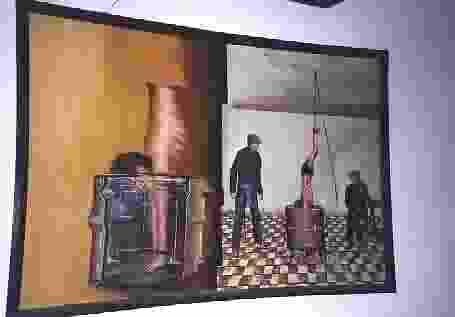
LI has always hated the comparison between Hitler and Bush. It's ridiculous.
With his success in legalizing torture, Bush is much more like Pol Pot.
Here's a painting by Cambodian artist Vann Noth, which we copped from Andy Brouwer's site. Inspired by CT's site, which links to David Corn's site, showing what water torture is. Good idea.

We live in a rogue state. We need to take it back. Bush is comfortable taking this country, which, with all its faults, kept lynching illegal for two hundred fifty years, and bringing it into the moral orbit of Idi Amin's Uganda, Pol Pot's Kampuchea, apartheid South Africa. Oh, what have you. I used to be against impeaching Bush, but now I am for something different -- a war crimes tribunal. It worked for Milosovic.
I need to find some other water torture pics suitable for putting up on my side bar. This, by the way, is an anti-torture site.
Friday, September 29, 2006
paleolithic dreams
Often, to take our mind off unpaid bills and the unhallowed gov’mint, we will sit in a coffee shop – or in Whole Foods – and take out our little book and draw. We don’t draw chairs, or food, or coffee cups – we draw people. LI loves drawing people. Always has. Now, lately we’ve been reading a beautiful book about cave art for an upcoming review for the Austin Statesman. Reading it, we were struck like by 100 000 volts that during the Upper Paleolithic – that wonderful time when there were, max, 150 000 people in Europe, and life was good for around twenty thousand years - the cave artists generally didn’t draw or paint or engrave people. There were your stray vulvas, the masked bird man, many hand prints, but generally – no people. Instead, there were mammoths. There were lions. There were rhinos and horses. Oddly, much fewer reindeer, even though reindeer meat was the spam of the Paleolithic – it was always poached reindeer for breakfast, fricasseed reindeer for lunch, and reindeer pudding for dinner. We are often told how to evolution stories about this or that human habit, but in reality, the way those how to stories are formed is that evo psychologists extrapolate back from ‘primitive people’ of today to those wandering around 200,000 years ago. However, this habit is in serious disconnect from archeologists, who have long held that ethnography of people today, in no matter what state of society they live in, is essentially unhelpful when trying to reconstruct the way the inhabits of the Eurasia 30,000 years ago lived. It is impossible not to imagine back using our PBS/National Geographic images, but what tribe do we know of that doesn’t draw people? Deleuze and Guattari talk of the special faciality of the West – this seems right, on all accounts – but to show so little interest in people when one has mastered perspective, and the expressive character of animals? That seems quite significant. But of what? Well, this is where speculation is dumb, but irresistible. The cave art of 30,000 years ago, perhaps – just perhaps – precedes the period when humans assumed they were superior. In fact, the assumption at that time was that they weren’t. The assumption was that mammoths were in every way superior creatures – or, to erase the whole superior/inferior notion, the assumptions in the paintings flowed from a life in which humans were as much prey as predator. The dreams we have of this percolate through hundreds of generations back, so it seems entirely dim. Of course, humans as prey is our favorite story, but now the story features our favorite predator, who is still human – hence, the infinite crime shows. We can of course think of grizzlies or sharks or whatever preying on humans. But what we can’t think is that this is just the way it is. That thought makes us think, wow, this is to live in misery. We seem unable to fully immerse ourselves into that form of life as a norm. We can only indirectly, vaguely wave at that notion. To find human beings relatively uninteresting compared to horses is funny – which is why Swift was able to use that shtick. But it wouldn’t even have been controversial in 17,000 b.c. The movies we make trying to touch this – say Alien – always, ultimately, focus the camera on the humans. What would Aliens be like if the same story were told, except the humans were incidentally – took up ten minutes of film time – the rest being the things the Alien monster did. Although, admittedly, Alien didn't have the hair and muscles and eyes the Paleolithics loved. They didn't paint fish, though they ate em. But the human figure was mostly boring. I mean, one at least figures that there will be considerable smut, but no. Mostly, cave art is chaste. Dick, pussy, fucking -- ho hum, seems to have been the word. But bison -- why, the world can't get enough bison. And so for almost twenty thousand years, the cave painters, generation after generation, gave the people what they wanted - more bison. Nietzsche hints that the story of civilization is the story of humans becoming interesting. Ah, the Paleolithic dream did come to N., didn’t it?
Subscribe to:
Posts (Atom)
-
 You can skip this boring part ... LI has not been able to keep up with Chabert in her multi-entry assault on Derrida. As in a proper duel, t...
 -
 Ladies and Gentlemen... the moment you have all been waiting for! An adventure beyond your wildest dreams! An adrenaline rush from start to...
 -
LI feels like a little note on politics is called for. The comments thread following the dialectics of diddling post made me realize that, ...