Casting our eye over the last year, LI feels … good. This has been, of course, a terrible year in the set of terrible years that have made up this decade of complete and utter failure. Our failure to achieve the economic viability of even the lowliest bottomfeeder, which we used to justify, in a half assed way, as the price of art, is no longer justifiable by any criteria. We will long remember and long regret the various outrageous stupidities that have threaded themselves in our moment-to-moment, especially as it looks like we are headed towards streetcorner destitution as surely as the stunned ox slipping down the greased chute is headed for the butcher’s blade. But I would like to think that every life has its little Camelot moment, yes? And so I look back at LI’s past year and a half and like God looking at the green and blue globe he dreamed up on one of eternity’s slower nights, I can say: it is good.
I’ve been five and a half years at the blogging biz, and looking over my back pages, I obviously took some time to figure out what I was doing. For a writer of more traditional narratives, as well as one of more traditional discursive texts, blogging is difficult. It is a text type in the literature of spontaneity that gives us Jules Renand’s journals and Horace Walpole’s letters – not to speak of Malcolm Lowry’s – , which is a literature I have a fondness for. In any work that aspires to literature, one is looking for the real right thing, the moment in which urgency and the mediation of artifice form a more perfect union. And every romantic soul, from Shelley to the Beats, has longed for a way of casting off the mediation, of making good on the adage, first thought, best thought. Unfortunately for the romantics, mediation is indispensable. The path to the urgent moment is necessary, even if, from the subjective viewpoint, it is secondary and always irritating.
But so speaks the classicist mickey within. Of course, LI is living in a society in which boredom is considered the worst quality – to say that a book is boring is to say it has committed a capital offense. Myself, I think the liquidation of boredom in the aesthetic realm is intimately connected to the Gated Community ethos in the social realm, in which the unbought graces of life now come out of a high end catalogue, and are called “pre-owned”. If you don’t know how to be boring – its time, its place, its subtle effects on the unconscious, what it is for, what it tells you about time and solitude – you’ll make a fucking twist of everything. It will just be Man and his faithful tv-set tracking across the void. LI is not for man and his tv set tracking across the void. We are against that shit.
I’m not excursing here – boredom is of course just the thing about spontaneous literature. To have a boring bit of exposition in a novel is tolerable, given other qualities of the novel, and its ultimate interestingness. To have a boring bit of exposition in a letter, however, is much less tolerable. Still, the premise of a letter or a journal is intimacy, which forgives many things. The great letter writers – say, Byron – visibly have a lot of fun writing their three sheets. I’ve been reading the letters of Henry Adams, lately, and it is obvious that the young Adams was modeling himself on letter writers of the past – more than anybody else, Walpole. Obviously, there are parallels between Horace and Henry – both coming from great political families, both being acute observers, and both feeling, acutely, their lack of power as a sign of some failure of character. Adams, in any case, pushes the entertainment too much to the fore. When that happens – when a certain hard to define threshold is crossed – the letter ceases to be intimate, and thus violates its own contract.
Blogging begins by pissing on that contract. I’ve noticed that those who blog for friends start out strong, but quickly peter out. That’s because, well, here it is and don’t say I said it: Hegel is right about some things. The Spirit does obey a pattern – or at least, produces one – and it goes badly with people who try to cross da Spirit. Blogging derives from intimate literature, but is as cold as a motherfucker, in the end. And here’s the paradox: just because LI is so out of sorts with the Spirit of the Age, a pterodactyl among canaries, blogging has been good to us. The reason for that is that complaining – especially complaining from one’s whole existence, complaining that is rooted in a total failure to fit in, in a total complaint levied at the basic social system – is one of those transitional speech forms. It provides a passage from intimacy to anonymity. I have poured more anger and moaning into the ears of debt collectors on the other end of the phone – or, say, the bureaucrats who periodically threaten to turn off my power – than I would dare to do even with a lover. Of course, this is partly cause I’m half mad, but I’m not the half mad guy who talks to himself on the bus. Yet.
But complaining itself is only transitional. And it moves to two extremes – either monomania, or extreme dispersion. Complaining about one thing over and over, or complaining about everything.
Which gets me to why LI is pleased with the past year. It is no secret that, of course, I am a monomaniac. I have the same hardon against the Bush administration that Jeremiah had against the worshippers of Baal. But Jeremiah – or lets say one of the Isaiahs, who are my fave prophets – the Isaiahs were clever prophets. They saw the wickedness of one kingdom or king in terms of a whole vision of what the world is like. They saw early and plainly that the world is balanced between paradise or hell, and one gesture can send it either way. That gesture is the prophetic fiction – the only time anybody listens to the prophet in the Bible, in Jonah, the prophet is naturally pissed off. It is much more fun to predict fire and brimstone than to have people listen to you, change their ways, and avert the fire and brimstone. Dire is sexy – everybody mocks a reformer. But backing up to the point: in the last year and a half I think I’ve successfully found the bigger poetic themes, the motifs I want – madness, the supremacy of war, magic, the synthesis of Michelet’s witchcraft and Marxism – to organize my random bitchery.
Tuesday, December 26, 2006

Monday, December 25, 2006
a star! a star!
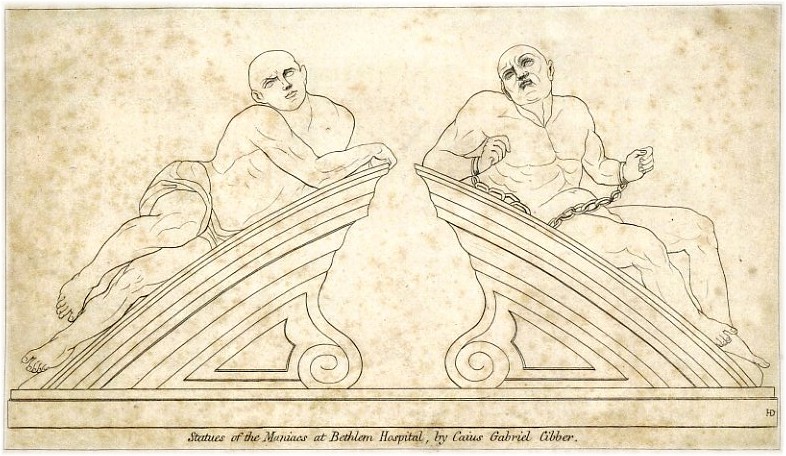
When Simon Fitzmary, the Mayor of London, was fighting in the holy land during the Crusades, he beheld, one lost night, the star of Bethlehem – the very star! Returning to England, in 1236 he founded an asylum – the Church of St. Mary of Bethlehem. It was unique, in that it gave unique shelter to the mad, the first time a public institution in Europe had so specialized. In time, the name was whittled down to Bethlem, and by Shakespeare’s time it had become Bedlam.
And so it was that the rider on the highway is overthrown by the raven, the beast slouches east in the ditch, and poor Jesus o’ Bedlam was born…
Merrrrrrrrrrrrrrrrryyyyyyyyyyyyyyy Christmasssssssssssss
Sunday, December 24, 2006
nostrodamus/LI
A bad policy is one that is so structured that it cannot even exploit advantageous opportunities. By that definition, America’s policy in the Middle East is a magnitude more than bad. This week showcased the cul de sac into which Americans have been lead by the Bush White House.
Given a more rational order of things, this should have been a good week for American foreign policy. Iranian elections struck a heavy blow at the rightwing populism of Mahmoud Ahmadinejad. In the Iranian setting, he is proving to be even worse than he seemed at first. His attempt to straddle the contradictions of social and cultural repression and economic expansion – not that these are always in contradiction with each other, but, in Iran’s present case, they certainly are – has failed; his primitive notion of economics to begin with has fatally limited him; and his appeal to a core base has alienated the rest of the country. So Ahmadinejad, like Bush, is becoming a leader/minority.
However, this good news for the Americans can’t get past the American media filter. Since it has been decided that Iran is a dictatorship, run by mad mullahs (as distinguished from the sweet, kindly mullahs that the U.S. has been appealing to, in the Islamic Republic of Iraq, to overthrow the democratically elected leadership), the press can’t even recognize the election. To do so would, after all, put in question the democratic swindle – which was underlined by a mad Blair appealing to dictatorial Gulf emirates to march, oh so democratically, against Iran, even as he was bowing to the Saudi princes and suppressing investigation into the astonishing briberies that have accompanied the British attempt to litter the Middle East with the weapons of mass destruction. This is a familiar pattern – having long ago decided on an absolutist program of hegemony in the Middle East, the U.S. (and, as always, Blair should be viewed as an American subaltern, his rank somewhat below an under undersecretary in the Department of Agriculture) has frozen itself into a posture in which it is impossible to accept anything but total victory – the emplacement, everywhere, of U.S. dominated allies in the Middle East - or defeat. The odds are heavily on defeat.
A sane U.S. foreign policy would recognize a few things. One of them is that the U.S. does not have the moral upper hand on the nuclear issue in the Middle East. Israel practically announced what everybody knows this week – it has a reserve of atomic weapons. How did it get those weapons? Nuclear proliferation happened, here, illegally. The criminal culprit was – the U.S.A. In fact, the powers that managed to get nuclear materials to Israel in the sixties were breaking U.S. domestic law as well. There is a plaque to James Jesus Angleton in Israel, as well there should be. That crazy as a bedbug CIA man handled the Israeli “account’ at the agency, and decided unilaterally to supply the country with atomic weapons. One of the loopier decisions of the D.C. right. Iran may not go for building nuclear weapons – for all the Sturm and Drang, there’s no evidence that they are. If they want to, of course, they have access to Pakistan – with whom they had a very cordial meeting, this week, in the course of which Pakistan announced its aid to Iran’s energy program. This is the same Pakistan that U.S. administrations have tied themselves to now since the seventies, and received, in return – a base to organize jihadism as an international force, a secret service that set up the Taliban and aided Al Qaeda, and a government that has set aside a reservation for Al Qaeda and the Taliban for the last three or four months, reproducing the conditions in Afghanistan in 2000, as Al Qaeda prepared for its big adventure.
But of course, this happens invisibly right before our eyes. The agent of invisibility is language – Pakistan becomes democratic because the U.S. papers call it democratic, Iran becomes a tyranny because the U.S. papers say it is a tyranny, and so on. Currently, the Bush administration’s notion that the Badr brigade represents ‘moderates’ is going down like chocolate milk in the media. By moderate, we are not exactly sure what is meant: do they mean that when Badr brigade members take out the drill, plug it in, and insert the whirling drill bit in the eye socket of some kidnapped Iraqi, that the militia man only pressed down very gently as the liquid eye matter is scattered over the victim’s cheeks and chin? Or is it that the Badr brigade lets the man freely scream as the drill bit plunges into the brain, instead of using tape over his mouth as those bad, bad Sadr people do? LI, moral relativists that we are, doesn’t see the vital, freedom loving part of the Badr program. But of course, we are so morally confused that we think the Vice President was inciting genocide for floating a memo suggesting that the U.S. ‘eliminate’ the Sunnis in Iraq, thus competing with Ahmadinejad for the ‘morally depraved’ part of the competition in the Mr. Rebel in Chief contest. Of course, it may be that this is soft genocide, a moderate position in which certain Sunni children will be allowed to live, as long of course as they agree to the flat tax, but LI is such a blame America firster that we find this unacceptable. Imagine!
This week is no doubt a foretaste of things to come. 2007 should be an even more disastrous year for the U.S. in the Middle East. As we’ve consistently said over the past two years, the chance of the U.S. attacking Iran is low. The Bush administration is surprising – it has explored whole new dimensions of fucking up – and it could surprise us about this issue. After all, the Nixon administration decided, in spite of the evident unpopularity of the Vietnam war, and knowing that they had lost it, to encroach into Cambodia and Laos. But Cambodia and Laos didn’t produce oil, or buy the latest air defense missiles from Russia. Besides which, there is the financial question. In the next couple years, there are about 400 billion dollars in privatization projects on the table in the Middle East, according to the WSJ. And nobody wants these babies fucked up. The Carlyle group is already very heavily into trying to become financier and buyer. What would fuck up the privatizations is an inflamed populace, which might not, to begin with, like the idea of foreign countries buying their water, power, telephone, and other firms. Baby Bush might not want to listen to Daddy, but other people in his administration are looking forward to whoring themselves out in the private sphere for big bucks after their ripoff service with the government is done. These people are going to restrain Baby Bush’s tantrums, we think.
Given a more rational order of things, this should have been a good week for American foreign policy. Iranian elections struck a heavy blow at the rightwing populism of Mahmoud Ahmadinejad. In the Iranian setting, he is proving to be even worse than he seemed at first. His attempt to straddle the contradictions of social and cultural repression and economic expansion – not that these are always in contradiction with each other, but, in Iran’s present case, they certainly are – has failed; his primitive notion of economics to begin with has fatally limited him; and his appeal to a core base has alienated the rest of the country. So Ahmadinejad, like Bush, is becoming a leader/minority.
However, this good news for the Americans can’t get past the American media filter. Since it has been decided that Iran is a dictatorship, run by mad mullahs (as distinguished from the sweet, kindly mullahs that the U.S. has been appealing to, in the Islamic Republic of Iraq, to overthrow the democratically elected leadership), the press can’t even recognize the election. To do so would, after all, put in question the democratic swindle – which was underlined by a mad Blair appealing to dictatorial Gulf emirates to march, oh so democratically, against Iran, even as he was bowing to the Saudi princes and suppressing investigation into the astonishing briberies that have accompanied the British attempt to litter the Middle East with the weapons of mass destruction. This is a familiar pattern – having long ago decided on an absolutist program of hegemony in the Middle East, the U.S. (and, as always, Blair should be viewed as an American subaltern, his rank somewhat below an under undersecretary in the Department of Agriculture) has frozen itself into a posture in which it is impossible to accept anything but total victory – the emplacement, everywhere, of U.S. dominated allies in the Middle East - or defeat. The odds are heavily on defeat.
A sane U.S. foreign policy would recognize a few things. One of them is that the U.S. does not have the moral upper hand on the nuclear issue in the Middle East. Israel practically announced what everybody knows this week – it has a reserve of atomic weapons. How did it get those weapons? Nuclear proliferation happened, here, illegally. The criminal culprit was – the U.S.A. In fact, the powers that managed to get nuclear materials to Israel in the sixties were breaking U.S. domestic law as well. There is a plaque to James Jesus Angleton in Israel, as well there should be. That crazy as a bedbug CIA man handled the Israeli “account’ at the agency, and decided unilaterally to supply the country with atomic weapons. One of the loopier decisions of the D.C. right. Iran may not go for building nuclear weapons – for all the Sturm and Drang, there’s no evidence that they are. If they want to, of course, they have access to Pakistan – with whom they had a very cordial meeting, this week, in the course of which Pakistan announced its aid to Iran’s energy program. This is the same Pakistan that U.S. administrations have tied themselves to now since the seventies, and received, in return – a base to organize jihadism as an international force, a secret service that set up the Taliban and aided Al Qaeda, and a government that has set aside a reservation for Al Qaeda and the Taliban for the last three or four months, reproducing the conditions in Afghanistan in 2000, as Al Qaeda prepared for its big adventure.
But of course, this happens invisibly right before our eyes. The agent of invisibility is language – Pakistan becomes democratic because the U.S. papers call it democratic, Iran becomes a tyranny because the U.S. papers say it is a tyranny, and so on. Currently, the Bush administration’s notion that the Badr brigade represents ‘moderates’ is going down like chocolate milk in the media. By moderate, we are not exactly sure what is meant: do they mean that when Badr brigade members take out the drill, plug it in, and insert the whirling drill bit in the eye socket of some kidnapped Iraqi, that the militia man only pressed down very gently as the liquid eye matter is scattered over the victim’s cheeks and chin? Or is it that the Badr brigade lets the man freely scream as the drill bit plunges into the brain, instead of using tape over his mouth as those bad, bad Sadr people do? LI, moral relativists that we are, doesn’t see the vital, freedom loving part of the Badr program. But of course, we are so morally confused that we think the Vice President was inciting genocide for floating a memo suggesting that the U.S. ‘eliminate’ the Sunnis in Iraq, thus competing with Ahmadinejad for the ‘morally depraved’ part of the competition in the Mr. Rebel in Chief contest. Of course, it may be that this is soft genocide, a moderate position in which certain Sunni children will be allowed to live, as long of course as they agree to the flat tax, but LI is such a blame America firster that we find this unacceptable. Imagine!
This week is no doubt a foretaste of things to come. 2007 should be an even more disastrous year for the U.S. in the Middle East. As we’ve consistently said over the past two years, the chance of the U.S. attacking Iran is low. The Bush administration is surprising – it has explored whole new dimensions of fucking up – and it could surprise us about this issue. After all, the Nixon administration decided, in spite of the evident unpopularity of the Vietnam war, and knowing that they had lost it, to encroach into Cambodia and Laos. But Cambodia and Laos didn’t produce oil, or buy the latest air defense missiles from Russia. Besides which, there is the financial question. In the next couple years, there are about 400 billion dollars in privatization projects on the table in the Middle East, according to the WSJ. And nobody wants these babies fucked up. The Carlyle group is already very heavily into trying to become financier and buyer. What would fuck up the privatizations is an inflamed populace, which might not, to begin with, like the idea of foreign countries buying their water, power, telephone, and other firms. Baby Bush might not want to listen to Daddy, but other people in his administration are looking forward to whoring themselves out in the private sphere for big bucks after their ripoff service with the government is done. These people are going to restrain Baby Bush’s tantrums, we think.
Saturday, December 23, 2006
IT's pig metaphysics
LI’s readers are, presumably, the same people who read Infinite thought. For those who haven’t read IT’s prolegomena to all future pig metaphysics, go here.
“What we have to understand, as a matter of some urgency, is that the transcendental pig is our friend, just as the empirical pig is our lunch.”
“What we have to understand, as a matter of some urgency, is that the transcendental pig is our friend, just as the empirical pig is our lunch.”
the passion for ascendancy
“The good Samaritan he’s dressing
He’s getting ready for the show…”
Mark Danner begins his NRYB essay (see last post) with an exemplary historiette concerning a young State Department employee in Falluja who reminds him of a:
“… young Kennan's reincarnation in the person of a junior State Department official: a bright, aggressive young man who spent his twenty-hour days rumbling down the ruined streets in body armor and helmet with his reluctant Marine escorts, meeting with local Iraqi officials, and writing tart cables back to Baghdad or Washington telling his bosses the truth of what was happening on the ground, however reluctant they might be to hear it. This young diplomat was resourceful and brilliant and indefatigable, and as I watched him joking and arguing with the local sheikhs and politicos and technocrats —who were meeting, as they were forced to do, in the American bunker —I thought of the indomitable young Kennan of the interwar years, and of how, if the American effort in Iraq could ever be made to "work," only undaunted and farseeing young men like this one, his spiritual successor, could make it happen.”
This was in the days leading up to the vote on the Constitution. You will remember that Falluja is a mainly Sunni city. It was also razed by American troops in November, 2004. The inhabitants, returning to the ruins of their home, are treated like parolees in a work camp by the Americans. A little background for what the young Kenner told Danner: “And so as I sat after midnight on the eve of the vote, scribbling in my notebook in the dimly lit C-Moc bunker as the young diplomat explained to me the intricacies of the politics of the battered city, I was pleased to see him suddenly lean forward and, with quick glances to either side, offer me a confidence. "You know, tomorrow you are going to be surprised," he told me, speaking softly. "Everybody is going to be surprised. People here are not only going to vote. People here—a great many people here—are going to vote yes.”
Now, only a true mook could think something so unutterably stupid. And yet, the bright young thing almost dazzled Danner into disbelieving his own peepers. Until, of course, the elections showed that the Sunni population voted against the constitution which would basically immiserate them forever) by around 97 percent.
I think that mook was not stupid, but, rather,representative. In LI’s last post, we tried to show that the twilight of the Cold War witnessed a huge economic shift away from the Social Democratic policies of the early Cold War period within the structure created by the Cold War. The end of the Cold War, in a sense, stripped bare these shifts. George Santayana, speaking of patriotism, claimed that, without an ideal, patriotism reduces to a mere “passion for ascendancy.” This was the code of the post-war order. And it is with this code that the U.S. invaded Iraq.
Yet historic forms just don’t pop like the pricked balloons at the end of a children’s birthday party. The intensity of the anti-communist crusade created a whole discourse of righteousness that was extremely potent in America. That discourse no longer had a set object. The idea that our defining anti-thetical is now Islamo-fascism has proven to be a massive flop. Except among a small zombie contingent, Islamofascism hasn’t even entered into the public domain. If you ask around, you will find that the average person hasn’t even heard of it. This shows the common sense of the average person, since, of course, there is no such thing as Islamofascism. The closest actual thing in the world to that hybrid nothing was the government the U.S. conjured up in Iran after overthrowing Mossedeq, since it relied on a heavy contingent of those people around the Pahlavis, in the 1950s, who had ardently supported the Nazis in the 1940s. That ardor was obviously premature anticommunism, and so given a big round of applause by America’s handlers at the time. But there is nothing else on the face of the earth that resembles, in any way, this neo-con anxiety dream.
So… we are left with the passion for ascendancy. The State Department official in Danner’s article walks about in a kind of dream of this passion, as does most of the Bush White House. Mere ascendancy, however, is never sufficient to prompt social action. It generates legitimating stories. These stories are essentially heroic in nature. This, for those who have the eyes to see it, is why the Bush people are so… well, funny. They think of themselves in heroic terms, which is in stark contrast to their incredibly pampered existences and their lifelong avoidance of any real existential risk outside of quailhunting with the gross V.P. These are Chihuahuas dreaming they are lions. They are uniquely disqualified from understanding Iraq -- not because they are unfamiliar with the facts about Iraq, but because their very lifestyles have stifled the faculty of imagination within them. Imagination, for them, is merely projection. Thus, the state department boy projects onto the Iraqis he meets a passion for… well, for the ascension of the state department boy. In their hearts, they all want him to climb the ladder. And to climb the ladder, he needs them to get on board. It is a photo op world, but the reward is that we happy plebes, we rude mechanicals can say, “we knew him when.”
Perhaps the worst thing Chalabi, the prototype D.C. salon Iraqi, ever did was to convince policy-makers that Iraq has the best interests of the U.S. at heart, and in particular the best interests of the 0.00001 percent of the U.S. that owns an AEI card. The ingratitude of the Iraqis must painfully remind these people of other betrayals that strew the path of the meritocratic - like that trusted maid one caught rummaging in the medicine cabinet, pilfering those very expensive mood changing pills. How could she? And just as we gave that made the best hand me down toys and clothes for her squalling brats, in truth, we had given the Iraqis the best of hand me down constitutions -- we trained their savage young men in the best policing techniques, though we did have to laugh behind our hands about how new it all was to them - and we are all about training up an army for them. But of course they know nothing, and in the end you can’t turn your backs on these people.
And so the disappointments of that cadre of people like the eager State department boy have mounted, until we have polite articles in the Sunday NYT debating the pros and cons of Sunni genocide – should we kill one million, or maybe three? The memos, as we know, have been emanating from the V.P.’s office. These articles that are conveniently right next to blasts at the President of Iran for threatening to wipe out Israel, so that we can get the full flavor of the moral arrogance on hand here, a moral arrogance inseparable from the passion for ascendancy.
That passion, we think, is going to get a good and stout fucking in the next year.
He’s getting ready for the show…”
Mark Danner begins his NRYB essay (see last post) with an exemplary historiette concerning a young State Department employee in Falluja who reminds him of a:
“… young Kennan's reincarnation in the person of a junior State Department official: a bright, aggressive young man who spent his twenty-hour days rumbling down the ruined streets in body armor and helmet with his reluctant Marine escorts, meeting with local Iraqi officials, and writing tart cables back to Baghdad or Washington telling his bosses the truth of what was happening on the ground, however reluctant they might be to hear it. This young diplomat was resourceful and brilliant and indefatigable, and as I watched him joking and arguing with the local sheikhs and politicos and technocrats —who were meeting, as they were forced to do, in the American bunker —I thought of the indomitable young Kennan of the interwar years, and of how, if the American effort in Iraq could ever be made to "work," only undaunted and farseeing young men like this one, his spiritual successor, could make it happen.”
This was in the days leading up to the vote on the Constitution. You will remember that Falluja is a mainly Sunni city. It was also razed by American troops in November, 2004. The inhabitants, returning to the ruins of their home, are treated like parolees in a work camp by the Americans. A little background for what the young Kenner told Danner: “And so as I sat after midnight on the eve of the vote, scribbling in my notebook in the dimly lit C-Moc bunker as the young diplomat explained to me the intricacies of the politics of the battered city, I was pleased to see him suddenly lean forward and, with quick glances to either side, offer me a confidence. "You know, tomorrow you are going to be surprised," he told me, speaking softly. "Everybody is going to be surprised. People here are not only going to vote. People here—a great many people here—are going to vote yes.”
Now, only a true mook could think something so unutterably stupid. And yet, the bright young thing almost dazzled Danner into disbelieving his own peepers. Until, of course, the elections showed that the Sunni population voted against the constitution which would basically immiserate them forever) by around 97 percent.
I think that mook was not stupid, but, rather,representative. In LI’s last post, we tried to show that the twilight of the Cold War witnessed a huge economic shift away from the Social Democratic policies of the early Cold War period within the structure created by the Cold War. The end of the Cold War, in a sense, stripped bare these shifts. George Santayana, speaking of patriotism, claimed that, without an ideal, patriotism reduces to a mere “passion for ascendancy.” This was the code of the post-war order. And it is with this code that the U.S. invaded Iraq.
Yet historic forms just don’t pop like the pricked balloons at the end of a children’s birthday party. The intensity of the anti-communist crusade created a whole discourse of righteousness that was extremely potent in America. That discourse no longer had a set object. The idea that our defining anti-thetical is now Islamo-fascism has proven to be a massive flop. Except among a small zombie contingent, Islamofascism hasn’t even entered into the public domain. If you ask around, you will find that the average person hasn’t even heard of it. This shows the common sense of the average person, since, of course, there is no such thing as Islamofascism. The closest actual thing in the world to that hybrid nothing was the government the U.S. conjured up in Iran after overthrowing Mossedeq, since it relied on a heavy contingent of those people around the Pahlavis, in the 1950s, who had ardently supported the Nazis in the 1940s. That ardor was obviously premature anticommunism, and so given a big round of applause by America’s handlers at the time. But there is nothing else on the face of the earth that resembles, in any way, this neo-con anxiety dream.
So… we are left with the passion for ascendancy. The State Department official in Danner’s article walks about in a kind of dream of this passion, as does most of the Bush White House. Mere ascendancy, however, is never sufficient to prompt social action. It generates legitimating stories. These stories are essentially heroic in nature. This, for those who have the eyes to see it, is why the Bush people are so… well, funny. They think of themselves in heroic terms, which is in stark contrast to their incredibly pampered existences and their lifelong avoidance of any real existential risk outside of quailhunting with the gross V.P. These are Chihuahuas dreaming they are lions. They are uniquely disqualified from understanding Iraq -- not because they are unfamiliar with the facts about Iraq, but because their very lifestyles have stifled the faculty of imagination within them. Imagination, for them, is merely projection. Thus, the state department boy projects onto the Iraqis he meets a passion for… well, for the ascension of the state department boy. In their hearts, they all want him to climb the ladder. And to climb the ladder, he needs them to get on board. It is a photo op world, but the reward is that we happy plebes, we rude mechanicals can say, “we knew him when.”
Perhaps the worst thing Chalabi, the prototype D.C. salon Iraqi, ever did was to convince policy-makers that Iraq has the best interests of the U.S. at heart, and in particular the best interests of the 0.00001 percent of the U.S. that owns an AEI card. The ingratitude of the Iraqis must painfully remind these people of other betrayals that strew the path of the meritocratic - like that trusted maid one caught rummaging in the medicine cabinet, pilfering those very expensive mood changing pills. How could she? And just as we gave that made the best hand me down toys and clothes for her squalling brats, in truth, we had given the Iraqis the best of hand me down constitutions -- we trained their savage young men in the best policing techniques, though we did have to laugh behind our hands about how new it all was to them - and we are all about training up an army for them. But of course they know nothing, and in the end you can’t turn your backs on these people.
And so the disappointments of that cadre of people like the eager State department boy have mounted, until we have polite articles in the Sunday NYT debating the pros and cons of Sunni genocide – should we kill one million, or maybe three? The memos, as we know, have been emanating from the V.P.’s office. These articles that are conveniently right next to blasts at the President of Iran for threatening to wipe out Israel, so that we can get the full flavor of the moral arrogance on hand here, a moral arrogance inseparable from the passion for ascendancy.
That passion, we think, is going to get a good and stout fucking in the next year.
Thursday, December 21, 2006
bush at the end of the daisy chain
LI finally got around to reading Mark Danner’s article on Iraq. It is very good. However, one notices that Danner makes the blunders in Iraq stand out against a rather blurry background of America’s foreign policy history, one which exudes a lot of feel good aura but little content. That’s a shame. As we have pointed out before, one of the truly underreported aspects of the American debacle in Iraq goes back to class. Namely, America’s natural tendency to work with the upper class in third world countries was, in Iraq, uniquely negated by the fact that much of that upper class was Sunni, or was perceived to be supportive of Saddam Hussein. Meanwhile, the working class justly saw America as its enemy, since in fact America is always the enemy of the working class in any third world country you want to name. That class aspect only comes into view once one starts viewing America’s foreign policy critically – i.e., once one departs from the consensus about the Cold War that has been dribbled over the establishment like Ronald Reagan’s hair mousse.
You cannot see Iraq, you cannot see the long war, you cannot see 9/11, until you have a clear view of foreign policy past. A timely reminder of what that was all about is given to us by the recent fascistic salute to Jean Kirkpatrick in Hiatt’s Washington Post editorial. To quote it again: “The contrast between Cuba and Chile more than 30 years after Mr. Pinochet's coup is a reminder of a famous essay written by Jeane J. Kirkpatrick, the provocative and energetic scholar and U.S. ambassador to the United Nations who died Thursday. In "Dictatorships and Double Standards," a work that caught the eye of President Ronald Reagan, Ms. Kirkpatrick argued that right-wing dictators such as Mr. Pinochet were ultimately less malign than communist rulers, in part because their regimes were more likely to pave the way for liberal democracies. She, too, was vilified by the left. Yet by now it should be obvious: She was right.”
Kirkpatrick’s terms were, actually, not a change in the weather, but a call to order – a way of reminding the Carter administration of what American policy makers since Truman had always stood for: the implantation, in third world nations, of governments that implemented the Hitler model circa 1938. And, of course, that train of action lead directly to 9/11. There’s a nice reminder of this in Tariq Ali’s concise essay about Pakistan’s history in the LRB. And it calls for some overview.
While Kirkpatrick’s terms simply made visible an old pattern, it is true that the legitimacy of that pattern had been undermined by the obvious U.S. viciousness in Vietnam. Vietnam brought to the surface a critical view of U.S. aims sadly lacking now. It made visible, behind the window dressing of democracy, the real policy of instituting and supporting “authoritarian” regimes. But the critique projected that foreign policy back into the domestic realm in a way that overlooked the contradictions of the system. The foreign policy-maker’s fondness for authoritarian states was in constant tension with America’s political culture. The same liberal newspapers that could support the extension of the liberal program – for instance, disestablishing Dixie apartheid, sustaining the structures of the Keynesian welfare state in health, education, and retirement – could also maintain, without blinking, a network of assumptions shared among foreign correspondents and editors that adopted a wholly other attitude towards third world countries. Eventually, this would have a domestic political effect – cultivating reactionary political economies in Asia and South America was like creating a laboratory for the design of macro-economic policies that would hit the U.S. in the eighties, creating the conditions for a reactionary culture: heavy on military spending, using an unleashed credit sector to weaken the labor movement, with its narrow focus on pay and its inability to understand the new factors brought into the economy by easy credit, the piecemeal de-industrialization, etc., etc. Thomas Friedman, the idiot savant ideologist of neo-liberalism, was right: the whole aim was to take the economy out of politics – to put it wholly in institutional hands unaffected by popular mandate or need.
Thus, the work of the foreign policy establishment in seventies and eighties was to create a new international order of capital, founded on easy credit and pre-30s economic inequality. To buffer the economy completely – to surrender it to investors and business leaders – meant, before anything else, breaking labor’s power decisively. Thus, in the zones outside the ‘democracies’, the ‘fumigation’ began, provided at first by the Hitlerite model – National Security States - and could then become transit points in which loans (for fraudulent, state sponsored projects) and capital flight could come together to bring money into the House – the U.S. and Western Europe.
This structure required the Soviet Union as the enemy that would keep it all together. But that necessity led to a second contradiction in the system – and like one would expect, contradictions lead to innovations. The innovation that the U.S. cultivated, funded, directed and then abandoned happened to be the arming of Islamicists within the structure of fungible National Security States. This is where Tariq Ali’s history comes in as a nice reminder, since the fake history that gives us a fake debate is all about grievances – ah, the framework of victimization, so convenient as a decoy. The real history, which is deeply embedded in the pathological anti-communism and industrial policy of the American foreign policymakers can then be comfortably ignored. The problem, of course, is that it is unignorable – Iraq is a debacle, as Danner says, of the American imagination, or lack of it, but it is also a debacle exposing the way the system has been run, and the antitheses that are now coming, with IEDs and mortar fire, to ruin our ‘freedom loving’ President’s party Middle Eastern bash for himself. There is a sense in which Bush is the victim of a very old and respected Texas fraud – he’s the last link in the daisy chain. A daisy chain is not a mass fuck, in this case – a daisy chain consists of buying a property and selling it to a confederate for an inflated value, who sells it to another confederate for an inflated value, until it is laid off on a mark who, believing these values, shells out some fantastic sum for what turns out to be a world class lemon.
In the case of the Central Asian lemon, as Tariq Ali points out in this overview of Pakistan, the story has roots in the dawn of the independence period. That is when the Free World had need of a subordinate system of non-free gunga din states:
“Pakistan’s first uniformed ruler, General Ayub Khan, a Sandhurst-trained colonial officer, seized power in October 1958 with strong encouragement from both Washington and London. They were fearful that the projected first general election might produce a coalition that would take Pakistan out of security pacts like Seato and towards a non-aligned foreign policy. Ayub banned all political parties, took over opposition newspapers and told the first meeting of his cabinet: ‘As far as you are concerned there is only one embassy that matters in this country: the American Embassy.’”
In Ali’s version, the familiar scenario enfolds – the fakery of pressuring a NSS client into an election that is rigged – by suitable murders, kidnapping and torturing of radicals, students, civilians, etc., etc. – the electing of our man in Karachi, and then the praise showered on him by an adoring American press.
Let’s quote a few grafs that cluster around the Reaganite adventure in creating a jihadi network, arming them, and encouraging them to attack a superpower – a fabulous success that was somehow left out of the funeral orations over the Great Communicator’s corpse:
“Always a bad judge of character, he [Bhutto] had made a junior general and small-minded zealot, Zia-ul-Haq, army chief of staff. As head of the Pakistani training mission to Jordan, Brigadier Zia had led the Black September assault on the Palestinians in 1970. In July 1977, to pre-empt an agreement between Bhutto and the opposition parties that would have entailed new elections, Zia struck. Bhutto was arrested, and held for a few weeks, and Zia promised that new elections would be held within six months, after which the military would return to barracks. A year later Bhutto, still popular and greeted by large crowds wherever he went, was again arrested, and this time charged with murder, tried and hanged in April 1979.
Over the next ten years the political culture of Pakistan was brutalised. As public floggings (of dissident journalists among others) and hangings became the norm, Zia himself was turned into a Cold War hero – thanks largely to events in Afghanistan. Religious affinity did nothing to mitigate the hostility of Afghan leaders to their neighbour. The main reason was the Durand Line, which was imposed on the Afghans in 1893 to mark the frontier between British India and Afghanistan and which divided the Pashtun population of the region. After a hundred years (the Hong Kong model) all of what became the North-Western Frontier Province of British India was supposed to revert to Afghanistan but no government in Kabul ever accepted the Durand Line any more than they accepted British, or, later, Pakistani control, over the territory.”
Then we get into it – although these facts are known, it is always good to have a concise account of how the U.S. fought the Cold War, outside of the purview of the population:
“In 1977, when Zia came to power, 90 per cent of men and 98 per cent of women in Afghanistan were illiterate; 5 per cent of landowners held 45 per cent of the cultivable land and the country had the lowest per capita income of any in Asia. The same year, the Parcham Communists, who had backed the 1973 military coup by Prince Daud after which a republic was proclaimed, withdrew their support from Daud, were reunited with other Communist groups to form the People’s Democratic Party of Afghanistan (PDPA), and began to agitate for a new government. The regimes in neighbouring countries became involved. The shah of Iran, acting as a conduit for Washington, recommended firm action – large-scale arrests, executions, torture – and put units from his torture agency at Daud’s disposal. The shah also told Daud that if he recognised the Durand Line as a permanent frontier the shah would give Afghanistan $3 billion and Pakistan would cease hostile actions. Meanwhile, Pakistani intelligence agencies were arming Afghan exiles while encouraging old-style tribal uprisings aimed at restoring the monarchy. Daud was inclined to accept the shah’s offer, but the Communists organised a pre-emptive coup and took power in April 1978. There was panic in Washington, which increased tenfold as it became clear that the shah too was about to be deposed. General Zia’s dictatorship thus became the lynchpin of US strategy in the region, which is why Washington green-lighted Bhutto’s execution and turned a blind eye to the country’s nuclear programme. The US wanted a stable Pakistan whatever the cost.
As we now know, plans (a ‘bear-trap’, in the words of the US national security adviser Zbigniew Brzezinski) were laid to destabilise the PDPA, in the hope that its Soviet protectors would be drawn in. Plans of this sort often go awry, but they succeeded in Afghanistan, primarily because of the weaknesses of the Afghan Communists themselves: they had come to power through a military coup which hadn’t involved any mobilisation outside Kabul, yet they pretended this was a national revolution; their Stalinist political formation made them allergic to any form of accountability and ideas such as drafting a charter of democratic rights or holding free elections to a constituent assembly never entered their heads. Ferocious factional struggles led, in September 1979, to a Mafia-style shoot-out at the Presidential Palace in Kabul, during which the prime minister, Hafizullah Amin, shot President Taraki dead. Amin, a nutty Stalinist, claimed that 98 per cent of the population supported his reforms but the 2 per cent who opposed them had to be liquidated. There were mutinies in the army and risings in a number of towns as a result, and this time they had nothing to do with the Americans or General Zia.
Finally, after two unanimous Politburo decisions against intervention, the Soviet Union changed its mind, saying that it had ‘new documentation’. This is still classified, but it would not surprise me in the least if the evidence consisted of forgeries suggesting that Amin was a CIA agent. Whatever it was, the Politburo, with Yuri Andropov voting against, now decided to send troops into Afghanistan. Its aim was to get rid of a discredited regime and replace it with a marginally less repulsive one. Sound familiar?
From 1979 until 1988, Afghanistan was the focal point of the Cold War. Millions of refugees crossed the Durand Line and settled in camps and cities in the NWFP. Weapons and money, as well as jihadis from Saudi Arabia, Algeria and Egypt, flooded into Pakistan. All the main Western intelligence agencies (including the Israelis’) had offices in Peshawar, near the frontier. The black-market and market rates for the dollar were exactly the same. Weapons, including Stinger missiles, were sold to the mujahedin by Pakistani officers who wanted to get rich quickly. The heroin trade flourished and the number of registered addicts in Pakistan grew from a few hundred in 1977 to a few million in 1987.”
Well, enough for today. I am going to add to this post tomorrow, I hope.
You cannot see Iraq, you cannot see the long war, you cannot see 9/11, until you have a clear view of foreign policy past. A timely reminder of what that was all about is given to us by the recent fascistic salute to Jean Kirkpatrick in Hiatt’s Washington Post editorial. To quote it again: “The contrast between Cuba and Chile more than 30 years after Mr. Pinochet's coup is a reminder of a famous essay written by Jeane J. Kirkpatrick, the provocative and energetic scholar and U.S. ambassador to the United Nations who died Thursday. In "Dictatorships and Double Standards," a work that caught the eye of President Ronald Reagan, Ms. Kirkpatrick argued that right-wing dictators such as Mr. Pinochet were ultimately less malign than communist rulers, in part because their regimes were more likely to pave the way for liberal democracies. She, too, was vilified by the left. Yet by now it should be obvious: She was right.”
Kirkpatrick’s terms were, actually, not a change in the weather, but a call to order – a way of reminding the Carter administration of what American policy makers since Truman had always stood for: the implantation, in third world nations, of governments that implemented the Hitler model circa 1938. And, of course, that train of action lead directly to 9/11. There’s a nice reminder of this in Tariq Ali’s concise essay about Pakistan’s history in the LRB. And it calls for some overview.
While Kirkpatrick’s terms simply made visible an old pattern, it is true that the legitimacy of that pattern had been undermined by the obvious U.S. viciousness in Vietnam. Vietnam brought to the surface a critical view of U.S. aims sadly lacking now. It made visible, behind the window dressing of democracy, the real policy of instituting and supporting “authoritarian” regimes. But the critique projected that foreign policy back into the domestic realm in a way that overlooked the contradictions of the system. The foreign policy-maker’s fondness for authoritarian states was in constant tension with America’s political culture. The same liberal newspapers that could support the extension of the liberal program – for instance, disestablishing Dixie apartheid, sustaining the structures of the Keynesian welfare state in health, education, and retirement – could also maintain, without blinking, a network of assumptions shared among foreign correspondents and editors that adopted a wholly other attitude towards third world countries. Eventually, this would have a domestic political effect – cultivating reactionary political economies in Asia and South America was like creating a laboratory for the design of macro-economic policies that would hit the U.S. in the eighties, creating the conditions for a reactionary culture: heavy on military spending, using an unleashed credit sector to weaken the labor movement, with its narrow focus on pay and its inability to understand the new factors brought into the economy by easy credit, the piecemeal de-industrialization, etc., etc. Thomas Friedman, the idiot savant ideologist of neo-liberalism, was right: the whole aim was to take the economy out of politics – to put it wholly in institutional hands unaffected by popular mandate or need.
Thus, the work of the foreign policy establishment in seventies and eighties was to create a new international order of capital, founded on easy credit and pre-30s economic inequality. To buffer the economy completely – to surrender it to investors and business leaders – meant, before anything else, breaking labor’s power decisively. Thus, in the zones outside the ‘democracies’, the ‘fumigation’ began, provided at first by the Hitlerite model – National Security States - and could then become transit points in which loans (for fraudulent, state sponsored projects) and capital flight could come together to bring money into the House – the U.S. and Western Europe.
This structure required the Soviet Union as the enemy that would keep it all together. But that necessity led to a second contradiction in the system – and like one would expect, contradictions lead to innovations. The innovation that the U.S. cultivated, funded, directed and then abandoned happened to be the arming of Islamicists within the structure of fungible National Security States. This is where Tariq Ali’s history comes in as a nice reminder, since the fake history that gives us a fake debate is all about grievances – ah, the framework of victimization, so convenient as a decoy. The real history, which is deeply embedded in the pathological anti-communism and industrial policy of the American foreign policymakers can then be comfortably ignored. The problem, of course, is that it is unignorable – Iraq is a debacle, as Danner says, of the American imagination, or lack of it, but it is also a debacle exposing the way the system has been run, and the antitheses that are now coming, with IEDs and mortar fire, to ruin our ‘freedom loving’ President’s party Middle Eastern bash for himself. There is a sense in which Bush is the victim of a very old and respected Texas fraud – he’s the last link in the daisy chain. A daisy chain is not a mass fuck, in this case – a daisy chain consists of buying a property and selling it to a confederate for an inflated value, who sells it to another confederate for an inflated value, until it is laid off on a mark who, believing these values, shells out some fantastic sum for what turns out to be a world class lemon.
In the case of the Central Asian lemon, as Tariq Ali points out in this overview of Pakistan, the story has roots in the dawn of the independence period. That is when the Free World had need of a subordinate system of non-free gunga din states:
“Pakistan’s first uniformed ruler, General Ayub Khan, a Sandhurst-trained colonial officer, seized power in October 1958 with strong encouragement from both Washington and London. They were fearful that the projected first general election might produce a coalition that would take Pakistan out of security pacts like Seato and towards a non-aligned foreign policy. Ayub banned all political parties, took over opposition newspapers and told the first meeting of his cabinet: ‘As far as you are concerned there is only one embassy that matters in this country: the American Embassy.’”
In Ali’s version, the familiar scenario enfolds – the fakery of pressuring a NSS client into an election that is rigged – by suitable murders, kidnapping and torturing of radicals, students, civilians, etc., etc. – the electing of our man in Karachi, and then the praise showered on him by an adoring American press.
Let’s quote a few grafs that cluster around the Reaganite adventure in creating a jihadi network, arming them, and encouraging them to attack a superpower – a fabulous success that was somehow left out of the funeral orations over the Great Communicator’s corpse:
“Always a bad judge of character, he [Bhutto] had made a junior general and small-minded zealot, Zia-ul-Haq, army chief of staff. As head of the Pakistani training mission to Jordan, Brigadier Zia had led the Black September assault on the Palestinians in 1970. In July 1977, to pre-empt an agreement between Bhutto and the opposition parties that would have entailed new elections, Zia struck. Bhutto was arrested, and held for a few weeks, and Zia promised that new elections would be held within six months, after which the military would return to barracks. A year later Bhutto, still popular and greeted by large crowds wherever he went, was again arrested, and this time charged with murder, tried and hanged in April 1979.
Over the next ten years the political culture of Pakistan was brutalised. As public floggings (of dissident journalists among others) and hangings became the norm, Zia himself was turned into a Cold War hero – thanks largely to events in Afghanistan. Religious affinity did nothing to mitigate the hostility of Afghan leaders to their neighbour. The main reason was the Durand Line, which was imposed on the Afghans in 1893 to mark the frontier between British India and Afghanistan and which divided the Pashtun population of the region. After a hundred years (the Hong Kong model) all of what became the North-Western Frontier Province of British India was supposed to revert to Afghanistan but no government in Kabul ever accepted the Durand Line any more than they accepted British, or, later, Pakistani control, over the territory.”
Then we get into it – although these facts are known, it is always good to have a concise account of how the U.S. fought the Cold War, outside of the purview of the population:
“In 1977, when Zia came to power, 90 per cent of men and 98 per cent of women in Afghanistan were illiterate; 5 per cent of landowners held 45 per cent of the cultivable land and the country had the lowest per capita income of any in Asia. The same year, the Parcham Communists, who had backed the 1973 military coup by Prince Daud after which a republic was proclaimed, withdrew their support from Daud, were reunited with other Communist groups to form the People’s Democratic Party of Afghanistan (PDPA), and began to agitate for a new government. The regimes in neighbouring countries became involved. The shah of Iran, acting as a conduit for Washington, recommended firm action – large-scale arrests, executions, torture – and put units from his torture agency at Daud’s disposal. The shah also told Daud that if he recognised the Durand Line as a permanent frontier the shah would give Afghanistan $3 billion and Pakistan would cease hostile actions. Meanwhile, Pakistani intelligence agencies were arming Afghan exiles while encouraging old-style tribal uprisings aimed at restoring the monarchy. Daud was inclined to accept the shah’s offer, but the Communists organised a pre-emptive coup and took power in April 1978. There was panic in Washington, which increased tenfold as it became clear that the shah too was about to be deposed. General Zia’s dictatorship thus became the lynchpin of US strategy in the region, which is why Washington green-lighted Bhutto’s execution and turned a blind eye to the country’s nuclear programme. The US wanted a stable Pakistan whatever the cost.
As we now know, plans (a ‘bear-trap’, in the words of the US national security adviser Zbigniew Brzezinski) were laid to destabilise the PDPA, in the hope that its Soviet protectors would be drawn in. Plans of this sort often go awry, but they succeeded in Afghanistan, primarily because of the weaknesses of the Afghan Communists themselves: they had come to power through a military coup which hadn’t involved any mobilisation outside Kabul, yet they pretended this was a national revolution; their Stalinist political formation made them allergic to any form of accountability and ideas such as drafting a charter of democratic rights or holding free elections to a constituent assembly never entered their heads. Ferocious factional struggles led, in September 1979, to a Mafia-style shoot-out at the Presidential Palace in Kabul, during which the prime minister, Hafizullah Amin, shot President Taraki dead. Amin, a nutty Stalinist, claimed that 98 per cent of the population supported his reforms but the 2 per cent who opposed them had to be liquidated. There were mutinies in the army and risings in a number of towns as a result, and this time they had nothing to do with the Americans or General Zia.
Finally, after two unanimous Politburo decisions against intervention, the Soviet Union changed its mind, saying that it had ‘new documentation’. This is still classified, but it would not surprise me in the least if the evidence consisted of forgeries suggesting that Amin was a CIA agent. Whatever it was, the Politburo, with Yuri Andropov voting against, now decided to send troops into Afghanistan. Its aim was to get rid of a discredited regime and replace it with a marginally less repulsive one. Sound familiar?
From 1979 until 1988, Afghanistan was the focal point of the Cold War. Millions of refugees crossed the Durand Line and settled in camps and cities in the NWFP. Weapons and money, as well as jihadis from Saudi Arabia, Algeria and Egypt, flooded into Pakistan. All the main Western intelligence agencies (including the Israelis’) had offices in Peshawar, near the frontier. The black-market and market rates for the dollar were exactly the same. Weapons, including Stinger missiles, were sold to the mujahedin by Pakistani officers who wanted to get rich quickly. The heroin trade flourished and the number of registered addicts in Pakistan grew from a few hundred in 1977 to a few million in 1987.”
Well, enough for today. I am going to add to this post tomorrow, I hope.
Wednesday, December 20, 2006
the new Mount Rushmore
Fred Barnes is glowing with pleasure today. He knew that the Rebel in Chief had super powers. He knew that that face, those abs, the incredibly long member, that loveable grin, could only have come from the Planet Zygon. And today, the President shyly let the cat – or as they say on Zygon, the endless stream of copulating cockroaches – out of the bag, in this interview with the Washington Post:
“Bush, who has always said that the United States is headed for victory in Iraq, conceded yesterday what Gates, Powell and most Americans in polls have already concluded. "An interesting construct that General Pace uses is, 'We're not winning, we're not losing,' " Bush said, referring to Marine Gen. Peter Pace, the Joint Chiefs chairman, who was spotted near the Oval Office before the interview. "There's been some very positive developments. . . . [But] obviously the real problem we face is the sectarian violence that needs to be dealt with."
Asked yesterday about his "absolutely, we're winning" comment at an Oct. 25 news conference, the president recast it as a prediction rather than an assessment. "Yes, that was an indication of my belief we're going to win," he said.”
There it is. The stabbers in the back who, inexplicably, aren’t being tortured to death so that we can preserve our democracy, have accused our Greatest President of lying. But those who wore the special glasses (mail the Weekly Standard for your own pair, kids!) already knew that English verbal structure is much too primitive for a Zygonite. Our President travels through the past, present and future with the greatest of ease, and thus sometimes makes statements that seem like they are set in the present when they are actually set at some other time. For instance, the statement that Iraq has WMD meant that in 1989, Iraq had WMD. But had, has, and all temporal modes of having are Earthling delusions – all time is now time, or as the Zygon proverb goes: it is always time to take a shit! According to Zygonites, we must temporally orient ourselves by unloading our bowels on unworthy specimens of unfreedom. Zygonites also recommend, for maximum skin care, a lotion that is compounded of the blood of six hundred thousand human beings who have met violent ends. Since skin care is the number one priority on Zygon, you can of course see with what joy the properly constituted Zygonite would regard the war in Iraq.
In truth, all time, to the Zygonite, dissolves into what they call the great Narcissistic time. The great Narcissistic time flows out of the brain of the greatest and wisest of the Zygonites – the Rebels in Chief – and creates reality itself. It would seem that all Earthlings, being relatively primitive beings, would not even be able to comprehend the complexity of the Zygonite mind. But some Earthlings do! Magically transcending their own brainstem, Fred Barnes and a few selected journalists (all of whom, by a happy chance, have been hired to analyse the news endlessly on our freedom loving tv channels!) could see that the Rebel-in-Chief was no ordinary man, but a fierce extraterrestrial on a mission. His mission will only be accomplished when he has made a just distribution of the goods of the earth (which, by right, belong to members of the Carlyle Group), changed the atmosphere of the earth for the better (eliminating inefficient life forms), and Christianized forever the backwards Middle East.
Isn’t it time for the press, having had its week or two of celebrating the stab-in-the-backers of the Baker-Hamilton group, to get back to marveling at our Zygonite leader? I always like to think of the high point of the last six years, in which our long, long long war gone wild! has gone from climax to climax, was that heartwarming moment when our President brought a smile to the lips of the hardened Press with his hilarious skits – you remember! Back in 2004, as described by the Post:
“President Bush opened his 10-minute remarks to the gathering with a reference to what he referred to as Defense Secretary Donald Rumsfeld's "favorite show" on television. Those anticipating an "Apprentice" punch line -- the Donald, after all, was only a few yards away -- guessed wrong.
"Queer Eye for the Straight Guy," Bush said, generating a roomful of laughter. "My Cabinet could take some pointers from watching that show. In fact, I'm going to have the Fab Five do a makeover on [Attorney General John] Ashcroft."
“From there, Bush went on to poke at his own malapropisms before unveiling a slide show titled "White House Election Year Album" that had the crowd chuckling. Yes, there were a few jabs at the Democrats, including a couple of shots taken at Democratic challenger John Kerry. Bush described a picture of himself doing what looked like the shuffle in the Oval Office in front of Condoleezza Rice as "here I'm trying to explain John Kerry's foreign policy to Condi." He also faked a phone conversation between Kerry and North Korean leader Kim Jong Il. "Hey, John," he said. "Kim Jong Il here. Just wanted to let you know, you're my guy."
Mostly, though, he put up dorky-looking pictures of himself. A recurring joke involved photos of the president in awkward positions -- bent over as if he's looking under a table, leaning to look out a window -- accompanied by remarks such as "Those weapons of mass destruction must be somewhere!" and "Nope, no weapons over there!" and "Maybe under here?"
That was as funny now as it was then, since, of course, now and then are one now, one big Zygonite now without end. And from this perspective, our Greatest President is President forever!
I should mention that our former president, a pseudo-Zygonite if there ever was one, once hinted at his own power over time by saying, “that depends on what your definition of is is.” How we were shocked at the way he lied about getting a blowjob! He wasn’t a true Zygonite at all. Saying that in front of the whole nation too. However, a true Zygonite president transcends the question of ‘lying’ – nobody is going to question him about ‘lying’ when he said we were winning in Iraq. That would be too laughable. It is not an issue that is as important as a blowjob. As Barnes has pointed out, our Zygonite president has a member that is so extremely and awesomely huge that one thinks not of blowjobs, but of a special, maybe new like Mount Rushmore thing which would be exclusively dedicated to his dick. I am totally behind this project.
“Bush, who has always said that the United States is headed for victory in Iraq, conceded yesterday what Gates, Powell and most Americans in polls have already concluded. "An interesting construct that General Pace uses is, 'We're not winning, we're not losing,' " Bush said, referring to Marine Gen. Peter Pace, the Joint Chiefs chairman, who was spotted near the Oval Office before the interview. "There's been some very positive developments. . . . [But] obviously the real problem we face is the sectarian violence that needs to be dealt with."
Asked yesterday about his "absolutely, we're winning" comment at an Oct. 25 news conference, the president recast it as a prediction rather than an assessment. "Yes, that was an indication of my belief we're going to win," he said.”
There it is. The stabbers in the back who, inexplicably, aren’t being tortured to death so that we can preserve our democracy, have accused our Greatest President of lying. But those who wore the special glasses (mail the Weekly Standard for your own pair, kids!) already knew that English verbal structure is much too primitive for a Zygonite. Our President travels through the past, present and future with the greatest of ease, and thus sometimes makes statements that seem like they are set in the present when they are actually set at some other time. For instance, the statement that Iraq has WMD meant that in 1989, Iraq had WMD. But had, has, and all temporal modes of having are Earthling delusions – all time is now time, or as the Zygon proverb goes: it is always time to take a shit! According to Zygonites, we must temporally orient ourselves by unloading our bowels on unworthy specimens of unfreedom. Zygonites also recommend, for maximum skin care, a lotion that is compounded of the blood of six hundred thousand human beings who have met violent ends. Since skin care is the number one priority on Zygon, you can of course see with what joy the properly constituted Zygonite would regard the war in Iraq.
In truth, all time, to the Zygonite, dissolves into what they call the great Narcissistic time. The great Narcissistic time flows out of the brain of the greatest and wisest of the Zygonites – the Rebels in Chief – and creates reality itself. It would seem that all Earthlings, being relatively primitive beings, would not even be able to comprehend the complexity of the Zygonite mind. But some Earthlings do! Magically transcending their own brainstem, Fred Barnes and a few selected journalists (all of whom, by a happy chance, have been hired to analyse the news endlessly on our freedom loving tv channels!) could see that the Rebel-in-Chief was no ordinary man, but a fierce extraterrestrial on a mission. His mission will only be accomplished when he has made a just distribution of the goods of the earth (which, by right, belong to members of the Carlyle Group), changed the atmosphere of the earth for the better (eliminating inefficient life forms), and Christianized forever the backwards Middle East.
Isn’t it time for the press, having had its week or two of celebrating the stab-in-the-backers of the Baker-Hamilton group, to get back to marveling at our Zygonite leader? I always like to think of the high point of the last six years, in which our long, long long war gone wild! has gone from climax to climax, was that heartwarming moment when our President brought a smile to the lips of the hardened Press with his hilarious skits – you remember! Back in 2004, as described by the Post:
“President Bush opened his 10-minute remarks to the gathering with a reference to what he referred to as Defense Secretary Donald Rumsfeld's "favorite show" on television. Those anticipating an "Apprentice" punch line -- the Donald, after all, was only a few yards away -- guessed wrong.
"Queer Eye for the Straight Guy," Bush said, generating a roomful of laughter. "My Cabinet could take some pointers from watching that show. In fact, I'm going to have the Fab Five do a makeover on [Attorney General John] Ashcroft."
“From there, Bush went on to poke at his own malapropisms before unveiling a slide show titled "White House Election Year Album" that had the crowd chuckling. Yes, there were a few jabs at the Democrats, including a couple of shots taken at Democratic challenger John Kerry. Bush described a picture of himself doing what looked like the shuffle in the Oval Office in front of Condoleezza Rice as "here I'm trying to explain John Kerry's foreign policy to Condi." He also faked a phone conversation between Kerry and North Korean leader Kim Jong Il. "Hey, John," he said. "Kim Jong Il here. Just wanted to let you know, you're my guy."
Mostly, though, he put up dorky-looking pictures of himself. A recurring joke involved photos of the president in awkward positions -- bent over as if he's looking under a table, leaning to look out a window -- accompanied by remarks such as "Those weapons of mass destruction must be somewhere!" and "Nope, no weapons over there!" and "Maybe under here?"
That was as funny now as it was then, since, of course, now and then are one now, one big Zygonite now without end. And from this perspective, our Greatest President is President forever!
I should mention that our former president, a pseudo-Zygonite if there ever was one, once hinted at his own power over time by saying, “that depends on what your definition of is is.” How we were shocked at the way he lied about getting a blowjob! He wasn’t a true Zygonite at all. Saying that in front of the whole nation too. However, a true Zygonite president transcends the question of ‘lying’ – nobody is going to question him about ‘lying’ when he said we were winning in Iraq. That would be too laughable. It is not an issue that is as important as a blowjob. As Barnes has pointed out, our Zygonite president has a member that is so extremely and awesomely huge that one thinks not of blowjobs, but of a special, maybe new like Mount Rushmore thing which would be exclusively dedicated to his dick. I am totally behind this project.
Tuesday, December 19, 2006
why I love the Washington Post
Moments in the dreamlife of the governing class
This exchange in the Washington Post deserves an award of some kind – it so exactly represents the way in which, in D.C. circles, conventional wisdom deals with those truths that upset it:
“Waterville, Maine: Good Morning Dan,
President Bush's proposal to increase troops in Iraq by 20-30,000 has received a lot of attention this weekend and has sparked considerable debate and controversy. On the one hand, incoming Majority Leader Reid stated he would support a short-term increase. On the other hand, I thought it was very interesting that former Secretary Powell and Hillary Clinton spoke out against the idea. Powell even suggested that the army was "nearly broken" and could not sustain another build-up. How is the White House responding to all this? Are we seeing evidence of a growing rift between Democratic leaders? How many other Republicans will speak out now that Powell has come out publicly?
Dan Balz: These are all good questions and the focus of a considerable amount of reporting these days here and elsewhere. You've got two conflicting forces at work. The November elections clearly sent a message that the American people want a change in Iraq and that what they most want is a plan that begins to draw down U.S. forces. Because there are worries that an abrupt pullout would leave Iraq and the Middle East in even more chaos, there is a desire to find a way to reduce the warfare in Baghdad. Can the addition of more U.S. troops, for a short period of time, accomplish that? People who are far more expert than I in military matters are debating that right now.”
So, an election in which people seemed to vote for withdrawing from Iraq really requires “the addition of more U.S. troops, for a short period of time.” Just as an election in which people didn’t voted against withdrawing from Iraq would seem to require “the addition of more U.S. troops, for a short period of time.” A surge, if you will. The tiptoeing language of "for a short period" is so beautiful - I mean, you get a serious turd from the White House and you have to dress it up like a Christmas turkey, so you say things like that. And of course Balz is inexpert in military affairs. Goodness gracious, we have to leave those military affairs to the generals, who have been doing such a truly outstanding job so far.
It is a joke. I laughed at this exchange so heartily I could almost taste fresh Iraqi blood in my mouth. While I have emphasized, and will continue to emphasize, that the only interest served by the occupation of Iraq is that of Bush’s vanity, one must always remember the context: vanity is the stock in trade of these people. They are attracted to vanity, parasites of it, investors in it. Little pieces of the imperial vanity are broken off and carried by the little drones like pieces of the cross. Really, it is hard to imagine a viler elite. They get in their little Hummers after a good days work, they get home and play with their meritocratic 2.1 kids, and they have not a single thought in their heads that wasn’t put there by some boss figure from the time they are 18 to the time they die. Complete servility, complete nullity. Withdrawal from Iraq – which will happen only when the army is so squeezed that the U.S. will have to withdraw in self defense – is only the first condition for a more peaceful, just world. A deeper condition is disempowering these terrible buffoons.
This exchange in the Washington Post deserves an award of some kind – it so exactly represents the way in which, in D.C. circles, conventional wisdom deals with those truths that upset it:
“Waterville, Maine: Good Morning Dan,
President Bush's proposal to increase troops in Iraq by 20-30,000 has received a lot of attention this weekend and has sparked considerable debate and controversy. On the one hand, incoming Majority Leader Reid stated he would support a short-term increase. On the other hand, I thought it was very interesting that former Secretary Powell and Hillary Clinton spoke out against the idea. Powell even suggested that the army was "nearly broken" and could not sustain another build-up. How is the White House responding to all this? Are we seeing evidence of a growing rift between Democratic leaders? How many other Republicans will speak out now that Powell has come out publicly?
Dan Balz: These are all good questions and the focus of a considerable amount of reporting these days here and elsewhere. You've got two conflicting forces at work. The November elections clearly sent a message that the American people want a change in Iraq and that what they most want is a plan that begins to draw down U.S. forces. Because there are worries that an abrupt pullout would leave Iraq and the Middle East in even more chaos, there is a desire to find a way to reduce the warfare in Baghdad. Can the addition of more U.S. troops, for a short period of time, accomplish that? People who are far more expert than I in military matters are debating that right now.”
So, an election in which people seemed to vote for withdrawing from Iraq really requires “the addition of more U.S. troops, for a short period of time.” Just as an election in which people didn’t voted against withdrawing from Iraq would seem to require “the addition of more U.S. troops, for a short period of time.” A surge, if you will. The tiptoeing language of "for a short period" is so beautiful - I mean, you get a serious turd from the White House and you have to dress it up like a Christmas turkey, so you say things like that. And of course Balz is inexpert in military affairs. Goodness gracious, we have to leave those military affairs to the generals, who have been doing such a truly outstanding job so far.
It is a joke. I laughed at this exchange so heartily I could almost taste fresh Iraqi blood in my mouth. While I have emphasized, and will continue to emphasize, that the only interest served by the occupation of Iraq is that of Bush’s vanity, one must always remember the context: vanity is the stock in trade of these people. They are attracted to vanity, parasites of it, investors in it. Little pieces of the imperial vanity are broken off and carried by the little drones like pieces of the cross. Really, it is hard to imagine a viler elite. They get in their little Hummers after a good days work, they get home and play with their meritocratic 2.1 kids, and they have not a single thought in their heads that wasn’t put there by some boss figure from the time they are 18 to the time they die. Complete servility, complete nullity. Withdrawal from Iraq – which will happen only when the army is so squeezed that the U.S. will have to withdraw in self defense – is only the first condition for a more peaceful, just world. A deeper condition is disempowering these terrible buffoons.
Monday, December 18, 2006
the age of the airloom
LI was pleased to receive some compliments on our Pinochet post from our friend in Mexico City, M., the more so as we seem, lately, to have either stunned or bored our readers to the extent that we sadly, visibly lack comments. On other blogs, there are lively debates about censoring or not censoring comment sections, but we don’t have that sort of problem here. Christ, you write an anti-Christmas piece that ties together father Christmas and Hitler and nobody even peeps.
We’ve been thinking, perhaps we haven’t been mad enough. Or is it that we are too mad? And this thought naturally led us to consider the autobiographies of mad political cosmologists before us. The most famous, of course, is Paul Schreber, the son of Germany’s greatest anti-onanist, Moritz Schreber. Paul Schreber’s spacewalk into a new heaven and new earth, which occured in the nuthouse where he was committed, was published in book form and, famously, analyzed by Freud, and then by Canetti, and then by all the epigones.
But Schreber is not modernity’s only mad cosmologist. There is, for instance, Friedrich Krauss, the clerk who fell into confusion in Antwerp in 1816 as he was folded, spindled, mutilated, mocked, and had his thoughts replaced by senseless or obscene images. He realized he was being poisoned by animal magnetism, directed against him by a black magnitiseur, and wrote a warning to the fathers of families and such, Nothschrei eines Magnetisch-Vergifteten (Scream of a man poisoned by magnetism).
Then there is James Tilly Matthews . Matthews, as his biographer, Mike Jay, explains in the summation of his book at nthposition, was a Welsh tea merchant of Republican sympathies who acted as an agent for Pitt with the moderates in Paris in the Revolution. Unfortunately for Matthews, the Jacobin triumph caught him still in Paris, and he was imprisoned for three years. When he was released, he got back to London and started making harsh accusations of treason, like some Edgar Allan Poe figure. And this got him quickly committed by the political establishment to Bedlam, where he met up with the apothecary, John Haslam.
Matthews apparently shared his ideas and papers with Haslam. When it appeared that Matthews family was going to succeed in getting him released, Haslam, to prove that Matthews was truly insane, published his Illustrations of Madness, which is a mixture of Blakean and Schreberian. Haslam begins his account like this:
“Mr. M Insists that in some apartment near London Wall, there is a gang of villains profoundly skilled in Pneumatic Chemistry, who assail him by means of an Air Loom. A description of this formidable instrument will be given hereafter; but he is persuaded that an account of it is to be found in Chambers’s Dictionary, edited by Dr. Rees in 1783, under the article Loom…
It is unnecessary to tell the reader that he will fruitlessly search that work for such information.”
I must quote from Mike Jay’s wonderful summary:
"Matthews was convinced that outside the grounds of Bedlam, in a basement cellar by London Wall, a gang of villains were controlling and tormenting his mind with diabolical rays. They were using a machine called an 'Air Loom', of which Matthews was able to draw immaculate technical diagrams, and which combined recent developments in gas chemistry with the strange force of animal magnetism, or mesmerism. It incorporated keys, levers, barrels, batteries, sails, brass retorts and magnetic fluid, and worked by directing and modulating magnetically charged air currents, rather as the stops of an organ modulate its tones. It ran on a mixture of foul substances, including 'spermatic-animal-seminal rays', 'effluvia of dogs' and 'putrid human breath', and its discharges of magnetic fluid were focused to deliver thoughts, feelings and sensations directly into Matthews' brain. There were many of these mind-control settings, all classified by vivid names: 'fluid locking', 'stone making', 'thigh talking', 'lobster-cracking', 'bomb-bursting', and the dreaded 'brain-saying', whereby thoughts were forced into his brain against his will. To facilitate this process, the gang had implanted a magnet into his head. As a result of the Air Loom, Matthews was tormented constantly by delusions, physical agonies, fits of laughter and being forced to parrot whatever nonsense they chose to feed into his head. No wonder some people thought he was mad.
"The Air Loom was being run by a gang of undercover Jacobin revolutionaries, bent on forcing Britain into a disastrous war with Revolutionary France. These characters, too, Matthews could describe with haunting precision. They were led by a puppet-master named 'Bill the King'; all details were recorded by his second-in-command, 'Jack the Schoolmaster'. The French liaison was accomplished by a woman called Charlotte, who seemed to Matthews to be as much a prisoner as himself, and was often chained up near-naked. 'Sir Archy' was a woman who dressed as a man and spoke in obscenities; the machine itself was operated by the sinister, pockmarked and nameless 'Glove Woman'. If Matthews were to see any of these characters in the street, they would grasp batons of magnetic metal which would cause them to disappear."
This is magnificent – although it is a bit heartless to say so, since these ravings are so obviously rooted in vast amounts of pain. There is surely some vast underground counterpoint in operation here to Blake – the same mythological sense of the forces at work in the French revolution, some of the same images – notably the near naked, chained up woman. Is there a common Swedenborgian root? Or - as I madly suspect - is there some contact below the surface, some underground, poetic continent whose inhabitants look at the treadmill of production, the uprooting of all things by white magic, with eyes in which are reflected the burning wheels of Revelations?
For the most striking thing, to me, is that Matthew’s Air Loom seems so familiar – isn’t this some horrendous pre-cognition of television? Haven’t we seen, in the last six years, “delusions, physical agonies, fits of laughter and being forced to parrot whatever nonsense they chose to feed into his head” on a national scale?
We’ve been thinking, perhaps we haven’t been mad enough. Or is it that we are too mad? And this thought naturally led us to consider the autobiographies of mad political cosmologists before us. The most famous, of course, is Paul Schreber, the son of Germany’s greatest anti-onanist, Moritz Schreber. Paul Schreber’s spacewalk into a new heaven and new earth, which occured in the nuthouse where he was committed, was published in book form and, famously, analyzed by Freud, and then by Canetti, and then by all the epigones.
But Schreber is not modernity’s only mad cosmologist. There is, for instance, Friedrich Krauss, the clerk who fell into confusion in Antwerp in 1816 as he was folded, spindled, mutilated, mocked, and had his thoughts replaced by senseless or obscene images. He realized he was being poisoned by animal magnetism, directed against him by a black magnitiseur, and wrote a warning to the fathers of families and such, Nothschrei eines Magnetisch-Vergifteten (Scream of a man poisoned by magnetism).
Then there is James Tilly Matthews . Matthews, as his biographer, Mike Jay, explains in the summation of his book at nthposition, was a Welsh tea merchant of Republican sympathies who acted as an agent for Pitt with the moderates in Paris in the Revolution. Unfortunately for Matthews, the Jacobin triumph caught him still in Paris, and he was imprisoned for three years. When he was released, he got back to London and started making harsh accusations of treason, like some Edgar Allan Poe figure. And this got him quickly committed by the political establishment to Bedlam, where he met up with the apothecary, John Haslam.
Matthews apparently shared his ideas and papers with Haslam. When it appeared that Matthews family was going to succeed in getting him released, Haslam, to prove that Matthews was truly insane, published his Illustrations of Madness, which is a mixture of Blakean and Schreberian. Haslam begins his account like this:
“Mr. M Insists that in some apartment near London Wall, there is a gang of villains profoundly skilled in Pneumatic Chemistry, who assail him by means of an Air Loom. A description of this formidable instrument will be given hereafter; but he is persuaded that an account of it is to be found in Chambers’s Dictionary, edited by Dr. Rees in 1783, under the article Loom…
It is unnecessary to tell the reader that he will fruitlessly search that work for such information.”
I must quote from Mike Jay’s wonderful summary:
"Matthews was convinced that outside the grounds of Bedlam, in a basement cellar by London Wall, a gang of villains were controlling and tormenting his mind with diabolical rays. They were using a machine called an 'Air Loom', of which Matthews was able to draw immaculate technical diagrams, and which combined recent developments in gas chemistry with the strange force of animal magnetism, or mesmerism. It incorporated keys, levers, barrels, batteries, sails, brass retorts and magnetic fluid, and worked by directing and modulating magnetically charged air currents, rather as the stops of an organ modulate its tones. It ran on a mixture of foul substances, including 'spermatic-animal-seminal rays', 'effluvia of dogs' and 'putrid human breath', and its discharges of magnetic fluid were focused to deliver thoughts, feelings and sensations directly into Matthews' brain. There were many of these mind-control settings, all classified by vivid names: 'fluid locking', 'stone making', 'thigh talking', 'lobster-cracking', 'bomb-bursting', and the dreaded 'brain-saying', whereby thoughts were forced into his brain against his will. To facilitate this process, the gang had implanted a magnet into his head. As a result of the Air Loom, Matthews was tormented constantly by delusions, physical agonies, fits of laughter and being forced to parrot whatever nonsense they chose to feed into his head. No wonder some people thought he was mad.
"The Air Loom was being run by a gang of undercover Jacobin revolutionaries, bent on forcing Britain into a disastrous war with Revolutionary France. These characters, too, Matthews could describe with haunting precision. They were led by a puppet-master named 'Bill the King'; all details were recorded by his second-in-command, 'Jack the Schoolmaster'. The French liaison was accomplished by a woman called Charlotte, who seemed to Matthews to be as much a prisoner as himself, and was often chained up near-naked. 'Sir Archy' was a woman who dressed as a man and spoke in obscenities; the machine itself was operated by the sinister, pockmarked and nameless 'Glove Woman'. If Matthews were to see any of these characters in the street, they would grasp batons of magnetic metal which would cause them to disappear."
This is magnificent – although it is a bit heartless to say so, since these ravings are so obviously rooted in vast amounts of pain. There is surely some vast underground counterpoint in operation here to Blake – the same mythological sense of the forces at work in the French revolution, some of the same images – notably the near naked, chained up woman. Is there a common Swedenborgian root? Or - as I madly suspect - is there some contact below the surface, some underground, poetic continent whose inhabitants look at the treadmill of production, the uprooting of all things by white magic, with eyes in which are reflected the burning wheels of Revelations?
For the most striking thing, to me, is that Matthew’s Air Loom seems so familiar – isn’t this some horrendous pre-cognition of television? Haven’t we seen, in the last six years, “delusions, physical agonies, fits of laughter and being forced to parrot whatever nonsense they chose to feed into his head” on a national scale?
Sunday, December 17, 2006
Blair, that eggbeater

There are people to whom a sense for quality is denied in the same way others are blind or deaf and dumb. Only the first type is incomparably more numerous - which is why nobody sees their condition as pathological - Kurt Heller
Far, far from the Commons of Great Britain be all manner of real vice; but ten thousand times further from them, as far as from pole to pole, be the whole tribe of false, spurious, affected, counterfeit, hypocritical virtues! These are the things which are ten times more at war with real virtue, these are the things which are ten times more at war with real duty, than any vice known by its name and distinguished by its proper character. My Lords, far from us, I will add, be that false and affected candor that is eternally in treaty with crime,—that half virtue, which, like the ambiguous animal that flies about in the twilight of a compromise between day and night, is to a just man's eye an odious and disgusting thing! There is no middle point in which the Commons of Great Britain can meet tyranny and oppression. No, we never shall (nor can we conceive that we ever should) pass from this bar, without indignation, without rage and despair, if the House of Commons should, upon such a defence as has here been made against such a charge as they have produced, be foiled, baffled, and defeated. – Edmund Burke, Speech on the Impeachment of Warren Hastings
A political crime is a most peculiar species in the animal kingdom of crimes, for its eggs are perpetually hatching its own negation. Investigation, here, tends towards the cover up, and cover ups tend to be defended as a necessary bulwark for society, which is defended as a necessary bulwark against crime. Eggs give way to eggs, and all of them are rotten.
The BAE case, which has blipped on the radar of the papers for an instant, and is already making its sucking way down the memory hole, is a case in point.
If there were ever a creature that, to the just man’s eye in Burke’s speech, had an odious and disgusting look, that creature is Tony Blair. He is at once today’s man, the kind of vacuity destined to be a second circuit celebrity, and a throwback – a throwback to the worst side of Gladstone combined with one of those Dickens villain, a Pecksniff or a Uriah Heep, in which the essential Victorian indecency that ran the empire and built oligarchy emerged undisguised. Or, no – never undisguised. It was the peculiarity of the Victorian hypocrite, as opposed to the hypocrite of the ancien regime, that the hypocrisy went all the way down. Even his worst vices were haunted by virtues. Even Jack the Ripper had interiorized the progressive urbanist view of prostitution as a riddable vice of the working classes. In Blair, there is no ripping off of the mask even in the most solitary moment. He is thoroughly spoiled, like a pound of hamburger left for a week on a counter in room temperature. He is wormy with his own virtue.
If we are ever to understand the mock world war in which we are invested, the BAE case is a wonderful place to start. But where to start? For the present BAE case is only the successor of past BAE cases. It seems that, since the eighties, the British establishment, Tory or Labour, spends a lot of time and energy trying to pry money out of the Saudis in return for a vast armament of the weapons of mass destruction. Oh, but don’t worry. As we know, the Saudi regime has merely financed Osama bin Laden, spread a militant form of Islamic belief intolerant of other Islamic beliefs throughout the world, and is at the moment bankrolling the Sunni insurgency in Iraq. Thus, they are perfectly sound.
LI rather admires the symbolic demands of the Saudis. Whenever they are in the mood to buy another 20 billion dollars worth of bugridden, obsolete weaponry from the U.K., an elaborate ritual ensues. First, the Brits take time off from the lectures about democracy and freedom with which they bore the rest of the world (following, as usual, the boss of bosses, Uncle Sam) to do a little third world repressing. In 96, as contracts were making the Brits salivate, they simply deported a Saudi dissident, a man named Mas'ari, to the Caribbean without really even finding an excuse for it. Blair has done the same, but he has covered these acts of sycophancy with the language, so dear to him, of security.
(As a side note: the language of security is all over the sale of the weapons of mass destruction – the newspapers commonly report on these as sales from ‘defense’ industries, which is a lovely devolution from the more robust Edwardian description of them as war industries. However, war is now unheard of in this world. It is never declared. It is always defense against defense.)
The first of the big BAE sales followed in the wake of the “Death of the Princess” fiasco, in which the Saudis held the British responsible for that embarrassing docu-drama and the Thatcherite cabinet ministers – led by Douglas Hurd – ritually abased themselves. In the U.S., I should say, things didn’t go much better. Mobile Oil and the State Department tried to keep the film from being shown on Public TV, and half of the locally owned Public stations refused to show it. In any case, the Thatcherites had made their peace with the Saudis to the extent that they were able to sell them 20 billion dollars worth of the weapons of mass destruction in 1984. And wasn’t Maggie’s son, Mark, fortunate! As an indispensable middle man, he seems to have made out pretty well on the deal. Alas, how well has never quite been exposed, as the investigation into that, by the House of Commons, was buried in the early nineties, with Labour pledging to dig it up as soon as they got into power. Well, Labour got into power with Maggie’s biggest fan, Tony Blair, as the grinning face of the catastrophe, and somehow Labour never did get back to the case.
Blair, of course, presided over another BAE deal, and there is one pending. As always, these deals exhibit how farcical is the conservative idea that the state and private enterprise are somehow ontologically separated. The whole point of being in the upper class is to have the ability to use the government as a sort of private club, and the governing cadre of any moment is more than happy to oblige. Thus, Blair’s numerous trips in which, after making with the sickening sermons that are solemnly reported in the Murdoch papers, he gets down to crawling on the ground for Saudi money. Or does he do his famous Bo Jangles routine? I’m not sure which it is.
So, here we are again, going through the ritual. An investigation. A Saudi threat - apparently Blair had fifteen days to shut down the investigation. And, being the kind of man he is, he has put the keebosh on it while droning on as though he were performing some act in accordance with the famous “universal laws of the enlightenment” that the Euston belligeranti so like to hear about. BAE stock is up. The money is flowing to the gangsters who support him – and all the little people can keep their jobs, hurray hurray! busy producing lethality for the Saudis. However – and this is Blair’s Dickensian side – he can’t resist moralizing over his own outrageous acts of immorality. You can’t beat the man for pure bushwa:
"Leave aside the effects on thousands of British jobs and billions worth of pounds for British industry," he said.
"Leave that to one side - our relationship with Saudi Arabia is vitally important for our country in terms of counter terrorism, in terms of the broader Middle East, in terms of helping in respect of Israel/Palestine.
"That strategic interest comes first, particularly in circumstances where if prosecutions have gone forward, all that would have happened is that we would have had months, potentially years, of ill feeling between us and a key partner and ally, and probably for no purpose."
Mr Blair said he was in no doubt the right decision had been taken in terms of the UK's interest and took "full responsibility" for the advice he gave. "I have no doubt at all that had we allowed things to go forward, we would have done immense damage to the true interests of this country, leaving aside the fact that we would have lost thousands of highly-skilled jobs and very, very important business for British industry," he added.
For more on the business side of the BAE deal, see Monbiot here.
On Mark “Thickie” Thatcher’s mosquito-like ride atop the first BAE-Saudi arms deal under Maggie Pinochet, his mom, see David Osler’s blog here. Thickie not only has in common with our current Rebel in Chief that he was the underachieving son of a country's leader, but the two knew each other when Thickie came to Texas and plunged into the world of unethical business practices with Texas companies.
And here’s some fun facts from Global Security Org. Read it for the fine, full blast of hypocrisy in the morning – like the smell, in a small airless room, of the results of a four day drunk!
"Saudi Arabia does not have weapons of mass destruction. [Editor's note: Global security defines WMD in the foreshortened terms used by the U.S. In Limited Inc terms, he who has a peashooter can be presumed to have access, sooner or later, to a pea. And he who has a delivery system for a nuclear weapon and pays for nuclear weapons to be developed in another state can be presumed to have simply outsourced WMD.] It did, however, buy long-range CSS-2 ballistic missiles from China in 1988. More recently, Saudi officials have discussed the procurement of new Pakistani intermediate-range missiles capable of carrying nuclear warheads. Some concern remains that Saudi Arabia, like its neighbors, may be seeking to acquire nuclear weapons, apparently by purchase rather than indigenous development. While there is no direct evidence that Saudi Arabia has chosen a nuclear option, the Saudis have in place a foundation for building a nuclear deterrent.
Saudi Arabia first opened a nuclear research center in the desert military complex at Al-Suleiyel, near Al-Kharj, in 1975. Saudi Arabia reportedly offered to pay for reconstruction of the Osirak-reactor, destructed by Israel on 06 June 1981. By at least 1985 Iraqi and Saudi military and nuclear experts were co-operating closely. Saudi nuclear scientists were sent to Baghdad for months of training.
In late June 1994 Muhammad Khilewi, the second-in-command of the Saudi mission to the United Nations, abandoned his UN post to join the opposition. After defecting, Mr. Khilewi, who was denied federal protection, went into hiding, fearing for his life. He has tried to distribute more than 10,000 documents he obtained from the Saudi Arabian Embassy.
Khilewi produced documents for the London Sunday Times that supported his charge that the Saudi government had paid up to five billion dollars from the Saudi treasury for Saddam Hussein to build a nuclear weapon. Between 1985 and 1990, up to the time Saddam invaded Kuwait, the payments were made on condition that some of the bombs, should the project succeed, be transferred to the Saudi arsenal. Khilewi cache included transcripts of a secret desert meeting between Saudi and Iraqi military teams a year before the invasion of Kuwait. The transcrips depicts the Saudis funding the nuclear program and handing over specialised equipment that Iraq could not have obtained elsewhere.
What Khilewi did not know was that the Fahd-Saddam nuclear project was also a closely held secret in Washington. According to a former high-ranking American diplomat, the CIA was fully apprised. The funding stopped only at the outbreak of the Gulf War in 1991.
Friday, December 15, 2006
gott mit uns
In the First International Dada Fair in 1920, one of the exhibits, a collaboration between John Heartfield and Rudulf Schlichter, was entitled Prussische Erzengel. It was a dummy, dressed in a military uniform, surmounted by a pig’s head. A note on the dummy read: “in order to understand this work of art, go on a daily twelve hour exercise on the Tempelhof Field with full backpack and equipped for maneuvers.”
Alas, the simple and direct attack on the military that characterized the Vietnam war protests and help shrink the American military in the seventies has not materialized, so far, in the Iraq war. The American archangel has yet to be attacked for its brainlessness, its threat to our liberties, and its criminal waste of resources. The good side is that recruitment – which, by relentlessly manipulating numbers, the Bush administration has tried to portray as being excellent – is, in reality, in trouble. While re-enlistment is high (for the same reason that, in the 1890s, the coal companies could find coal miners – temporary bonuses and steady wages in low wage and impoverished areas), in truth, the army is breaking. Slowly but surely:
“Warning that the active-duty Army "will break" under the strain of today's war-zone rotations, the nation's top Army general yesterday called for expanding the force by 7,000 or more soldiers a year and lifting Pentagon restrictions on involuntary call-ups of Army National Guard and Army Reserve troops.
Gen. Peter J. Schoomaker, the Army's chief of staff, issued his most dire assessment yet of the toll of the wars in Iraq and Afghanistan on the nation's main ground force. At one point, he banged his hand on a House committee-room table, saying the continuation of today's Pentagon policies is "not right."
In particularly blunt testimony, Schoomaker said the Army began the Iraq war "flat-footed" with a $56 billion equipment shortage and 500,000 fewer soldiers than during the 1991 Persian Gulf War. Echoing the warnings from the post-Vietnam War era, when Gen. Edward C. Meyer, then the Army chief of staff, decried the "hollow Army," Schoomaker said it is critical to make changes now to shore up the force for what he called a long and dangerous war.
"The Army is incapable of generating and sustaining the required forces to wage the global war on terror . . . without its components -- active, Guard and reserve -- surging together," Schoomaker said in testimony before the congressionally created Commission on the National Guard and Reserves.”
Since the global war on terror is a farce and a fraud, one can only consider this great news. The army spokesman is saying this after a year in which the U.S. spent approximately a trillion dollars on the Pentagon (mostly, of course, these were vast engineering welfare payments, hundreds of billions spent on useless equipment, technology, and ‘consulting’ that soaks into areas like D.C. and gives them hot hot hot real estate markets and fascist-leaning editorial pages in their local paper, blood in their mouth-ers looking longingly to the Pinochet model of governance). The mock-Cold war that is the phylogenic expression of the mock President’s vanity is starting to bite the American ass. And, gasp, the will of the American public is starting to falter and fumble! Will wonders never cease. The rubes are no longer amused.
So, remember, in the next year, lets all surge together, discourage recruitment, make every effort to break the pseudo-war on terror, encourage defeatism, pacifism, and the dada attitude. Long, long ago, John Kerry was right (although, being a completely cowardly putz, he quickly hid from his own conclusions): terrorism is a police, not a military matter. Making it a military matter has been a complete fiasco, from Bush-Rumsfeld-Cheney idea of letting Osama bin Laden go (the terrorist on tap strategy) to the armies of ignorance unleashed by our peck of peckerwoods on poor Iraq. There is no war on terrorism. There can’t be any war on terrorism. And, of course, the human violence expressed in the stock of nuclear missiles the U.S., Russia, China, the U.K., France and (in bomb form) Israel, India and Pakistan possess is still the greatest terroristic threat to the world.
Alas, the simple and direct attack on the military that characterized the Vietnam war protests and help shrink the American military in the seventies has not materialized, so far, in the Iraq war. The American archangel has yet to be attacked for its brainlessness, its threat to our liberties, and its criminal waste of resources. The good side is that recruitment – which, by relentlessly manipulating numbers, the Bush administration has tried to portray as being excellent – is, in reality, in trouble. While re-enlistment is high (for the same reason that, in the 1890s, the coal companies could find coal miners – temporary bonuses and steady wages in low wage and impoverished areas), in truth, the army is breaking. Slowly but surely:
“Warning that the active-duty Army "will break" under the strain of today's war-zone rotations, the nation's top Army general yesterday called for expanding the force by 7,000 or more soldiers a year and lifting Pentagon restrictions on involuntary call-ups of Army National Guard and Army Reserve troops.
Gen. Peter J. Schoomaker, the Army's chief of staff, issued his most dire assessment yet of the toll of the wars in Iraq and Afghanistan on the nation's main ground force. At one point, he banged his hand on a House committee-room table, saying the continuation of today's Pentagon policies is "not right."
In particularly blunt testimony, Schoomaker said the Army began the Iraq war "flat-footed" with a $56 billion equipment shortage and 500,000 fewer soldiers than during the 1991 Persian Gulf War. Echoing the warnings from the post-Vietnam War era, when Gen. Edward C. Meyer, then the Army chief of staff, decried the "hollow Army," Schoomaker said it is critical to make changes now to shore up the force for what he called a long and dangerous war.
"The Army is incapable of generating and sustaining the required forces to wage the global war on terror . . . without its components -- active, Guard and reserve -- surging together," Schoomaker said in testimony before the congressionally created Commission on the National Guard and Reserves.”
Since the global war on terror is a farce and a fraud, one can only consider this great news. The army spokesman is saying this after a year in which the U.S. spent approximately a trillion dollars on the Pentagon (mostly, of course, these were vast engineering welfare payments, hundreds of billions spent on useless equipment, technology, and ‘consulting’ that soaks into areas like D.C. and gives them hot hot hot real estate markets and fascist-leaning editorial pages in their local paper, blood in their mouth-ers looking longingly to the Pinochet model of governance). The mock-Cold war that is the phylogenic expression of the mock President’s vanity is starting to bite the American ass. And, gasp, the will of the American public is starting to falter and fumble! Will wonders never cease. The rubes are no longer amused.
So, remember, in the next year, lets all surge together, discourage recruitment, make every effort to break the pseudo-war on terror, encourage defeatism, pacifism, and the dada attitude. Long, long ago, John Kerry was right (although, being a completely cowardly putz, he quickly hid from his own conclusions): terrorism is a police, not a military matter. Making it a military matter has been a complete fiasco, from Bush-Rumsfeld-Cheney idea of letting Osama bin Laden go (the terrorist on tap strategy) to the armies of ignorance unleashed by our peck of peckerwoods on poor Iraq. There is no war on terrorism. There can’t be any war on terrorism. And, of course, the human violence expressed in the stock of nuclear missiles the U.S., Russia, China, the U.K., France and (in bomb form) Israel, India and Pakistan possess is still the greatest terroristic threat to the world.
Thursday, December 14, 2006
the borderline between white and black magic
‘In a sense, it is the market that free-rides on extra-market values that make our market society a bearable place, by tempering the relentless opportunism that the market model commends. Norms of civility are a public good. Without them, the world would degenerate into a society of relentless mutual suspicion.” – Robert Kuttner
LI’s last post breezily went on about the social imposition of money as the supremely cathected object. To understand that, I thought it would be nice to turn to a product that is on the twilight borderline between white and black magic – blood. You know, the substance the wine turns into during mass. That fascinating liquid with the color that serves no evolutionary purpose – pure accident, that red.
As a matter of fact, blood and its sale was the object of one of the most cited books in defense of the welfare state by Richard Titmuss, who correctly saw that white magic depends on inverting a fundamental human fact – that the gift relationship logically and historically precedes the money relationship. But Titmuss is not nostalgic for the highly hierarchized society overthrown by the white magic. This is why the donation of blood is such an exemplary act for him:
“Unlike gift-exchange in traditional societies, there is in the free gift of blood to unnamed strangers no contract of custom, no legal bond, no functional determinism, no situations of discriminatory power, domination, constraint or compulsion, no sensed of shame or guilt, no gratitude imperative and no need for the penitence of a Chrysostom.”
Blood, like air, love, a fuck, a wank, everyday speech, etc., is one of those seemingly unmonetized things, the things outside the white magic mesh. The task of making money a super-cathectic object entails the double task of either monetizing these things or devaluing them. Those functions are, of course, related. So, for instance, that air is free means that there is no cost to polluting air, no individual hurt. There is no stealing, here. In the white magic world, stealing is a fundamental negative principle, defining what is valuable. Prometheus stealing fire, or Jahweh commanding his people not to steal, are just as founding, in their way, as any incest tabu.
To which subject I will return in another post.
LI’s last post breezily went on about the social imposition of money as the supremely cathected object. To understand that, I thought it would be nice to turn to a product that is on the twilight borderline between white and black magic – blood. You know, the substance the wine turns into during mass. That fascinating liquid with the color that serves no evolutionary purpose – pure accident, that red.
As a matter of fact, blood and its sale was the object of one of the most cited books in defense of the welfare state by Richard Titmuss, who correctly saw that white magic depends on inverting a fundamental human fact – that the gift relationship logically and historically precedes the money relationship. But Titmuss is not nostalgic for the highly hierarchized society overthrown by the white magic. This is why the donation of blood is such an exemplary act for him:
“Unlike gift-exchange in traditional societies, there is in the free gift of blood to unnamed strangers no contract of custom, no legal bond, no functional determinism, no situations of discriminatory power, domination, constraint or compulsion, no sensed of shame or guilt, no gratitude imperative and no need for the penitence of a Chrysostom.”
Blood, like air, love, a fuck, a wank, everyday speech, etc., is one of those seemingly unmonetized things, the things outside the white magic mesh. The task of making money a super-cathectic object entails the double task of either monetizing these things or devaluing them. Those functions are, of course, related. So, for instance, that air is free means that there is no cost to polluting air, no individual hurt. There is no stealing, here. In the white magic world, stealing is a fundamental negative principle, defining what is valuable. Prometheus stealing fire, or Jahweh commanding his people not to steal, are just as founding, in their way, as any incest tabu.
To which subject I will return in another post.
Wednesday, December 13, 2006
strength through joylessness

“When it happens that a person has to give up a sexual object, there quite often ensues an alteration of his ego which can only be described as a setting up of the object inside the ego, as it occurs in melancholia; the exact nature of this substitution is as yet unknown to us. It may be that [by] this introjection, which is a kind of regression to the mechanism of the oral phase, the ego makes it easier for the object to be given up or renders that process possible. It may be that this identification is the sole condition under which the id can give up its objects. At any rate the process, especially in the early phases of development, is a very frequent one, and it makes it possible to suppose that the character of the ego is a precipitate of abandoned object-cathexes and that it contains the history of those object-choices.” – Freud, the Id and the Ego.
LI did not plan to write anything about Pinochet. But the astonishingly fascist Washington Post editorial, which bears all the hallmarks of a Fred Hiatt special (you can use the same rule of thumb on it as you use to spot rabies in a dog – check for foam around the muzzle) has made LI think again.
The celebration of Pinochet and his apologist, Jean Kirkpatrick, starts out with the patented cigars and whiskey tone that they used to like down at Signatures, the neo-con’s favorite Georgetown restaurant:
“AUGUSTO PINOCHET, who died Sunday at the age of 91, has been vilified for three decades in and outside of Chile, the South American country he ruled for 17 years. For some he was the epitome of an evil dictator. That was partly because he helped to overthrow, with U.S. support, an elected president considered saintly by the international left: socialist Salvador Allende, whose responsibility for creating the conditions for the 1973 coup is usually overlooked. Mr. Pinochet was brutal: More than 3,000 people were killed by his government and tens of thousands tortured, mostly in his first three years. Thousands of others spent years in exile.”
Creating conditions for the coup, that Allende. Hiatt does feel he has to tiptoe around the bodies a bit, but he comes back for the strong finish:
“Like it or not, Mr. Pinochet had something to do with this success. To the dismay of every economic minister in Latin America, he introduced the free-market policies that produced the Chilean economic miracle -- and that not even Allende's socialist successors have dared reverse. He also accepted a transition to democracy, stepping down peacefully in 1990 after losing a referendum.
By way of contrast, Fidel Castro -- Mr. Pinochet's nemesis and a hero to many in Latin America and beyond -- will leave behind an economically ruined and freedomless country with his approaching death. Mr. Castro also killed and exiled thousands. But even when it became obvious that his communist economic system had impoverished his country, he refused to abandon that system: He spent the last years of his rule reversing a partial liberalization. To the end he also imprisoned or persecuted anyone who suggested Cubans could benefit from freedom of speech or the right to vote.
The contrast between Cuba and Chile more than 30 years after Mr. Pinochet's coup is a reminder of a famous essay written by Jeane J. Kirkpatrick, the provocative and energetic scholar and U.S. ambassador to the United Nations who died Thursday. In "Dictatorships and Double Standards," a work that caught the eye of President Ronald Reagan, Ms. Kirkpatrick argued that right-wing dictators such as Mr. Pinochet were ultimately less malign than communist rulers, in part because their regimes were more likely to pave the way for liberal democracies. She, too, was vilified by the left. Yet by now it should be obvious: She was right.”
Praising Pinochet’s economic policy is sheer fantasy, but this editorial does point us backwards and forwards – backwards to the primal beginnings of the neo-liberal world order, emerging as the Bretton Woods structure fell apart, and forwards to our recent, noble attempt to grant the ungrateful Iraqis the same wonderful shock treatments that Pinochet was good enough to visit upon his own people.
All of which makes me think of another event that happened in 1973: the publication of Joachim Fest’s biography of Hitler. In that biography, Fest wrote, at one point, that if Hitler had died in 1938, he would have been regarded as one of Germany’s greatest statesmen.
By coincidence, in 1973, that statement could jump out of the book and be incarnated in a real venue: Chile. In 1933, Hitler had set up seventy some concentration camps, had processed 45,000 people through them, and had effectually terrorized the opposition, unions, the socialists, the communists, and the cultural Bolsheviks, so that by 1938 many of the concentration camps could be closed down. Some of the guards in the more notorious concentration camp were even tried for their excesses – torture and murder. The racial laws in place were moving towards Kristalnacht, but hadn’t got there yet. Hitler had reinflated the economy, was pouring money into the military, was very soundly against the Bolsheviks. He was, of course, laying the foundation for the kind of guns and consumerism economy that West Germany adopted, with some major Social Democratic modifications later on.
I’m less concerned with all of the parallels here (although it would be interesting to see the response if Hiatt wrote an editorial praising the first part of Hitler’s rule, granting that there were certain human rights excesses of it, although one can’t really sympathize with the “saintly” Social Democrats, and surely they deserved blame for the social chaos that necessitated the Nazi seizure of power) than with one of them, which looms larger for me: the persecution of the “cultural Bolsheviks”. Why do these regimes spend so much time imprisoning singers, gays, poets, cabaret female impersonators, beggers, and the lot? Why do they rail against degenerate art, drugs, and the collapse of morality? I think there is an explanation beyond the personal peculiarities of Hitler or Pinochet. The reason, I think, is that authoritarian rightwing regimes aim, ultimately, at instituting a regime of seriousness. Seriousness is a political category. It has to be defended from the attempts of the Cultural Bolsheviks to undermine it because, in so doing, the C.B.s undermine something more important – the psychological underpinnings of the political economy as a whole. For seriousness is, in the end, about the id and its unstable objects of affection. It is about disciplining a nation to adopt one and only one overriding cathectic object.
Now, this psychological structure is somewhat disguised by the use of the slogans of the 19th century about hard work and thrift. That is not what is really happening. A Germany that was drifting towards slave labor was not a Germany that really wanted its population to be particularly industrious. Granted, the break up of the unions is about the greater exploitation of labor to the profit of capital. But in the dawning era of neo-liberalism, the psychological path that is being blazed is to impose a new cathectic object – money – upon the population as a whole. To paraphrase Freud’s famous phrase about the id and the ego, the psychological structure of the authoritarian states created by D.C. involve setting up the leader as an Id proxy, in order to replace him, as the chief sanctioned cathectic object, with money itself. There is, as Freud might put it, a mystery here: why does the fuhrer precede the dollar? I have some ideas about that, but... I will devote another of my lectures in the series, Confessions of an ectoplasm, to that fascinating subject.
But to return to matters at hand: this mass introjection of money is the whole point of the fascist regime. In Hitler’s case, the leader who bore this role was blind to it, but the pattern was set: first a leader who creates a disaster, then the leap into a money centered value system – first the Third Reich, then the West German miracle. Similarly, first Pinochet, then the Washington Consensus. First the Brazilian generals, then the Washington consensus. First the Argentinian generals, then the Washington consensus. First Suharto, phase I - the 800000 dead Indonesian communists - then the Washington consensus.
This is why, actually, LI believes that the U.S. is relatively immune to fascism – the leadership principle, here, would be archaic, a perversion. There is no need for it. Money as the great national cathectic object already rules. Thus, the short lived surge of Bush as the Rebel in Chief was doomed to parody from the beginning.
tilting towards SCIRI
When the obvious becomes obvious, it becomes news. The headlines in the NYT and the scuttlebutt on the political blogs is that the U.S. is trying to create an anti-Sadr coalition, centering around SCIRI, to replace the coalition that currently supports Maliki. Two months ago, on October 08, LI pointed out that the U.S. was leaning heavily towards SCIRI, and explained why:
“The last couple of weeks have seen the reintroduction of a push to ‘federalize’ Iraq – which is a long way to say, SCIRI wants to break off Southern Iraq and use its Badr brigade militia to create a state as autonomous as the Kurdish state, under SCIRI rule. Really, that means under the rule of Mohamad Baqir Al Hakim. This, it might seem at first glance, is counter to the Bush junta’s interests. After all, Hakim is notoriously close to Iran.
But in the dirty war, nothing is what it seems. From the start of the war, the idea of breaking off Southern Iraq and creating a neo-liberal slave state has been floated around as a project. The NYT’s group of reporter/propagandists were particularly dreamy about that prospect in 2003 and 2004, writing thumbsucker pieces about a Chalabi-headed Iraq ‘Singapore.’ To have a notorious thief in charge of territory right above Kuwait, this was an irresistible wet dream to the Bungalow Bill set. James Glanz, one of the worst reporters of the war so far, wrote a story on 2/27/05 with the grotesque title, “Iraq's Serene South Asks, Who Needs Baghdad?” Glanz, in wet dream mode, wrote:
“Several different versions of a southern Iraqi republic have been proposed. One would include only the three or four southernmost provinces -- Basra, Muthanna, Dhi Gar and Maysan; and another would stretch as far north as the holy city of Karbala, 50 miles from Baghdad.
The one that sparks the most interest here, though, is a Singapore-style Republic of Basra alone. Comparable in area to neighboring Kuwait, such a republic could be equally rich. With foreign investment, Ramzi asserted, its economy could overtake that of the tiny but sparkling Gulf emirate of Qatar within three years.”
With the saliva coming out of the corner of his mouth, Glanz conjured up a gentle, business friendly, Brown and Root friendly entity. One of the great things about Glanz as a reporter is that he is so invariably wrong that the article was a sign in itself – surely the war was coming South when a reporter as blind as Glanz couldn’t see it. And so it went, as into the trash went the gentle Singapore south, and out came the new, Taliban version South, envisioned by SCIRI.
Yet, SCIRI’s scheme has annexed the American military, who are presently campaigning to destroy Muqtada al-Sadr’s forces. Sadr is, of course, the enemy of SCIRI. He is also an advocate of Iraqi nationalism. And his party is as popular as or more popular than the proxy party of SCIRI’s.
Why would the Americans have become part of the scheme to break up Iraq and hand a considerable amount of territory to a Islamacist group? Well, the key is still the dreamy dream of Singapore. The South would, to this view, be a smaller, and much more easily dominated entity. And whatever SCIRI’s ties to Iran, they are a group very much interested in the money to be grafted off of privatizing oil resources – under one cover or another. The Dirty intentions of the Bush junta and the dirty intentions of the Badr brigades shake hands over their mutual interest in money money money. And the price is cheap – a few hundred American soldiers, white trash lives the president, and this country, could give a shit about. Being a bold Rebel in Chief, the president is willing to risk American flesh here if the price is right. It will cost him a pang – he’s not an unfeeling brute. Out there, toking up among the Crawford Ranch brush, he might think of the losses suffered by his guys and remind himself how tough he is, to take them. For their wounds are, metaphorically, his wounds. It is the third awakening, and we should count our blessings in getting a sub-messiah like our Bush, but as an even bigger man once said, you gotta take up your cross. And Bush’s cross is made of American and Iraqi bodies.”
LI was happy to see this kind of thinking explained, today, by Josh Marshall, who back in 2003 was a liberal half-a-hawk and thus privy to the important shit going down in the important D.C. circles.
"The folks who brought you the Iraq War have always been weak in the knees for a really whacked-out vision of a Shi'a-US alliance in the Middle East. I used to talk to a lot of these folks before I became persona non grata. So here's basically how the theory went and, I don't doubt, still goes ... We hate the Saudis and the Egyptians and all the rest of the standing Arab governments. But the Iraqi Shi'a were oppressed by Saddam. So they'll like us. So we'll set them up in control of Iraq. You might think that would empower the Iranians. But not really. The mullahs aren't very powerful. And once the Iraqi Shi'a have a good thing going with us. The Iranians are going to want to get in on that too. So you'll see a new government in Tehran. Plus, big parts of northern Saudi Arabia are Shi'a too. And that's where a lot of the oil is. So they'll probably want to break off and set up their own pro-US Shi'a state with tons of oil. So before you know it, we'll have Iraq, Iran, and a big chunk of Saudi Arabia that is friendly to the
US and has a ton of oil. And once that happens we can tell the Saudis to f$#% themselves once and for all.”
“The last couple of weeks have seen the reintroduction of a push to ‘federalize’ Iraq – which is a long way to say, SCIRI wants to break off Southern Iraq and use its Badr brigade militia to create a state as autonomous as the Kurdish state, under SCIRI rule. Really, that means under the rule of Mohamad Baqir Al Hakim. This, it might seem at first glance, is counter to the Bush junta’s interests. After all, Hakim is notoriously close to Iran.
But in the dirty war, nothing is what it seems. From the start of the war, the idea of breaking off Southern Iraq and creating a neo-liberal slave state has been floated around as a project. The NYT’s group of reporter/propagandists were particularly dreamy about that prospect in 2003 and 2004, writing thumbsucker pieces about a Chalabi-headed Iraq ‘Singapore.’ To have a notorious thief in charge of territory right above Kuwait, this was an irresistible wet dream to the Bungalow Bill set. James Glanz, one of the worst reporters of the war so far, wrote a story on 2/27/05 with the grotesque title, “Iraq's Serene South Asks, Who Needs Baghdad?” Glanz, in wet dream mode, wrote:
“Several different versions of a southern Iraqi republic have been proposed. One would include only the three or four southernmost provinces -- Basra, Muthanna, Dhi Gar and Maysan; and another would stretch as far north as the holy city of Karbala, 50 miles from Baghdad.
The one that sparks the most interest here, though, is a Singapore-style Republic of Basra alone. Comparable in area to neighboring Kuwait, such a republic could be equally rich. With foreign investment, Ramzi asserted, its economy could overtake that of the tiny but sparkling Gulf emirate of Qatar within three years.”
With the saliva coming out of the corner of his mouth, Glanz conjured up a gentle, business friendly, Brown and Root friendly entity. One of the great things about Glanz as a reporter is that he is so invariably wrong that the article was a sign in itself – surely the war was coming South when a reporter as blind as Glanz couldn’t see it. And so it went, as into the trash went the gentle Singapore south, and out came the new, Taliban version South, envisioned by SCIRI.
Yet, SCIRI’s scheme has annexed the American military, who are presently campaigning to destroy Muqtada al-Sadr’s forces. Sadr is, of course, the enemy of SCIRI. He is also an advocate of Iraqi nationalism. And his party is as popular as or more popular than the proxy party of SCIRI’s.
Why would the Americans have become part of the scheme to break up Iraq and hand a considerable amount of territory to a Islamacist group? Well, the key is still the dreamy dream of Singapore. The South would, to this view, be a smaller, and much more easily dominated entity. And whatever SCIRI’s ties to Iran, they are a group very much interested in the money to be grafted off of privatizing oil resources – under one cover or another. The Dirty intentions of the Bush junta and the dirty intentions of the Badr brigades shake hands over their mutual interest in money money money. And the price is cheap – a few hundred American soldiers, white trash lives the president, and this country, could give a shit about. Being a bold Rebel in Chief, the president is willing to risk American flesh here if the price is right. It will cost him a pang – he’s not an unfeeling brute. Out there, toking up among the Crawford Ranch brush, he might think of the losses suffered by his guys and remind himself how tough he is, to take them. For their wounds are, metaphorically, his wounds. It is the third awakening, and we should count our blessings in getting a sub-messiah like our Bush, but as an even bigger man once said, you gotta take up your cross. And Bush’s cross is made of American and Iraqi bodies.”
LI was happy to see this kind of thinking explained, today, by Josh Marshall, who back in 2003 was a liberal half-a-hawk and thus privy to the important shit going down in the important D.C. circles.
"The folks who brought you the Iraq War have always been weak in the knees for a really whacked-out vision of a Shi'a-US alliance in the Middle East. I used to talk to a lot of these folks before I became persona non grata. So here's basically how the theory went and, I don't doubt, still goes ... We hate the Saudis and the Egyptians and all the rest of the standing Arab governments. But the Iraqi Shi'a were oppressed by Saddam. So they'll like us. So we'll set them up in control of Iraq. You might think that would empower the Iranians. But not really. The mullahs aren't very powerful. And once the Iraqi Shi'a have a good thing going with us. The Iranians are going to want to get in on that too. So you'll see a new government in Tehran. Plus, big parts of northern Saudi Arabia are Shi'a too. And that's where a lot of the oil is. So they'll probably want to break off and set up their own pro-US Shi'a state with tons of oil. So before you know it, we'll have Iraq, Iran, and a big chunk of Saudi Arabia that is friendly to the
US and has a ton of oil. And once that happens we can tell the Saudis to f$#% themselves once and for all.”
Tuesday, December 12, 2006
random notes - completely weimar free!
IT is now a Doctor. (I think.)Congratulations from all of us here at Limited Inc!
…
Someone asked LI if we were going to say something about the death of Pinochet. No, we have nothing much to add. Pinochet was not only a dirty murderer, but he has also become a ritual object for abuse by lefties who long ago took the don’t-look-back rightist turn – the Jorge Castenedas and Christopher Hitchens. Kicking that corpse gives this group the illusion that they are still fighting the good fight of their youth – when of course they long ago joined the side of the Chicago Boyz and the ‘third way.’ Kicking Kissinger is another thing this group likes to do. It is rather like the boss airguitaring to “Keep on Rockin’ in the Free World.’ You really, really don’t want to see it, be in the room with it, or have to talk to the boss about the rock n roll giants of his youth later.
Give me the fascists of yore, who didn’t wrap the iron fist in the Winnie the Pooh language of the winds, the winds of freedom – and wasn’t that 68 something?
…
I’m reading a book by Geoffrey Hosking, Rulers and Victims: the Russians in the Soviet Union. Hosking’s thesis about communism is, from the beginning, a non-starter – it is a reprise of the tiresome communism-is-a-religion. And there is an astonishing underestimate of the effect of World War I on Russia – Hosking doesn’t even consider it as a major shaping factor in the end of the Czarist system. This is the usual – historians do seem to have problems with the sociological effects of war, and would much prefer to talk about communism-is-a-religion. However, I found this an astonishing fact:
‘During the course of the war, 17.6 million men passed through the barracks, trenches, naval bases, and hospitals of the armed services. Of those, 11.4 million (60.4 percent) never returned…”
But, of course, you will never read a historian include Czar Nicholas II as one of the 20th centuries great mass murderers. It was war, you see. Whereas Lenin, in spite of the fact that Lenin’s prison system was no different than, say, France’s, is a mass murderer. The architect of the Gulag. And all the rest of that total shit.
…
Someone asked LI if we were going to say something about the death of Pinochet. No, we have nothing much to add. Pinochet was not only a dirty murderer, but he has also become a ritual object for abuse by lefties who long ago took the don’t-look-back rightist turn – the Jorge Castenedas and Christopher Hitchens. Kicking that corpse gives this group the illusion that they are still fighting the good fight of their youth – when of course they long ago joined the side of the Chicago Boyz and the ‘third way.’ Kicking Kissinger is another thing this group likes to do. It is rather like the boss airguitaring to “Keep on Rockin’ in the Free World.’ You really, really don’t want to see it, be in the room with it, or have to talk to the boss about the rock n roll giants of his youth later.
Give me the fascists of yore, who didn’t wrap the iron fist in the Winnie the Pooh language of the winds, the winds of freedom – and wasn’t that 68 something?
…
I’m reading a book by Geoffrey Hosking, Rulers and Victims: the Russians in the Soviet Union. Hosking’s thesis about communism is, from the beginning, a non-starter – it is a reprise of the tiresome communism-is-a-religion. And there is an astonishing underestimate of the effect of World War I on Russia – Hosking doesn’t even consider it as a major shaping factor in the end of the Czarist system. This is the usual – historians do seem to have problems with the sociological effects of war, and would much prefer to talk about communism-is-a-religion. However, I found this an astonishing fact:
‘During the course of the war, 17.6 million men passed through the barracks, trenches, naval bases, and hospitals of the armed services. Of those, 11.4 million (60.4 percent) never returned…”
But, of course, you will never read a historian include Czar Nicholas II as one of the 20th centuries great mass murderers. It was war, you see. Whereas Lenin, in spite of the fact that Lenin’s prison system was no different than, say, France’s, is a mass murderer. The architect of the Gulag. And all the rest of that total shit.
Monday, December 11, 2006
an instinct has always told me: it is senseless to be a martyr without effect

Mir hat das mein Instinkt immer gesagt: Märtyrer ohne Wirkung, das ist etwas Sinnloses. – Tucholsky
Eric Kastner said that Tucholsky was a “fat little berliner who wanted to stave off a catastrophe with a typewriter.” Although Karl Kraus’ name has penetrated beyond the Germano-sphere, so that even people who have never read him have read about him, Tucholsky hasn’t been as fortunate.
So here are a few things I like about Kurt Tucholsky.
- He was eminently modern. There was not a shred of false nostalgia in his makeup. In an essay in which he talked about a French essayists phrase that, in Europe, they waste people and spare things, and in America they waste things and spare people, Tucholsky writes about the peasant that spends hours trying to bang out some crookedness in a metal flange and says that it isn’t exactly the height of civilization that we can brag about this banging peasant against the American response – to throw the flange away and get a new one. The elevation of the banging peasant, he thought, smelled a bit too much of reaction.
- He told the truth about war – that it was murder, and that the people who wage war are murderers, as well as the people who order it. He was not a support our soldiers kind of anti-war person: he was for a militaristic pacifism.
- He was wholly for: contraception; abortion rights; gay rights; sexual enlightenment. He was wholly against: catholic obscurantism; the stupid idea of women as breeders; the bourgeois hypocrisies of the family.
- He was against the death penalty.
- He found the upper class laughable.
Since LI has been pondering the Met’s exhibit of what was weirdly enough call the school of lucidity (or was it lucidists?) on the little notes that were attached to the walls where the pictures were hung (and that the truly snobbish viewer – i.e. me – tries not to read, since the snobbish viewer trusts that no curator or curator’s assistant is going to help his eyes along, and that you can pick up the references in medias res), we’ve been thinking of how Tucholsky threw himself at the reactionary forces he could see and feel gathering in Weimar Germany.
Tucholsky died on Dec. 21, 1935. He died from an overdose of painkillers, a death that many called suicide. This site has an interview with Peter Böthig of the Tucholsky-Museum in Rheinsberg, published last year. Here’s a translation:
Herr Böthig, seventy years ago today, Kurt Tucholsky died at the age of 45. Was it suicide?
Peter Böthig: Even today, that is not 100 percent clear. The one thing we can agree on is that it was a desired death. He had briefly before changed his will, written farewell letters, and sent his political testament to Arnold Zweig. Whether on this particular evening he had it in mind to kill himself or whether there was in it a component of accident, that is something we cannot explicate at this point .
Q:Michael Hepp, his biographer, brings up the possibility that it could have been a suicide ‘by mistake’. He speaks of a pill automatism.
Böthig: That is an answer we can agree on. There was also speculation that it could have been a morder.
Q: A political murder?
Böthig: We have proof that the Gestapo knew where Tucholsky was staying. He had intensively sought to conceal that. He received and sent his letters with a counterfeit address in Switzerland. But they certainly knew. He stood high on the list of those that they wanted to liquidate.
Q: What was the most important element in Tucholsky’s choice of death? the existential, the physical or the political motive?
Böthig: You have to give the existential motive the priority. But he was also sick, and very much in pain. And also, his economic situation was becoming ever more impossible. His accounts were sealed, and he had no income. Tucholsky, also, consciously did not join exile circles, didn’t publish. One shouldn’t undervalue political despair. The years between 1933 and 1935 were triumphant years for the Nazis. They had no opponent in Europe. Tucholsky saw very clearly that his epoch was over.
Q: What kind of person was this Tucholsky anyway?
Böthig: He had an artist’s nature. Highly sensible, highly gifted. At the same time he was a man who very much possessed a strong desire for social engagement. Who was really interested in people. He wanted to understand and be read. He wanted to have an effect.
Q: Where did he stand, politically?
Böthig: He belonged to the little group of intellectuals who believed in the possibility of a democracy and a republic – and that were willing to fight for it. With all their power, their minds, their spirit.
Q; Although the criticism is frequently made that Tucholsky ought to have done more to work with the Weimar Republic rather than criticize it.
Böthig: Yes, this argument keeps reappearing. However, it is an infamous inversion of the facts.
Q: The DDR had a hard time knowing what to do with Tucholsky. Why?
Böthig: Because he was a skeptic, who, of course, even critized the holy of holies, Marxism. He didn’t allow himself to become part of any party or group. He trusted his own powers of judgment. .
Q: He hasn’t been published in Israel for over 45 years.
Böthig: That has to do with his bitter and drastic complaints against the jews, to whom he threw the reproach from exile that they put up no resistance in 1933 through cowardice and opportunism, and that they didn’t leave en masse.
Q: What are the questions that drive Tucholsky research today?
Böthig: The question of his extremely complicated relationship to Judaism. Recently there was a conference on Tucholsky and the media. He was also a music critic, reviewing records, and he wrote about film. One tries to displace him from being the journalist of the Weimar time.
Q: What book would you recommend to Tucholsky beginners?
Böthig: A book I really like is the 1927 Pyrennes Book. It is a journey book in Heine’s tradition, a very beautiful essay about France and a very serious polemic against Catholicism, the cult of the saints and the belief in miracles. But also a wonderful read.
Q: What part of Tucholsky do you seriously miss in the present?
Böthig: I miss the concise satirist who was able to condense problems to such a dense point that they hurt. There is too little of this. Maybe Wiglaf Droste. But really, for this kind of literature we lack an informed culture.
Sunday, December 10, 2006
a message from a reader
Peter Beinart, Nude Model, here.
I was relaxing in the hottub the other day with my good friend, Johnny Chait. It had been a hard week, let me tell you. However, the production values on “Is that a gun in your pocket or are you happy to see me, muscular liberal?” have truly been marvelous. Scruggs+Limitedinc+Gulf and Western have really gone all out on this film, which comes in at a cost of 7500 dollars – we even rented a new apartment! I was so getting tired of the couch in producer’s pad that we used in the previous fifty films, let me tell you – I have the polyester burns to prove it. I, of course, play the Pool boy. Well, enough plugging! Chait asked if I had seen the story about the Democrats meeting our President. As my many fans know, I have been trying to avoid D.C., since I made that little booboo in advocating liberating a certain Middle Eastern country. But, as Johnny quickly noticed, every time our President is mentioned, there is something about it that causes Petey to rise to attention. So hard to break old habits!
No, I said. So he gave me the scoop. According to the newspaper:
“… Bush began his talk by comparing himself to President Harry S Truman, who launched the Truman Doctrine to fight communism, got bogged down in the Korean War and left office unpopular.
Bush said that "in years to come they realized he was right and then his doctrine became the standard for America," recalled Senate Majority Whip-elect Richard Durbin, D-Ill.”
Of course, I realized right away what was happening. This was a bi-partisan shout out to me. Besides my new career as a nude model and a much in demand pool boy, I am also, I think I can say immodestly, perhaps the foremost Trumanist in this land of purple mountain’s majesty. In my book, A New Policy to Get America Aggressive Again, I used the example of Truman in a much commented upon way. As we know, in 1947, Soviet aggression was the issue of the hour. In a controversial move, in Christmas of that year, Truman slew and ate a girl scout cookie salesman. There were many in his own party that did not appreciate the message of toughness he was sending. Henry Wallace, already under the sway of the Communists, famously said that, president or not, cannibalism was flat wrong where he came from. We can already see the kind of moral relativism that nearly undid our long twilight struggle against the evil empire. In the first political campaign in which I can vote, Reagan vs. Carter, this of course resurfaced. While JFK had, of course, slain and eaten a girlscout cookie seller to show Khruschev what was what during the Cuban missile crisis (JFK’s greatness was in his willingness to learn), and Johnson had eaten girlscouts ritually every year – barbecuing them, actually, on the ranch in that great old Texas way of his – with Watergate and the failure of our national resolve, the tradition seemed to go into abeyance. In that famous speech to the McGovernite wing in 77, Carter had gone so far as to pledge never to slay and fricassee, fry, poach, or even slowly marinate a girl scout cookie seller. The American people, naturally, had to question a Democratic party that was willing to give up our place in the world as the city on the hill and to slip in decline - and for what? A few buttercreams more? I consider Reagan’s pledge to eat a girl scout cookie seller every Christmas in the second debate to have sent a message of hope with which the Democrats, carping and whining, couldn’t compete.
Of course, when, in 2001, President George Bush and Vice President Cheney roasted a whole troop of girl scouts, I was temporarily bowled over. In retrospect, I should have seen that the crucial element of the will has to be accompanied by an elementary competence. The lack of barbecue sauce, the way they had to order out for skewers at the last moment, and the way Bush ended up with all those buttons in his teeth should have been warning signs for a muscular liberal like me.
However, this isn’t about me, or the frankly hilarious whipped cream scene that my fans will talk about for years, or at least months, or maybe a day or two – no, this is about something even more important: our country, as Johnny and I like to call it. In the long, long, extremely deep, wet oh so wet and did I say long? war gone wild that we are fighting at the present moment, we need to do more than recall Truman: we need, I think, to drop some atom bombs. I don’t know where. I don’t know on who. But I do know that it will should be done, after due deliberation, and in support of democracy. We lose our will at our peril.
Thank you.
I remain,
Peter Beinart
Nude Model
I was relaxing in the hottub the other day with my good friend, Johnny Chait. It had been a hard week, let me tell you. However, the production values on “Is that a gun in your pocket or are you happy to see me, muscular liberal?” have truly been marvelous. Scruggs+Limitedinc+Gulf and Western have really gone all out on this film, which comes in at a cost of 7500 dollars – we even rented a new apartment! I was so getting tired of the couch in producer’s pad that we used in the previous fifty films, let me tell you – I have the polyester burns to prove it. I, of course, play the Pool boy. Well, enough plugging! Chait asked if I had seen the story about the Democrats meeting our President. As my many fans know, I have been trying to avoid D.C., since I made that little booboo in advocating liberating a certain Middle Eastern country. But, as Johnny quickly noticed, every time our President is mentioned, there is something about it that causes Petey to rise to attention. So hard to break old habits!
No, I said. So he gave me the scoop. According to the newspaper:
“… Bush began his talk by comparing himself to President Harry S Truman, who launched the Truman Doctrine to fight communism, got bogged down in the Korean War and left office unpopular.
Bush said that "in years to come they realized he was right and then his doctrine became the standard for America," recalled Senate Majority Whip-elect Richard Durbin, D-Ill.”
Of course, I realized right away what was happening. This was a bi-partisan shout out to me. Besides my new career as a nude model and a much in demand pool boy, I am also, I think I can say immodestly, perhaps the foremost Trumanist in this land of purple mountain’s majesty. In my book, A New Policy to Get America Aggressive Again, I used the example of Truman in a much commented upon way. As we know, in 1947, Soviet aggression was the issue of the hour. In a controversial move, in Christmas of that year, Truman slew and ate a girl scout cookie salesman. There were many in his own party that did not appreciate the message of toughness he was sending. Henry Wallace, already under the sway of the Communists, famously said that, president or not, cannibalism was flat wrong where he came from. We can already see the kind of moral relativism that nearly undid our long twilight struggle against the evil empire. In the first political campaign in which I can vote, Reagan vs. Carter, this of course resurfaced. While JFK had, of course, slain and eaten a girlscout cookie seller to show Khruschev what was what during the Cuban missile crisis (JFK’s greatness was in his willingness to learn), and Johnson had eaten girlscouts ritually every year – barbecuing them, actually, on the ranch in that great old Texas way of his – with Watergate and the failure of our national resolve, the tradition seemed to go into abeyance. In that famous speech to the McGovernite wing in 77, Carter had gone so far as to pledge never to slay and fricassee, fry, poach, or even slowly marinate a girl scout cookie seller. The American people, naturally, had to question a Democratic party that was willing to give up our place in the world as the city on the hill and to slip in decline - and for what? A few buttercreams more? I consider Reagan’s pledge to eat a girl scout cookie seller every Christmas in the second debate to have sent a message of hope with which the Democrats, carping and whining, couldn’t compete.
Of course, when, in 2001, President George Bush and Vice President Cheney roasted a whole troop of girl scouts, I was temporarily bowled over. In retrospect, I should have seen that the crucial element of the will has to be accompanied by an elementary competence. The lack of barbecue sauce, the way they had to order out for skewers at the last moment, and the way Bush ended up with all those buttons in his teeth should have been warning signs for a muscular liberal like me.
However, this isn’t about me, or the frankly hilarious whipped cream scene that my fans will talk about for years, or at least months, or maybe a day or two – no, this is about something even more important: our country, as Johnny and I like to call it. In the long, long, extremely deep, wet oh so wet and did I say long? war gone wild that we are fighting at the present moment, we need to do more than recall Truman: we need, I think, to drop some atom bombs. I don’t know where. I don’t know on who. But I do know that it will should be done, after due deliberation, and in support of democracy. We lose our will at our peril.
Thank you.
I remain,
Peter Beinart
Nude Model
Saturday, December 09, 2006
thoughts on Christmas
In 1937, for a Christmas present, Goebbels gave Hitler 18 Mickey Mouse films. Goebbels was always a big Disney cartoon fan – Snow White, in particular, was a favorite.
Christmas, too, was a favorite of the Nazis. An officially sanctioned favorite. Long before Bill O’Reilly discovered that Christmas was being traduced by traitors from within, the Nazis had found in Christmas a powerful way to promote a number of their most signal policies. Hitler’s state was the first modern guns and butter regime, and such regimes require a resilient consumer sector. The most zealous Nazis tried to make Weihnacht into a more Aryan holiday, promoting the use of Yule, for instance. But the effect of the Nazi re-inflation in Germany is more coolly represented in Heimat, which shows the high point of the thirties as a Christmas – the Christmas of 1937 or 1938, I believe. Sebald mentions the mythical Christmases of the 30s in his book on the Air War. The Fox news emphasis on the American-ness of this peculiar holiday simply follows, blindly, a logic at work in war culture economies – the identity of country and consumerism in a holiday that sanctifies using a credit card or spending Deutsche marks.
War’s id finds, in Christmas, a particularly rich text. It is a place where all the many poisons in the system can come out as cranberry sauce and war games for the kids. Let them grow up remembering, on this festive occasion in which we can proudly look across the ocean to the piles and piles of Iraqi bodies, all murdered in an act of generosity by the great American people, that America is a uniquely benign super power, for which Jesu Christi was spangled on a Christmas tree. A great baby, a great savior, who never left home without his Visa card. Imagine, this year Santa is splashing through the blood of thousands of bad little Iraqi children just to bring American children, all nestled in their beds of democracy and CO2, the nicest little computer gifts global corporations can provide! Makes me feel warm and snug.
Ah, and here’s a nice little 1919 Christmas poem by Tucholsky to end with. Here’s the German, with my translation:
Einkäufe
Was schenke ich dem kleinen Michel
zu diesem kalten Weihnachtsfest?
Den Kullerball? Den Sabberpichel?
Ein Gummikissen, das nicht näßt?
Ein kleines Seifensiederlicht?
Das hat er noch nicht. Das hat er noch nicht!
Wähl ich den Wiederaufbaukasten?
Schenk ich ihm noch mehr Schreibpapier?
Ein Ding mit schwarzweißroten Tasten;
ein patriotisches Klavier?
Ein objektives Kriegsgericht?
Das hat er noch nicht. Das hat er noch nicht!
Schenk ich den Nachttopf ihm auf Rollen?
Schenk ich ein Moratorium?
Ein Sparschwein, kugelig geschwollen?
Ein Puppenkrematorium?
Ein neues gescheites Reichsgericht?
Das hat er noch nicht. Das hat er noch nicht!
Ach, liebe Basen, Onkels, Tanten –
Schenkt ihr ihm was. Ich find es kaum.
Ihr seid die Fixen und Gewandten,
hängt ihrs ihm untern Tannenbaum.
Doch schenkt ihm keine Reaktion!
Die hat er schon. Die hat er schon!
Purchases
What am I going to get little Mikey
on this cold Christmas day?
The little ball? a bib for the tykie?
A waterproof little rubber tray?
A clue, that’s what I could get!
He doesn’t have that yet. Nope, he doesn’t have that yet.
Perhaps the re-building set, please?
Or how about more stationary?
A thingamabob with whiteblackred keys;
a patriotic piano?
An objective war report I might get?
He doesn’t have that yet. He doesn’t have that yet!
How about a little potty on wheels?
How about a moratorium?
A pig for his pennies, swollen from deals?
Or a G.I. Joe doll crematorium?
Hey, a war tribunal with rights I might get?
He doesn’t have that yet. Oh, he doesn’t have that yet?
O, dear cousins, uncles and aunts –
Give him something good. I can hardly find it.
You day traders, short sellers, financial hot pants
hang it up for him under the Christmas tree.
But don’t give him any more pro-war shit!
He has just enough. Just enough of it!
Subscribe to:
Posts (Atom)
The view of the top 20 percent income bracket: the great American twenty first century
An interesting variable in U.S. elections is that the top 20 % does most of the talking - the media, the politicians, the "experts...

-
 You can skip this boring part ... LI has not been able to keep up with Chabert in her multi-entry assault on Derrida. As in a proper duel, t...
 -
 Ladies and Gentlemen... the moment you have all been waiting for! An adventure beyond your wildest dreams! An adrenaline rush from start to...
 -
LI feels like a little note on politics is called for. The comments thread following the dialectics of diddling post made me realize that, ...