It was good to see some bipartisanship return to D.C. this week. According to the WAPO, a bill to re-write the preamble to the Constitution found support from both Hilary Clinton and John McCain – the two sides of the aisle came together in a spirit of amity. “Senator Clinton said that the tedious first sentence - We the People of the United States, in Order to form a more perfect union, etc., etc.” was good in its time, but times have changed. “’I’m with stupid’ has always been my favorite t shirt slogan, and when Senator McCain said it was also his, we thought, why not make erase the obsolete, eighteenth century wording of our founding document and introduce something fresh and representative from the new millennium?” The “I’m with stupid’ change was passed, 95-1, with 4 abstentions. It is also being haled at the White House, where President Bush admitted that it was his favorite t shirt slogan too.” The first sentence now reads: "We, the people of the United States, say: I'm with stupid!"
The I’m with stupid theme is behind the happy convergence of two news stories today. One, in the WAPO, is about Katherine Harris’s own constitutional theory. Harris is running for Senator in Florida. Her personal position on the constitution (a position conveyed to her by a cohort of senile angels, who then went onto Disneyland, using their New Jerusalem discount) is the following:
Rep. Katherine Harris (R-Fla.) said this week that God did not intend for the United States to be a "nation of secular laws" and that the separation of church and state is a "lie we have been told" to keep religious people out of politics.
"If you're not electing Christians, then in essence you are going to legislate sin," Harris told interviewers from the Florida Baptist Witness, the weekly journal of the Florida Baptist State Convention. She cited abortion and same-sex marriage as examples of that sin.”
The other story is about another party of God, Hezbollah. It, too, is about the Constitution – apparently, that first amendment part of it can be trashed when your gov feels like trashing it – to protect us though. In this glorious, long war on terrorism, with the wind of liberty sweeping the planet, we can’t afford to have people just saying whatever they want to. Speech has consequences. Cops need the power to shut your trap by knocking your teeth in, or arresting you and sending you to a prison where (heh heh) you better not lean over to pick up the soap in the shower! God, I love jokes about the sodomy rape of prisoners – makes me feel so part of this great nation. Here’s the story in the NYT. A Mr. Iqbal apparently runs a business providing ‘satellite programming for households.” In its wisdom, the FBI has come down on his type – did I say his name is Iqbal? Did I say it isn’t Smith, a good American name, but Iqbal? As in Iqbal? Did I say that? – to stop his nefarious doings:
“But this week, the budding entrepreneur’s house and storefront were raided by federal agents, and Mr. Iqbal was charged with providing customers services that included satellite broadcasts of a television station controlled by Hezbollah — a violation of federal law.
Yesterday, Mr. Iqbal was arraigned in Federal District Court in Manhattan and was ordered held in $250,000 bail. The Hezbollah station, Al Manar — or “the beacon” in Arabic — was designated a global terrorist entity by the United States Treasury Department in March of this year.”
Now here’s some synergy for you:
“For several years, Javed Iqbal has operated a small company from a Brooklyn storefront and out of the garage at his Staten Island home that provides satellite programming for households, including sermons from Christian evangelists seeking worldwide exposure.”
Yes, it is idiot vs. idiot on the bloody junkyard of this world, Christian evangelist vs. Hezbollah, and the loser is (envelope please)--
Your right to freedom of speech!
A big round of applause for the end of that shit. We got our American Idol. We got our angelically inspired senatorial candidates. They got the party of God. They got the holocaust cartoon exhibit (the NYT story about which was, actually, rather hopeful. Iranians aren’t attending that sick and rabid stunt – and the story mentioned, as an afterthought, that there is actually a Jewish member of the Iranian parliament who condemned it. How many Jewish members of the Saudi parliament are there? or the Egyptian? or Iraqi?). And all together, if we work real hard, we can encase ourselves in complete and utter ignorance, a worldwide theo-perversity combining Witchhunters, Jewhaters, Ragheadhaters, and the perpetual war crowd in order to better clusterbomb, clusterfuck, atomfuck and enucleate each other and all the rest of us for the glory of God, leaving the planet to look like the Aral Sea on a bad day. Planet Chernobyl. At least, god damn it, it will rid us of all those ultra-dangerous moral relativists running about destroying our civilization.
Is that cool or what? This is what our systems are leading to – showing, once again, that they are the best damn systems in all the world. What other system offers the prospect of world wide heat death while stewing in our gas exhausts and middle aged male rages?
The prosecutor in the Iqbal case has said that – oh my! – Al Manar glorifies suicide bombers! they are anti-semites as well. Fuck, throw the book at him. We can’t have that running rampant, or soon all of Staten Island will be building IEDs in its spare time. Now, let’s get back to our regularly scheduled program of embedded reporters explaining the great job liberty loving American forces are doing throughout Iraq.
ps
The roots of the G.O.P. hatred of freedom of speech go back to the Southern hatred of freedom of speech. We have, perhaps, too casually tossed this history into the memory hole, but it is important, since the conservative defense of restricting freedom of speech seems, at first, to go oddly with a libertarian strain in conservative theory. To see why this isn’t so, we have to go back to the abolitionist campaign of 1835.
In that year, abolitionist groups decided to create some publicity for themselves by mailing out anti-slavery pamphlets and newspapers – flooding the zone in their own way. Now, in 1835, that great Democratic president, Andrew Jackson, was ruling the roost. He has been viewed via the liberal historians of the 1950s as a democratic president, a people’s president. But Jackson was impatient of democracy when it got in the way of public order. For instance, the exercise of speech to promote terrorism certainly got him hot around the collar – as it so often gets our good Democrats in Congress hot around the collar today. In his annual message to congress in December, 1835, he came up with an excellent solution to the terrorism problem: we needed federal laws to severely repress these incendiaries. The first thing to do, according to Jackson, was for the postmasters to publish the names of every person who received anti-slavery terrorist propaganda. He’d already praised the mobbing of abolitionists, so the publishing of the names would rationalize the lynching process in a way that would hearten the Cheney crowd today. Also, he called for federal laws to stop abolitionists from sending anti-slavery literature through the mail to the South.
This legislation was opposed by, of all people, John C. Calhoun. Calhoun was for censoring the abolitionists, with hot tar if necessary, but he was against the federal government taking control of the postal system in this way. Calhoun did like the informal federal effort, led by the Postmaster General, Amos Kendall, to confiscate anti-slavery materials. The postmaster General of New York City was on board, too.
In 1836, a gag rule was passed prohibiting the House of Representatives from discussing any anti-slavery petition or referring to one in any way. In Charleston, S.C., a crowd broke into the post office and burnt the handily available anti-slavery, pro-terrorist literature. In D.C., a man named Crandall was discovered with anti-slavery pamphlets in his possession. This led to some fine sport – a lynch crowd formed, buildings were burned, and Crandall was marched to jail. The equivalent of the WAPO, the Washington National Intelligencer, published an editorial that could have been penned by Fred Hiatt – a wonderful exercise in mature judgment, deploring the riots but attributing it to “ the natural resentment inspired by the demoniacal design, on the part of a fanatical individual to stir up our Negro population to insurrection and murder.” A terrorist sympathizer for sure, this Crandall, and well deserving of remaining in jail eight months until his trial, where – oh, how symbolism has graced this republic – he was prosecuted by Francis Scott Key. Alas, a duped jury let him off on the damned first amendment excuse. Surely the Justice Department should look up this case for pointers, so we don’t have any aberrant juries letting off today’s terrorist sympathizers.
All of these events played out in the shadow of the Nate Turner slave revolt, in which whites were massacred. Our beloved Dixie, assaulted by savage slaves, who were stirred up by the abolitionists. Is it any wonder that, for our security, the first amendment had to be temporarily suppressed in these cases?
The GOP has long been the inheritor of the Calhoun strain in the American culture. The ruling class in the South has had utter contempt for the first amendment for one hundred eighty years – that class now rules the GOP and, by extension, the country. Stifling free expression is near the very heart of their tradition, and they will work to do it with might and main.
Saturday, August 26, 2006

Friday, August 25, 2006
the new mlch
While eating, they normally conceal themselves or else close their eyes.
- Doctor Brodies Report.
In Borges’ short story, Doctor Brodie’s Report, then narrator describes the habits of the Mlch - a Yahoo like people who perform all their ‘physical acts’ in open view except for eating. They have the delicacy to conceal the tiniest hints of mastication, even though they are coarse enough to enjoy devouring raw corpses.
Restaurants, for the Mlch, would be as shocking as would be, for us, emporiums designed to let parents to copulate in front of stangers and their own children. But Borges’ story isn’t simply about inverting customs. It plays with an image of the private and the public that registers in myth – an image that sees these as two opposite poles. From that socially false but mythically re-enforced idea flows the libertarian notion of capitalism as a system of private enterprises. In reality, privacy is always defined by reference to a public; it is not in opposition to that public, nor is it even particularly concealed from the public. The mythical ideal of privacy is, in the social sphere, mere autism.
To trace the menu and its effects, as the crow-like LI has been doing – or delaying doing - is just a little attempt to get a few steps into how myth and history split, here, and why, and what havoc it has wrought – to reckon up the beauty and the casualties.
The burden of LI’s insanity, over the last decade, can be summed up as the coming of the Mlch – the leap from myth to history made by the governing class that has administered privatizations worldwide in an attempt to destroy privacy. For the nature of privacy does not reside in its incommunicability, or its surveyed and absolutely defended property lines, but in the fact that privacy is about who one chooses to share space with, who one chooses to share time with. Privacy is not defined by solitude; rather, solitude as private time is derived from privacy as shared time. Only after Friday joins Robinson Crusoe does privacy come into the picture.
This is what makes the appearance of the menu such an interesting little fold in the disembedding of the economic. The menu comes out of the great houses, where the cooking is done by the servants on a scale appropriate to the notables of the ancien regime, and into the public sphere, in restaurants. It comes out of the houses as, what? A marker of the re-organization of the social? an insensible change in the way intimacy is transacted? a way of closing off space in the public for the private? as a constitution of preferences? Hey, a lot depends on the menu here. Too much to bite off, so to speak. But I suppose what should concern me is the link between intimacy and taste – and the role of individuating payment, which was one of the first and most striking things about menus. The rule in the inn was that how much you paid for the food depended solely on how many people were at the table – you did not pay for what you ate. The rule, after the restaurant was established
(- which here is the history, quickly: According to Rebecca Stang’s The Invention of the Restaurant, the first restaurant to call itself a restaurant was opened on Rue Saint-Honore, Hotel d’Aligre in Paris by Mathurin Roze de Chantoiseau in 1766. The restaurant was about restoration of the health – the eighteenth century doctor, when not worried about rotting smells and onanism, was worried about the effect of heavy foods, such as those served in auberge, on women and gens des lettres. Along with the restaurant came the menu, for in the restaurant, unlike the auberge, the diners’ physiques were individually addressed)
was that each paid for what each ate. And this, of course, is a concept that could only be welcomed by the budding political economist, since it made the eating of food correspond more rationally to the actual market. Or seemed to. However, it rather shocked Rousseau, who recounts going to a restaurant in the fourth of the Reveries chez la dame Vacassin, restauratrice – Rousseau calls it going to dine “en manière de pique-nique” – and who missed the old custom. Even though the restaurant as an invention serving the public health was, as Herve Dumez points out, inspired by Rousseauist themes - the same concern with breastfeeding, with being natural, with getting rid of traditional, unhealthy urban customs. In fact, the Mathurin’s restaurant, originally, emphasized broths – simple instead of healthy foods.
“The framework of the establishment lent itself to the calm necessary for good digestion: for the first time, it would be possible to eat at a separate table, alone, en famille or with friends. One has here the three elements radically new of the restaurant: flexibility of the hours of dining, the choice, with the menu, and the mixture of a private intimacy made possible in a public place open to all. To which we should add a last point: the mixture of traditional cooking with innovation, simplicity (le bouillon) with sophistication. Quickly, but in the line of the maison de sante, the restaurant menus opened up to other dishes than simple soups: fruits and milk based desserts, notably rice pudding, inspired by the best seller, la Nouvelle Heloise.”
It should be pointed out that the idea that the inn simply offered common tables, here, is a myth. You could eat in your room, or you could eat at a table apart, depending on the capaciousness of the inn.
But LI has wandered into facts, here, taking us away from the bonds between taste, privacy, and intimacy. Hmm, that will be for another post.
- Doctor Brodies Report.
In Borges’ short story, Doctor Brodie’s Report, then narrator describes the habits of the Mlch - a Yahoo like people who perform all their ‘physical acts’ in open view except for eating. They have the delicacy to conceal the tiniest hints of mastication, even though they are coarse enough to enjoy devouring raw corpses.
Restaurants, for the Mlch, would be as shocking as would be, for us, emporiums designed to let parents to copulate in front of stangers and their own children. But Borges’ story isn’t simply about inverting customs. It plays with an image of the private and the public that registers in myth – an image that sees these as two opposite poles. From that socially false but mythically re-enforced idea flows the libertarian notion of capitalism as a system of private enterprises. In reality, privacy is always defined by reference to a public; it is not in opposition to that public, nor is it even particularly concealed from the public. The mythical ideal of privacy is, in the social sphere, mere autism.
To trace the menu and its effects, as the crow-like LI has been doing – or delaying doing - is just a little attempt to get a few steps into how myth and history split, here, and why, and what havoc it has wrought – to reckon up the beauty and the casualties.
The burden of LI’s insanity, over the last decade, can be summed up as the coming of the Mlch – the leap from myth to history made by the governing class that has administered privatizations worldwide in an attempt to destroy privacy. For the nature of privacy does not reside in its incommunicability, or its surveyed and absolutely defended property lines, but in the fact that privacy is about who one chooses to share space with, who one chooses to share time with. Privacy is not defined by solitude; rather, solitude as private time is derived from privacy as shared time. Only after Friday joins Robinson Crusoe does privacy come into the picture.
This is what makes the appearance of the menu such an interesting little fold in the disembedding of the economic. The menu comes out of the great houses, where the cooking is done by the servants on a scale appropriate to the notables of the ancien regime, and into the public sphere, in restaurants. It comes out of the houses as, what? A marker of the re-organization of the social? an insensible change in the way intimacy is transacted? a way of closing off space in the public for the private? as a constitution of preferences? Hey, a lot depends on the menu here. Too much to bite off, so to speak. But I suppose what should concern me is the link between intimacy and taste – and the role of individuating payment, which was one of the first and most striking things about menus. The rule in the inn was that how much you paid for the food depended solely on how many people were at the table – you did not pay for what you ate. The rule, after the restaurant was established
(- which here is the history, quickly: According to Rebecca Stang’s The Invention of the Restaurant, the first restaurant to call itself a restaurant was opened on Rue Saint-Honore, Hotel d’Aligre in Paris by Mathurin Roze de Chantoiseau in 1766. The restaurant was about restoration of the health – the eighteenth century doctor, when not worried about rotting smells and onanism, was worried about the effect of heavy foods, such as those served in auberge, on women and gens des lettres. Along with the restaurant came the menu, for in the restaurant, unlike the auberge, the diners’ physiques were individually addressed)
was that each paid for what each ate. And this, of course, is a concept that could only be welcomed by the budding political economist, since it made the eating of food correspond more rationally to the actual market. Or seemed to. However, it rather shocked Rousseau, who recounts going to a restaurant in the fourth of the Reveries chez la dame Vacassin, restauratrice – Rousseau calls it going to dine “en manière de pique-nique” – and who missed the old custom. Even though the restaurant as an invention serving the public health was, as Herve Dumez points out, inspired by Rousseauist themes - the same concern with breastfeeding, with being natural, with getting rid of traditional, unhealthy urban customs. In fact, the Mathurin’s restaurant, originally, emphasized broths – simple instead of healthy foods.
“The framework of the establishment lent itself to the calm necessary for good digestion: for the first time, it would be possible to eat at a separate table, alone, en famille or with friends. One has here the three elements radically new of the restaurant: flexibility of the hours of dining, the choice, with the menu, and the mixture of a private intimacy made possible in a public place open to all. To which we should add a last point: the mixture of traditional cooking with innovation, simplicity (le bouillon) with sophistication. Quickly, but in the line of the maison de sante, the restaurant menus opened up to other dishes than simple soups: fruits and milk based desserts, notably rice pudding, inspired by the best seller, la Nouvelle Heloise.”
It should be pointed out that the idea that the inn simply offered common tables, here, is a myth. You could eat in your room, or you could eat at a table apart, depending on the capaciousness of the inn.
But LI has wandered into facts, here, taking us away from the bonds between taste, privacy, and intimacy. Hmm, that will be for another post.
Wednesday, August 23, 2006
menus, cartes, and where we are
In the OED, the first meaning of menu is – the common people. Sons of the menu seems to have been a seventeenth century phrase. The second meaning, a schedule or list, takes its first instance of menu in English from a book, in 1830, that refers to French cooking.
In his essay on Grimod de la Reynier’s Almanach in Consuming Culture, the arts of the French Table, Michael Garval (whose homepage links to a “menu of the month” ) describes the frontispiece, which presented a little semi-humorous cartoon of the gourmand, with the bibliotheque of the 19th gourmand (bookshelves overflowing with provisions), his meditations, the first duty of an Amphitrion “with the master of the house, in the kitchen, receiving a menu from his chef,” his dreams, his awakening, and then “le plus mortel ennemi du diner”, in “which the gourmand spoils his appetite by indulging in an overly copious lunch.” I am probably not the first person to see this as a parody of Descartes in the Discours, right? So I won’t flog the comparison. What is interesting, instead, is the appearance of this menu in the household. The civilizing process, man. From the aristocrat’s schedule to the bourgeois’s grand palaces of gourmandise to the driveby ‘can I take your order’, something is happening here. But do we know what it is?
Of course, it is menu in English, but carte gastronomique in the early nineteenth century. A carte is a map, which implies a referent in which one orients oneself – a space. But what kind of space is this – the space of cuisine?
Well, I could take a leap here into Kant’s essay on orientation, which is actually a pretty good intro to the always fascinating topic of left and right and might give us some anchors for the ur-text of preferences (remember, of course, that while menus and restaurants are appearing in Paris, Bentham is dividing the moral world into pleasures and pains, a binary over which one can calculate – in fact, LI, at this moment, has half a mind to claim an intimate connection between the origin of the political economic text, constitutions and menus – text types bound together in this moment, a disguised relationship that seems to have attracted few critics – yes, many are the ties that bind the U.S. Constitution to the menu at the Taco place up the street, and a true American deconstructor, or simply your average KritikDJ, would set about mixing one with the other, scratch scratch) but let’s stick, for a moment, with Grimod.
Ah, let's do that in our next post.
In his essay on Grimod de la Reynier’s Almanach in Consuming Culture, the arts of the French Table, Michael Garval (whose homepage links to a “menu of the month” ) describes the frontispiece, which presented a little semi-humorous cartoon of the gourmand, with the bibliotheque of the 19th gourmand (bookshelves overflowing with provisions), his meditations, the first duty of an Amphitrion “with the master of the house, in the kitchen, receiving a menu from his chef,” his dreams, his awakening, and then “le plus mortel ennemi du diner”, in “which the gourmand spoils his appetite by indulging in an overly copious lunch.” I am probably not the first person to see this as a parody of Descartes in the Discours, right? So I won’t flog the comparison. What is interesting, instead, is the appearance of this menu in the household. The civilizing process, man. From the aristocrat’s schedule to the bourgeois’s grand palaces of gourmandise to the driveby ‘can I take your order’, something is happening here. But do we know what it is?
Of course, it is menu in English, but carte gastronomique in the early nineteenth century. A carte is a map, which implies a referent in which one orients oneself – a space. But what kind of space is this – the space of cuisine?
Well, I could take a leap here into Kant’s essay on orientation, which is actually a pretty good intro to the always fascinating topic of left and right and might give us some anchors for the ur-text of preferences (remember, of course, that while menus and restaurants are appearing in Paris, Bentham is dividing the moral world into pleasures and pains, a binary over which one can calculate – in fact, LI, at this moment, has half a mind to claim an intimate connection between the origin of the political economic text, constitutions and menus – text types bound together in this moment, a disguised relationship that seems to have attracted few critics – yes, many are the ties that bind the U.S. Constitution to the menu at the Taco place up the street, and a true American deconstructor, or simply your average KritikDJ, would set about mixing one with the other, scratch scratch) but let’s stick, for a moment, with Grimod.
Ah, let's do that in our next post.
menus con't
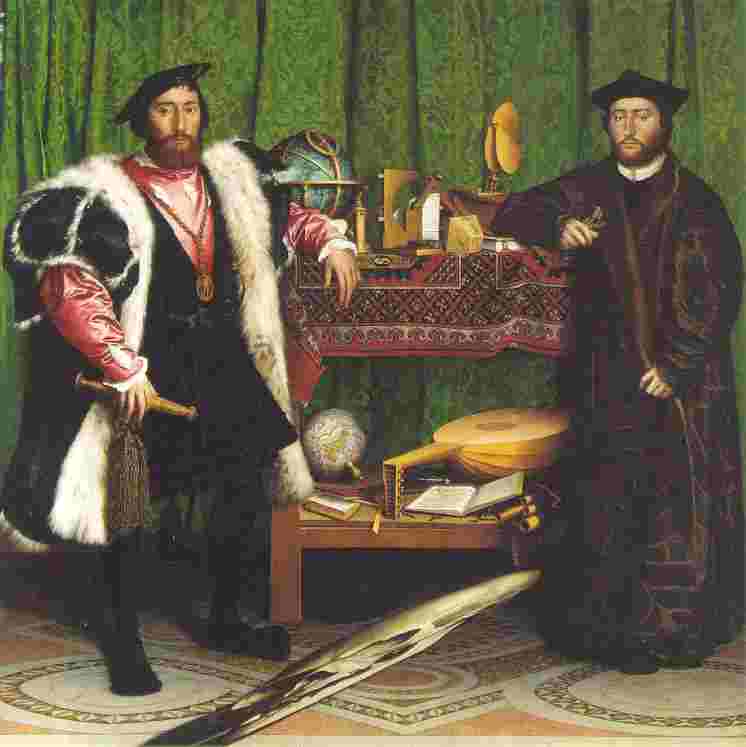
Give me liberty, or give me death, and can you make that with extra cheese?” – Patrick Henry at the Burger King
When I cast my beady, crow’s eyes over the long stretch of modernity – in these dog, dead days, I have little else to amuse me – I see nothing that so aptly fits Polanyi’s model of the disembedding of the economy as the rise of the menu – the course of which is, appropriately, a blank as far as I can tell. No opus to light the weary traveler on his way. Just the kind of trace that makes my juices flow. At the same time, of course, LI is a humble blogger, no maker of opuses but a poker of holes: we aren’t going to build Rome in a thousand words or less, or give you the foundations of menu-ology here.
In the two scenes we picked out from two movies in our last post, it would be easy to leave the menus behind. Like the King in Las Meninas, or – a better comparison – like the anamorphic skull in Holbein’s Ambassadors, gracing Lacan’s Seminaire, volume 11, they are where the gazes are gathered and the source that builds the space the gazes all span. So, what royal personage is doing the looking here? Well, it is LI’s humble contention, and the root of the insanity that has obviously driven him mad, that the gaze that stares out from the menu is the fly’s gaze, one in which two hundred flavors of ice cream, thirty brands of corn flakes, eggs with rye toast or steak cooked to your preference and ten combinations of milk (soy, whole, or one percent) and coffee can be held in balance, equally. The restaurant ain’t no panopticon, but it is one of the many entrances to the fly’s world, the kingdom of Capital. And we do know the name of the Lord of the Flies, don’t we?
Not that LI is particularly kicking against Belzebuub. We are humble servitors, more humble, because more miserably unsuccessful, than most - we simply have a causist’s quibble with the definition of freedom in the fly’s kingdom. That definition is spelled out in preferences, and he who says preferences says a pricing and market mechanism before you can say “still working on that, sir?” Or, “do you want onions and pickle on that?” What better text for preferences is there, what better object of the neo-classical school than the menu? Belzebuub’s poetic conceit is that all that exists, exists to be put on a menu. It functions not only to separate and classify choices, but to civilize and educate. Just as the child’s growth as a biological entity is measured by yardsticks and charts, the child’s entry into the fly’s kingdom comes by way of learning about, well, entrees.
All of which is LI creeping towards his object and around it again, instead of making the bold pounce. Maybe I can make the pounce in the next, or the next, post.
Tuesday, August 22, 2006
for a history of the menu
When I wrote my master’s thesis on seriousness, I spoke, in the Pauline phrase, as a child – or rather as a child of French philosophy. Thus, I did not look hard enough at English sources to find references to seriousness. I did find that seriousness has never been seriously thematized in philosophy, even though it has been inherent since Socrates made his first wisecrack. Imagine my surprise, then, when I came across this while reading Hazlitt – who I read to strengthen my prose style. (My master’s thesis, by the way, is that seriousness never really forms an opposite – it is always a wildcard in the play of the dialectic, and thus functions both to maintain and to deconstruct the system of oppositions within metaphysics. About which I could go on at length, but… being in all things merciful to my readers … I won’t):
“To understand or define the ludicrous, we must first know what the serious is. Now the serious is the habitual stress which the mind lays upon the expectation of a given order of events, following one another with a certain regularity and weight of interest attached to them. When this stress is increased beyond its usual pitch of intensity, so as to overstrain the feelings by the violent opposition of good to bad, or of object to our desires, it becomes the pathetic or tragical. The ludicrous, or comic, is the unexpected loosening or relaxing this stress below its usual pitch of intensity, by such an abrupt transposition of the order of our ideas, as taking the mind unawares, throws it off its guard, startles it into a lively sense of pleasure, and leaves no time nor inclination for painful reflections.”
There is much that is wrong with this – and especially the naïve distinction between pain and pleasure – but the nice thing about it is that Hazlitt recognizes that the serious is distinct not just from the ludicrous, but from the tragic.
Now, myself, as a loser, I have found that every oracle in my life eventually pokes a big stick up my ass except for the ludicrous – and so I have followed it like my own personal destiny, and here I now sit, a crow in all but feathers, cawing over the corpse of the American culture in its Bushian phase, where painful reflection mixes inextricably with the clownish. That culture, as I grew up with it, I realize dimly, is an aspect of war culture, which has its zones and manners.
But on to the subject of this post, which is existential freedom, liberalism, and the menu.
…
A few days ago, LI was visiting our local video store when the clerks put on a movie that stands out, in our mind, for loathsomeness. Not the loathsomeness of catsup flecked fx, nor that of porno raunch, but a more dreadful, soul destroying loathsomeness, a glimpse into the dark abysm of the middle class soul. I am speaking, of course, of When Sally Met Harry. Or is it When Harry Met Sally? In any case, I was visiting just as Meg Ryan was seated with -- oh, what’s his name, the guy who plays Harry, that sadsack comic – and she was ordering something at a restaurant. And it flashed on my senses that this scene was obviously referencing the scene in Five Easy Pieces when Jack Nicholson tried to order breakfast at a diner. Now, while FEP isn’t my favorite piece of cinema, the anger in Nicholson has a didactic quality that LI likes – for here, in a nutshell, is the problem with social contract liberalism, with its notion that freedom is about preferences. The solution to that anger, in FEP, for this form of liberalism, is expanding the preferences – hence, the same scene in WHMS, in which we get glimpses of what the hippie revolution wrought in lifestyle America – a place where a decent latte is never too far away. Or something like that.
Now LI has long contended that freedom isn’t defined by preferences – that, in fact, the idea of identifying freedom in that technical, economic sense with political freedom per se is exactly where the libertarian goes wrong. There is a rather beautiful phrase is G. Baum’s book on Karl Polanyi: “This, then, is Polanyi’s orginal argument: the longing of the bourgeois conscience transcends the possibilities of bourgeois society. What this conscience calls for is the creation of a transparent society that allows its members to estimate the effects of what they are doing and thus assume ethical responsibility for their actions.”
I am not sure about the transparency, but I am sure about the longing and the anger when that longing is marginalized, or translated into mere preference mongering.
Now, one thing about both movies is that the scenes are centered around the interaction between a text and social action – the text being the menu. I have looked around, but in vain, for a history of menus. Menus are considered to be so obvious that the fact that menus weren’t present in places where people came to eat – inns, basically – until the start of restauranting in the late 18th century doesn’t really register as a historically interesting event. To see how people would enter an inn and order food or drink, look, for instance, at Don Quixote. Or the 18th century picaresque. No character brandishes a menu in these texts. In fact, the same thing is true in Dickens -- characters are continually being brought chops and beer, but you don't see the characters asking, well, what type of beer do you have? Although by this time, actually, that sentence was starting to make sense.
This is why my next post will be about Grimod de la Reyniere, the man who wrote the first popular restaurant guide, the Almanach des gourmands. Overshadowed by Brillat-Savarin, Grimod de la Reyniere is now experiencing a little renaissance of interest by pop culture scholars.
Or at least that is what I think the next post will be about.
“To understand or define the ludicrous, we must first know what the serious is. Now the serious is the habitual stress which the mind lays upon the expectation of a given order of events, following one another with a certain regularity and weight of interest attached to them. When this stress is increased beyond its usual pitch of intensity, so as to overstrain the feelings by the violent opposition of good to bad, or of object to our desires, it becomes the pathetic or tragical. The ludicrous, or comic, is the unexpected loosening or relaxing this stress below its usual pitch of intensity, by such an abrupt transposition of the order of our ideas, as taking the mind unawares, throws it off its guard, startles it into a lively sense of pleasure, and leaves no time nor inclination for painful reflections.”
There is much that is wrong with this – and especially the naïve distinction between pain and pleasure – but the nice thing about it is that Hazlitt recognizes that the serious is distinct not just from the ludicrous, but from the tragic.
Now, myself, as a loser, I have found that every oracle in my life eventually pokes a big stick up my ass except for the ludicrous – and so I have followed it like my own personal destiny, and here I now sit, a crow in all but feathers, cawing over the corpse of the American culture in its Bushian phase, where painful reflection mixes inextricably with the clownish. That culture, as I grew up with it, I realize dimly, is an aspect of war culture, which has its zones and manners.
But on to the subject of this post, which is existential freedom, liberalism, and the menu.
…
A few days ago, LI was visiting our local video store when the clerks put on a movie that stands out, in our mind, for loathsomeness. Not the loathsomeness of catsup flecked fx, nor that of porno raunch, but a more dreadful, soul destroying loathsomeness, a glimpse into the dark abysm of the middle class soul. I am speaking, of course, of When Sally Met Harry. Or is it When Harry Met Sally? In any case, I was visiting just as Meg Ryan was seated with -- oh, what’s his name, the guy who plays Harry, that sadsack comic – and she was ordering something at a restaurant. And it flashed on my senses that this scene was obviously referencing the scene in Five Easy Pieces when Jack Nicholson tried to order breakfast at a diner. Now, while FEP isn’t my favorite piece of cinema, the anger in Nicholson has a didactic quality that LI likes – for here, in a nutshell, is the problem with social contract liberalism, with its notion that freedom is about preferences. The solution to that anger, in FEP, for this form of liberalism, is expanding the preferences – hence, the same scene in WHMS, in which we get glimpses of what the hippie revolution wrought in lifestyle America – a place where a decent latte is never too far away. Or something like that.
Now LI has long contended that freedom isn’t defined by preferences – that, in fact, the idea of identifying freedom in that technical, economic sense with political freedom per se is exactly where the libertarian goes wrong. There is a rather beautiful phrase is G. Baum’s book on Karl Polanyi: “This, then, is Polanyi’s orginal argument: the longing of the bourgeois conscience transcends the possibilities of bourgeois society. What this conscience calls for is the creation of a transparent society that allows its members to estimate the effects of what they are doing and thus assume ethical responsibility for their actions.”
I am not sure about the transparency, but I am sure about the longing and the anger when that longing is marginalized, or translated into mere preference mongering.
Now, one thing about both movies is that the scenes are centered around the interaction between a text and social action – the text being the menu. I have looked around, but in vain, for a history of menus. Menus are considered to be so obvious that the fact that menus weren’t present in places where people came to eat – inns, basically – until the start of restauranting in the late 18th century doesn’t really register as a historically interesting event. To see how people would enter an inn and order food or drink, look, for instance, at Don Quixote. Or the 18th century picaresque. No character brandishes a menu in these texts. In fact, the same thing is true in Dickens -- characters are continually being brought chops and beer, but you don't see the characters asking, well, what type of beer do you have? Although by this time, actually, that sentence was starting to make sense.
This is why my next post will be about Grimod de la Reyniere, the man who wrote the first popular restaurant guide, the Almanach des gourmands. Overshadowed by Brillat-Savarin, Grimod de la Reyniere is now experiencing a little renaissance of interest by pop culture scholars.
Or at least that is what I think the next post will be about.
Monday, August 21, 2006
my buds and companeros, the hummers
LI hopes readers haven’t found our last two posts intolerably dull. The thing is, the graphix novel we are working on does some projecting into the future. We have been dreaming of a period of great thirst, as the extent of glacial melting starts truly drying up drinking water sources, some time after 2040. Our little dystopian vision is of a Rwanda like situation in which the generation that drove cars (called "the Hummers") is systematically slaughtered by their offspring. How that fits into the plot remains to be seen. So, in any case, we are playing around with a vocabulary and vision. Sorry for the longeurs.
…
Ah, the symbols of the great glacier melt. Last week, the British papers had an interesting story about the reappearance of the body of a climber lost on Mount Blanc in 1989:
From the Daily Telegraph:
“THE mummified remains of a British mountaineer who vanished 17 years ago have been found in a melting glacier in the Italian Alps.
Michael Seavers, 31, was one of three British climbers who disappeared in a snowstorm with a German companion.
The bodies of William Ogburn, 32, and Leslie Lawrence, 29, were found within six months of the tragedy.
But Mr Seavers's body and that of his German companion Dirk Ziolkowske, 24, have not been found until now.
A guide said yesterday that he had seen their remains last Friday and mountain rescue teams recovered them from an altitude of 10,500ft, close to the Toula glacier on the Italian side of Mt Blanc.”
The alps are the scene of some geologically interesting stuff at the moment. They are actually growing again. As the weight of the alpine glaciers diminishes, the mountains grow inches taller. And how much is that weight going to diminish?
This is from Biotech week:
“Scientists consider glaciers to be among the best natural indicators of climate change and, therefore, monitor them closely. Rapidly shrinking glacier areas, spectacular tongue retreats, and increasing mass losses are clear signs of the atmospheric warming observed in the Alps during the last 150 years.
Michael Zemp and colleagues in the Department of Geography of the University of Zurich note that in the 1970s, about 5,150 Alpine glaciers covered a total area of 2,909 square kilometers [1,123 square miles]. This represented a loss of about 35% of glacial area from 1850 to that time. Accelerated loss of ice cover since then has resulted in a total loss of 50% of the 1850 area, culminating in a volume loss of 5 to 10% of the remaining ice during the extraordinary warm year of 2003.
According to the Intergovernmental Panel on Climate Change (IPCC), an increase in summer air temperature of one to five degrees Celsius [two to nine degrees Fahrenheit] and a precipitation change between minus-20% and plus-30% by the end of the 21st century is a plausible scenario. The University of Zurich researchers say that for each one degree Celsius [two degrees Fahrenheit] increase in mean summer temperature, precipitation would have to increase by 25% to offset the glacial loss.”
There is a lake in the center of Austin. It wasn’t there one hundred years ago. It might well not be there a hundred years from now. But nobody is going to experience that span. Rather, our experiences are in the permanent. The way you make it home from work is permanent. The work you do is permanent. Sun rises permanently. Sun sets permanently. What is now is, of course, permanent. What is now always was and always will be.
Only fanatics – the kind of people who never say amen - could think otherwise.
…
Ah, the symbols of the great glacier melt. Last week, the British papers had an interesting story about the reappearance of the body of a climber lost on Mount Blanc in 1989:
From the Daily Telegraph:
“THE mummified remains of a British mountaineer who vanished 17 years ago have been found in a melting glacier in the Italian Alps.
Michael Seavers, 31, was one of three British climbers who disappeared in a snowstorm with a German companion.
The bodies of William Ogburn, 32, and Leslie Lawrence, 29, were found within six months of the tragedy.
But Mr Seavers's body and that of his German companion Dirk Ziolkowske, 24, have not been found until now.
A guide said yesterday that he had seen their remains last Friday and mountain rescue teams recovered them from an altitude of 10,500ft, close to the Toula glacier on the Italian side of Mt Blanc.”
The alps are the scene of some geologically interesting stuff at the moment. They are actually growing again. As the weight of the alpine glaciers diminishes, the mountains grow inches taller. And how much is that weight going to diminish?
This is from Biotech week:
“Scientists consider glaciers to be among the best natural indicators of climate change and, therefore, monitor them closely. Rapidly shrinking glacier areas, spectacular tongue retreats, and increasing mass losses are clear signs of the atmospheric warming observed in the Alps during the last 150 years.
Michael Zemp and colleagues in the Department of Geography of the University of Zurich note that in the 1970s, about 5,150 Alpine glaciers covered a total area of 2,909 square kilometers [1,123 square miles]. This represented a loss of about 35% of glacial area from 1850 to that time. Accelerated loss of ice cover since then has resulted in a total loss of 50% of the 1850 area, culminating in a volume loss of 5 to 10% of the remaining ice during the extraordinary warm year of 2003.
According to the Intergovernmental Panel on Climate Change (IPCC), an increase in summer air temperature of one to five degrees Celsius [two to nine degrees Fahrenheit] and a precipitation change between minus-20% and plus-30% by the end of the 21st century is a plausible scenario. The University of Zurich researchers say that for each one degree Celsius [two degrees Fahrenheit] increase in mean summer temperature, precipitation would have to increase by 25% to offset the glacial loss.”
There is a lake in the center of Austin. It wasn’t there one hundred years ago. It might well not be there a hundred years from now. But nobody is going to experience that span. Rather, our experiences are in the permanent. The way you make it home from work is permanent. The work you do is permanent. Sun rises permanently. Sun sets permanently. What is now is, of course, permanent. What is now always was and always will be.
Only fanatics – the kind of people who never say amen - could think otherwise.
Sunday, August 20, 2006
cosmo-polemos
“Few polls were take to measure the air force’s success in public relations, but by June 1945 a Fortune survey indicated progress. As Fortune put it, “The people are sold on peace through air power.” On more subjective grounds, the air force also had reason for optimism as 1945 appraoched because doubts ere arising within the military establishment about public support for a large peacetime ground army. Arnold believed that Americans would support in its place a powerful air foce making few demands on manpower and responding to public anxieties, nourished by the air force itself, about defending against future Pearl Harbors.” The Rise of American Air Power: the creation of Armageddon by Michael Sherry
He sew his eyes shut
Because he is afraid to see – Nine Inch Nails
The conclusion I draw from my last post is nothing so facile as that all wars are one war. That is an analytic dead end. But I’d suggest that the set of wars that have taken place between 1939 and, say, the beginning of the Heat Death era, around 2040, form a distinct, unified historical epoch. And that war, here, has to include events that are usually segregated from it – the mass transformation of infrastructure that appeared all across the globe (dams, irrigation systems, road systems, the dispersal of urban areas into subways), the great scientific and technological research systems, the psychology-education complex – etc.
We are citizens of the wars. War men and women, war races. Human product among low use populations – this should be the caption for much of our history at the moment. We have devised elaborate plots behind which the parts actually fit together, the hidden patterns come alive, and we love them. We are entertained infinitely by our own destruction. And such has been the creation of cosmo-polemos.
This is why I find articles like Ralph’s fascinating. It begins with those events that have been rather forgotten relative to the bombing of Hiroshima and Nagasaki.
“On the night of 9 March 1945, 325 B-29 ‘Superfortresses’, based in the Marianas and under the command of Major General Curtis E. LeMay, dropped 1665 tons of bombs, all of which were incendiaries,on the heart of residential Tokyo. The bombs generated a ferocious, unstoppable firestorm that consumed 15.8 square miles of the city and killed a roughly estimated 100 000 of its citizens. The targeted residential zone bordered a large manufacturing sector of the city: consequently 22 numbered industrial targets were destroyed and struck from the target list the next morning. By official Japanese estimates, 267 171 buildings were levelled (one-quarter of the city), and 1 008 005 Japanese were left homeless.2 Viewed as a massive success by the United States Army Air Forces (USAAF), the Tokyo raid kicked off a firebombing campaign. that laid waste to more than 60 of Japan’s largest cities and killed hundreds of thousands of its civilians by the end of the Second World War.”
Historians of the war confront a puzzle, here. U.S. air policy, laid out in the 1930s, was very clear about what the Brits called ‘area bombing.’ Roosevelt, in a speech in 1939, said:
“The ruthless bombing from the air of civilians in unfortified centers of population during the course of the hostilities which have raged in various quarters of the earth during the past few years, which has resulted in the maiming and in the death of thousands of defenseless men, women and children has sickened the hearts of every civilized man and woman, and has profoundly shocked the conscience of humanity.”
Roosevelt wasn’t just engaging in rhetoric. The U.S. air power policy developed in the thirties specifically aimed at destroying the industrial fabric of enemy power. In the air war over Germany, the U.S. tried, at least, to adhere to this policy. When, in 1945, Dresden was destroyed by an Anglo-American fleet of bombers, a British officer, C.M. Grierson, suggested at a press conference that the purpose was to kill civilians, it disturbed the American command. In fact, the destruction of German cities, Operation Clarion, was discussed and disputed with these issues in mind:
“Lieutenant General Ira C. Eaker, former commander of the 8th Air Force in Germany, wrote to Lieutenant General Carl Spaatz (who was then co-ordinating Clarion) and asked him not to carry out the attack: ‘We should never allow the history of this war to convict us of throwing the strategic bomber against the man in the street.’12 Spaatz went ahead with Clarion anyway, but remained, according to one general’s diary, ‘determined that the American Air Forces will not end this war with a reputation for indiscriminate bombing’.”
Given this dialogue in the European theater, why was the Pacific theater so different?
Ralph’s structured answer gives weight to the logical development, out of precision bombing, of a terror bombing policy. But in practice, terror bombing was enacted due to the interplay between Curtis LeMay and General ‘Hap’ Hapgood Arnold. It was not planned, but emerged as an improvisation from a context in which it was dialectically prefigured -- by which I simply mean that the boundaries that defined the industrial attrition policy were always subject to change, and were never anchored to any logical constant. Both LeMay and Hapgood knew that they were facing a potential crisis: peace. Hapgood was a strong advocate of strengthening the Air Force and keeping it independent from the army. Independence meant resources.
The Committee assessing the air war over Japan, as Ralph describes it, went from advocating the destruction of industry according to the thirties strategic framework to consideration of the “intriguing idea,” as one General put it, of promoting “complete chaos” in six cities by killing “584,000 people.” But this was put in terms of its economic effects – for killing people as people did make one feel a bit of a heel. Rather, the 584,000 would be workers. Human product. Subtract workers and you effect the economy.
These thoughts, then, were in the Air Force mind. And there were threats closing in:
“The pressure to do ever more for the purpose of air force independence manifested itself in many ways. First to feel it were those within the B-29 programme. As mentioned above, Arnold had risked his career for this US$3 billion endeavour. It was the B-29 that could grant air force independence, because it was the weapon that could deliver fire-power in ways the army and navy could not. But Arnold constantly risked losing his B-29s to the insatiable needs of the army and navy. In early 1944 Arnold specifically designed the 20th Air Force (which would contain the XX and XXI Bomber Commands) to be as far removed from other branches of the military as possible. In a novel fashion, the 20th reported not to the army, but directly to the Joint Chiefs of Staff. Arnold, a member of the JCS, was both commanding general of the 20th as well as executive agent for the JCS in the Pentagon.36 The JCS created the broad strategic framework, but within that framework Arnold
could do essentially whatever he wanted.37
“Command freedom did not guarantee wartime independence, however. Arnold was very candid in his memoirs about his fears that the Air Forces would be subordinated in the Pacific theatre. He recalled that Admiral King, the highly effective commander of the US Fleet, said, ‘Trouble with all this rearrangement and reorganization is your Air Force, Hap. If you would take your Air Force and bring it over to the Navy, then the Navy … would be the largest and most powerful force in the world.’38 Arnold certainly had no desire to follow this plan, and was instead determined to keep his 20th as far from naval operations as possible. But even if Arnold maintained an independent air arm, he still would have to prove he was achieving results with his B-29s in order to keep them.”
Keeping what you got – this is the essence of great drama. Arnold, like the Golem in Lord of the Rings, wanted his precious. And the navy was threatening to take his precious away. And what stood between him and his loss? A buncha Japanese civilians.
These rivalries have become a thing of comedy. However, the 584,000 Japanese, in addition to contributing to the war effort, were notoriously humorless, which meant that, as they were dying, they wouldn’t be dying of laughter. Which is funny, since laughter is the best medicine.
So, 1944 was coming to a close, and the precision bombing campaign, which Arnold had entrusted to the man who developed the precision bombing strategy, Hansell, had been pounding Japan. Precision bombing depended on the relatively primitive guiding technology the air force had, and on weather. The publicity was bad about the bombing of the steel factories that were targeted according to the earlier protocol, since they stubbornly withstood bombardment. In the meantime, over in China, Curtis LeMay was doing wonders. Somehow, his B-29s were getting to their targets in Japan at twice the rate of Hansell’s.
So it all started to click. If precision bombing depended on such complexities, perhaps one could considering widening the cone of destruction. Hansell was asked to make a whole incendiary strike on Nagoya. The purpose was specifically to kill civilians. Hansell answered back:
“I have with great difficulty implanted the principle that our mission is the destruction of selected primary targets by sustained and determined attacks using precision bombing methods … We are just
beginning to get results … I am concerned that a change to area bombing of the cities will undermine the progress we have made.”
Well, this resistance was no good.
“Arnold did not want to hear about any more problems from Hansell; he was impatient, and wanted reports of big results. As he said himself, the ‘best evidence of how you are getting along is the pictures of the destruction that you have accomplished against your primary targets’.53 Hansell was not providing these pictures. Shortly after Hansell’s interview, Arnold made the decision to relieve Hansell and replace him with LeMay. Norstad delivered the news to Hansell in person on 6 January. Again, Hansell was shocked, but now also extremely disappointed. General Arnold wrote to him soon after, explaining his reasoning for the change in command: ‘The job from now on is no longer planning and pioneering. It has become one of operating. LeMay … should be our best qualified operator.’54 This small statement is most revealing. Arnold did not want a planner in charge of his B-29s: he needed someone who would just get things done; again, he wanted results – and fast.”
One often reads about how the Truman White House had its eye on the Soviets during the last phase of the war against Japan. Or that the main point, vide Paul Fussell, was to save American lives. But we should also remember how many eyes were turned to Boeing. And how easily we can go from precision bombing to ‘area bombing.’ In fact, it seems to be the history of the use of American air power after WWII.
He sew his eyes shut
Because he is afraid to see – Nine Inch Nails
The conclusion I draw from my last post is nothing so facile as that all wars are one war. That is an analytic dead end. But I’d suggest that the set of wars that have taken place between 1939 and, say, the beginning of the Heat Death era, around 2040, form a distinct, unified historical epoch. And that war, here, has to include events that are usually segregated from it – the mass transformation of infrastructure that appeared all across the globe (dams, irrigation systems, road systems, the dispersal of urban areas into subways), the great scientific and technological research systems, the psychology-education complex – etc.
We are citizens of the wars. War men and women, war races. Human product among low use populations – this should be the caption for much of our history at the moment. We have devised elaborate plots behind which the parts actually fit together, the hidden patterns come alive, and we love them. We are entertained infinitely by our own destruction. And such has been the creation of cosmo-polemos.
This is why I find articles like Ralph’s fascinating. It begins with those events that have been rather forgotten relative to the bombing of Hiroshima and Nagasaki.
“On the night of 9 March 1945, 325 B-29 ‘Superfortresses’, based in the Marianas and under the command of Major General Curtis E. LeMay, dropped 1665 tons of bombs, all of which were incendiaries,on the heart of residential Tokyo. The bombs generated a ferocious, unstoppable firestorm that consumed 15.8 square miles of the city and killed a roughly estimated 100 000 of its citizens. The targeted residential zone bordered a large manufacturing sector of the city: consequently 22 numbered industrial targets were destroyed and struck from the target list the next morning. By official Japanese estimates, 267 171 buildings were levelled (one-quarter of the city), and 1 008 005 Japanese were left homeless.2 Viewed as a massive success by the United States Army Air Forces (USAAF), the Tokyo raid kicked off a firebombing campaign. that laid waste to more than 60 of Japan’s largest cities and killed hundreds of thousands of its civilians by the end of the Second World War.”
Historians of the war confront a puzzle, here. U.S. air policy, laid out in the 1930s, was very clear about what the Brits called ‘area bombing.’ Roosevelt, in a speech in 1939, said:
“The ruthless bombing from the air of civilians in unfortified centers of population during the course of the hostilities which have raged in various quarters of the earth during the past few years, which has resulted in the maiming and in the death of thousands of defenseless men, women and children has sickened the hearts of every civilized man and woman, and has profoundly shocked the conscience of humanity.”
Roosevelt wasn’t just engaging in rhetoric. The U.S. air power policy developed in the thirties specifically aimed at destroying the industrial fabric of enemy power. In the air war over Germany, the U.S. tried, at least, to adhere to this policy. When, in 1945, Dresden was destroyed by an Anglo-American fleet of bombers, a British officer, C.M. Grierson, suggested at a press conference that the purpose was to kill civilians, it disturbed the American command. In fact, the destruction of German cities, Operation Clarion, was discussed and disputed with these issues in mind:
“Lieutenant General Ira C. Eaker, former commander of the 8th Air Force in Germany, wrote to Lieutenant General Carl Spaatz (who was then co-ordinating Clarion) and asked him not to carry out the attack: ‘We should never allow the history of this war to convict us of throwing the strategic bomber against the man in the street.’12 Spaatz went ahead with Clarion anyway, but remained, according to one general’s diary, ‘determined that the American Air Forces will not end this war with a reputation for indiscriminate bombing’.”
Given this dialogue in the European theater, why was the Pacific theater so different?
Ralph’s structured answer gives weight to the logical development, out of precision bombing, of a terror bombing policy. But in practice, terror bombing was enacted due to the interplay between Curtis LeMay and General ‘Hap’ Hapgood Arnold. It was not planned, but emerged as an improvisation from a context in which it was dialectically prefigured -- by which I simply mean that the boundaries that defined the industrial attrition policy were always subject to change, and were never anchored to any logical constant. Both LeMay and Hapgood knew that they were facing a potential crisis: peace. Hapgood was a strong advocate of strengthening the Air Force and keeping it independent from the army. Independence meant resources.
The Committee assessing the air war over Japan, as Ralph describes it, went from advocating the destruction of industry according to the thirties strategic framework to consideration of the “intriguing idea,” as one General put it, of promoting “complete chaos” in six cities by killing “584,000 people.” But this was put in terms of its economic effects – for killing people as people did make one feel a bit of a heel. Rather, the 584,000 would be workers. Human product. Subtract workers and you effect the economy.
These thoughts, then, were in the Air Force mind. And there were threats closing in:
“The pressure to do ever more for the purpose of air force independence manifested itself in many ways. First to feel it were those within the B-29 programme. As mentioned above, Arnold had risked his career for this US$3 billion endeavour. It was the B-29 that could grant air force independence, because it was the weapon that could deliver fire-power in ways the army and navy could not. But Arnold constantly risked losing his B-29s to the insatiable needs of the army and navy. In early 1944 Arnold specifically designed the 20th Air Force (which would contain the XX and XXI Bomber Commands) to be as far removed from other branches of the military as possible. In a novel fashion, the 20th reported not to the army, but directly to the Joint Chiefs of Staff. Arnold, a member of the JCS, was both commanding general of the 20th as well as executive agent for the JCS in the Pentagon.36 The JCS created the broad strategic framework, but within that framework Arnold
could do essentially whatever he wanted.37
“Command freedom did not guarantee wartime independence, however. Arnold was very candid in his memoirs about his fears that the Air Forces would be subordinated in the Pacific theatre. He recalled that Admiral King, the highly effective commander of the US Fleet, said, ‘Trouble with all this rearrangement and reorganization is your Air Force, Hap. If you would take your Air Force and bring it over to the Navy, then the Navy … would be the largest and most powerful force in the world.’38 Arnold certainly had no desire to follow this plan, and was instead determined to keep his 20th as far from naval operations as possible. But even if Arnold maintained an independent air arm, he still would have to prove he was achieving results with his B-29s in order to keep them.”
Keeping what you got – this is the essence of great drama. Arnold, like the Golem in Lord of the Rings, wanted his precious. And the navy was threatening to take his precious away. And what stood between him and his loss? A buncha Japanese civilians.
These rivalries have become a thing of comedy. However, the 584,000 Japanese, in addition to contributing to the war effort, were notoriously humorless, which meant that, as they were dying, they wouldn’t be dying of laughter. Which is funny, since laughter is the best medicine.
So, 1944 was coming to a close, and the precision bombing campaign, which Arnold had entrusted to the man who developed the precision bombing strategy, Hansell, had been pounding Japan. Precision bombing depended on the relatively primitive guiding technology the air force had, and on weather. The publicity was bad about the bombing of the steel factories that were targeted according to the earlier protocol, since they stubbornly withstood bombardment. In the meantime, over in China, Curtis LeMay was doing wonders. Somehow, his B-29s were getting to their targets in Japan at twice the rate of Hansell’s.
So it all started to click. If precision bombing depended on such complexities, perhaps one could considering widening the cone of destruction. Hansell was asked to make a whole incendiary strike on Nagoya. The purpose was specifically to kill civilians. Hansell answered back:
“I have with great difficulty implanted the principle that our mission is the destruction of selected primary targets by sustained and determined attacks using precision bombing methods … We are just
beginning to get results … I am concerned that a change to area bombing of the cities will undermine the progress we have made.”
Well, this resistance was no good.
“Arnold did not want to hear about any more problems from Hansell; he was impatient, and wanted reports of big results. As he said himself, the ‘best evidence of how you are getting along is the pictures of the destruction that you have accomplished against your primary targets’.53 Hansell was not providing these pictures. Shortly after Hansell’s interview, Arnold made the decision to relieve Hansell and replace him with LeMay. Norstad delivered the news to Hansell in person on 6 January. Again, Hansell was shocked, but now also extremely disappointed. General Arnold wrote to him soon after, explaining his reasoning for the change in command: ‘The job from now on is no longer planning and pioneering. It has become one of operating. LeMay … should be our best qualified operator.’54 This small statement is most revealing. Arnold did not want a planner in charge of his B-29s: he needed someone who would just get things done; again, he wanted results – and fast.”
One often reads about how the Truman White House had its eye on the Soviets during the last phase of the war against Japan. Or that the main point, vide Paul Fussell, was to save American lives. But we should also remember how many eyes were turned to Boeing. And how easily we can go from precision bombing to ‘area bombing.’ In fact, it seems to be the history of the use of American air power after WWII.
Saturday, August 19, 2006
war culture in the heraclitean framework
After it became apparent that the Israeli strategy of using air power to make Lebanon Hezbollah-rein had failed, a curious paen to air power appeared in the Washington Post, filed by their military analyst, William Arkin.
“If you've been reading my commentary on the Israel-Hezbollah war here, you know that I am a fan of airpower. To me, modern precision airpower is the epitome of discriminate warfare, which is to say, that it uniquely allows armed forces to discriminate between combatants and civilians. That is, short of two armies consenting to deploy to an unpopulated battlefield -- sort of like what Saddam Hussein did in 1990 after his invasion of Kuwait when he dug his army into the Kuwaiti and Iraqi desert.
I've heard the howls of protest -- Dresden, Tokyo, London -- before, but again, to reiterate, modern airpower, with its new precision weapons, allows an unprecedented degree of discrimination.”
There are many interests that converge in the War Culture, and one of the most difficult tasks for the analyst is to separate them and sort them by their various ‘degrees of discrimination’. And if this task wasn’t difficult in itself, there is a philosophical difficulty that is rarely mentioned, at least by historians, foreign policy think tankers, and political philosophers. The difficulty goes back to the standard assumption that war is derivative from the State. First we have the state, then we have the wars between states, just as first we have teams, then we have baseball. However, that assumption is rarely argued for. In LI’s opinion, you could just as well have war first – ontologically and historically, Hobbes’ war of all against all – and then the state. In this view, states derive from war, rather than the other way around. Just as Mallarme thought that everything strives to be written in a book, every war, striving to be part of the one war, leaves in its path fragments of itself. Those fragments are states. But war is the shaper. The more powerful the state, the more the culture becomes a war culture.
The philosophical warrant for this goes back to Heraclitus. The Heraclitean view is expressed in a cluster of fragments recently re-translated, along with the whole corpus of Heraclitus’ work, by Charles Kahn in The Art and Thought of Heraclitus. Fragment 51 reads: “Homer was wrong when he said “Would that Conflict might vanish from among gods and men!” For there would be no attunement without high and low notes nor any animals without male and female, both of which are opposites.” 52 reads: “One must realize that war is shared, and Conflict is Justice, and that all things come to pass (are are ordained?) in accordance with conflict. And 53, the most famous of the fragments on war, reads: War is the father of all and king of all; and some he has shown as gods, others men; some he has made slaves, others free.”
Kahn’s commentary on these fragments is interesting. According to him, the criticism of Homer is that he, like most men, cannot see how, behind appearance, there is a hidden fitting together of all things. According to Kahn, in these fragments, Heraclitus formulates four responses to the question: ‘What is it that most men do not comprhend.’
1. “One must realize that War is common (xynos, shared)’. “…in the place of the familiar thought that the fortunes of war are shared by both sides and that the victor today may be vanquished tomorrow, Heraclitus takes xynos, ‘common’ in his own sense of ‘universal’, ‘all-pervading’, ‘unifying’, and thus gives the words of the poets a deeper meaning they themselves did not comprehend. The symmetrical confrontation of the two sides in battle now becomes a figura for the shifting but reciprocal balance between opposites in human life in the natural world…”
2. “Conflict is Justice”. “Vlastos is clrearly right to insist that Heraclitus’ conception of cosmic justice goes beyond that of Anaximander [one of whose phrases is echoed in Heraclitus’ phrase], since he construes dike not merely as compensation for crime or excess but as a total pattern that includes both punishment and crime itself as necessary ingredients of the world order.
3. ‘All things come to pass in accordance with conflict.’ Kahn points out that this echoes the notion of all things coming to pass in logos. Come to pass can also be understood as birth – which then gives us the strange reversal of the 53rd fragment, since birth here comes from the father, not the mother.
4. “And all things are ordained by conflict.” Kahn thinks that the word for ordained is corrupt. But if it is ordained, he sees the ordination as that proper to an oracle.
If one has the heraclitean framework in mind, the idea that war solely serves the interests of states gives place to the question of what interests are being served by war. And this is a useful thing, insofar as states are not homogenous units. Although we are familiar with trans-national corporations, we still seem to grope when trying to understand transnational interests, which are usually attributed to the hegemonic ambition of a given state. And then, too, there is the definition of wars. We like to count them as distinct things, having beginnings and endings. However, we all know that wars might well have continuities disguised by the ceasefires or intervals of peace that supposedly define them into separate wars, and sometimes we acknowledge this by talking of world wars, or of the sixty or hundred years war.
I hope this isn’t a too utterly philosophical introduction to the topic I am going to discuss in the next post – William W. Ralph’s essay, in the latest issue of War in History, entitled: “Improvised Destruction: Arnold, LeMay, and the Firebombing of Japan,” which argues a thesis that might well explain the motivation for Arkin’s column – or at least one abiding, institutional motivation within the American War Culture.
“If you've been reading my commentary on the Israel-Hezbollah war here, you know that I am a fan of airpower. To me, modern precision airpower is the epitome of discriminate warfare, which is to say, that it uniquely allows armed forces to discriminate between combatants and civilians. That is, short of two armies consenting to deploy to an unpopulated battlefield -- sort of like what Saddam Hussein did in 1990 after his invasion of Kuwait when he dug his army into the Kuwaiti and Iraqi desert.
I've heard the howls of protest -- Dresden, Tokyo, London -- before, but again, to reiterate, modern airpower, with its new precision weapons, allows an unprecedented degree of discrimination.”
There are many interests that converge in the War Culture, and one of the most difficult tasks for the analyst is to separate them and sort them by their various ‘degrees of discrimination’. And if this task wasn’t difficult in itself, there is a philosophical difficulty that is rarely mentioned, at least by historians, foreign policy think tankers, and political philosophers. The difficulty goes back to the standard assumption that war is derivative from the State. First we have the state, then we have the wars between states, just as first we have teams, then we have baseball. However, that assumption is rarely argued for. In LI’s opinion, you could just as well have war first – ontologically and historically, Hobbes’ war of all against all – and then the state. In this view, states derive from war, rather than the other way around. Just as Mallarme thought that everything strives to be written in a book, every war, striving to be part of the one war, leaves in its path fragments of itself. Those fragments are states. But war is the shaper. The more powerful the state, the more the culture becomes a war culture.
The philosophical warrant for this goes back to Heraclitus. The Heraclitean view is expressed in a cluster of fragments recently re-translated, along with the whole corpus of Heraclitus’ work, by Charles Kahn in The Art and Thought of Heraclitus. Fragment 51 reads: “Homer was wrong when he said “Would that Conflict might vanish from among gods and men!” For there would be no attunement without high and low notes nor any animals without male and female, both of which are opposites.” 52 reads: “One must realize that war is shared, and Conflict is Justice, and that all things come to pass (are are ordained?) in accordance with conflict. And 53, the most famous of the fragments on war, reads: War is the father of all and king of all; and some he has shown as gods, others men; some he has made slaves, others free.”
Kahn’s commentary on these fragments is interesting. According to him, the criticism of Homer is that he, like most men, cannot see how, behind appearance, there is a hidden fitting together of all things. According to Kahn, in these fragments, Heraclitus formulates four responses to the question: ‘What is it that most men do not comprhend.’
1. “One must realize that War is common (xynos, shared)’. “…in the place of the familiar thought that the fortunes of war are shared by both sides and that the victor today may be vanquished tomorrow, Heraclitus takes xynos, ‘common’ in his own sense of ‘universal’, ‘all-pervading’, ‘unifying’, and thus gives the words of the poets a deeper meaning they themselves did not comprehend. The symmetrical confrontation of the two sides in battle now becomes a figura for the shifting but reciprocal balance between opposites in human life in the natural world…”
2. “Conflict is Justice”. “Vlastos is clrearly right to insist that Heraclitus’ conception of cosmic justice goes beyond that of Anaximander [one of whose phrases is echoed in Heraclitus’ phrase], since he construes dike not merely as compensation for crime or excess but as a total pattern that includes both punishment and crime itself as necessary ingredients of the world order.
3. ‘All things come to pass in accordance with conflict.’ Kahn points out that this echoes the notion of all things coming to pass in logos. Come to pass can also be understood as birth – which then gives us the strange reversal of the 53rd fragment, since birth here comes from the father, not the mother.
4. “And all things are ordained by conflict.” Kahn thinks that the word for ordained is corrupt. But if it is ordained, he sees the ordination as that proper to an oracle.
If one has the heraclitean framework in mind, the idea that war solely serves the interests of states gives place to the question of what interests are being served by war. And this is a useful thing, insofar as states are not homogenous units. Although we are familiar with trans-national corporations, we still seem to grope when trying to understand transnational interests, which are usually attributed to the hegemonic ambition of a given state. And then, too, there is the definition of wars. We like to count them as distinct things, having beginnings and endings. However, we all know that wars might well have continuities disguised by the ceasefires or intervals of peace that supposedly define them into separate wars, and sometimes we acknowledge this by talking of world wars, or of the sixty or hundred years war.
I hope this isn’t a too utterly philosophical introduction to the topic I am going to discuss in the next post – William W. Ralph’s essay, in the latest issue of War in History, entitled: “Improvised Destruction: Arnold, LeMay, and the Firebombing of Japan,” which argues a thesis that might well explain the motivation for Arkin’s column – or at least one abiding, institutional motivation within the American War Culture.
Friday, August 18, 2006
rwg writing services
Alas, the editing jobs aren't pouring in this summer. We did get a nice note from a client who just graduated from {blank} university, the other day, thanking us for our work on his papers.
So, LI readers, drivebys, friends, Romans and Countrymen - help us out. Tell people about our writing service. The links are on the sidebar (or, for mysterious reasons, on the bottom of the page for those of you looking at this via IE 6).
Remember: a full blogger is a happy blogger.
So, LI readers, drivebys, friends, Romans and Countrymen - help us out. Tell people about our writing service. The links are on the sidebar (or, for mysterious reasons, on the bottom of the page for those of you looking at this via IE 6).
Remember: a full blogger is a happy blogger.
Thursday, August 17, 2006
following this summer's murder story
There are some murders we follow. There are some murders we don’t.
During the infinite newscycle of OJ-iana, the only thing that really impressed us was the slo mo car chase. Oh, and OJ’s houseguest, Kato Kaelin. Actually, Kato impressed us a lot – what a job! My own parents evidently abused me: they never once mentioned the career opportunity of being a houseguest to the stars. If LI had known about this as a tyke, forget the dreams of wealth, or the teenage idea of writing and forging, in the smithy of my soul, the consciousness of my race – fuck that. I would have cultivated better hair, better connections, and practiced saying things in the mirror like, “My Cher,” (or Billy Bob or Telly or Chevy or whoever), this is a big place you got here! Roomy is no word for it. You must get lonely here sometimes, eh?” But no, as aforesaid, my folks abused me by hiding the facts, which I can only excuse them for partly by the fact that we were hicks living in Dekalb County, Georgia, where houseguests were usually your uncle or aunt.
But the murder of Jon Benet was much more interesting, in that sick way that certain murders unzip the underlife. Unfortunately, that is only probed by the tabloids. That is, by reporters and celebrity tv persona who have a fair share of the necessary voyeurism to gawp at the doings behind the drapes but no real curiosity about the meat and beat of people – about their pulsing existences. This is why tabloids are frustrating – they strip the two dimensional of its clothing, but its like the Rape of the Sabine Women being reenacted with mannequins. There is no there there not because there is no there there, but because the there has been condensed, evaporated, and replaced with there-substitute.. Plus, of course, the compass points are all the assumption that the only perspective is that of straight morality, and zero question about why, if the straight morality is such a good thing, we find it so utterly, utterly boring, and why it has created a system that is, in so many ways, detestable. Now, LI is not necessarily against boredom – as so many of our long posts attest! – but we do think that it is motivated, and hence subject to the endless novelist’s project.
Since we are neck deep, at the moment, in Mailer’s Executioner’s Song, we are just in the right spirit for the news about Jon Benet’s supposed killer. I should emphasize supposed, since a confession does not equal case solved. The confession is, to say the least, confused, and the pre-made articles pouring out from straight news outlets about how the tabloids injured the poor parents and distorted the facts – amazing how the press, resistant to any criticism about its three year obeisance to Bush and the rush to war, is always willing to criticize the tabloids for the rush to judgment on any given topic - aren’t convincing to me, yet. We will see.
During the infinite newscycle of OJ-iana, the only thing that really impressed us was the slo mo car chase. Oh, and OJ’s houseguest, Kato Kaelin. Actually, Kato impressed us a lot – what a job! My own parents evidently abused me: they never once mentioned the career opportunity of being a houseguest to the stars. If LI had known about this as a tyke, forget the dreams of wealth, or the teenage idea of writing and forging, in the smithy of my soul, the consciousness of my race – fuck that. I would have cultivated better hair, better connections, and practiced saying things in the mirror like, “My Cher,” (or Billy Bob or Telly or Chevy or whoever), this is a big place you got here! Roomy is no word for it. You must get lonely here sometimes, eh?” But no, as aforesaid, my folks abused me by hiding the facts, which I can only excuse them for partly by the fact that we were hicks living in Dekalb County, Georgia, where houseguests were usually your uncle or aunt.
But the murder of Jon Benet was much more interesting, in that sick way that certain murders unzip the underlife. Unfortunately, that is only probed by the tabloids. That is, by reporters and celebrity tv persona who have a fair share of the necessary voyeurism to gawp at the doings behind the drapes but no real curiosity about the meat and beat of people – about their pulsing existences. This is why tabloids are frustrating – they strip the two dimensional of its clothing, but its like the Rape of the Sabine Women being reenacted with mannequins. There is no there there not because there is no there there, but because the there has been condensed, evaporated, and replaced with there-substitute.. Plus, of course, the compass points are all the assumption that the only perspective is that of straight morality, and zero question about why, if the straight morality is such a good thing, we find it so utterly, utterly boring, and why it has created a system that is, in so many ways, detestable. Now, LI is not necessarily against boredom – as so many of our long posts attest! – but we do think that it is motivated, and hence subject to the endless novelist’s project.
Since we are neck deep, at the moment, in Mailer’s Executioner’s Song, we are just in the right spirit for the news about Jon Benet’s supposed killer. I should emphasize supposed, since a confession does not equal case solved. The confession is, to say the least, confused, and the pre-made articles pouring out from straight news outlets about how the tabloids injured the poor parents and distorted the facts – amazing how the press, resistant to any criticism about its three year obeisance to Bush and the rush to war, is always willing to criticize the tabloids for the rush to judgment on any given topic - aren’t convincing to me, yet. We will see.
Wednesday, August 16, 2006
the story of the little lie that wants to be a big one
For the past month the United States has worked urgently to end the violence that Hezbollah and its sponsors have imposed on the people of Lebanon and Israel. –Condolezza Rice,
LI does have to wonder how long this joke can last. This is not, contrary to those who immediately go for the Nazi reference, a big lie. This is a little lie. It is little minded. There is little evidence that anybody believes it, except in D.C. circles and the White House. It is not the slogan of a triumphant imperialist movement, but the delusive cry of a ruined, debt ridden, arthritic giant, in slo mo fall as all the Jacks cut down all the beanstalks. So pathetic that it really is appropriate for the WAPO op ed page, that funhouse of thinktanker testosterone, the bipartisan CW that goes all the way from the Heritage Foundation to the New Republic, and produces the undead language of Krauthammer, Fred Hiatt and crewe, a stange speak that is more like a drug than a language, a bit of the old ultraviol swallowed by meritocratic peabrains, enlivened of course with that favorite magic word ‘terrorism.” But something is wrong here. Condi’s little lie lacks, somehow, the robust cynicism of the White House’s past real big lies – the wonderful, silky ones of 2002, when the White House was riding high on its failure to respond to the small threat posed by Al Qaeda in August 2001, its failure to defeat Al Qaeda in December- February, 2001-2002 (the start of the famous meme, Al Qaeda’s on the run, which has become the official way to describe the growth of Al Qaeda – related political parties as they extend their power in the nuclear armed state of Pakistan – always on the run, that OBL, and makin’ videos on the way. Why, he’s a cybernetic Bonnie Parker!) and its failure to sufficiently resource a brief war in Afghanistan, thus extending the stay of troops there ad infinitum – or until, as seems more and more likely, they are handed their asses.
O les beaux jours! So much for democratic intervention, eh? That sweetsounding name for mass murder in the name of superpower aggression – it passed like a fad. Like hula hoops, except with collateral casualties.
Rice’s delusions about what the UN resolution actually says are par for the course. But how about the U.S. making an effort to buy back a little love? Surely Cheney, et al., have enough experience with buying sex that they know – you get what you pay for. But no – cheap Johns to the very end, this is what the U.S is proposing:
“For our part, the United States is helping to lead relief efforts for the people of Lebanon, and we will fully support them as they rebuild their country. As a first step, we have increased our immediate humanitarian assistance to $50 million.”
That and a nickel will buy you ten yards of road repair from Brown and Root. Which may be the problem, in all honesty. There might not be enough profit in humanitarian assistance to Lebanon – no non-competitive contracts for Bush’s own al qaeda of war industry honchos – to make it worth gouging the U.S. treasury.
And so much for episode one, in which Uncle Sam tries to start a war with Iran using its little buddy Israel to light the fire, and its little buddy gets its fingers burnt. Stay tuned for episode two, in which we shift back to the war in Iraq, or, as the AEI site helpfully reminds us, THE WAR THAT WE HAVE ALREADY WON! for the ever stupider ways this administration spirals out of control. We'll be here -- mocking.
LI does have to wonder how long this joke can last. This is not, contrary to those who immediately go for the Nazi reference, a big lie. This is a little lie. It is little minded. There is little evidence that anybody believes it, except in D.C. circles and the White House. It is not the slogan of a triumphant imperialist movement, but the delusive cry of a ruined, debt ridden, arthritic giant, in slo mo fall as all the Jacks cut down all the beanstalks. So pathetic that it really is appropriate for the WAPO op ed page, that funhouse of thinktanker testosterone, the bipartisan CW that goes all the way from the Heritage Foundation to the New Republic, and produces the undead language of Krauthammer, Fred Hiatt and crewe, a stange speak that is more like a drug than a language, a bit of the old ultraviol swallowed by meritocratic peabrains, enlivened of course with that favorite magic word ‘terrorism.” But something is wrong here. Condi’s little lie lacks, somehow, the robust cynicism of the White House’s past real big lies – the wonderful, silky ones of 2002, when the White House was riding high on its failure to respond to the small threat posed by Al Qaeda in August 2001, its failure to defeat Al Qaeda in December- February, 2001-2002 (the start of the famous meme, Al Qaeda’s on the run, which has become the official way to describe the growth of Al Qaeda – related political parties as they extend their power in the nuclear armed state of Pakistan – always on the run, that OBL, and makin’ videos on the way. Why, he’s a cybernetic Bonnie Parker!) and its failure to sufficiently resource a brief war in Afghanistan, thus extending the stay of troops there ad infinitum – or until, as seems more and more likely, they are handed their asses.
O les beaux jours! So much for democratic intervention, eh? That sweetsounding name for mass murder in the name of superpower aggression – it passed like a fad. Like hula hoops, except with collateral casualties.
Rice’s delusions about what the UN resolution actually says are par for the course. But how about the U.S. making an effort to buy back a little love? Surely Cheney, et al., have enough experience with buying sex that they know – you get what you pay for. But no – cheap Johns to the very end, this is what the U.S is proposing:
“For our part, the United States is helping to lead relief efforts for the people of Lebanon, and we will fully support them as they rebuild their country. As a first step, we have increased our immediate humanitarian assistance to $50 million.”
That and a nickel will buy you ten yards of road repair from Brown and Root. Which may be the problem, in all honesty. There might not be enough profit in humanitarian assistance to Lebanon – no non-competitive contracts for Bush’s own al qaeda of war industry honchos – to make it worth gouging the U.S. treasury.
And so much for episode one, in which Uncle Sam tries to start a war with Iran using its little buddy Israel to light the fire, and its little buddy gets its fingers burnt. Stay tuned for episode two, in which we shift back to the war in Iraq, or, as the AEI site helpfully reminds us, THE WAR THAT WE HAVE ALREADY WON! for the ever stupider ways this administration spirals out of control. We'll be here -- mocking.
Tuesday, August 15, 2006
liberalism and fear
Lately LI has been reading Karl Polanyi’s The Great Transformation. So we were pleased to see an article in the Journal of Social Philosophy by Frank Cunningham, a professor at the University of Toronto, that dealt with a central Polanyi-ish theme: does a market economy necessarily generate a market culture? To clarify the problem, Cunningham quotes a pertinent passage in one of Polanyi’s essays:
“This institutional gadget, which became the dominant force in the economy—now justly described as a market economy—then gave rise to yet another, even more extreme development, namely as a whole society embedded in the mechanism of its own economy—a market society.”
This may seem like an esoteric theme, but, in actuality, it is the central problem of our time. If the one always leads to the other, not only is liberalism sunk, but the ability to meet the enormous environmental challenges that are even now building in the oceans and the heavens is doomed to failure. That will then doom to failure whole swathes of the planet. For instance, the melting of the glacial system in the Himalayas will essential drain the source of water for around 400 to 500 million Indians and Chinese. Although the libertarians, Randians, Bushians and other fine purveyors of superstition probably don’t know this, without water, people die. The Randians, et al., would probably answer that at least they would die in freedom, able to freely exchange their whole life savings for a couple of cups of water before expiring. And think of the enormous flexibility this would put into the labor market!
But these people are crazy. Unfortunately, at the moment they govern the planet, write the newspapers, and release the bombs. To use the word in the proper sense, they are the terrorist class.
Terror, or fear, is, according to Cunningham, one of the great connectors between a market economy and a market society. Cunningham makes the case that what is commonly viewed as greed – that insatiable avarice for more money driving the ideal type capitalist (he quotes John D. Rockefeller’s response to the question, how much do you need, by saying – “just a little more”) is actually driven by the fear that is promoted by one of the mechanisms of the market – its efficiency. That efficiency depends, in good old capitalist fashion, on removing ‘unnatural’ restraints to the pricing of commodities.
“Still, market economies are characterized by expansion of the market into all domains. Part of the explanation for this is greed for profits, but I suggest that at a more primordial level expansion derives from insecurity or, more precisely, fear.
Competition among producers and retailers promotes efficiency by prompting them to make and distribute things that people want and by keeping the costs of those things down—this is the key premise of free market economic theory. But at the same time, competitors must fear each other. Employment of wage labor with the omnipresent threat of dismissal keeps wages down, thus reducing this cost of production or distribution. Privatization of publicly needed goods provides captive markets. From the side of working people and consumers, market economies are also fearful places. Wage laborers must fear dismissal. Market transactions may signal consumer preferences, but they do not guarantee that goods produced in response to those preferences will be affordable.”
Cunningham’s point is that fear is what turns the relation of the economic and social around – in Polanyi’s terms, what makes it the case that, in capitalism, the economy is no longer embedded in social relationships, but social relationships are embedded in the economy.
Cunningham gracefully moves from his analysis of the key role played by fear to the kind of social philosophy I recognize as liberal:
"The upshot of the foregoing is that a market economy can be prevented from engendering a market society by voiding it of fear. There is no mystery about the sorts of measures to accomplish this. They include a guaranteed annual income,full employment through job creation and training, adequate health and old age care programs, and the like. At the end of the paper I shall return to some questions about what structural arrangements (welfare capitalist or a more socialist alternative) are necessary to inhibit the nurturing of a possessive individualist culture, while maintaining room for an economic market. Here I pursue the hypothesis’ cultural implications.
Removing fear from the market would inhibit selfishness at least to the extent that people could afford to be moral." [my italics]
The last sentence is excellent, since this is the heart of liberalism – allowing people to afford morality. And the attack on fear connects up to the founding political father of liberalism in the U.S. – Roosevelt – who explicitly connected liberal programs with fear.
Yet this interpretation also hints at the reason that liberal society decays. Once one removes fear, after all, it is like past pain – the memory of it is not equivalent to the thing itself. Liberal society can lead to two things – the kind of free riding that re-introduces a conservative politics; and a search for invulnerability that feeds into a perpetual war culture.
About which LI will have more to say later.
“This institutional gadget, which became the dominant force in the economy—now justly described as a market economy—then gave rise to yet another, even more extreme development, namely as a whole society embedded in the mechanism of its own economy—a market society.”
This may seem like an esoteric theme, but, in actuality, it is the central problem of our time. If the one always leads to the other, not only is liberalism sunk, but the ability to meet the enormous environmental challenges that are even now building in the oceans and the heavens is doomed to failure. That will then doom to failure whole swathes of the planet. For instance, the melting of the glacial system in the Himalayas will essential drain the source of water for around 400 to 500 million Indians and Chinese. Although the libertarians, Randians, Bushians and other fine purveyors of superstition probably don’t know this, without water, people die. The Randians, et al., would probably answer that at least they would die in freedom, able to freely exchange their whole life savings for a couple of cups of water before expiring. And think of the enormous flexibility this would put into the labor market!
But these people are crazy. Unfortunately, at the moment they govern the planet, write the newspapers, and release the bombs. To use the word in the proper sense, they are the terrorist class.
Terror, or fear, is, according to Cunningham, one of the great connectors between a market economy and a market society. Cunningham makes the case that what is commonly viewed as greed – that insatiable avarice for more money driving the ideal type capitalist (he quotes John D. Rockefeller’s response to the question, how much do you need, by saying – “just a little more”) is actually driven by the fear that is promoted by one of the mechanisms of the market – its efficiency. That efficiency depends, in good old capitalist fashion, on removing ‘unnatural’ restraints to the pricing of commodities.
“Still, market economies are characterized by expansion of the market into all domains. Part of the explanation for this is greed for profits, but I suggest that at a more primordial level expansion derives from insecurity or, more precisely, fear.
Competition among producers and retailers promotes efficiency by prompting them to make and distribute things that people want and by keeping the costs of those things down—this is the key premise of free market economic theory. But at the same time, competitors must fear each other. Employment of wage labor with the omnipresent threat of dismissal keeps wages down, thus reducing this cost of production or distribution. Privatization of publicly needed goods provides captive markets. From the side of working people and consumers, market economies are also fearful places. Wage laborers must fear dismissal. Market transactions may signal consumer preferences, but they do not guarantee that goods produced in response to those preferences will be affordable.”
Cunningham’s point is that fear is what turns the relation of the economic and social around – in Polanyi’s terms, what makes it the case that, in capitalism, the economy is no longer embedded in social relationships, but social relationships are embedded in the economy.
Cunningham gracefully moves from his analysis of the key role played by fear to the kind of social philosophy I recognize as liberal:
"The upshot of the foregoing is that a market economy can be prevented from engendering a market society by voiding it of fear. There is no mystery about the sorts of measures to accomplish this. They include a guaranteed annual income,full employment through job creation and training, adequate health and old age care programs, and the like. At the end of the paper I shall return to some questions about what structural arrangements (welfare capitalist or a more socialist alternative) are necessary to inhibit the nurturing of a possessive individualist culture, while maintaining room for an economic market. Here I pursue the hypothesis’ cultural implications.
Removing fear from the market would inhibit selfishness at least to the extent that people could afford to be moral." [my italics]
The last sentence is excellent, since this is the heart of liberalism – allowing people to afford morality. And the attack on fear connects up to the founding political father of liberalism in the U.S. – Roosevelt – who explicitly connected liberal programs with fear.
Yet this interpretation also hints at the reason that liberal society decays. Once one removes fear, after all, it is like past pain – the memory of it is not equivalent to the thing itself. Liberal society can lead to two things – the kind of free riding that re-introduces a conservative politics; and a search for invulnerability that feeds into a perpetual war culture.
About which LI will have more to say later.
Monday, August 14, 2006
professor challenger, the stupidity seismograph, and the WAPO editorial board
In the world of Conan Doyle’s Professor Challenger, there is always another fantastic machine being tinkered with in one of the world’s laboratories. Unfortunately, Professor Challenger was undone by one of those machines, Nemor’s diabolical disintegration machine, that makes objects vanish. Before Challenger vanished himself, however, he said something prophetic: 'You cannot explain one incredible thing by quoting another incredible thing,' said Challenger.
The Challenger principle is, of course, denied every day by the current administration of cons and imbeciles and their minions in the press. But Challenger himself might be inclined to give LI some slack on our latest invention. It is called the stupidity seismograph. The principle is quite simple. Just feed the editorials of the Washington Post to the machine, and you can actually map waves of stupidity as they travel from one pole of conventional wisdom to the other. I’m not sure how to patent it, however.
Today’s editorial threatened to shake the machine to bits, so powerful were these particular waves of stupidity. The headline – hold onto your hats – is: “A Month of War:
And now, at least a chance for peace.”
This is, perhaps, not as self evident as a 7 on the stupid scale to the laymen, but to those of us who have been using the WAPO editorial page (not only for our scientific studies, but as a highly satisfying way to wipe our asses), the blood in their mouth whoops of the editorial board, which dines on roasted cadaver of Lebanese child, with a little cream sauce on the side (a perfect meal for you and your date at Signature, the restaurant to go to in D.C.!) have of course been all about delaying peace until the land of Lebanon, and its people, were all in pieces. Imagine the moral imagination of a serial killer, wrapped up in the dulcet tones of Charles Krauthammer.
Nemor baited Challenger in that last, dramatic episode of the Professor’s life. He pointed to his machine and said, with a villainous voice: 'This is the model which is destined to be famous, as altering the balance of power among the nations.’ The balance of power among nations does have a way of generating villainy, especially when it is all about preserving an essential imbalance among nations, in which some are heros, bombing calmly and humanely in the most expensive machinery, while some are evildoers that out evil do Fu Manchu, lurking around in their villages and not even painting targets on their roofs or clothes. Disgusting subhuman… er, subhumans! Or to put it in the stupid tones of the WAPO crowd (this is a 7.5 – watch out!):
“Now the United Nations has called for the Lebanese armed forces to deploy to southern Lebanon and -- because they are woefully weak -- for an international force of 15,000 troops to join them. The resolution doesn't explicitly authorize the force to disarm Hezbollah but it does authorize it "to take all necessary action" to ensure that southern Lebanon can no longer be used as a base for attacks against Israel. Importantly, U.S. diplomats resisted demands that Israel withdraw immediately, which would have created a vacuum that Hezbollah would quickly have filled. Instead, Israel will withdraw as the Lebanese and international forces arrive, which could take several weeks.”
Ah, the security, the peace, as of the grave, and the moral benefit all the way around, of a force that “fills in” those untidy vacuums. That exist, alas, outside of one’s own boundary lines – although, as we know from the unenforced and apparently unnoticed 40 years of U.N. resolutions, those boundary lines on the west bank are a tricky thing! It appears that Israelis grow, actually, on the West Bank much like mushrooms – who knew? Which is why Israel has a justified claim there, and - vide the delicious WAPO op ed page - to Damascas, and actually to Baghdad, and beyond. Israel should, as we know, be exactly the same size as the Middle East. It would be, well, an opportunity, n’est-ce pas? Birth pangs of the new Middle East, where opportunity runs through the streets like white phosphorus.
Now the stupidity seismograph had to be turned off at the next paragraph. It started throwing itself around the lab, and issuing a most unseismograph like horse laugh. It did a jig, thumbed its nose, and finally made a long and disgusting fart sound. When we finally de-activated the gizmo, we were curious to see what part of the WAPO editorial caused that behavior. These were the words (warning: may cause heartburn, madness, and diarrhea – or an uncontrollable urge to pie pundits):
“Secretary General Kofi Annan deplored how long it took for the Security Council to act, but it may be that the damage inflicted on Hezbollah during a month of fighting is what led it to accept the terms of the resolution.”
You can’t get stupider than that, surely. However, we have not yet fed the seismograph the editorials praising the progress we are making in the Iraq war. We are waiting for funding to get a new, special alloy, a combination of iron, bullshit, and flipundium. Anyone who wants to fund or work on this project is urged to contact LI’s lab.
The Challenger principle is, of course, denied every day by the current administration of cons and imbeciles and their minions in the press. But Challenger himself might be inclined to give LI some slack on our latest invention. It is called the stupidity seismograph. The principle is quite simple. Just feed the editorials of the Washington Post to the machine, and you can actually map waves of stupidity as they travel from one pole of conventional wisdom to the other. I’m not sure how to patent it, however.
Today’s editorial threatened to shake the machine to bits, so powerful were these particular waves of stupidity. The headline – hold onto your hats – is: “A Month of War:
And now, at least a chance for peace.”
This is, perhaps, not as self evident as a 7 on the stupid scale to the laymen, but to those of us who have been using the WAPO editorial page (not only for our scientific studies, but as a highly satisfying way to wipe our asses), the blood in their mouth whoops of the editorial board, which dines on roasted cadaver of Lebanese child, with a little cream sauce on the side (a perfect meal for you and your date at Signature, the restaurant to go to in D.C.!) have of course been all about delaying peace until the land of Lebanon, and its people, were all in pieces. Imagine the moral imagination of a serial killer, wrapped up in the dulcet tones of Charles Krauthammer.
Nemor baited Challenger in that last, dramatic episode of the Professor’s life. He pointed to his machine and said, with a villainous voice: 'This is the model which is destined to be famous, as altering the balance of power among the nations.’ The balance of power among nations does have a way of generating villainy, especially when it is all about preserving an essential imbalance among nations, in which some are heros, bombing calmly and humanely in the most expensive machinery, while some are evildoers that out evil do Fu Manchu, lurking around in their villages and not even painting targets on their roofs or clothes. Disgusting subhuman… er, subhumans! Or to put it in the stupid tones of the WAPO crowd (this is a 7.5 – watch out!):
“Now the United Nations has called for the Lebanese armed forces to deploy to southern Lebanon and -- because they are woefully weak -- for an international force of 15,000 troops to join them. The resolution doesn't explicitly authorize the force to disarm Hezbollah but it does authorize it "to take all necessary action" to ensure that southern Lebanon can no longer be used as a base for attacks against Israel. Importantly, U.S. diplomats resisted demands that Israel withdraw immediately, which would have created a vacuum that Hezbollah would quickly have filled. Instead, Israel will withdraw as the Lebanese and international forces arrive, which could take several weeks.”
Ah, the security, the peace, as of the grave, and the moral benefit all the way around, of a force that “fills in” those untidy vacuums. That exist, alas, outside of one’s own boundary lines – although, as we know from the unenforced and apparently unnoticed 40 years of U.N. resolutions, those boundary lines on the west bank are a tricky thing! It appears that Israelis grow, actually, on the West Bank much like mushrooms – who knew? Which is why Israel has a justified claim there, and - vide the delicious WAPO op ed page - to Damascas, and actually to Baghdad, and beyond. Israel should, as we know, be exactly the same size as the Middle East. It would be, well, an opportunity, n’est-ce pas? Birth pangs of the new Middle East, where opportunity runs through the streets like white phosphorus.
Now the stupidity seismograph had to be turned off at the next paragraph. It started throwing itself around the lab, and issuing a most unseismograph like horse laugh. It did a jig, thumbed its nose, and finally made a long and disgusting fart sound. When we finally de-activated the gizmo, we were curious to see what part of the WAPO editorial caused that behavior. These were the words (warning: may cause heartburn, madness, and diarrhea – or an uncontrollable urge to pie pundits):
“Secretary General Kofi Annan deplored how long it took for the Security Council to act, but it may be that the damage inflicted on Hezbollah during a month of fighting is what led it to accept the terms of the resolution.”
You can’t get stupider than that, surely. However, we have not yet fed the seismograph the editorials praising the progress we are making in the Iraq war. We are waiting for funding to get a new, special alloy, a combination of iron, bullshit, and flipundium. Anyone who wants to fund or work on this project is urged to contact LI’s lab.
Friday, August 11, 2006
the lords of rule
I talked to a friend last night in Mexico City. Her husband had just returned from visiting one of Lopez Obrador’s encampments on the Zocalo. He was enthused. There’s even a makeshift library, as well as musicians, things for kids, etc. It sounds like Christmas along Reforma, the huge street going into downtown. There springs up, in the Christmas season all along Reforma, fairs and manger scenes. While intellectuals like to talk about political theory, I think there is something to the idea that political action is full of bricolage – take a bit of Christmas here, add it to a bit of revolutionary iconography here. The Lord of Misrule used to come to London, in Tudor times, and be very seriously treated by the London corporation. That Lord has been repressed in our time – bombed, poisoned, and chased by business, education and the military. But you can’t chase him away forever. They’ve cleared the area of the Lord of Misrule. They’ve labeled him a terrorist. Yet he keeps coming back.
Meanwhile, the Lords of Rule step on our freedom, host insane, bloody, and civilian targeting wars in which the tactics of the guerilla side are no fair (stand up so that we can kill you with our very expensive weapons, please), and talk in the language of buyouts – here a proxy, there a proxy, everywhere a proxy.
Douglas Gardner’s column in the Financial Times is, again, a plea for the only sensible course in the middle east – the U.S. and Iran must open direct talks. The pull out of American troops, the takeover of Lebanon’s territory by Lebanon’s army (which Hezbollah has agreed to), and the withdrawal of Israeli settlements on the West Bank are the natural outcomes of such talk. Israel is going to have to forget its regional hegemon ambitions.
All of which is not going to come to pass with the Lords of Rule, such as they are. The point, however, is to insert them into the mainstream so that they assume a presence, against the howlings of such as the WAPO editorial page.
“All the Anglo-American approach to Lebanon promises to do is join these up, adding a failed state on Israel's northern border to the failed would-be state of Palestine to its south, with the broken state of Iraq to its east. This is a policy that continues and compounds the failure in Iraq where, as Anthony Cordesman, the US strategist and supporter of the war, recently observed: "we essentially used a bull to liberate a china shop".
It is also a policy that is hopelessly inconsistent, adding further to Arab and Muslim perception of western hypocrisy. In Lebanon, a Shia Islamist militia allied to Iran that is also part of an elected government, Hizbollah, must be destroyed. In Iraq, however, a Shia Islamist militia allied to Iran, the Badr brigades of the Supreme Council for the Islamic Revolution in Iraq, is part of an elected government Washington supports. Inconsistencies of this sort have a way of stewing for a bit, but then they boil over.
That is what is happening among the Shia in Iraq, tactical allies of the US who could soon become its enemies. Hundreds of thousands came out into the streets in Baghdad and southern Iraq last week to support Hizbollah and/or their Lebanese Shia co-religionists, not just the followers of Moqtada al-Sadr, the young Shia radical who models his Mahdi army on Hizbollah, but the Sciri, too. Indeed, how many members of the US Congress, recently addressed by Nouri al-Maliki, Iraq's prime minister, would know that his Da'wa party was one of the original progenitors of Hizbollah?”
This is the Financial Times, so certain truths are discretely sheathed – Western hypocrisy becoming the ‘perception of Western hypocrisy’, etc. To get to a simple truth in the press, you do have to go through the bodyguard of lies – and in fact, sometimes all there is is the bodyguard of lies.
LI, about three years ago, already sorta said this. But, as usual, we can’t find, in our confusing archive, the exact moment when we connected the withdrawal of American troops to talking with Iran. So many words, so few paths. However, we did come upon our little predictions (in September, 2004) about what the Bush regime would look like in the Middle East. We did pretty good. Since this touches on the current situation, we will quote our own selves:
“Given the vast and almost incomprehensible incompetence of the Bush people in managing the ‘war on terrorism’ so far, in other circumstances this would surely signal an expansion of the war in the Middle East to Syria and Iran. The post Powell State Department would certainly be on-line for that adventure. And it will be vigorously pushed by the Pentagon pump house gang. One of the real winners in the upcoming election will be Cheney, whose side – the President’s base – will be massively owed.
One thing this will certainly mean, given the characteristic bloodthirstiness of this group, is a lot more Iraqi deaths. The Vietnam comparisons are always to the number of Americans killed – not to the number of Iraqis killed. But with the re-installation of an ultra-hawkish wing in D.C. (who will justly take the election as a legitimation of their methods) surely we will see an acceleration of Rumsfeld’s kind of warfare – the terror bombing of Fallujah, the pillage of Najaf, that kind of thing. The Bush people have been pushing a re-definition of the aim in Iraq as ‘working democracy” – which means that they will skew what election process they allow, in January, to put in an American puppet. Allawi is the candidate right now, and he does have one essential quality – he will rubber stamp any terror tactics the U.S. forces take against the Iraqi population. But it is hard to see how an election, no matter how corrupt, could be won by Allawi. Without opposition in Washington, however, there might be no pressure to hold elections at all. Postponing the elections next year would surely be on the Pump house wish list.
What are the constraining factors here? We think the major constraint is the Bush fear of having to resource its war. It has been obvious for some time, in Iraq, that the distance between what Bush says is the goal in Iraq and Iraqi reality could have only been bridged if Iraq were treated as a serious occupation. That would require about two to three times the manpower that is there right now. Instead, this war is being fought like a child playing with the puddles from its bottle of milk on the high chair – American soldiers go into an area, ”pacify” it, then withdraw. Then the insurgents return. Going to war with Iran and/or Syria is going to require a lot more military manpower. We think the fear of that will drive the Bush administration to make threats, and to maybe use its airpower, but not to invade. The worst case scenario would be: seeing that we need a proxy in the Middle East, Wolfowitz et al encourage an Israeli attack on Syria.
The down side of the constraint on Bush’s aggression is that the administration will increasingly use Rumsfeld tactics. That is why we expect a big upsurge in Iraqi deaths – that will be the major characteristic of at least the first year of the Bush administration. At a certain number of deaths, as Saddam Hussein has shown, a country can be pacified. Will the Bush people reach this threshold?
Another component enters the picture, here. That’s the unknown variable of the network that has radiated out from Al Qaeda. Again, the vast, almost incomprehensible incompetence shown by the Bush people in the past, vis a vis Al Qaeda, will no doubt continue. So far, the Bush’s have benefited enormously from their errors – from the attack on the towers itself, from the comedy of the WMD, and from actually colluding in the preservation of a continuing Al Qaeda threat in Peshawar. Each of these were failures that should have brought down the administration. Instead, they renewed the allegiance of the American public to this administration. Will the thinking in the administration change about these things? We’d guess that the answer, for Pavlovian reasons, is no. When the button rings and the animal responds badly, and is rewarded multiply for the bad response, it will keep responding in the same way when the bell rings again. Other terrorist attacks, in Europe, Latin America, or the U.S., will be mishandled in the same way, and surrounded by the same aura of propaganda that will disallow criticism of the performance as a subtle aiding of the perpetrators.
To sum up: four more years of Bush, if these components are near correct, will lead to a multiple of Iraqi deaths, more successful terrorist attacks, and a belligerence towards Iran and Syria that will either encourage a war between Israel and Syria, or will, at the least, lead to some American military action, short of war, targeting one of those countries. Wild cards here are the effectiveness of the Al Qaeda like organizations – will they, for instance, opt for what, to an outside observer, seems like the obvious ploy? Namely, disrupting the flow of oil. Especially Saudi oil. Will the Saudi royals, through its usual combination of mass murder and bribery, be able to tamp down its rebels? And finally, if Israel under Likud has already managed to seize a goodly portion of the West Bank. Will it be satisfied with that amount, or will it try for more?”
Meanwhile, the Lords of Rule step on our freedom, host insane, bloody, and civilian targeting wars in which the tactics of the guerilla side are no fair (stand up so that we can kill you with our very expensive weapons, please), and talk in the language of buyouts – here a proxy, there a proxy, everywhere a proxy.
Douglas Gardner’s column in the Financial Times is, again, a plea for the only sensible course in the middle east – the U.S. and Iran must open direct talks. The pull out of American troops, the takeover of Lebanon’s territory by Lebanon’s army (which Hezbollah has agreed to), and the withdrawal of Israeli settlements on the West Bank are the natural outcomes of such talk. Israel is going to have to forget its regional hegemon ambitions.
All of which is not going to come to pass with the Lords of Rule, such as they are. The point, however, is to insert them into the mainstream so that they assume a presence, against the howlings of such as the WAPO editorial page.
“All the Anglo-American approach to Lebanon promises to do is join these up, adding a failed state on Israel's northern border to the failed would-be state of Palestine to its south, with the broken state of Iraq to its east. This is a policy that continues and compounds the failure in Iraq where, as Anthony Cordesman, the US strategist and supporter of the war, recently observed: "we essentially used a bull to liberate a china shop".
It is also a policy that is hopelessly inconsistent, adding further to Arab and Muslim perception of western hypocrisy. In Lebanon, a Shia Islamist militia allied to Iran that is also part of an elected government, Hizbollah, must be destroyed. In Iraq, however, a Shia Islamist militia allied to Iran, the Badr brigades of the Supreme Council for the Islamic Revolution in Iraq, is part of an elected government Washington supports. Inconsistencies of this sort have a way of stewing for a bit, but then they boil over.
That is what is happening among the Shia in Iraq, tactical allies of the US who could soon become its enemies. Hundreds of thousands came out into the streets in Baghdad and southern Iraq last week to support Hizbollah and/or their Lebanese Shia co-religionists, not just the followers of Moqtada al-Sadr, the young Shia radical who models his Mahdi army on Hizbollah, but the Sciri, too. Indeed, how many members of the US Congress, recently addressed by Nouri al-Maliki, Iraq's prime minister, would know that his Da'wa party was one of the original progenitors of Hizbollah?”
This is the Financial Times, so certain truths are discretely sheathed – Western hypocrisy becoming the ‘perception of Western hypocrisy’, etc. To get to a simple truth in the press, you do have to go through the bodyguard of lies – and in fact, sometimes all there is is the bodyguard of lies.
LI, about three years ago, already sorta said this. But, as usual, we can’t find, in our confusing archive, the exact moment when we connected the withdrawal of American troops to talking with Iran. So many words, so few paths. However, we did come upon our little predictions (in September, 2004) about what the Bush regime would look like in the Middle East. We did pretty good. Since this touches on the current situation, we will quote our own selves:
“Given the vast and almost incomprehensible incompetence of the Bush people in managing the ‘war on terrorism’ so far, in other circumstances this would surely signal an expansion of the war in the Middle East to Syria and Iran. The post Powell State Department would certainly be on-line for that adventure. And it will be vigorously pushed by the Pentagon pump house gang. One of the real winners in the upcoming election will be Cheney, whose side – the President’s base – will be massively owed.
One thing this will certainly mean, given the characteristic bloodthirstiness of this group, is a lot more Iraqi deaths. The Vietnam comparisons are always to the number of Americans killed – not to the number of Iraqis killed. But with the re-installation of an ultra-hawkish wing in D.C. (who will justly take the election as a legitimation of their methods) surely we will see an acceleration of Rumsfeld’s kind of warfare – the terror bombing of Fallujah, the pillage of Najaf, that kind of thing. The Bush people have been pushing a re-definition of the aim in Iraq as ‘working democracy” – which means that they will skew what election process they allow, in January, to put in an American puppet. Allawi is the candidate right now, and he does have one essential quality – he will rubber stamp any terror tactics the U.S. forces take against the Iraqi population. But it is hard to see how an election, no matter how corrupt, could be won by Allawi. Without opposition in Washington, however, there might be no pressure to hold elections at all. Postponing the elections next year would surely be on the Pump house wish list.
What are the constraining factors here? We think the major constraint is the Bush fear of having to resource its war. It has been obvious for some time, in Iraq, that the distance between what Bush says is the goal in Iraq and Iraqi reality could have only been bridged if Iraq were treated as a serious occupation. That would require about two to three times the manpower that is there right now. Instead, this war is being fought like a child playing with the puddles from its bottle of milk on the high chair – American soldiers go into an area, ”pacify” it, then withdraw. Then the insurgents return. Going to war with Iran and/or Syria is going to require a lot more military manpower. We think the fear of that will drive the Bush administration to make threats, and to maybe use its airpower, but not to invade. The worst case scenario would be: seeing that we need a proxy in the Middle East, Wolfowitz et al encourage an Israeli attack on Syria.
The down side of the constraint on Bush’s aggression is that the administration will increasingly use Rumsfeld tactics. That is why we expect a big upsurge in Iraqi deaths – that will be the major characteristic of at least the first year of the Bush administration. At a certain number of deaths, as Saddam Hussein has shown, a country can be pacified. Will the Bush people reach this threshold?
Another component enters the picture, here. That’s the unknown variable of the network that has radiated out from Al Qaeda. Again, the vast, almost incomprehensible incompetence shown by the Bush people in the past, vis a vis Al Qaeda, will no doubt continue. So far, the Bush’s have benefited enormously from their errors – from the attack on the towers itself, from the comedy of the WMD, and from actually colluding in the preservation of a continuing Al Qaeda threat in Peshawar. Each of these were failures that should have brought down the administration. Instead, they renewed the allegiance of the American public to this administration. Will the thinking in the administration change about these things? We’d guess that the answer, for Pavlovian reasons, is no. When the button rings and the animal responds badly, and is rewarded multiply for the bad response, it will keep responding in the same way when the bell rings again. Other terrorist attacks, in Europe, Latin America, or the U.S., will be mishandled in the same way, and surrounded by the same aura of propaganda that will disallow criticism of the performance as a subtle aiding of the perpetrators.
To sum up: four more years of Bush, if these components are near correct, will lead to a multiple of Iraqi deaths, more successful terrorist attacks, and a belligerence towards Iran and Syria that will either encourage a war between Israel and Syria, or will, at the least, lead to some American military action, short of war, targeting one of those countries. Wild cards here are the effectiveness of the Al Qaeda like organizations – will they, for instance, opt for what, to an outside observer, seems like the obvious ploy? Namely, disrupting the flow of oil. Especially Saudi oil. Will the Saudi royals, through its usual combination of mass murder and bribery, be able to tamp down its rebels? And finally, if Israel under Likud has already managed to seize a goodly portion of the West Bank. Will it be satisfied with that amount, or will it try for more?”
Thursday, August 10, 2006
The New Bloody Assizes
Ominous headlines today, making me wonder how my friend S. is ever going to get rid of all the conditioners and shampoos she no doubt packed this morning before she went to the airport.
More ominous than the threat of attack from an Al Qaeda that was, readers will recall, cynically put on tap five years ago in the comedy cut up campaign in Afghanistan, the one designed to give the political establishment a ready, remote control threat (and which has proven to be beyond their control, and which is happily working from its base in Pakistan, to the almost unanimous disinterest of the Western Press). At the moment, there is a tremendous threat by to our civil liberties posed by the ill named Labour party (Surely the name should be the Blood and Soil party) in Britain and the D.C. party – the LieberCheney party – in the U.S.
This is from the horrendous British home secretary, John Reid, the man who espouses the Blairist policy of minimum freedom and maximum unctuousness – that peculiarly British twist on the authoritarian personality:
“John Reid yesterday accused the government's anti-terror critics of putting national security at risk by their failure to recognise the serious nature of the threat facing Britain. "They just don't get it," he said.
"The home secretary yesterday gave the thinktank Demos his strongest hint yet that a new round of anti-terror legislation is on the way this autumn by warning that traditional civil liberty arguments were not so much wrong as just made for another age.
""Sometimes we may have to modify some of our own freedoms in the short term in order to prevent their misuse and abuse by those who oppose our fundamental values and would destroy all of our freedoms in the modern world," he said.”"
LI can see a certain justice in those words, but applies them to the greatest threat to our fundamental values – that posed by the current British and American governments. A sneaking foreign policy, politicized to expand the brute power of the operatives who benefit from it, coddled by a syncophantic crew of journalists, has indeed been striking at all our freedoms; they have thwarted investigations into their low and negligent acts, they have designed, in a remarkably short time, one of the world’s great machines for peculating public funds, showering favored companies with billions, and they have actively delayed any of the necessary changes to our current system of production to prevent an environmental catastrophe, which we actually know is coming. This, more than anything else, will make the depleted future generations curse us.
Now, traditionally the blog thing to do at this point in my rant is to roll out the Nazis as the epitome of evil. I am truly sick to death of the Nazis as stage devils, stalking into that garden of Eden, universal history. I do think there are more devils than are dreamt of in the blogger philosophy – home grown ones too. Reid doesn’t remind me of Hitler – he reminds me of a very British character, Lord Jeffrys.
Jeffrys, like the Home Secretary, was a carious, career tending, threatening man. He became King James II’s right hand man for mass repression. As his biographer, Woolrych, says, “to secure his own fortunes, let the means or consequences be as they might, was the utmost he had any care for, but the difficulty lay in discerning the best political game for accomplishing those ends.”
Jeffrys is most famous for the “bloody Assizes.” This is the story. James II combined the Stuart idea that he was God on Earth with the idea, unpopular in England, that God on Earth should be worshipped in the Roman Catholic way. His accession led to revolts – or, as Reid might say, “the serious nature of the threat facing Britain” was embodied by various invasions, starting with the Duke of Monmouth, one of those handsome, stupid Protestant nobles with a vague, blood claim to the throne, in 1685. Jeffrys was a judge at the time, and had married upward, and was eager to please James, since he had made many enemies among the Dissenters. In fact, he appears to have been a regular New Labour personality, and would certainly have fit in at any of the Murdochian conferences to which Blair likes to flit and kiss, on bended knee, Rupert’s ring.
Jeffrys was appointed as the cleanup man in Western England after the Monmouth army had been defeated. His first victim, Alice Lisle, was dispatched with alacrity – hung. This is how Macaulay describes his coming into Dorchester:
“Jeffreys reached Dorchester, the principal town of the county in which Monmouth had landed; and the judicial massacre began. The court was hung, by order of the Chief Justice, with scarlet; and this innovation seemed to the multitude to indicate a bloody purpose. It was also rumoured that, when the clergyman who preached the assize sermon enforced the duty of mercy, the ferocious mouth of the Judge was distorted by an ominous grin. These things made men augur ill of what was to follow.”
This is Reid, numbering the things that need to change if England is to be purged of terrorism:
"· The media commentators who "apparently give more prominence to the views of Islamist terrorists rather than democratically elected Muslim politicians like premier Maliki of Iraq or President Karzai of Afghanstan"."
Jeffrys, obviously looking down upon Reid with approval, knew just what to do with trash that didn’t praise the democratically elected, god damn it.
"“More than three hundred prisoners were to be tried. The work seemed heavy; but Jeffreys had a contrivance for making it light. He let it be understood that the only chance of obtaining pardon or respite was to plead guilty.”
Another group of people who Reid believes needs to be dashed to the ground are those puling human rightsers:
"“· European judges who passed the "Chahal judgment" that prohibited the home secretary from weighing the security of millions of British people if a suspected terrorist remained in the UK against the risk he faced if deported back to his own country.”"
And who, my Lords, isn’t a suspected terrorist in these troubled times? Yes, the only thing to do is to let those in authority, looking out for your best interest, decide on these things. Preferably in secret.
"“At every spot where two roads met, on every marketplace, on the green of every large village which had furnished Monmouth with soldiers, ironed corpses clattering in the wind, or heads and quarters stuck on poles, poisoned the air, and made the traveller sick with horror. In many parishes the peasantry could not assemble in the house of God without seeing the ghastly face of a neighbour grinning at them over the porch. The Chief Justice was all himself. His spirits rose higher and higher as the work went on. He laughed, shouted, joked, and swore in such a way that many thought him drunk from morning to night. But in him it was not easy to distinguish the madness produced by evil passions from the madness produced by brandy. A prisoner affirmed that the witnesses who appeared against him were not entitled to credit. One of them, he said, was a Papist, and another a prostitute. "Thou impudent rebel," exclaimed the Judge, "to reflect on the King's evidence! I see thee, villain, I see thee already with the halter round thy neck." Another produced testimony that he was a good Protestant. "Protestant! " said Jeffreys; "you mean Presbyterian. I'll hold you a wager of it. I can smell a Presbyterian forty miles." One wretched man moved the pity even of bitter Tories. "My Lord," they said, "this poor creature is on the parish." "Do not trouble yourselves," said the Judge, "I will ease the parish of the burden.""
The latter joke would make them roll in the Blairite conclaves. Get off the dole, you fucking twat – that’s the spirit. Reid, following in the example of his spiritual ancestor, has his own numbers:
"“Mr Reid argued that since 2000 almost 1,000 people have been arrested for terror-related offences, with 154 of them charged and 60 suspects now awaiting trial. Four significant terrorist plots had been disrupted. But the opposition from politicians, media commentators and judges had left the government ill-prepared to tackle the threat.
""In spite of these successes we remain unable to adapt our institutions and legal orthodoxy as fast as we need to," he said. "This is the area that puts us at risk in national security terms. There have been several contributory factors to this, including party political point scoring by the Conservative and Liberal opposition during the passage of key anti-terrorism measures, through to repeated challenges under the Human Rights Act and the convention, which I continue to contest."”
Of course, Reid has turned his face to the source of all the discontent with Britain’s gentle democratizing – the Muslims. Fuck those people.
“Such havoc must have excited disgust even if the sufferers had been generally odious. But they were, for the most part, men of blameless life, and of high religious profession. They were regarded by themselves, and by a large proportion of their neighbours, not as wrongdoers, but as martyrs who sealed with blood the truth of the Protestant religion. Very few of the convicts professed any repentance for what they had done. Many, animated by the old Puritan spirit, met death, not merely with fortitude, but with exultation.”
Suicide bombers, those exulting old Puritans.
Macaulay has a vivid description of one of Jeffrys’ spies, a man named Ferguson. I’d apply this mock heroic catalogue to many in the reactionary network that connects England and America. In fact, this sounds like a job application to work for the Sun, or the Weekly Standard.
“At length he turned his attention almost entirely from theology to the worst part of politics. He belonged to the class whose office it is to render in troubled times to exasperated parties those services from which honest men shrink in disgust and prudent men in fear, the class of fanatical knaves. Violent, malignant, regardless of truth, insensible to shame, insatiable of notoriety, delighting in intrigue, in tumult, in mischief for its own sake, he toiled during many years in the darkest mines of faction. He lived among libellers and false witnesses. He was the keeper of a secret purse from which agents too vile to be acknowledged received hire, and the director of a secret press whence pamphlets, bearing no name, were daily issued.”
Welcome to Reid’s world.
More ominous than the threat of attack from an Al Qaeda that was, readers will recall, cynically put on tap five years ago in the comedy cut up campaign in Afghanistan, the one designed to give the political establishment a ready, remote control threat (and which has proven to be beyond their control, and which is happily working from its base in Pakistan, to the almost unanimous disinterest of the Western Press). At the moment, there is a tremendous threat by to our civil liberties posed by the ill named Labour party (Surely the name should be the Blood and Soil party) in Britain and the D.C. party – the LieberCheney party – in the U.S.
This is from the horrendous British home secretary, John Reid, the man who espouses the Blairist policy of minimum freedom and maximum unctuousness – that peculiarly British twist on the authoritarian personality:
“John Reid yesterday accused the government's anti-terror critics of putting national security at risk by their failure to recognise the serious nature of the threat facing Britain. "They just don't get it," he said.
"The home secretary yesterday gave the thinktank Demos his strongest hint yet that a new round of anti-terror legislation is on the way this autumn by warning that traditional civil liberty arguments were not so much wrong as just made for another age.
""Sometimes we may have to modify some of our own freedoms in the short term in order to prevent their misuse and abuse by those who oppose our fundamental values and would destroy all of our freedoms in the modern world," he said.”"
LI can see a certain justice in those words, but applies them to the greatest threat to our fundamental values – that posed by the current British and American governments. A sneaking foreign policy, politicized to expand the brute power of the operatives who benefit from it, coddled by a syncophantic crew of journalists, has indeed been striking at all our freedoms; they have thwarted investigations into their low and negligent acts, they have designed, in a remarkably short time, one of the world’s great machines for peculating public funds, showering favored companies with billions, and they have actively delayed any of the necessary changes to our current system of production to prevent an environmental catastrophe, which we actually know is coming. This, more than anything else, will make the depleted future generations curse us.
Now, traditionally the blog thing to do at this point in my rant is to roll out the Nazis as the epitome of evil. I am truly sick to death of the Nazis as stage devils, stalking into that garden of Eden, universal history. I do think there are more devils than are dreamt of in the blogger philosophy – home grown ones too. Reid doesn’t remind me of Hitler – he reminds me of a very British character, Lord Jeffrys.
Jeffrys, like the Home Secretary, was a carious, career tending, threatening man. He became King James II’s right hand man for mass repression. As his biographer, Woolrych, says, “to secure his own fortunes, let the means or consequences be as they might, was the utmost he had any care for, but the difficulty lay in discerning the best political game for accomplishing those ends.”
Jeffrys is most famous for the “bloody Assizes.” This is the story. James II combined the Stuart idea that he was God on Earth with the idea, unpopular in England, that God on Earth should be worshipped in the Roman Catholic way. His accession led to revolts – or, as Reid might say, “the serious nature of the threat facing Britain” was embodied by various invasions, starting with the Duke of Monmouth, one of those handsome, stupid Protestant nobles with a vague, blood claim to the throne, in 1685. Jeffrys was a judge at the time, and had married upward, and was eager to please James, since he had made many enemies among the Dissenters. In fact, he appears to have been a regular New Labour personality, and would certainly have fit in at any of the Murdochian conferences to which Blair likes to flit and kiss, on bended knee, Rupert’s ring.
Jeffrys was appointed as the cleanup man in Western England after the Monmouth army had been defeated. His first victim, Alice Lisle, was dispatched with alacrity – hung. This is how Macaulay describes his coming into Dorchester:
“Jeffreys reached Dorchester, the principal town of the county in which Monmouth had landed; and the judicial massacre began. The court was hung, by order of the Chief Justice, with scarlet; and this innovation seemed to the multitude to indicate a bloody purpose. It was also rumoured that, when the clergyman who preached the assize sermon enforced the duty of mercy, the ferocious mouth of the Judge was distorted by an ominous grin. These things made men augur ill of what was to follow.”
This is Reid, numbering the things that need to change if England is to be purged of terrorism:
"· The media commentators who "apparently give more prominence to the views of Islamist terrorists rather than democratically elected Muslim politicians like premier Maliki of Iraq or President Karzai of Afghanstan"."
Jeffrys, obviously looking down upon Reid with approval, knew just what to do with trash that didn’t praise the democratically elected, god damn it.
"“More than three hundred prisoners were to be tried. The work seemed heavy; but Jeffreys had a contrivance for making it light. He let it be understood that the only chance of obtaining pardon or respite was to plead guilty.”
Another group of people who Reid believes needs to be dashed to the ground are those puling human rightsers:
"“· European judges who passed the "Chahal judgment" that prohibited the home secretary from weighing the security of millions of British people if a suspected terrorist remained in the UK against the risk he faced if deported back to his own country.”"
And who, my Lords, isn’t a suspected terrorist in these troubled times? Yes, the only thing to do is to let those in authority, looking out for your best interest, decide on these things. Preferably in secret.
"“At every spot where two roads met, on every marketplace, on the green of every large village which had furnished Monmouth with soldiers, ironed corpses clattering in the wind, or heads and quarters stuck on poles, poisoned the air, and made the traveller sick with horror. In many parishes the peasantry could not assemble in the house of God without seeing the ghastly face of a neighbour grinning at them over the porch. The Chief Justice was all himself. His spirits rose higher and higher as the work went on. He laughed, shouted, joked, and swore in such a way that many thought him drunk from morning to night. But in him it was not easy to distinguish the madness produced by evil passions from the madness produced by brandy. A prisoner affirmed that the witnesses who appeared against him were not entitled to credit. One of them, he said, was a Papist, and another a prostitute. "Thou impudent rebel," exclaimed the Judge, "to reflect on the King's evidence! I see thee, villain, I see thee already with the halter round thy neck." Another produced testimony that he was a good Protestant. "Protestant! " said Jeffreys; "you mean Presbyterian. I'll hold you a wager of it. I can smell a Presbyterian forty miles." One wretched man moved the pity even of bitter Tories. "My Lord," they said, "this poor creature is on the parish." "Do not trouble yourselves," said the Judge, "I will ease the parish of the burden.""
The latter joke would make them roll in the Blairite conclaves. Get off the dole, you fucking twat – that’s the spirit. Reid, following in the example of his spiritual ancestor, has his own numbers:
"“Mr Reid argued that since 2000 almost 1,000 people have been arrested for terror-related offences, with 154 of them charged and 60 suspects now awaiting trial. Four significant terrorist plots had been disrupted. But the opposition from politicians, media commentators and judges had left the government ill-prepared to tackle the threat.
""In spite of these successes we remain unable to adapt our institutions and legal orthodoxy as fast as we need to," he said. "This is the area that puts us at risk in national security terms. There have been several contributory factors to this, including party political point scoring by the Conservative and Liberal opposition during the passage of key anti-terrorism measures, through to repeated challenges under the Human Rights Act and the convention, which I continue to contest."”
Of course, Reid has turned his face to the source of all the discontent with Britain’s gentle democratizing – the Muslims. Fuck those people.
“Such havoc must have excited disgust even if the sufferers had been generally odious. But they were, for the most part, men of blameless life, and of high religious profession. They were regarded by themselves, and by a large proportion of their neighbours, not as wrongdoers, but as martyrs who sealed with blood the truth of the Protestant religion. Very few of the convicts professed any repentance for what they had done. Many, animated by the old Puritan spirit, met death, not merely with fortitude, but with exultation.”
Suicide bombers, those exulting old Puritans.
Macaulay has a vivid description of one of Jeffrys’ spies, a man named Ferguson. I’d apply this mock heroic catalogue to many in the reactionary network that connects England and America. In fact, this sounds like a job application to work for the Sun, or the Weekly Standard.
“At length he turned his attention almost entirely from theology to the worst part of politics. He belonged to the class whose office it is to render in troubled times to exasperated parties those services from which honest men shrink in disgust and prudent men in fear, the class of fanatical knaves. Violent, malignant, regardless of truth, insensible to shame, insatiable of notoriety, delighting in intrigue, in tumult, in mischief for its own sake, he toiled during many years in the darkest mines of faction. He lived among libellers and false witnesses. He was the keeper of a secret purse from which agents too vile to be acknowledged received hire, and the director of a secret press whence pamphlets, bearing no name, were daily issued.”
Welcome to Reid’s world.
Wednesday, August 09, 2006
Gwynne Dyer gets it
LI’s recommend of the day is to Gwynne Dyer’s article, “America has to acknowledge its own vulnerability”, in the Kitchener-Waterloo Record (where I found it – Google has a link to it in the Trinidad paper.)
Journalists write way too much to think, which is why one doesn’t go to them for philosophical analysis – one goes to them to see how ‘it’ thinks – the conventional wisdom. ‘It’ actually does most of our thinking – our telephone conversations, jokes, waterfountain talk, is animated mostly by the various, multi-headed it, which has plenty of words and snap together phrases, a lego kit full – which is fine, as long as the world can be represented by legos. But is not when the world is not. However, Dyer’s article actually articulates a distinct thought – one not wrapped up in the usual columnist’s mummery:
“The three most ill-considered (and probably doomed) political enterprises on the international political scene today are the Israeli assault on Lebanon, the American campaign to force Iran to renounce its alleged nuclear weapons program, and the similar campaign that has been mounted against North Korea. What common theme unites these three enterprises? The quest for invulnerability for one side, at the expense of total vulnerability for the other."
Exactly. As Dyer points out, "between 1945 and about 1970," the U.S. had to cope with going from being by far the world's most powerful country to allowing for the fact that the U.S. could never, by way of open warfare, abolish Russia's ability to launch nuclear missiles at it. "By 1970 it was ready to concede nuclear weapons parity to the Soviet Union, an openly hostile totalitarian state, and was negotiating arms-control agreements that limited missile numbers but guaranteed the Soviets the ability to destroy the United States."
This is philosophical analysis in the Husserlian vein – it brackets other considerations that distort the outlines of what really happened – the phenomenon. This is precisely what did happen. The structure of the Cold War was about the U.S. and the U.S.S.R accepting that vulnerability. The structure of the post-War period, or, rather, the Bush end of it, has been a childish attempt to return to American invulnerability.
Dyer applies that model to Israel. I have been thinking that Israel's aggressiveness is the result of being a free rider -- but Dyer is right to point out one of the unexpected results of Israel's success:
“Israel's period of invulnerability began later, after the 1973 war, and has lasted far longer. No combination of Arab armies can defeat Israel in war, or even inflict major casualties on it. And should Israeli generals ever prove so incompetent that Arab armies did make a little headway, Israel still has its regional nuclear weapons monopoly 40 years after developing the things. (America lost its own nuclear monopoly after only four years in its confrontation with the Soviet Union.)”
This is why Israeli actions have been tinged by such arrogance. Menacheim Begin’s election began a new phase in Israel's history, one that seemed to promise power - and Israel has been going down the path, ever since, of expansion and crushing its opponents.
“Israel faces a bigger 'terrorist threat' than the US, but it is still a pretty marginal concern. Hezbollah's activities on Israel's northern borders were an occasional nuisance, but until Israel's quite deliberate overreaction to its hostage-seizure operation on July 12-- bombing targets all across Lebanon -- it had not fired rockets at Israeli towns in years. Hezbollah had the capability to do that, so Israel was theoretically vulnerable (though not very, since the rockets hardly ever hit anyone), but it wasn't actually doing it.”
At last, the acknowledgement of reality! Of course, reality creeps into the newspaper world via rather obscure Caribbean and Canadian papers, but having arrived on this side of the Atlantic, who knows where it will go?
Check it out, people. You can find the full piece here.
Journalists write way too much to think, which is why one doesn’t go to them for philosophical analysis – one goes to them to see how ‘it’ thinks – the conventional wisdom. ‘It’ actually does most of our thinking – our telephone conversations, jokes, waterfountain talk, is animated mostly by the various, multi-headed it, which has plenty of words and snap together phrases, a lego kit full – which is fine, as long as the world can be represented by legos. But is not when the world is not. However, Dyer’s article actually articulates a distinct thought – one not wrapped up in the usual columnist’s mummery:
“The three most ill-considered (and probably doomed) political enterprises on the international political scene today are the Israeli assault on Lebanon, the American campaign to force Iran to renounce its alleged nuclear weapons program, and the similar campaign that has been mounted against North Korea. What common theme unites these three enterprises? The quest for invulnerability for one side, at the expense of total vulnerability for the other."
Exactly. As Dyer points out, "between 1945 and about 1970," the U.S. had to cope with going from being by far the world's most powerful country to allowing for the fact that the U.S. could never, by way of open warfare, abolish Russia's ability to launch nuclear missiles at it. "By 1970 it was ready to concede nuclear weapons parity to the Soviet Union, an openly hostile totalitarian state, and was negotiating arms-control agreements that limited missile numbers but guaranteed the Soviets the ability to destroy the United States."
This is philosophical analysis in the Husserlian vein – it brackets other considerations that distort the outlines of what really happened – the phenomenon. This is precisely what did happen. The structure of the Cold War was about the U.S. and the U.S.S.R accepting that vulnerability. The structure of the post-War period, or, rather, the Bush end of it, has been a childish attempt to return to American invulnerability.
Dyer applies that model to Israel. I have been thinking that Israel's aggressiveness is the result of being a free rider -- but Dyer is right to point out one of the unexpected results of Israel's success:
“Israel's period of invulnerability began later, after the 1973 war, and has lasted far longer. No combination of Arab armies can defeat Israel in war, or even inflict major casualties on it. And should Israeli generals ever prove so incompetent that Arab armies did make a little headway, Israel still has its regional nuclear weapons monopoly 40 years after developing the things. (America lost its own nuclear monopoly after only four years in its confrontation with the Soviet Union.)”
This is why Israeli actions have been tinged by such arrogance. Menacheim Begin’s election began a new phase in Israel's history, one that seemed to promise power - and Israel has been going down the path, ever since, of expansion and crushing its opponents.
“Israel faces a bigger 'terrorist threat' than the US, but it is still a pretty marginal concern. Hezbollah's activities on Israel's northern borders were an occasional nuisance, but until Israel's quite deliberate overreaction to its hostage-seizure operation on July 12-- bombing targets all across Lebanon -- it had not fired rockets at Israeli towns in years. Hezbollah had the capability to do that, so Israel was theoretically vulnerable (though not very, since the rockets hardly ever hit anyone), but it wasn't actually doing it.”
At last, the acknowledgement of reality! Of course, reality creeps into the newspaper world via rather obscure Caribbean and Canadian papers, but having arrived on this side of the Atlantic, who knows where it will go?
Check it out, people. You can find the full piece here.
a monster loses in CT
Mr. Scruggs has advised Limited Inc. of the bad effects of shooting up elections. Soon you become addicted. Soon you actually think they are important. He’s counseled the hard cases, the ones eventually found sprawled, bluefaced, dead, under the set blinking and winking the CNN news. All my friends they died/died! as the song says. But LI –in a junkie’s relapse – was pretty happy about the CT. primary. In the end, we even felt sorry for Lieberman – we wanted his ass kicked, but that clueless fellow, out of his D.C. shell, in the pictures in the NYT seemed so … harmless. We couldn’t put him together with the vicious little prick from his identikit presence on so many blogs, getting his aids to write him up another scorcher for the WSJ editorial page, browbeating the head of the SEC to give accounting firms one more chance to defraud investors and workers – instead, here’s this guy with his hand out in the diner I used to breakfast at in New Haven. You want to lead him to a booth.
Of course, this is the whole problem of democracy, one not often talked about – the elected by a mysterious process become monsters. Their egos become huge and grotesque, Mr. Hydes, stamping around with a cane, pillaging, hobnobing with the worst, vicariously enjoying death. The monster problem is the central problem in democracy – and Carl Schmitt is not the guy you want to go to to have it all explained to you. Try Richard III, instead.
But there are better monsters and worse ones. We know what Lieberman was. Lamont sounds harmless, and he might do some good, who the fuck knows.
In any case: Hurray!
Although I dread the morphine treatment Mistah Scruggs will make me go through in the next coupla weeks.
Of course, this is the whole problem of democracy, one not often talked about – the elected by a mysterious process become monsters. Their egos become huge and grotesque, Mr. Hydes, stamping around with a cane, pillaging, hobnobing with the worst, vicariously enjoying death. The monster problem is the central problem in democracy – and Carl Schmitt is not the guy you want to go to to have it all explained to you. Try Richard III, instead.
But there are better monsters and worse ones. We know what Lieberman was. Lamont sounds harmless, and he might do some good, who the fuck knows.
In any case: Hurray!
Although I dread the morphine treatment Mistah Scruggs will make me go through in the next coupla weeks.
Tuesday, August 08, 2006
advertisements for myself
I hate August, as it is a terrible month for getting editing jobs. No money, no happiness, autumn in my heart and spectacles on my nose, as I. Babel once put it in a different context. The landlady at the door with an axe in her hand… Etc.
So I am going to U.T. and put up my advertisement for editing work here and there. I’ve sent out my flyer to sororities and fraternities, honor societies and all kinds of student organizations, which are all pretty much in suspended animation in the summer. This is a reminder to my readers who may know someone who needs an editor for a paper, an article, or a translator, or a ghostwriter – please refer them to my writing services site. It is here:
http://www.geocities.com/rogergathman/writing.html
So I am going to U.T. and put up my advertisement for editing work here and there. I’ve sent out my flyer to sororities and fraternities, honor societies and all kinds of student organizations, which are all pretty much in suspended animation in the summer. This is a reminder to my readers who may know someone who needs an editor for a paper, an article, or a translator, or a ghostwriter – please refer them to my writing services site. It is here:
http://www.geocities.com/rogergathman/writing.html
Monday, August 07, 2006
Jonathan Chait's heart breaks -- but don't worry, he doesn't use it anyway
Jonathan Chait’s column in the Guardian begins like this:
“Let's face it, Israel's counter offensive in Lebanon doesn't seem to be going very well. Liberals are saying it. Conservatives are saying it. Plenty of Israelis are saying it. But here is the odd thing: nobody is paying very careful attention to the alternative. The criticism of Israel's ground campaign - however sound much of it may be - takes place against an assumption that peace could be at hand if only Israel stopped fighting.”
Of course, we know that Chait, being a clever American, will tell us that peace isn’t the absence of fighting. In this way, a garden variety word, peace, suddenly starts doing summersaults.
“Let's examine that idea. The United Nations types argue that Israel should withdraw from Lebanon and cease its airstrikes and that an international force should patrol southern Lebanon. But every country that could contribute to such a force has insisted they don't want to fight Hizbullah. Kofi Annan has said that a "cardinal principle" of any peacekeeping force would be obtaining Lebanon's consent. And neither Hizbullah nor the Lebanese government has evinced any willingness to remove Hizbullah's forces from southern Lebanon.”
Hmm. So, peace, it turns out, and Israel’s victory are one and the same thing. If Lebanon itself doesn’t have any willingness to remove Hizbullah’s force from Southern Lebanon – an unwillingness reinforced, in the last two weeks, by the evidence that other than having that force there, Israel will invade and batter the country any time it feels like it –well, according to the impeccable logic of Chait, Israel just has to keep fighting. They are fighting, you see, for peace. Such peaceful bombing of children was never seen before. A regular miracle.
In Chait’s view though, the problem is that Israel is threatened. Lebanon, which Israel has invaded now three times in the last twenty years, is, by contrast, unthreatened. Funny, that. To be really unthreatened, you have to have an air force making hundreds of bombing sortees over your cities every day. It makes things more and more peaceful. It is almost like they are dropping apple pie, except the bombs are not sugared, and they rip your guts out and your arms off. But otherwise, it is just like a picnic.
“But the death toll doesn't quite capture the damage wrought by Hizbullah. The purpose of the missile attacks is to force Israelis to live under a constant threat - missile attacks or cross-border raids that, while sporadic, can occur at any time. No nation would consider that condition acceptable. And even if Israel learns to take periodic attacks from Hizbullah with good cheer, there's no guarantee that the attacks won't get worse. After all, Hizbullah is acquiring newer, more powerful rockets from Iran.”
So, we are to consider Israel as doing what any nation would do. There are things that are acceptable for all nations, according to Chait. An interesting concession. Similarly, no nation would allow its neighbor to occupy its land. No nation would allow its neighbor to repeatedly violate its air space. No nation should remain uncompensated for damage wrought over eighteen years of occupation. No nation would tolerate its neighbor calmly planning and carrying out assassinations of its political leaders.
In actuality, just as Chait’s idea of peace is simply war, Chait’s appeal to the universal acceptable behavior of nations is not meant to be taken seriously. One nation, Lebanon, according to Chait, should happily swallow anything that Israel wants to do to it. In return, Israel has the right to reply in any way it feels fit to aggression. But of course, if another nation, say Syria, occupied Lebanon, why that would be a serious crime against humanity.
Chait’s logic is about an equivalence that is simply bogus. That equivalence is between Israel and the more powerful nations. He is simply appealing to the behavior sanctioned by the special group of nations of which he wants to make Israel part – the great powers, the former and present empires, who have given themselves the right to bomb and invade at will.
This overlooks the fact that Israel simply isn’t part of that group, and never will be.
Chait is correct to sum up the pluses and minuses of the Israeli military operation against Hezbollah, but somehow he misses the alternative that would emerge if Israel’s ruling class hadn’t made military supremacy and the settlement of the West Bank Israel’s supreme goals for the last forty years. The inability to triumph militarily in Lebanon is a sign that this ruling clique has lead Israel into a trap. The trap is disguised by Israel’s current idea that it will take unilateral action – which really means endless violence, resting on endless efforts to achieve military supremacy, financed by the United States. That, it seems to me, is the path that Israel is taking in Southern Lebanon. As with many an American proxy, though, Israel is going to find out the limits of existing as a free rider on American benevolence. Squandering its moral stature and its wealth against a militia party that is unlikely to be dislodged at all in Southern Lebanon is not a good deal at all – although no doubt the red meat boys at the New Republic, where Chait writes, think that it is neat. The same thinkers thought invading Iraq was neat.
Unilateralism is dead. Military action has obviously reached its limit. Oh oh, that means the dreaded and wimpy negotiation thing – even, perhaps, giving up the Golan heights, and giving up the settler’s welfare state on the West Bank. If Israel heeds the call of its “friends” such as Chait, however, it will be giving up much more, in the not too distant future.
“The doves are right that any solution that involves attacking innocent civilians is a terrible one. It's heartbreaking to see houses flattened and children killed. But when you have a nation populated in part by murderous religious fanatics who delight in killing enemy civilians and see the deaths of their own civilians as a strategic boon, any option is going to be terrible.
Israel is hoping to change the equation, to force Lebanon to take control of its border or accept an outside force that would do so. The tactic of striking Hizbullah has some chance of bringing that about. Stopping the attack and hoping for the best has no chance at all.”
Heartbreaking, is it? I think those are the mass manufactiured, Hallmark kind of hearts he is alluding to. Any breaks they may suffer are easily healed. It isn't the likes of Chait who will refer, again, to the Children's Massacre in Quana.
However, the more Israel heeds the words of hawks like Chait, the more it is going to confront no choice at all. As Iraq showed, an insurgent force can stop an occupier. And certainly as Israel huffs and puffs about bombing Teheran if Tel Aviv is bombed, they are moving blindly in a direction that has been mapped out by group that has never yet been right in the middle east – the neo cons.
“Let's face it, Israel's counter offensive in Lebanon doesn't seem to be going very well. Liberals are saying it. Conservatives are saying it. Plenty of Israelis are saying it. But here is the odd thing: nobody is paying very careful attention to the alternative. The criticism of Israel's ground campaign - however sound much of it may be - takes place against an assumption that peace could be at hand if only Israel stopped fighting.”
Of course, we know that Chait, being a clever American, will tell us that peace isn’t the absence of fighting. In this way, a garden variety word, peace, suddenly starts doing summersaults.
“Let's examine that idea. The United Nations types argue that Israel should withdraw from Lebanon and cease its airstrikes and that an international force should patrol southern Lebanon. But every country that could contribute to such a force has insisted they don't want to fight Hizbullah. Kofi Annan has said that a "cardinal principle" of any peacekeeping force would be obtaining Lebanon's consent. And neither Hizbullah nor the Lebanese government has evinced any willingness to remove Hizbullah's forces from southern Lebanon.”
Hmm. So, peace, it turns out, and Israel’s victory are one and the same thing. If Lebanon itself doesn’t have any willingness to remove Hizbullah’s force from Southern Lebanon – an unwillingness reinforced, in the last two weeks, by the evidence that other than having that force there, Israel will invade and batter the country any time it feels like it –well, according to the impeccable logic of Chait, Israel just has to keep fighting. They are fighting, you see, for peace. Such peaceful bombing of children was never seen before. A regular miracle.
In Chait’s view though, the problem is that Israel is threatened. Lebanon, which Israel has invaded now three times in the last twenty years, is, by contrast, unthreatened. Funny, that. To be really unthreatened, you have to have an air force making hundreds of bombing sortees over your cities every day. It makes things more and more peaceful. It is almost like they are dropping apple pie, except the bombs are not sugared, and they rip your guts out and your arms off. But otherwise, it is just like a picnic.
“But the death toll doesn't quite capture the damage wrought by Hizbullah. The purpose of the missile attacks is to force Israelis to live under a constant threat - missile attacks or cross-border raids that, while sporadic, can occur at any time. No nation would consider that condition acceptable. And even if Israel learns to take periodic attacks from Hizbullah with good cheer, there's no guarantee that the attacks won't get worse. After all, Hizbullah is acquiring newer, more powerful rockets from Iran.”
So, we are to consider Israel as doing what any nation would do. There are things that are acceptable for all nations, according to Chait. An interesting concession. Similarly, no nation would allow its neighbor to occupy its land. No nation would allow its neighbor to repeatedly violate its air space. No nation should remain uncompensated for damage wrought over eighteen years of occupation. No nation would tolerate its neighbor calmly planning and carrying out assassinations of its political leaders.
In actuality, just as Chait’s idea of peace is simply war, Chait’s appeal to the universal acceptable behavior of nations is not meant to be taken seriously. One nation, Lebanon, according to Chait, should happily swallow anything that Israel wants to do to it. In return, Israel has the right to reply in any way it feels fit to aggression. But of course, if another nation, say Syria, occupied Lebanon, why that would be a serious crime against humanity.
Chait’s logic is about an equivalence that is simply bogus. That equivalence is between Israel and the more powerful nations. He is simply appealing to the behavior sanctioned by the special group of nations of which he wants to make Israel part – the great powers, the former and present empires, who have given themselves the right to bomb and invade at will.
This overlooks the fact that Israel simply isn’t part of that group, and never will be.
Chait is correct to sum up the pluses and minuses of the Israeli military operation against Hezbollah, but somehow he misses the alternative that would emerge if Israel’s ruling class hadn’t made military supremacy and the settlement of the West Bank Israel’s supreme goals for the last forty years. The inability to triumph militarily in Lebanon is a sign that this ruling clique has lead Israel into a trap. The trap is disguised by Israel’s current idea that it will take unilateral action – which really means endless violence, resting on endless efforts to achieve military supremacy, financed by the United States. That, it seems to me, is the path that Israel is taking in Southern Lebanon. As with many an American proxy, though, Israel is going to find out the limits of existing as a free rider on American benevolence. Squandering its moral stature and its wealth against a militia party that is unlikely to be dislodged at all in Southern Lebanon is not a good deal at all – although no doubt the red meat boys at the New Republic, where Chait writes, think that it is neat. The same thinkers thought invading Iraq was neat.
Unilateralism is dead. Military action has obviously reached its limit. Oh oh, that means the dreaded and wimpy negotiation thing – even, perhaps, giving up the Golan heights, and giving up the settler’s welfare state on the West Bank. If Israel heeds the call of its “friends” such as Chait, however, it will be giving up much more, in the not too distant future.
“The doves are right that any solution that involves attacking innocent civilians is a terrible one. It's heartbreaking to see houses flattened and children killed. But when you have a nation populated in part by murderous religious fanatics who delight in killing enemy civilians and see the deaths of their own civilians as a strategic boon, any option is going to be terrible.
Israel is hoping to change the equation, to force Lebanon to take control of its border or accept an outside force that would do so. The tactic of striking Hizbullah has some chance of bringing that about. Stopping the attack and hoping for the best has no chance at all.”
Heartbreaking, is it? I think those are the mass manufactiured, Hallmark kind of hearts he is alluding to. Any breaks they may suffer are easily healed. It isn't the likes of Chait who will refer, again, to the Children's Massacre in Quana.
However, the more Israel heeds the words of hawks like Chait, the more it is going to confront no choice at all. As Iraq showed, an insurgent force can stop an occupier. And certainly as Israel huffs and puffs about bombing Teheran if Tel Aviv is bombed, they are moving blindly in a direction that has been mapped out by group that has never yet been right in the middle east – the neo cons.
Saturday, August 05, 2006
robert kaplan - stooge
The phrase ‘war profiteer’ causes noses to wrinkle among the conventional wisdom set. It is so… angry. And fringe. Not at all the kind of bloodless bloody talk preferred at Georgetown lunches, or Raytheon sponsored golfing trips for congressmen.
However, LI is so damn fringe that we spontaneously generate tie dyed shirts (it is a horrible FX, not suitable for children under 16 not accompanied by parent). And so we think that there are indeed war profiteers, and that wars are fought more often for stuff than for principles (which, actually, has turned out to be a good thing – stuff is limiting) and that the combination of fighting for stuff and claiming to be fighting for principles is the worst of both worlds. We think that there is a subculture, dominant in the U.S., that fattens on spilling human blood. We also think that the flaks of war are immensely important to keep the whole corrupt system going. It is these people that make mass murder exciting. Hip. And oh so serious – strategy rather than butchery. Which reminds us a bit of a parable John Selden, the English antiquarian and friend of Ben Johnson, jotted down in his strange little book, Table Talk:
“Boccaline has this passage of Souldiers, They came to Apollo to have their profession made the Eighth Liberal Science, which he granted. As soon as it was nois’d up and down, it come to the Butchers, and they desir’d their Profession might be made the Ninth: For say they, the Souldiers have this Honour for the killing of Men; now we kill as well as they; but we kill Beasts for the preserving of Men, and why should not we have Honour likewise done to us? Apollo could not Answer their Reasons, so he revers’d his Sentence, and made the Souldiers Trade a Mystery, as the Butchers is.”
This is, of course, obsolete in the age of Robert Kaplan, where all Mysteries have been bureaucratized into security clearances. Kaplan is an important flak who has “promoted/ the third world war” – like the guy in the Highway 61 song, Kaplan believes it can be “easily done.” He is writing in belligeranti mode in his article, Hunting the Taliban in Las Vegas, in this month’s Atlantic. Kaplan does Tom Wolfe like paens to military hardware, but it is like Wolfe with half a brain (unfortunately, that is what Wolfe, too, sounds like as a novelist).
It begins by framing the issue nicely. First we get the decadent civilians, whacking off:
“To embed on some of the niftiest air missions over Iraq and Afghanistan, I had to fly to Las Vegas. 1 drove out of town past the MGM Grand, the Bellagio, and Caesar's Palace and checked in at a low-end hotel-casino complex in Las Vegas for $59 a night. It was crowded with obese people in sweat suits and seniors driving motorized wheelchairs, yanking one-armed bandits in a masturbatory frenzy, and smelling of whiskey, cigarettes, and popcorn. Ten minutes away, at Nellis Air Force Base, I found a cluster of camouflaged trailers.”
Such nice distinctions between worlds. Oh, the nasties in their masturbatory frenzy. Oh, how they just don’t understand the price of Freedom! And oh, on the other side, the hardbody military, the world’s greatest fuckers – so beyond the primitives in 120 Days of Sodom. Sade’s fuckers, with their elaborate sodomies choreographed in cathedrals and vaults, their pitiful excesses of sperm and candle wax, can’t compete with the fucking of cyborg war, where the torture and death can be vicariously enjoyed by fuckers at home – such as Kaplan – dressed, no doubt, in camo. Although the logic remains the same – get to the to the Sadean vanishing point – that moment when pleasure and pain are indistinguishable. So, put on your helmets and enjoy the seared human sweetmeats with the drones!
“The Predator is the most famous of several dozen UAVs (Unmanned Aerial Vehicles) that the military operates. It was first deployed in the 1990s in the Balkans, but made its bones in November 2002 in Yemen, when a Predator fired ACM-114P armor-piercing Hellfire missile incinerated a car in which an al-Qaeda leader, Abu Ali al-Harithi, was traveling with five others through the desert. And a Predator tracked Iraqi insurgency leader Abu Musab al-Zarqawi during the last days of his life.”
al-Zarqawi is a perfect example of the antiquated Sadean fucker – orgasming over chopping off the heads of civilians. No wonder such as Kaplan despise him – oh, how much better to chuckle and grunt over incineration via OUR UAVS – such a great toy, much better than those masturbatory one armed bandits:
“I've been traveling to Iraq and Afghanistan for a quarter century, and yet some of the most illuminating moments I've experienced in those countries occurred here in Las Vegas. Each day began with a pilots' briefing, no different from those I've attended with Air Force pilots elsewhere,with a similar nervous edge to it. To wit, the brief began with "Motherhood"—that is, the idiot-proof basics. Then came an intelligence backgrounder, followed by a detailed weather report (for Iraq and Afghanistan, not Nevada), and concluding with the "Brevity," or code words for the day. The wall clocks focused on three time zones: Iraq's, Afghanistan's, and Zulu. (Zulu Time, or Z Time, is Greenwich Mean Time not adjusted to daylight saving time; the U.S. military uses
Z Time worldwide to prevent confusion.)
"Those who '"fly" Predators are indeed pilots, not operators, even though they don't have to leave the ground. They wear flight suits. Each is a veteran of an A-10, an F-15, a B-1 bomber, a B-52, or any of a host of other aerial platforms. The scrappy, lumbering, low-tech A-10 Warthog may give pilots the best preparation for flying the high-tech Pred. Both Warthogs and Predators are about hitting small targets and gunning down individuals in confined spaces. "If you want to pull the trigger and take out bad guys, you fly a Predator," one Pred pilot told me.”
Doing his hopped up clancyite routine is why Kaplan is just the cutest little reporter the neo-cons ever saw. Of course, the replacement of the face to face encounter by the kindergarten role play encounter of men wearing flight suits as costumes ‘taking out’ bad guys is exactly the reason the U.S. was gunning for military disaster from the moment they set foot in Iraq. Reporters who want to play the people who play the soldiers who kill the bad guys are the reason that, for so long, this obvious fact never emerged in any of the reporting on Iraq. Embedded reporters? Nope. The word is stooge. And Kaplan is the very model of a stooge. Really, he should get into the interactive war game market and compete with the Clance himself.
However, LI is so damn fringe that we spontaneously generate tie dyed shirts (it is a horrible FX, not suitable for children under 16 not accompanied by parent). And so we think that there are indeed war profiteers, and that wars are fought more often for stuff than for principles (which, actually, has turned out to be a good thing – stuff is limiting) and that the combination of fighting for stuff and claiming to be fighting for principles is the worst of both worlds. We think that there is a subculture, dominant in the U.S., that fattens on spilling human blood. We also think that the flaks of war are immensely important to keep the whole corrupt system going. It is these people that make mass murder exciting. Hip. And oh so serious – strategy rather than butchery. Which reminds us a bit of a parable John Selden, the English antiquarian and friend of Ben Johnson, jotted down in his strange little book, Table Talk:
“Boccaline has this passage of Souldiers, They came to Apollo to have their profession made the Eighth Liberal Science, which he granted. As soon as it was nois’d up and down, it come to the Butchers, and they desir’d their Profession might be made the Ninth: For say they, the Souldiers have this Honour for the killing of Men; now we kill as well as they; but we kill Beasts for the preserving of Men, and why should not we have Honour likewise done to us? Apollo could not Answer their Reasons, so he revers’d his Sentence, and made the Souldiers Trade a Mystery, as the Butchers is.”
This is, of course, obsolete in the age of Robert Kaplan, where all Mysteries have been bureaucratized into security clearances. Kaplan is an important flak who has “promoted/ the third world war” – like the guy in the Highway 61 song, Kaplan believes it can be “easily done.” He is writing in belligeranti mode in his article, Hunting the Taliban in Las Vegas, in this month’s Atlantic. Kaplan does Tom Wolfe like paens to military hardware, but it is like Wolfe with half a brain (unfortunately, that is what Wolfe, too, sounds like as a novelist).
It begins by framing the issue nicely. First we get the decadent civilians, whacking off:
“To embed on some of the niftiest air missions over Iraq and Afghanistan, I had to fly to Las Vegas. 1 drove out of town past the MGM Grand, the Bellagio, and Caesar's Palace and checked in at a low-end hotel-casino complex in Las Vegas for $59 a night. It was crowded with obese people in sweat suits and seniors driving motorized wheelchairs, yanking one-armed bandits in a masturbatory frenzy, and smelling of whiskey, cigarettes, and popcorn. Ten minutes away, at Nellis Air Force Base, I found a cluster of camouflaged trailers.”
Such nice distinctions between worlds. Oh, the nasties in their masturbatory frenzy. Oh, how they just don’t understand the price of Freedom! And oh, on the other side, the hardbody military, the world’s greatest fuckers – so beyond the primitives in 120 Days of Sodom. Sade’s fuckers, with their elaborate sodomies choreographed in cathedrals and vaults, their pitiful excesses of sperm and candle wax, can’t compete with the fucking of cyborg war, where the torture and death can be vicariously enjoyed by fuckers at home – such as Kaplan – dressed, no doubt, in camo. Although the logic remains the same – get to the to the Sadean vanishing point – that moment when pleasure and pain are indistinguishable. So, put on your helmets and enjoy the seared human sweetmeats with the drones!
“The Predator is the most famous of several dozen UAVs (Unmanned Aerial Vehicles) that the military operates. It was first deployed in the 1990s in the Balkans, but made its bones in November 2002 in Yemen, when a Predator fired ACM-114P armor-piercing Hellfire missile incinerated a car in which an al-Qaeda leader, Abu Ali al-Harithi, was traveling with five others through the desert. And a Predator tracked Iraqi insurgency leader Abu Musab al-Zarqawi during the last days of his life.”
al-Zarqawi is a perfect example of the antiquated Sadean fucker – orgasming over chopping off the heads of civilians. No wonder such as Kaplan despise him – oh, how much better to chuckle and grunt over incineration via OUR UAVS – such a great toy, much better than those masturbatory one armed bandits:
“I've been traveling to Iraq and Afghanistan for a quarter century, and yet some of the most illuminating moments I've experienced in those countries occurred here in Las Vegas. Each day began with a pilots' briefing, no different from those I've attended with Air Force pilots elsewhere,with a similar nervous edge to it. To wit, the brief began with "Motherhood"—that is, the idiot-proof basics. Then came an intelligence backgrounder, followed by a detailed weather report (for Iraq and Afghanistan, not Nevada), and concluding with the "Brevity," or code words for the day. The wall clocks focused on three time zones: Iraq's, Afghanistan's, and Zulu. (Zulu Time, or Z Time, is Greenwich Mean Time not adjusted to daylight saving time; the U.S. military uses
Z Time worldwide to prevent confusion.)
"Those who '"fly" Predators are indeed pilots, not operators, even though they don't have to leave the ground. They wear flight suits. Each is a veteran of an A-10, an F-15, a B-1 bomber, a B-52, or any of a host of other aerial platforms. The scrappy, lumbering, low-tech A-10 Warthog may give pilots the best preparation for flying the high-tech Pred. Both Warthogs and Predators are about hitting small targets and gunning down individuals in confined spaces. "If you want to pull the trigger and take out bad guys, you fly a Predator," one Pred pilot told me.”
Doing his hopped up clancyite routine is why Kaplan is just the cutest little reporter the neo-cons ever saw. Of course, the replacement of the face to face encounter by the kindergarten role play encounter of men wearing flight suits as costumes ‘taking out’ bad guys is exactly the reason the U.S. was gunning for military disaster from the moment they set foot in Iraq. Reporters who want to play the people who play the soldiers who kill the bad guys are the reason that, for so long, this obvious fact never emerged in any of the reporting on Iraq. Embedded reporters? Nope. The word is stooge. And Kaplan is the very model of a stooge. Really, he should get into the interactive war game market and compete with the Clance himself.
Subscribe to:
Posts (Atom)
The view of the top 20 percent income bracket: the great American twenty first century
An interesting variable in U.S. elections is that the top 20 % does most of the talking - the media, the politicians, the "experts...

-
 You can skip this boring part ... LI has not been able to keep up with Chabert in her multi-entry assault on Derrida. As in a proper duel, t...
 -
 Ladies and Gentlemen... the moment you have all been waiting for! An adventure beyond your wildest dreams! An adrenaline rush from start to...
 -
LI feels like a little note on politics is called for. The comments thread following the dialectics of diddling post made me realize that, ...