Yes – LI was hasty, yesterday, roundly condemning this administration. Today, we have to eat our words, because the Bush administration released a budget that is obviously a highly literate satire, on the order of Dead Souls or A Modest Proposal. Just as we were attacking Bush for boldness, he comes up with this truly postmodern classic, which can be enjoyed by the whole family.
There is, for instance, the halving of the deficit, which is achieved by pretending hundreds of billions of dollars just aren’t being spent. This in itself is a terrific satiric swipe at Enron’s accounting methods, which, by being adopted wholesale by the government, are exposed in all their ridiculousness.
Then there is the 6 percent increase for the military and the 3 percent decrease for education. Let’s see, the six percent raise is, what – 10 million per terrorist? 30? I don’t know, and it doesn’t matter anyway, as we all know that the war on terrorism is a wink wink job. The real battle is to get as much cash in the pockets of the defense industry as possible. And that education, so funny, so delicious. As somebody said, not long ago, we need to produce the best scientists and mathematicians to meet the challenges of the future – not! This made LI laugh until we had to change our clothes. It’s a bit of Lenny Bruce humor, a fuck you, America, but all in good fun.
Global warming? Addiction to oil? Future hurricanes? What me worry? There are priorities and then there are priorities. In the aftermath of Katrina, cutting the budget of the corps of engineers by some ten percent represents pure genius. The administration has always had a sharp eye for real time TV satire. Their version of it is to throw so much money at the wealthy that they go, literally, hog wild and do the darnedest, most unbelievable things – steal from poor Iraqis, cheat the government on defense ware for those laughable losers, the American soldier, and … and this is crème de la crème – load their own pockets as they ‘stabilize’ wages for their workers. Bye bye pensions is the motto of the kreative krewe known simply to the administration as the Pioneers. Sure, it isn’t pretty, but – just as in real tv – there are lessons to be learned among the laughs. Continuing this comedy feat and fiesta, the budget is loaded with tax breaks for the wealthy that will make your eyes water with laughter. An administration that has played one of the great practical jokes of all times – the medicare bill that forbids the government from dickering with the big pharma for lower prices, thus criminalizing efficiency – isn’t quite up to its old standard, but this budget tries in every way.
You’ll laugh. You’ll cry. You’ll wonder how the locust became king! Like an alternate reality, like the confederacy winning the Civil war and rammng its small bore, pathological ideas down our throat, this budget season looks to be as spicy as anything we’ve ever seen.
The best part is coming up, as “earmarks are good” Boehner and his merry men dig in.
And the way the newspapers report this thing – pulling a face as serious as Buster Keaton’s as they report one lie after another – is also a tickle.
We loved this from the NYT:
“The plan includes $50 billion for covering the cost of military operations in Iraq or Afghanistan into the next fiscal year, although administration officials said last week that requests would be submitted soon for supplemental spending for the current year for the wars and for the aftermath of Hurricane Katrina.
The budget office released a new estimate saying that the deficit for the current fiscal year would be $423 billion, a record high, up from its midyear estimate of $341 billion. The new budget projects the deficit to fall to $354 billion in the 2007 fiscal year, and to $183 billion in 2010.”
What was it that the old Cold Warriors used to say about Pravda? I think they said something about it printing government lies, and being an example of totalitarianism, and yada yada yada. My how we used to laugh when the Soviet Union would say something one day and something totally contradictory the next day, and their official newspapers would just put it out there without blinking. My that Soviet Union was a corker.
Monday, February 06, 2006

Sunday, February 05, 2006
political advise (caution, totally useless)
This is a waste of time, another useless political fantasia. But what the hell. We look like we are going to plunge into a prolonged contest in all venues between the Dems defending our civil liberties (meaning that they want to pass laws to take them away before the president does it unilaterally) and the Republicans defending our national security (can you look into the video camera, Osama? What’s the message for America again?)
Forgive me, I need some release.
The President’s newest and funniest defense of the NSA wiretappings is this: if we had had those wiretappings before 9/11, everything would have been different.
Now why doesn’t a Dem, one Dem, one little Dem, ask: how would things have been different? Would Bush have pressed the FBI? Directed the secretary of transportation to contact the airports? Done the type of things that, say, you do when you are warned that a terrorist attack is imminent?
Gee. It turns out that we were warned – or at least Bush was – that the chance was extremely high of terrorist attack. I suppose he wanted more info. Mohammed Atta’s address book. A map of New York city. Three years to think about it. After all, this is what Bush actually said about the memo he received on August 6, 2001:
"I read it and obviously was discomforted by the fact that Osama bin Laden hated America," Bush said. "But as I mentioned yesterday, we already knew that."
The farcical image of Bush as a bold leader, propagated by the press ever since we saw the real Bush, on 9/11, freeze and act with characteristic indecisiveness, is not so much political as psychopathological. It seems that the 9/11 attack hurt the country’s narcissism so deeply that we collectively -- or at least the media, on our behalf - decided that we have a bold, maybe even a reckless leader.
We don’t. We have a man with a character flaw as a leader. It isn’t a bad character flaw if, say, you are a bank teller. If you swing on a trapeze or lead a country supplied with 15,000 ICBM missiles, however, it can be deadly.
The flaw is this: Bush freezes up when meeting a crisis. We saw this plainly on 9/11. We saw this plainly with Katrina. And, I think, we saw this in the summer of 2003, when it became evident that Rumsfeld’s Iraq plan had failed and we needed new leadership if even a fifth of what Bush wanted to happen in Iraq was going to happen.
People who freeze up in crises do two things. First they lie. We know about the Katrina lies, Bush’s claim that nobody saw that the levees would bust when he had been informed 48 hours before Katrina that the levees would bust. We know about the 9/11 lies, the fight the Bush administration put up not to release the fact that Bush was informed, basically, that Al Q was ready to go soon. We know all about the lies in Iraq, from Mission Accomplished to the news about the thousand points of light in Iraq, an area in which American power is now pretty much irrelevant.
You'll notice that with Katrina, as with 9/11, Bush specifically flew away from the target area. This is a sad indication of the kind of behavior you would expect from someone who fails in crises. To use the military lingo, he doesn't have the guts to face up to these things.
The second thing people who freeze up in crises do is prolong. Having failed to address a situation at the crisis point, the person who freezes up can, by prolonging the situation, normalize it. A normalized bad situation melts the distinction between the moment of failure and all the failures that came afterward. So, for instance, it is normal for us to see Al Qaeda nesting in Pakistan, dabbling, according to the Bush people, in Iraq, blowing up a train station here, a synagogue there. It is so normal we don’t even think that Tora Bora was, uh, a fuckup, a massive fuckup, followed by the fuckup of not guarding the borders into Pakistan (lack of manpower being Rumsfeld’s m.o.), followed by the fuckup of allowing A.Q. and related Islamist groups to form a second power in Pakistan to the point where they are going to be that much harder to uproot. And of course the fuckup in Iraq, the prolongation of a pointless, pointless struggle. And the fuckup in New Orleans, the months of an emergency response that would have shamed Sri Lanka.
So, where’s the Dem to ask the simple question: okay, what would you have done with those wiretaps, Mr. President? Let’s hear it. Let’s hear the list. This ought to be good – a nice, big list of things that you do when you believe that you are in imminent danger of attack. Love to, love to hear it. Really. Take your time. Go on a vacation, perhaps, to get your bold thinking, freedom loving head around the idea.
Led by a contemptible putz who is opposed by a clueless bunch of political nitwits – America, circa 2006. Makes me feel all Walt Whitmanish inside.
ps -- surely someone will write LI to tell us that they had the famous San Diego apartment bugged -- that Bush's suggestion that they didn't is an error or a lie. Surely pursuing the minor fault relentlessly, dotting every i and beating the bushes for every bit of evidence, while letting the major fault -- the outstanding, public failures of leadership, intelligence, and responsibility -- go unquestioned, has been the whole sad pattern the past five years. I'll grant the President his buggings as a counterfactual. Again and again we swerve away from the obvious to forge our political weapons out of the esoteric. Since this has never, ever, worked, I guess the idea is: why not try the tactic one more time? Let me politely disagree, or more impolitely yell: fuck that. My idea is: hey, why don't we try to forge our weapons out of the obvious? Radical, eh?
Forgive me, I need some release.
The President’s newest and funniest defense of the NSA wiretappings is this: if we had had those wiretappings before 9/11, everything would have been different.
Now why doesn’t a Dem, one Dem, one little Dem, ask: how would things have been different? Would Bush have pressed the FBI? Directed the secretary of transportation to contact the airports? Done the type of things that, say, you do when you are warned that a terrorist attack is imminent?
Gee. It turns out that we were warned – or at least Bush was – that the chance was extremely high of terrorist attack. I suppose he wanted more info. Mohammed Atta’s address book. A map of New York city. Three years to think about it. After all, this is what Bush actually said about the memo he received on August 6, 2001:
"I read it and obviously was discomforted by the fact that Osama bin Laden hated America," Bush said. "But as I mentioned yesterday, we already knew that."
The farcical image of Bush as a bold leader, propagated by the press ever since we saw the real Bush, on 9/11, freeze and act with characteristic indecisiveness, is not so much political as psychopathological. It seems that the 9/11 attack hurt the country’s narcissism so deeply that we collectively -- or at least the media, on our behalf - decided that we have a bold, maybe even a reckless leader.
We don’t. We have a man with a character flaw as a leader. It isn’t a bad character flaw if, say, you are a bank teller. If you swing on a trapeze or lead a country supplied with 15,000 ICBM missiles, however, it can be deadly.
The flaw is this: Bush freezes up when meeting a crisis. We saw this plainly on 9/11. We saw this plainly with Katrina. And, I think, we saw this in the summer of 2003, when it became evident that Rumsfeld’s Iraq plan had failed and we needed new leadership if even a fifth of what Bush wanted to happen in Iraq was going to happen.
People who freeze up in crises do two things. First they lie. We know about the Katrina lies, Bush’s claim that nobody saw that the levees would bust when he had been informed 48 hours before Katrina that the levees would bust. We know about the 9/11 lies, the fight the Bush administration put up not to release the fact that Bush was informed, basically, that Al Q was ready to go soon. We know all about the lies in Iraq, from Mission Accomplished to the news about the thousand points of light in Iraq, an area in which American power is now pretty much irrelevant.
You'll notice that with Katrina, as with 9/11, Bush specifically flew away from the target area. This is a sad indication of the kind of behavior you would expect from someone who fails in crises. To use the military lingo, he doesn't have the guts to face up to these things.
The second thing people who freeze up in crises do is prolong. Having failed to address a situation at the crisis point, the person who freezes up can, by prolonging the situation, normalize it. A normalized bad situation melts the distinction between the moment of failure and all the failures that came afterward. So, for instance, it is normal for us to see Al Qaeda nesting in Pakistan, dabbling, according to the Bush people, in Iraq, blowing up a train station here, a synagogue there. It is so normal we don’t even think that Tora Bora was, uh, a fuckup, a massive fuckup, followed by the fuckup of not guarding the borders into Pakistan (lack of manpower being Rumsfeld’s m.o.), followed by the fuckup of allowing A.Q. and related Islamist groups to form a second power in Pakistan to the point where they are going to be that much harder to uproot. And of course the fuckup in Iraq, the prolongation of a pointless, pointless struggle. And the fuckup in New Orleans, the months of an emergency response that would have shamed Sri Lanka.
So, where’s the Dem to ask the simple question: okay, what would you have done with those wiretaps, Mr. President? Let’s hear it. Let’s hear the list. This ought to be good – a nice, big list of things that you do when you believe that you are in imminent danger of attack. Love to, love to hear it. Really. Take your time. Go on a vacation, perhaps, to get your bold thinking, freedom loving head around the idea.
Led by a contemptible putz who is opposed by a clueless bunch of political nitwits – America, circa 2006. Makes me feel all Walt Whitmanish inside.
ps -- surely someone will write LI to tell us that they had the famous San Diego apartment bugged -- that Bush's suggestion that they didn't is an error or a lie. Surely pursuing the minor fault relentlessly, dotting every i and beating the bushes for every bit of evidence, while letting the major fault -- the outstanding, public failures of leadership, intelligence, and responsibility -- go unquestioned, has been the whole sad pattern the past five years. I'll grant the President his buggings as a counterfactual. Again and again we swerve away from the obvious to forge our political weapons out of the esoteric. Since this has never, ever, worked, I guess the idea is: why not try the tactic one more time? Let me politely disagree, or more impolitely yell: fuck that. My idea is: hey, why don't we try to forge our weapons out of the obvious? Radical, eh?
Saturday, February 04, 2006
does it work?

From Suite venitienne
Sophie Calle is a French conceptual artist. There’s a good article on Sophie Calle in the winter Cultural Geographies (“Sophie Calle’s art of following and seduction” by Janet Hand).
Here are some of Calle’s pieces:
Hotel, 1981
“On Monday, February 16, 1981 I was hired as a temporary chambermaid for three weeks in a Venetian hotel. I was assigned twelve bedrooms on the fourth floor. In the course of my cleaning duties, I examined the personal belongings of the hotel guests and observed through details lives which remained unknown to me. On Friday, March 6 the job came to an end.”
Hand adds this detail: “The hotel, then, takes the form of a photographic and diaristic series describing her intimate encounters with the business and personal possessions of guests whilst working in the hotel.”
In The sleepers (1979) she photographed sleeping people.
In The address book (1983), “Calle used a ‘found’ address book to follow ‘virtually’ the man to whom the book belonged and whom, we are led to believe, she didn’t ‘know’. She visited people whose details were contained in the book, and photographed objects in some way connected to the man she was profiling and with whom she otherwise had no relation. Calle then published her work as ‘an instalment piece’ in the French national newspaper Liberation. It was in this project that Calle came most closely into conflict
with issues of privacy and rights. The man demanded a right of reply in the newspaper, we are told.”
Finally, in “Suite venitienne … she determined to follow a man she hardly knew (Henri B.) to Venice.” This was connected to a set of following pieces, like Twenty years later (2001), in which she asked a gallery owner, Emmanuel
Perrotin, to hire a detective to follow her. In The Shadow, 1981, she’d done the same piece, asking her mother to hire a detective to follow her.
In S.V., she writes:
“For months I followed strangers on the street _/ for the pleasure of following them, not because they particularly interested me. I photographed them without their knowledge, took notes of their movements, then finally lost sight of them and forgot them.
At the end of January 1980, on the streets of Paris, I followed a man whom I lost sight of a few minutes later in the crowd. That very evening, quite by chance, he was introduced to me at an opening. During the course of the conversation, he told me he was planning an imminent trip to Venice.”
Calle followed the man to Venice in a number of ways – for instance, she called all of the hotels in Venice until she found him. And she does eventually attract his attention. Henri B. probably knows about her reputation:
“When Calle encounters Henri B., when he recognizes her and prohibits her from taking his photograph in Venice, even when she follows him back to Paris by train, we are invited to ask what she wants from him. It is to the dramatized issues of consequence and judgement, and to the relation of judgement to aesthetics, that the chase demands our attention. Calle may conjure and preserve the idea of the work in the narrative of Suite ve´nitienne, but just as significantly, the narrative itself is irreducible to a self-referring statement in distinction from an authoring subject.”
Now, I love the descriptions of these pieces. I have immense respect for artists like Calle and Chris Burden, but I know that there is nothing so alienating and infuriating to even literary people than this kind of art. In fact, the first question (and least important) that is asked about such things is, is it art. This question was important in 1920, but just as certain currencies from the 20s have become mere curiosities (Mussolini’s lire, for instance), so, too, certain questions from that time have no exchange-value left. Much more interesting is: does this work? When Burden did a piece he called (as I recall) asshole, where he cuts his hair and buys a suit to look like an FBI agent, goes to a conference to which he has been invited, and answers all questions asked of him like an asshole, does that work?
The problem with conceptual art is the opening it gives to the critic. The art world suffers from the way in which critics have colonized the art world. Someone like Sophie Calle does her act, and collects the relics of it, and might even tell about it, but it is the critic that really conveys the work.
Art critics sometimes do a strange thing. Imagine going to your local club to listen to some band. Imagine a group of people getting out on the dance floor and announcing that you can only dance to this band in the following way, using the following gestures and steps. While that would not go over at a club, it often happens in the art world. Critics who are quite brilliant, like Rosalind Krauss, are also quite adept at doing this. If you read Art Forum, you will find article after article squeezing the work it talks about to death, as the critic fits himself into the art ‘space.’
I have an idea of the kind of demonic impulse to which Calle responds. One of her works is called The Wardrobe:
“I saw him for the first time in December 1985, at a lecture he was giving. I found him attractive, but one thing bothered me: he was wearing an ugly tie. The next day I anonymously sent him a thin brown tie. Later, I saw him at a restaurant and he was wearing it. Unfortunately, it clashed with his shirt. It was then that I decided to take on the task of dressing him from head to toe: I would send him one article of clothing
every year at Christmas.”
I once, as a joke, purchased several babilicous postcards in Florida, and then, as I was passing through a town in Mississippi, I looked up several names in the phonebook and wrote Missing you so much! heart, Candi, and sent them from New Orleans to those addresses. This might have been a cruel thing to do, I’ll grant you, but as a prank it worked extremely well. I strongly doubt I broke up anybody’s marriage, but surely I started a few dinner table conversations. Or perhaps these postcards never arrived, who knows?
Well, I have been pondering these things since my friend, D., sent me the invite to our mutual friend Thomas Glassford’s opening at the MUCA Campus of UNAM this spring. The opening is called Exquisite Corps, and the invite came with a critical epilogue that expounded in highly theoretical terms about the work without, actually, saying anything about the work whatsoever. The invite mentioned other of Thomas’ pieces, like Valley – “an upended ranch cot slit down the middle by a tin gutter” – the description of which I would bet the critical nabob got from Thomas himself. The shame of this is that the critical colonization of Thomas’ pieces really does nothing to help you see them. Quite the contrary. How many artists do I know who have to suffer being pimped out by a critic in order to be seen at all? It is a sad and inverted situation. And the worst of it is, nobody wants to talk about it. The artists can afford to alienate the critics if they are going to have any success – which depends on the critics. This is the sign of a rentier regime about to fall.
And the ones that do bitch are usually the most conservative -- they don't really give a fuck about colonization, they just want attention for another fatiguing go around about figuration a la Jed Perl.
This is the sign of a rentier regime about to fall. This isn't what Duchamp meant at all, at all...
Friday, February 03, 2006
house of cards, 4 br, 3 ba, 1/2 acre lot
Marty Feldstein is not an economist I particularly like – an old Reagan apparatchik – but he does have an interesting column in the Financial Times today. He poses a problem: why didn’t the oil increases spark an economic downturn?
He answers this by pointing to one unexpected benefit of Alan Greenspan’s bubble:
“The key to the economy's strength in 2004 and 2005 was that household saving declined dramatically while the price of oil rose. Household saving fell from 2.5 per cent of after-tax income in the third quarter of 2003 to a remarkable minus 1.8 per cent two years later. This 4.3 per cent shift of after-tax income was equal to a rise in consumer spending equal to 3 per cent of GDP.
In dollar terms, saving fell from a Dollars 205bn (Pounds 115bn) annual rate in the third quarter of 2003 to dissaving at a rate of Dollars 159bn two years later. This shift of Dollars 364bn in the annual rate of saving far outstripped the fall in income caused by the higher cost of oil. This fall in saving allowed households to raise consumption spending on non-oil goods and services while paying for the higher cost of imported oil.
The primary cause of this dramatic shift was the fall in interest rates and the resulting rise in mortgage refinancing. Homeowners who refinanced their mortgages took out cash and reduced their monthly payments at the same time. Much of the cash obtained by refinancing was spent on consumer durables, home improvements and the like. The lower monthly payments permitted a higher level of sustained spending on all non-durable categories.”
In spite of his randy Randian beginnings, Greenspan couldn’t have been more Keynesian in his policy over the last three years. One can argue that here, if anywhere, Keynes’ jibe that in the long term, we are all dead is justified. For really, those who point to the long term are in as much ignorance as anybody else as to the features of the long term. Who would have predicted, in 2001, that Exxon of all companies would make the greatest quarterly profit in corporate history five years down the road? The energy sector looked dead in the water back in those dear days when the afterglow of the New Economy powered by the Hi Tech Industry that was going to take everyone to Cisconian heights was the line still being pushed in the biz rags and newspaper columns.
There is a problem with turning savings into (oh glorious, English averse word) dissavings. Creditors have a bad habit of getting impatient with dissavings. Ask my landlord. The macro facts of the economy do show, pretty beautifully, how features emerge via turbulence in larger systems that are not caught in the causal net presupposed by linear thinking. That the American householder can both afford the Christmas presents and the SUV to truck them away from the mall she got them in is a piece of the jugglery of everyday life that should confound the petty prophets among us (among whom, of course, I include LI).
Feldstein points out that mortgages grew by 3 trillion dollars, to 7 percent of the GDP, from 2001 to 2004. His idea is that we are reaching a limit. And that as the limit is reached, further money for oil price increases is going to have to come from ceasing spending elsewhere. And that sounds logical.
“The powerful effect of mortgage refinancing on consumer spending was a very happy coincidence for the American economy at a time when oil prices were depressing consumers' real incomes. If oil prices were to rise again in 2006 or 2007, the adverse effect on consumers' real incomes would not be offset by increased mortgage refinancing. Mortgage refinancing has now peaked and is declining. The Federal Reserve is raising interest rates again to counter the inflationary pressures that remain from the rise in energy costs. And individuals no longer have the large amounts of household equity against which to borrow.
A rise in the oil price could happen again at any time. There is little spare capacity in global oil production and oil demand is rising rapidly in China and other Asian countries. A shock that reduced the production or shipping of oil could drive its price sharply higher. Speculative forces could compound this problem. The US was lucky after 2003 to escape the contractionary effect of an oil price rise even without an explicit change in monetary or fiscal policy. It would not be so lucky if a big oil price increase happened again now.”
The only country that benefits more from that happy coincidence than the U.S. is, perhaps, Iran. While the hawks would love nothing better than to sink their talons into the hide of that country, Bush – not the world’s brightest bulb, but a man who sucked oil from his mother’s breast, so to speak – has, we imagine, an intuition that the dogs of war would definitely knock over the jugglery of peace. And that would knock down – to continue this riot of journalistic metaphors – the whole house of cards. A house that can definitely be resold next year for more than it was bought for last year!
He answers this by pointing to one unexpected benefit of Alan Greenspan’s bubble:
“The key to the economy's strength in 2004 and 2005 was that household saving declined dramatically while the price of oil rose. Household saving fell from 2.5 per cent of after-tax income in the third quarter of 2003 to a remarkable minus 1.8 per cent two years later. This 4.3 per cent shift of after-tax income was equal to a rise in consumer spending equal to 3 per cent of GDP.
In dollar terms, saving fell from a Dollars 205bn (Pounds 115bn) annual rate in the third quarter of 2003 to dissaving at a rate of Dollars 159bn two years later. This shift of Dollars 364bn in the annual rate of saving far outstripped the fall in income caused by the higher cost of oil. This fall in saving allowed households to raise consumption spending on non-oil goods and services while paying for the higher cost of imported oil.
The primary cause of this dramatic shift was the fall in interest rates and the resulting rise in mortgage refinancing. Homeowners who refinanced their mortgages took out cash and reduced their monthly payments at the same time. Much of the cash obtained by refinancing was spent on consumer durables, home improvements and the like. The lower monthly payments permitted a higher level of sustained spending on all non-durable categories.”
In spite of his randy Randian beginnings, Greenspan couldn’t have been more Keynesian in his policy over the last three years. One can argue that here, if anywhere, Keynes’ jibe that in the long term, we are all dead is justified. For really, those who point to the long term are in as much ignorance as anybody else as to the features of the long term. Who would have predicted, in 2001, that Exxon of all companies would make the greatest quarterly profit in corporate history five years down the road? The energy sector looked dead in the water back in those dear days when the afterglow of the New Economy powered by the Hi Tech Industry that was going to take everyone to Cisconian heights was the line still being pushed in the biz rags and newspaper columns.
There is a problem with turning savings into (oh glorious, English averse word) dissavings. Creditors have a bad habit of getting impatient with dissavings. Ask my landlord. The macro facts of the economy do show, pretty beautifully, how features emerge via turbulence in larger systems that are not caught in the causal net presupposed by linear thinking. That the American householder can both afford the Christmas presents and the SUV to truck them away from the mall she got them in is a piece of the jugglery of everyday life that should confound the petty prophets among us (among whom, of course, I include LI).
Feldstein points out that mortgages grew by 3 trillion dollars, to 7 percent of the GDP, from 2001 to 2004. His idea is that we are reaching a limit. And that as the limit is reached, further money for oil price increases is going to have to come from ceasing spending elsewhere. And that sounds logical.
“The powerful effect of mortgage refinancing on consumer spending was a very happy coincidence for the American economy at a time when oil prices were depressing consumers' real incomes. If oil prices were to rise again in 2006 or 2007, the adverse effect on consumers' real incomes would not be offset by increased mortgage refinancing. Mortgage refinancing has now peaked and is declining. The Federal Reserve is raising interest rates again to counter the inflationary pressures that remain from the rise in energy costs. And individuals no longer have the large amounts of household equity against which to borrow.
A rise in the oil price could happen again at any time. There is little spare capacity in global oil production and oil demand is rising rapidly in China and other Asian countries. A shock that reduced the production or shipping of oil could drive its price sharply higher. Speculative forces could compound this problem. The US was lucky after 2003 to escape the contractionary effect of an oil price rise even without an explicit change in monetary or fiscal policy. It would not be so lucky if a big oil price increase happened again now.”
The only country that benefits more from that happy coincidence than the U.S. is, perhaps, Iran. While the hawks would love nothing better than to sink their talons into the hide of that country, Bush – not the world’s brightest bulb, but a man who sucked oil from his mother’s breast, so to speak – has, we imagine, an intuition that the dogs of war would definitely knock over the jugglery of peace. And that would knock down – to continue this riot of journalistic metaphors – the whole house of cards. A house that can definitely be resold next year for more than it was bought for last year!
Thursday, February 02, 2006
the new civil libertarians
Chris Bertram has a very good take on the controversy about the Muhammed cartoons It nicely breaks down the hypocrisy involved in this sudden overflow of support for civil liberties. Myself, I am astounded by the sudden enthusiasm for freedom of speech by a crowd that has just been busily arguing that the Executive branch in the U.S. has a perfect right to listen to all our telephone conversations and read all of our email – but it turns out there is one right that is precious, and that is to show funny pics of Muhammed. All very well, too, to condemn those ultra-violent Islamists who murdered Theo Van Gogh. We are so with you, brothers and sisters!
B.. but how about the U.S. Military murder of Tariq Ayoub? Somehow, this topic seems not to launch a thousand impassioned blogs. And certainly the U.S. military, who investigated the U.S. military and found to its satisfaction that the U.S. military was doing a damn fine job, doesn’t figure on anybody’s list of terrorist threats to freedom of the press. Funny, Taras Protsyuk didn’t know that. Neither did Jose Couso.
One does get sick of the under the surface pretence that Muslims everywhere are the horrid murderers of innocent white Christians. Anybody who does the death counts know that the opposite is the case.
So, for those of us who support the provocations of a Theo Van Gogh, I’d suggest going to this site dedicated to getting the U.S. Military to conduct a real investigation, leading to a trial, about the murder of Jose Couso.
This is what Couso’s Mother has to say on that site, in part:
“My son was good at his job. He was no kamikaze, nor was he reckless. That is why he decided to stay in Baghdad; and because he was a careful person, starting on April 7 he stayed inside the Hotel Palestine, which was the headquarters for the international media, as your commanders knew full well.
There you murdered him, in cold blood. There was no fighting, so there is no excuse. But you, Philip Decamp, authorized it; you, Philip Wolford, gave the order, and you, Thomas Gibson, pulled the trigger. And the three of you knew you were killing innocent people, But you did it anyway. Damn you.”
As for Dima Tahboub, wife of Tariq Ayoub, well, what can you expect from a Muslim? A lot of them think their lives are as good as Christian lives. The nerve. Doesn’t understand the least thing about the world.
“Dima Tahboub, wife of the 35-year-old journalist, says she may take legal action, because "The report proves the cold-blooded murder of my husband.""America always claimed it was an accident. But I believe the new revelations prove that claim was false or at least trustworthy," the Daily Mirror reported her as saying. "I will seek legal advice in light of this new information to achieve justice," she added.
Ayyoub died on 8 April 2003, when his office on the west bank of the Tigris river in Baghdad was hit by at least two American missiles as he reported from the roof. That same morning US tanks fired at the Palestine Hotel, which was used by scores of journalists, killing two of them. The offices of Abu Dhabi TV, some 300 metres away from the Al Jazeera office, were also hit that day. Following the attacks the Pentagon said it would never intentionally target journalists.
Ayyoub was born in Kuwait to a Palestinian family who later moved to Jordan as refugees as a result of the Gulf War. Before joining Al Jazeera he worked as a producer for the APTN news agency and wrote for the English language newspaper The Jordan Times. While working as a journalist he was arrested so many times his family said they had lost count, but he was never charged and was always released soon afterwards. He had one daughter, Fatmeh, who was just one-year-old when he died.”
The CPA, when in power in Iraq, showed the might and idealism of the Western Civil liberties standard by paying to put lies in Iraqi newspapers while at the same time raiding and shutting down Muqtada al-Sadr ‘s Al Hawza newspaper because it printed, well, lies. But I am sure the pro-war contingent, who are bleeding profusely at the threats being faced by poor, poor Danish cartoonists, can see that there are two sides of everything, and you can’t exactly have a newspaper criticize an occupying force, can you? That stirs up violence.
Or go to Al Jazeera’s blog, Don’t bomb us. And search for it on Google, too. Give the NSA something to look at.
B.. but how about the U.S. Military murder of Tariq Ayoub? Somehow, this topic seems not to launch a thousand impassioned blogs. And certainly the U.S. military, who investigated the U.S. military and found to its satisfaction that the U.S. military was doing a damn fine job, doesn’t figure on anybody’s list of terrorist threats to freedom of the press. Funny, Taras Protsyuk didn’t know that. Neither did Jose Couso.
One does get sick of the under the surface pretence that Muslims everywhere are the horrid murderers of innocent white Christians. Anybody who does the death counts know that the opposite is the case.
So, for those of us who support the provocations of a Theo Van Gogh, I’d suggest going to this site dedicated to getting the U.S. Military to conduct a real investigation, leading to a trial, about the murder of Jose Couso.
This is what Couso’s Mother has to say on that site, in part:
“My son was good at his job. He was no kamikaze, nor was he reckless. That is why he decided to stay in Baghdad; and because he was a careful person, starting on April 7 he stayed inside the Hotel Palestine, which was the headquarters for the international media, as your commanders knew full well.
There you murdered him, in cold blood. There was no fighting, so there is no excuse. But you, Philip Decamp, authorized it; you, Philip Wolford, gave the order, and you, Thomas Gibson, pulled the trigger. And the three of you knew you were killing innocent people, But you did it anyway. Damn you.”
As for Dima Tahboub, wife of Tariq Ayoub, well, what can you expect from a Muslim? A lot of them think their lives are as good as Christian lives. The nerve. Doesn’t understand the least thing about the world.
“Dima Tahboub, wife of the 35-year-old journalist, says she may take legal action, because "The report proves the cold-blooded murder of my husband.""America always claimed it was an accident. But I believe the new revelations prove that claim was false or at least trustworthy," the Daily Mirror reported her as saying. "I will seek legal advice in light of this new information to achieve justice," she added.
Ayyoub died on 8 April 2003, when his office on the west bank of the Tigris river in Baghdad was hit by at least two American missiles as he reported from the roof. That same morning US tanks fired at the Palestine Hotel, which was used by scores of journalists, killing two of them. The offices of Abu Dhabi TV, some 300 metres away from the Al Jazeera office, were also hit that day. Following the attacks the Pentagon said it would never intentionally target journalists.
Ayyoub was born in Kuwait to a Palestinian family who later moved to Jordan as refugees as a result of the Gulf War. Before joining Al Jazeera he worked as a producer for the APTN news agency and wrote for the English language newspaper The Jordan Times. While working as a journalist he was arrested so many times his family said they had lost count, but he was never charged and was always released soon afterwards. He had one daughter, Fatmeh, who was just one-year-old when he died.”
The CPA, when in power in Iraq, showed the might and idealism of the Western Civil liberties standard by paying to put lies in Iraqi newspapers while at the same time raiding and shutting down Muqtada al-Sadr ‘s Al Hawza newspaper because it printed, well, lies. But I am sure the pro-war contingent, who are bleeding profusely at the threats being faced by poor, poor Danish cartoonists, can see that there are two sides of everything, and you can’t exactly have a newspaper criticize an occupying force, can you? That stirs up violence.
Or go to Al Jazeera’s blog, Don’t bomb us. And search for it on Google, too. Give the NSA something to look at.
this I believe... oh yeah
Notes
Still more about the SOTU. LI stands for very little positive legislation, but we do believe strongly in one law. It should certainly be mandated that before every State of the Union Speech, the opening montage from Seven Beauties should be shown. No commentary from the commentariat, just the montage, those wonderful bombings, the destroyed cities, Hitler and Mussolini shaking hands, the fleeing masses escaping strafing of fighter planes, and that jazzy score, and the Italian chant with the English tag, oh yeah, on the end of every line ("The ones who don't enjoy themselves, even when they laugh. Oh yeah./ The ones who worship the corporate image, not knowing that they work for someone else. Oh yeah. /The ones who should have been shot in the cradle... Pow! Oh yeah. The ones who say 'Follow me to success, but kill me if I fail... so to speak.' Oh yeah.)
It would add a bit of reality to the theatre, blood to the abstract threats of blood. And we would know what it means when a country proclaims itself a force for good.
We hadn’t seen the film in years, and suddenly felt like seeing it again last night. It still has the old death magic, like a joke that gives you a heart attack. Oh yeah.
…
We did not celebrate Blair’s failure to revive the ye olde practice of the Auto de fe in LI the other day. Belated congratulations to the British for lighting that bill with a match and then stuffing it down the front of the odious P.M.’s pants.
Blair is a curious compound of the worst elements of the two ur-P.M.s, Gladstone and D’Israeli. He possesses Gladstone’s moral unctuousness, and D’Israeli’s unhinged adventurism. The morally vain rogue is not a common figure in literature, but Moliere pretty much patented the type with Tartuffe.
Here’s Lytton Strachey on the D’Israeli, Gladstone and Queen Vic:
Mr. Gladstone had been the disciple of her revered Peel, and had won the approval of Albert; Mr. Disraeli had hounded Sir Robert to his fall with hideous virulence, and the Prince had pronounced that he "had not one single element of a gentleman in his composition." Yet she regarded Mr. Gladstone with a distrust and dislike which steadily deepened, while upon his rival she lavished an abundance of confidence, esteem, and affection such as Lord Melbourne himself had hardly known.
Her attitude towards the Tory Minister had suddenly changed when she found that he alone among public men had divined her feelings at Albert's death. Of the others she might have said "they pity me and not my grief;" but Mr. Disraeli had understood; and all his condolences had taken the form of reverential eulogies of the departed. The Queen declared that he was "the only person who appreciated the Prince." She began to show him special favour; gave him and his wife two of the coveted seats in St. George's Chapel at the Prince of Wales's wedding, and invited him to stay a night at Windsor. When the grant for the Albert Memorial came before the House of Commons, Disraeli, as leader of the Opposition, eloquently supported the project. He was rewarded by a copy of the Prince's speeches, bound in white morocco, with an inscription in the royal hand. In his letter of thanks he "ventured to touch upon a sacred theme," and, in a strain which re-echoed with masterly fidelity the sentiments of his correspondent, dwelt at length upon the absolute perfection of Albert. "The Prince," he said, "is the only person whom Mr. Disraeli has ever known who realised the Ideal. None with whom he is acquainted have ever approached it. There was in him a union of the manly grace and sublime simplicity, of chivalry with the intellectual splendour of the Attic Academe. The only character in English history that would, in some respects, draw near to him is Sir Philip Sidney: the same high tone, the same universal accomplishments, the same blended tenderness and vigour, the same rare combination of romantic energy and classic repose." As for his own acquaintance with the Prince, it had been, he said, "one of the most satisfactory incidents of his life: full of refined and beautiful memories, and exercising, as he hopes, over his remaining existence, a soothing and exalting influence." Victoria was much affected by "the depth and delicacy of these touches," and henceforward Disraeli's place in her affections was assured. When, in 1866, the Conservatives came into office, Disraeli's position as Chancellor of the Exchequer and leader of the House necessarily brought him into a closer relation with the Sovereign. Two years later Lord Derby resigned, and Victoria, with intense delight and peculiar graciousness, welcomed Disraeli as her First Minister.”
This is Gladstone’s response upon hearing that the Conservative government had fallen, and Queen had sent for him to form a new government:
“Mr. Gladstone was in his shirt-sleeves at Hawarden, cutting down a tree, when the royal message was brought to him. "Very significant," he remarked, when he had read the letter, and went on cutting down his tree. His secret thoughts on the occasion were more explicit, and were committed to his diary. "The Almighty," he wrote, "seems to sustain and spare me for some purpose of His own, deeply unworthy as I know myself to be. Glory be to His name."
The Victorian vernacular, which slid easily between laissez faire and the Almighty’s designs, is easy to make fun of, but at least in Victorian times it was not frivolous. Tony Blair is, however, deeply frivolous, a sort of cuckoo conservative in Labour’s nest, singing a song of Thatcher. We look forward to his further humiliating defeats in Parliament.
….
And now a little self advertisement for our editing, ghostwriting, and translating service. If you or someone you know is looking for a writing service, please tell them about us. Our link is RWG Communications, Thanks.
Still more about the SOTU. LI stands for very little positive legislation, but we do believe strongly in one law. It should certainly be mandated that before every State of the Union Speech, the opening montage from Seven Beauties should be shown. No commentary from the commentariat, just the montage, those wonderful bombings, the destroyed cities, Hitler and Mussolini shaking hands, the fleeing masses escaping strafing of fighter planes, and that jazzy score, and the Italian chant with the English tag, oh yeah, on the end of every line ("The ones who don't enjoy themselves, even when they laugh. Oh yeah./ The ones who worship the corporate image, not knowing that they work for someone else. Oh yeah. /The ones who should have been shot in the cradle... Pow! Oh yeah. The ones who say 'Follow me to success, but kill me if I fail... so to speak.' Oh yeah.)
It would add a bit of reality to the theatre, blood to the abstract threats of blood. And we would know what it means when a country proclaims itself a force for good.
We hadn’t seen the film in years, and suddenly felt like seeing it again last night. It still has the old death magic, like a joke that gives you a heart attack. Oh yeah.
…
We did not celebrate Blair’s failure to revive the ye olde practice of the Auto de fe in LI the other day. Belated congratulations to the British for lighting that bill with a match and then stuffing it down the front of the odious P.M.’s pants.
Blair is a curious compound of the worst elements of the two ur-P.M.s, Gladstone and D’Israeli. He possesses Gladstone’s moral unctuousness, and D’Israeli’s unhinged adventurism. The morally vain rogue is not a common figure in literature, but Moliere pretty much patented the type with Tartuffe.
Here’s Lytton Strachey on the D’Israeli, Gladstone and Queen Vic:
Mr. Gladstone had been the disciple of her revered Peel, and had won the approval of Albert; Mr. Disraeli had hounded Sir Robert to his fall with hideous virulence, and the Prince had pronounced that he "had not one single element of a gentleman in his composition." Yet she regarded Mr. Gladstone with a distrust and dislike which steadily deepened, while upon his rival she lavished an abundance of confidence, esteem, and affection such as Lord Melbourne himself had hardly known.
Her attitude towards the Tory Minister had suddenly changed when she found that he alone among public men had divined her feelings at Albert's death. Of the others she might have said "they pity me and not my grief;" but Mr. Disraeli had understood; and all his condolences had taken the form of reverential eulogies of the departed. The Queen declared that he was "the only person who appreciated the Prince." She began to show him special favour; gave him and his wife two of the coveted seats in St. George's Chapel at the Prince of Wales's wedding, and invited him to stay a night at Windsor. When the grant for the Albert Memorial came before the House of Commons, Disraeli, as leader of the Opposition, eloquently supported the project. He was rewarded by a copy of the Prince's speeches, bound in white morocco, with an inscription in the royal hand. In his letter of thanks he "ventured to touch upon a sacred theme," and, in a strain which re-echoed with masterly fidelity the sentiments of his correspondent, dwelt at length upon the absolute perfection of Albert. "The Prince," he said, "is the only person whom Mr. Disraeli has ever known who realised the Ideal. None with whom he is acquainted have ever approached it. There was in him a union of the manly grace and sublime simplicity, of chivalry with the intellectual splendour of the Attic Academe. The only character in English history that would, in some respects, draw near to him is Sir Philip Sidney: the same high tone, the same universal accomplishments, the same blended tenderness and vigour, the same rare combination of romantic energy and classic repose." As for his own acquaintance with the Prince, it had been, he said, "one of the most satisfactory incidents of his life: full of refined and beautiful memories, and exercising, as he hopes, over his remaining existence, a soothing and exalting influence." Victoria was much affected by "the depth and delicacy of these touches," and henceforward Disraeli's place in her affections was assured. When, in 1866, the Conservatives came into office, Disraeli's position as Chancellor of the Exchequer and leader of the House necessarily brought him into a closer relation with the Sovereign. Two years later Lord Derby resigned, and Victoria, with intense delight and peculiar graciousness, welcomed Disraeli as her First Minister.”
This is Gladstone’s response upon hearing that the Conservative government had fallen, and Queen had sent for him to form a new government:
“Mr. Gladstone was in his shirt-sleeves at Hawarden, cutting down a tree, when the royal message was brought to him. "Very significant," he remarked, when he had read the letter, and went on cutting down his tree. His secret thoughts on the occasion were more explicit, and were committed to his diary. "The Almighty," he wrote, "seems to sustain and spare me for some purpose of His own, deeply unworthy as I know myself to be. Glory be to His name."
The Victorian vernacular, which slid easily between laissez faire and the Almighty’s designs, is easy to make fun of, but at least in Victorian times it was not frivolous. Tony Blair is, however, deeply frivolous, a sort of cuckoo conservative in Labour’s nest, singing a song of Thatcher. We look forward to his further humiliating defeats in Parliament.
….
And now a little self advertisement for our editing, ghostwriting, and translating service. If you or someone you know is looking for a writing service, please tell them about us. Our link is RWG Communications, Thanks.
Wednesday, February 01, 2006
Fluff and Circumstances
So the president followed his bliss last night. I missed it. I no longer have the stomach to watch Bush go the nine rounds with the English language. The English language has the odds, the weight, and the experience, while the President takes the body blows and collapses at the end. What was once funny is now the kind of thing that some society to prevent cruelty to the animals should surely look into. I imagine he was heavily applauded for making the usual adolescent tough remarks about the rest of the world. I imagine he did not refer to Pioneer Jack Abramoff as a close and important friend. Was it last year, or the year before that the axis of evil shifted to steroids being used by switch hitters? Well, I imagine the steroid references were dropped. At least this year he has laid off proposing doing away with other New Deal and Great Society programs. Although proposing doing away with his own pill company entitlement program would actually garner a blip in the polls.
Instead of watching fluff, I did my liberal duty and went out to see Good Night and Good Luck, finally. Nice film. LI shares Clooney’s nostalgia for a world that did its business in Manichean black and white, a world in which young men tried to look like middle aged men instead of the reverse. As I wrote to my friend, T., the barbering in this movie awed me. Clooney is a sport of political nature – our last remaining Rod Serling liberal. It is a liberalism born of a horror of sci fi totalitarianism, one that dreams Egyptian dreams of huge underground headquarters in which generals fondle the buttons that would send up the missiles. No casting department could have found a better face for the phobic ultima than was borne by McCarthy. The actual footage was pretty amazing – by the end, as we know, McCarthy was simply plastered most of the time, but to listen to the permanent sneer in his voice, and to know that, like the music Josephine sang to the Mouse folk, this sound entranced the millions – this is Twilight Zone America.
Of course, the horror now is Cheney’s face, McCarthy as an android CEO. McCarthy’s most fervid followers, and the ones who supported him financially, were the Texas oil millionaires. The Hunts, the Murchisons. The line between Lincoln and Bush, so often pushed by the Weekly Standard crowd, is faint and almost invisible, but the line between McCarthy and Bush is a living thing, a culture that grew around fear of nationalized oil fields abroad (Buckley’s dad, of course, suffered from the nationalization of his oil fields in Mexico), and the fear, at home, that the oil depletion tax would somehow be attacked provided almost all the money to make conservatism a political force in this country.
PS -- after writing the above, I looked at the NYT coverage of the speech. Surely the Times has never had a worse D.C. bureau. The funniest report was by David Sanger, which contains such ludicrous Timesman's gems as this, from the second graf:
"The Texan who swept onto the national political scene six years ago talking about drilling for new energy supplies and preserving the American way of life vowed on Tuesday night to wean the nation from its reliance on oil." Which, of course, is not at all true -- Bush made some inane remarks about lessening U.S. dependence on Middle Eastern oil, as if petroleum were not a fungible product. And of course Bush has made the hydrogen engine pledge before, and it has gone to that magic place where all the toothfairies deposit all the babyteeth.
Or this: "It was, in short, a speech rooted in some harsh global and political realities, and one unlikely to rank among Mr. Bush's most memorable. Instead of evoking the grand ambitions that have suffused his presidency since the Sept. 11 attacks, Mr. Bush emphasized the familiar and the modest."
I wonder how Sanger ranks the most memorable. No doubt they will be carved in stone on some stelae after Bush retires from office to a job he is actually qualified for: brush-cutting. The NYT decision that Bush will invariably be described as bold, or some synonym, creaks and moans with irreality. Meanwhile, we boldly never actually won the war we started out to win, as Osama bin Laden turns himself into an independent video producer. What a sad and shameful spectacle "swept in" six years ago, and what complete putzes report on it.
PPS h
Just so you know how the D.C. correspondents work, Froomkin’s column is about how the Bush white house chews up the speech and spits it into each little journalistic maw, so it can be re-spit into the pages of the newspaper. I say, cut out the middleman and have the White House press secretary write those analyses of the speech in the NYT:
Journalists are not exactly transparent about how much advance knowledge they have of the president's speech before he gives it.
As usual, the press yesterday got the full text of the speech an hour before delivery. Bush himself hosted an off-the-record lunch for network anchors.
And some six-and-a-half-hours before delivery, White House counselor Dan Bartlett spoke to the press in great detail about the speech for almost an hour.
Instead of watching fluff, I did my liberal duty and went out to see Good Night and Good Luck, finally. Nice film. LI shares Clooney’s nostalgia for a world that did its business in Manichean black and white, a world in which young men tried to look like middle aged men instead of the reverse. As I wrote to my friend, T., the barbering in this movie awed me. Clooney is a sport of political nature – our last remaining Rod Serling liberal. It is a liberalism born of a horror of sci fi totalitarianism, one that dreams Egyptian dreams of huge underground headquarters in which generals fondle the buttons that would send up the missiles. No casting department could have found a better face for the phobic ultima than was borne by McCarthy. The actual footage was pretty amazing – by the end, as we know, McCarthy was simply plastered most of the time, but to listen to the permanent sneer in his voice, and to know that, like the music Josephine sang to the Mouse folk, this sound entranced the millions – this is Twilight Zone America.
Of course, the horror now is Cheney’s face, McCarthy as an android CEO. McCarthy’s most fervid followers, and the ones who supported him financially, were the Texas oil millionaires. The Hunts, the Murchisons. The line between Lincoln and Bush, so often pushed by the Weekly Standard crowd, is faint and almost invisible, but the line between McCarthy and Bush is a living thing, a culture that grew around fear of nationalized oil fields abroad (Buckley’s dad, of course, suffered from the nationalization of his oil fields in Mexico), and the fear, at home, that the oil depletion tax would somehow be attacked provided almost all the money to make conservatism a political force in this country.
PS -- after writing the above, I looked at the NYT coverage of the speech. Surely the Times has never had a worse D.C. bureau. The funniest report was by David Sanger, which contains such ludicrous Timesman's gems as this, from the second graf:
"The Texan who swept onto the national political scene six years ago talking about drilling for new energy supplies and preserving the American way of life vowed on Tuesday night to wean the nation from its reliance on oil." Which, of course, is not at all true -- Bush made some inane remarks about lessening U.S. dependence on Middle Eastern oil, as if petroleum were not a fungible product. And of course Bush has made the hydrogen engine pledge before, and it has gone to that magic place where all the toothfairies deposit all the babyteeth.
Or this: "It was, in short, a speech rooted in some harsh global and political realities, and one unlikely to rank among Mr. Bush's most memorable. Instead of evoking the grand ambitions that have suffused his presidency since the Sept. 11 attacks, Mr. Bush emphasized the familiar and the modest."
I wonder how Sanger ranks the most memorable. No doubt they will be carved in stone on some stelae after Bush retires from office to a job he is actually qualified for: brush-cutting. The NYT decision that Bush will invariably be described as bold, or some synonym, creaks and moans with irreality. Meanwhile, we boldly never actually won the war we started out to win, as Osama bin Laden turns himself into an independent video producer. What a sad and shameful spectacle "swept in" six years ago, and what complete putzes report on it.
PPS h
Just so you know how the D.C. correspondents work, Froomkin’s column is about how the Bush white house chews up the speech and spits it into each little journalistic maw, so it can be re-spit into the pages of the newspaper. I say, cut out the middleman and have the White House press secretary write those analyses of the speech in the NYT:
Journalists are not exactly transparent about how much advance knowledge they have of the president's speech before he gives it.
As usual, the press yesterday got the full text of the speech an hour before delivery. Bush himself hosted an off-the-record lunch for network anchors.
And some six-and-a-half-hours before delivery, White House counselor Dan Bartlett spoke to the press in great detail about the speech for almost an hour.
Tuesday, January 31, 2006
la vie francaise
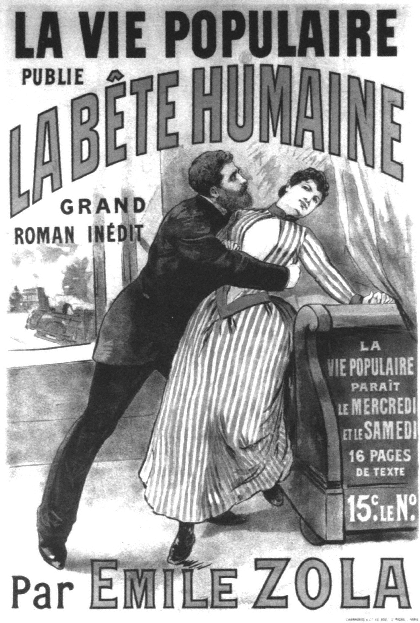
"The periodical press has been, as is its nature to be, only an instrument of disorder and sedition. . . . The press has thus disseminated disorder into the most upright minds, shaken the firmest convictions, and produced in the midst of society, a confusion of principles that yields to the most sinister attempts. Thus by anarchy of doctrines, it prepares anarchy in the state." – Report to the King, July 25, 1830, from Spectacular Realities : Early Mass Culture in Fin-de-siècle Paris by Vanessa Schwartz..
The story in Bel Ami is pretty simple. It is another story about a man rising to social success using the instruments of capitalism. This story, in an English novel, would be about the ‘natural’ rise of this man, through either a death (an inheritance) or sex (a marriage). In France, death and sex are wrenched from their natural poles – they are manipulated in one way or another. The English illusion that the peculiar stratifications of class respond to a natural order is, in France, a form of nostalgia for an époque when that was true. This is not to say that the rentier has no place in French literature. However, the great French novelists do not take a ceremonial authorial attitude towards the rentier, as the English novelists do. If I were to go about this in a Hegelian way, I’d probably posit Henry James’ work as the great synthesis of the two attitudes…
But I digress. In Bel Ami, an ex colonial soldier named Georges Duroy rises through the ranks of a newspaper, La Vie Francaise, on the way to becoming the tres rich husband of Suzanne Walter, the boss’ daughter. Duroy’s rise as a journalist is remarkable insofar as Maupassant portrays him as barely literate. But it turns out that, just as today, with its Novaks and Barnes and TV pundits, illiteracy is no bar to the ambitious man who doesn’t mind having his articles ghostwritten for him, and who realizes that the power of the pen is virtual – the menace disguised in the ability to disseminate “news,” - rather than actual, the virtuosity of the exercise. To the right character, a vista of profitable entries unscrolls before the rolling eye. That journalism is related, on the one side, to literature, and on the other side, to blackmail, has been abundantly revealed by the Plame scandal, even as it is unconsciously sensed by your average householder.
It isn’t only Duroy who uses his blackmailing propensities to get ahead: the owner of La Vie Francaise has set himself up in order to tout certain speculations and dowse others. The growth of news gathering around this central premise is a happy accident.
As the quote at the head of this post indicates, the very idea of a free press was a liberal idea in the nineteenth century. Bel-Ami was published in 1885, four years after the press laws were radically liberalized, allowing the “penny press.” The association between liberalism and the press was forged in the same process that brought about the extension of suffrage, the growth of unions, and the basic plan of what we’ve grown used to as the liberal state. This, of course, includes growth in the state’s military. Duroy’s original entry into LVF stems from his having served in Algeria. The imperialist effect appears at this moment, and not by some coincidence. Comically, the account of his adventures in Algeria is put together by Madame Forestier. After the party at which Duroy’sa stories about Algeria had attracted the attention of the proprietor of LVF, “M. Walter, Deputy, Financier, a man of money and affairs, a Jew from Southern France,” Duroy spends days trying to write an account of his experience – all in vain. He takes the task to be the same as the writing of an exposition in high school. It isn’t, of course. As Maupassant realized, the narrative of the news story calls upon the same narrative intelligence that flows into novels.
Duroy’s real talent is the manipulation of his dick. While Maupassant doesn’t go into the apocalyptic bedroom details, Duroy’s travels from the bed of one rich woman to another is carried on at the same time that he is wrestling with the finer points of journalistic ethics. Eventually, the two story lines converge in Duroy’s marriage to the attractive, mysterious Madam Forestier.
Monsieur Forestier is the editor of La Vie Francaise, and Duroy is inducted into the service of the newspaper by the whim of Forestier inviting him to the party at which he met the publisher. This is another modern note – for haven’t we seen editors and publishers lavish their care on some of the more dubious specimens of the newsgathering trade, recently? In Judy Miller’s case, there is even a slight scent of the boudoir that follows her from story to story – much as in the case of Duroy.
LI has, of course, been having some fun playing with parallels. But, more seriously, the existence of both the fictional LVF and the more factual NYT and WAPO both depends, essentially, on a particular act of consumption: being read. So if we take Singh, et al.’s nodes seriously, we should be looking at hierarchies of readership. Singh thinks of these as marketing relationships. I like the idea that these are reading constituencies. Still, what we have with the LVF, as with any newspaper, is:
1. The readership who subscribe to or buy the paper.
2. Institutional agencies that act as "guardians" of the marketplace, or censors.
3. Advertisers and others with financial stake in the paper.
4. And finally, the “noncommercial intermediaries that act as independent gatekeepers” – these are the readers of power, so to speak. The operate both as the subset of the readers (1) and as the readers to whom the papers producers go before the news appears. In terms of court societies, such as D.C., readers 4 become enmeshed in the news in a peculiar way, one which separates the image of the newspaper from its reality more and more as the newspaper becomes more and more powerful.
The ghost of these readers haunts every news story. One of the things Maupassant saw very well is that the act of writing is not, in the newspaper, independent of the readership constituencies. This is not the worry about whether a particular piece would sell or not. That worry is but one of a set. Right at the root of writing is a grand division of the seemingly indivisible writer – the text that eventually appears, with his byline, its production, its processing through the editorial system, its placement on the page, and the feedback it gets are all parts of a system that displaces the writer from the defining act – the writer is the one who writes – and turns it into another act – the writer is the one who ends up with the byline. This radically subverts the image of the writer as the hermit of the highest form of art. Maupassant knew all about that hermit – after all, he was related to Flaubert and an intimate of his circle.
That the news is, actually, an act of belief rather than of fact – “newness” being a judgment rather than an observation – disseminated by writers who aren’t writers makes the press a very strange locus of anxieties about what is and what isn’t authentic in liberal culture. Even odder, though, is the fact that freedom of the press, which emerges as part of the liberal program, so quickly develops tools that are seized by the right. In fact, the radical right in the twentieth century habitually used the media to achieve political goals, while the “liberal” media has been driven, in its quest for authenticity, to deny its essential liberalism.
Monday, January 30, 2006
Notes
At the moment, in the street outside my window actors are strolling around, clothed in what looks like some vintage 70s gear. The trucks showed up Saturday. The dressing truck, I suppose. A truck from which wires extend. A house up the street has black paper tacked up on the front, and cameras in the yard. In the back yard, this morning, there was a picnic atmosphere.
As far as I can tell, there are no name stars – although I might have just missed them or not recognized them in the cruel natural sunlight. Moviemaking seems to consist largely of people wandering up and down with cell phones held to their ears, making self conscious dialogue. The best thing I’ve heard so far was a young woman saying they have to be naked in this scene. Both of them.
I’m not sure what I dislike more: the businessman’s approach to cell phones, which is basically to carry on in public spaces by an astonishing immersion into the mechanics of private conversation – yelling, a lot of “fuck” this and that, and an imperious tone – or the actor’s more self-conscious use of the cell phone as a theatrical prop. I am pretty sure that the cell phone is not my kind of technological advance. In the old days, you could pretty much bet that a man yelling to himself in the street was off his med pac. Now, you can pretty much bet he has one of those hard to spot cell phone gadgets. The pod people aspect of wires coming out of people’s ears also rather scares me. But I am sure that these aren’t pod people…
I’m pretty sure…
If they were pod people, there’d be weird things happening in the land. Cities would flood, and nobody would respond, or they would respond like zombies after valium overdose. Nations would be invaded for reasons nobody could tell. Governments would unilaterally claim the right to eavesdrop on you, spy on your computer use, and pry into your correspondence. All of these would be symptoms of a pod person invasion, right?
Never happen.
…
Anyway, I asked a good looking blonde gaffer (I imagine she was a gaffer, which I’ve always thought was Hollywood for go-fer) what this movie was about. She told me it was about a man who is on the skids. Wow, and they are filming it in my neighborhood. Makes me feel very South Bronxish.
As far as I can tell, there are no name stars – although I might have just missed them or not recognized them in the cruel natural sunlight. Moviemaking seems to consist largely of people wandering up and down with cell phones held to their ears, making self conscious dialogue. The best thing I’ve heard so far was a young woman saying they have to be naked in this scene. Both of them.
I’m not sure what I dislike more: the businessman’s approach to cell phones, which is basically to carry on in public spaces by an astonishing immersion into the mechanics of private conversation – yelling, a lot of “fuck” this and that, and an imperious tone – or the actor’s more self-conscious use of the cell phone as a theatrical prop. I am pretty sure that the cell phone is not my kind of technological advance. In the old days, you could pretty much bet that a man yelling to himself in the street was off his med pac. Now, you can pretty much bet he has one of those hard to spot cell phone gadgets. The pod people aspect of wires coming out of people’s ears also rather scares me. But I am sure that these aren’t pod people…
I’m pretty sure…
If they were pod people, there’d be weird things happening in the land. Cities would flood, and nobody would respond, or they would respond like zombies after valium overdose. Nations would be invaded for reasons nobody could tell. Governments would unilaterally claim the right to eavesdrop on you, spy on your computer use, and pry into your correspondence. All of these would be symptoms of a pod person invasion, right?
Never happen.
…
Anyway, I asked a good looking blonde gaffer (I imagine she was a gaffer, which I’ve always thought was Hollywood for go-fer) what this movie was about. She told me it was about a man who is on the skids. Wow, and they are filming it in my neighborhood. Makes me feel very South Bronxish.
Sunday, January 29, 2006
more fun ...
I’m going to do something different …
I planned to pick through the recent controversies at the WAPO over the ombudsman’s remarks about Abramoff, and the response to those remarks by readers and blogs, and the rather astonishing response in turn by various WAPO appartchiks. But then I thought, that’s no fun.
The point is to try to get a half nelson on the growth of media criticism as a form of politics. LI wanted to use the article by Singh, et al, to complicate, complexify, lye and dye the matter of media, where at one time we made our bread and where, even now, we keep the sly hand in – today, for instance, we should have something in the Austin Statesman. Or is that going to be next week? And something in the Raleigh News and Observer.
But that seems all so boring. Instead, why not segregate out that stuff from Singh et al (and yes, we do like writing Singh et al – it’s a Here Comes Everybody moment) about the constituencies and then apply it to a paper we know more about than WAPO – La vie francaise, the fictional paper in Maupassant’s Bel-Ami. While Maupassant, who worked for Gil Blas and a number of papers, backed away from claiming that La vie francaise represented any particular paper – it was, instead, he wrote, an “agency for political cheats and stock market skimmers” – we think that the paper, with its portraits, its strong editorial positions creating the framework in which stories appear, its lazy, crooked, arrogant journalists paying off concierge to get tips about celebrities – we think that it is exactly the type of thing that is hidden under the ultramodern Teflon sheathing of contemporary journalism, with – in WAPO’s case – the role of Madame Forestier, the wife of the editor of the VF, being played by Sally Quinn, the wife of the former editor of WAPO, Ben Bradlee. And just as Madame Forestier is smart enough to ghostwrite the articles glorifying the French colonial effort, Quinn was smart enough and slimy enough to glorify Chalabi and thereby put him into play as our kind of crook, our kind of ruthless subaltern that would steal his nation blind and send the proceeds to the US, in the corridors of D.C. power.
Next post … or the next after that – will continue this theme.
I planned to pick through the recent controversies at the WAPO over the ombudsman’s remarks about Abramoff, and the response to those remarks by readers and blogs, and the rather astonishing response in turn by various WAPO appartchiks. But then I thought, that’s no fun.
The point is to try to get a half nelson on the growth of media criticism as a form of politics. LI wanted to use the article by Singh, et al, to complicate, complexify, lye and dye the matter of media, where at one time we made our bread and where, even now, we keep the sly hand in – today, for instance, we should have something in the Austin Statesman. Or is that going to be next week? And something in the Raleigh News and Observer.
But that seems all so boring. Instead, why not segregate out that stuff from Singh et al (and yes, we do like writing Singh et al – it’s a Here Comes Everybody moment) about the constituencies and then apply it to a paper we know more about than WAPO – La vie francaise, the fictional paper in Maupassant’s Bel-Ami. While Maupassant, who worked for Gil Blas and a number of papers, backed away from claiming that La vie francaise represented any particular paper – it was, instead, he wrote, an “agency for political cheats and stock market skimmers” – we think that the paper, with its portraits, its strong editorial positions creating the framework in which stories appear, its lazy, crooked, arrogant journalists paying off concierge to get tips about celebrities – we think that it is exactly the type of thing that is hidden under the ultramodern Teflon sheathing of contemporary journalism, with – in WAPO’s case – the role of Madame Forestier, the wife of the editor of the VF, being played by Sally Quinn, the wife of the former editor of WAPO, Ben Bradlee. And just as Madame Forestier is smart enough to ghostwrite the articles glorifying the French colonial effort, Quinn was smart enough and slimy enough to glorify Chalabi and thereby put him into play as our kind of crook, our kind of ruthless subaltern that would steal his nation blind and send the proceeds to the US, in the corridors of D.C. power.
Next post … or the next after that – will continue this theme.
Enron, the Washington Post, Oprah
“On August 27, 2002, the LAUSD board voted unanimously to ban the sale of soft drinks on its campuses, which included 677 schools with 748,000 students.” Which is the center of a case study on trust done by Jagdip Singh, Jean E. Kilgore, Rama Jayanti, Kokil Agarwal and Ramadesikan Gandarvakottai and published in the Journal of Public Policy and Marketing.
Actually, there are two case studies described in “What Goes Around Comes Around: Understanding Trust--Value Dilemmas of Market Relationships,” but the Coke case is more fascinating to me, simply because Coke’s struggle to retain its “pouring rights” in schools was a sorta typical 'we want to own your soul" corporate ploy. As the authors put it:
“Although Coke attracts a wide variety of consumer segments, our focus is the youth segment, especially school-going children. Children ages 5-14 spend $35 billion each year and influence the spending of approximately $200 billion annually (Harvey 2000; Rosenberg 2001). In an aggressive effort to reach school-going children, Coke entered into exclusive 5-10 year contracts that involved large, up-front, and distributed payments to school districts over the contract period. In return, the schools stocked their vending machines exclusively with the company's products and guaranteed exposure to the company's advertising in schools. Referred to as "pouring rights," these contracts include a comprehensive strategy to attract children with logos on school equipment, Channel One, and the Internet, as well as advertising, contests, free samples, and coupons (Nestle 2002, p. 202). As Coke's spokesperson noted, "Our strategy is to put soft drinks within arm's reach of desire and schools are one channel we want to make them available in" (Pear 1994, p. A15).”
In order that the arm’s reach of desire would be just in dollar distance of the third grade math class, Coke would grant school districts money – and in fact set up very cute programs to get the school districts (who were, in the nineties, busy putting up signs that read “drug free zone”) to actually push the stuff on the kiddies.
“A particularly troublesome aspect of pouring-rights contracts for parents and consumer advocates was the bonus incentives tied to soda sales (Kaufmann 2001). For example, Coke offered the schools a commission of 30% for each soft drink can sold compared with 15% for each noncarbonated drink sold (Day 2003). Higher commissions for soft drink sales coupled with bonus incentives for exceeding quotas resulted in many schools' initiating their own aggressive efforts to boost soft drink consumption on school premises. For example, in 1999, a widely publicized memo from a Colorado school administrator who signed himself "The Coke Dude" admonished the school district for not doing its fair share to attract more funds and offered prizes of $3,000, $15,000, and $25,000, respectively, to his elementary, middle, and high school principals. His memo read:
We must sell 70,000 cases of product … at least once during the first three years of the contract. If we reach this goal, your school allotments will be guaranteed for the next seven years…. If 35,439 staff and students buy one Coke product every other day for a school year, we will double the required quota. Here is how we can do it…. Allow students to purchase and consume vended products throughout the day…. I know this is "just one more thing from downtown," but the long-term benefits are worth it. (Bushey 1999, p. 1)”
Well, with Coke dudes in various districts, everything seemed to be working when the Gov'mint, and parents looking down at their children growing fat as pigs and insulin deficient, started coming around. What Singh, et al. were trying to trace is the network of trust nodes, as they call them, that activated as Coke was shoved out of the neighborhood of some lucrative little desiring units.
“… we approach a firm's diverse market relationships through a lens of simultaneity and interactivity. Specifically, we draw on the work of Drumwright (1996), Hutt, Mokwa, and Shapiro (1986), Menon and Menon (1997), and Wilkie and Moore (1999) and focus on four nodes of a firm's key market relationships: (1) consumers who are, have been, or will be end users and/or buyers of a firm's products/services; (2) regulatory and institutional agencies that are entrusted by society to act as "guardians" of the marketplace; (3) commercial intermediaries that participate in vertical arrangements with the firm to create time and place value for the latter's products/services; and (4) noncommercial intermediaries that act as independent gatekeepers and/or activists and thus influence access (e.g., parents of schoolchildren, media, scientific community) and/or provide value through information (e.g., consumerist agencies, activist organizations) to end users and buyers. A distinctive aspect of our study is that we extend previous research by examining explicitly how a firm's market relationships across the preceding four nodes intersect and interact.”
I like the authors’ model, even if it does lead to pretty complex mappings of the ‘diverse market relationships…” They trace the various factors that went into the LA school districts decision using the lens of trust, and in particular the way the sugar lobbyists and their allies in the food industry tried to filibuster legislation that would ban or regulate Coke and other sweets from being sold in schools. Coke, in 2001, began to realize it had a huge problem on its hands, and so was backpedaling from exclusive pouring rights contracts – but its bottlers were angry in turn, since they made a lot from those school venues in a market that had long reached saturation.
….
All of which brings us to the issue of media trust. LI has long maintained that the media fallout from the great media depression of 2001-2004 has concentrated way too much on a simple quantitative explanation: it was all an advertising shortfall, the result of the Net crash. We think that is bs. In fact, the pumping strategies that had fed the market in the late nineties was assiduously abetted by the media. I was looking back to newspaper and magazine articles about Enron, thinking of putting up a couple of where are they now posts for the likes of Rebecca Marks, and I was amazed, again, to be reminded about what was being published back in the nineties. For instance, I found something called Success Magazine – I haven’t checked to see if it is still around – and it published an article in Success magazine 1998 extolling “Visionaries. (profiles of five innovative business leaders) (includes related article on eight visionary entrepreneurs)” Of the five visionaries Stephen Rebello was awestruck by, one has now gone to jail and one, Bernie Ebbers, is almost certainly going to jail. And of course, where would visionaries be in the 90s without Ken Lay and Jeff S?
“Kenneth Lay CEO, Enron Corp. Houston, Tex. Number of employees: 14,000 worldwide Revenue: More than $13 billion yearly Lesson: One good idea can break the stranglehold of a monopoly
Most of us grew up with this impression: Flick on a light switch or fire up the furnace, and you're trafficking with a friendly monopoly -- the local utilities company, regulated by the fed. After all, what were our alternatives? A battery pack and a cache of firewood?
Kenneth Lay wanted to rearrange all that. In 1985 the former deputy undersecretary for energy of the U.S. Department of Interior helped forge Enron Corp. from two gas-pipeline firms. In short order, Lay pushed Enron to became something bigger -- a gas-marketing company that, by the '90s, was servicing Argentina, India, and the Philippines. With deregulation fervor brewing, Lay envisaged expanding to exploit an even bigger potential gold mine: freemarket electricity.
Open to competition the nation's $215 billion retail-electricity market? Sell electricity directly to homeowners, businesses, and industrial users? Sounds like a great idea -- unless, of course, you're a deeply entrenched utilities supplier.
"We simply made a commitment to providing consumer choice and competition for retail natural gas and electricity, much like what we've seen in the telecommunications industry," asserts Lay, who manages to sound like an underdog David tackling a monopolistic Goliath despite his power company's output's recently having jumped by 286 percent in one quarter alone.
What took him, md others, so long? "The electricity utilities, which, by the nature of their business, are very skilled at working the political regulatory process," he fires back, like a born zealot. "Few of the larger electricity facilities are pushing for consumer choice and competition."
Okay, so the gloves are off for a fight to die finish, but once the dust settles, how will die services provided by Lay and other free-market suppliers be any different?
The differences between a market and a monopoly will finally mean innovation," he explains, with contagious enthusiasm. "Consumers are going to save $60 million to $80 billion a year, more than $200 million a day. We won't use antiquated analog meters, and there'll be no more guys jumping over fences and fighting dogs to read meters. Digital meters and instantaneous readings will mean that consumers can start making choices as to when to turn on the washing machine or die dishwasher, taking advantage of lower rates that can save them 40, 50 percent."
I’m sure the people of California appreciated that.
But it wasn’t just fly by nights like Success. Fortune, in 1996, published perhaps one of the unintentionally funniest tongue baths of all Lay’s pleasure centers. It begins with that hoary but always good profile grabber, the CRISIS. In this one, our intrepid Lay is on the ski slopes when disaster seems to threaten:
“Kenneth Lay skied down Ajax Mountain in Aspen, Colorado, on a cold dark afternoon last December, blissfully unaware that the stock of his Houston-based energy conglomerate was taking an even steeper plunge. The Enron chairman returned to his vacation home on Roaring Fork River to find an urgent message from President and Chief Operating Officer Richard Kinder: "We've got a major problem, and we've got to talk."
That afternoon, Enron's stock had lost 2 7/8 points, or roughly $750 million in market capital, amid rumors that the company's natural gas marketing arm, Enron Capital & Trade Resources, was shorting the market even as the January futures contracts expired and a pre-Christmas cold snap was sending prices up the chimney. The crisis of confidence was compounded by rumors that Jeffrey Skilling, the 42-year-old wunderkind chairman of Enron Capital & Trade, had been led off the company trading floor in handcuffs.”
Imagine that. And of course the crisis, here, is all about stock prices. Which it might have behoved the author of the article to ponder.
These and a zillion other articles not only got things wrong – they actually got in the way of getting things right. They obstructed rationality and made skepticism into a “contrarian” stance – when of course skepticism is just the way one should approach a narrative involving a lot of money and people with an interest in skewing your perception of the narrative in a certain way.
The business press articles percolated through the four nodes of Singh, et al.'s article in peculiar and depressing ways…
About which, more tomorrow.
Actually, there are two case studies described in “What Goes Around Comes Around: Understanding Trust--Value Dilemmas of Market Relationships,” but the Coke case is more fascinating to me, simply because Coke’s struggle to retain its “pouring rights” in schools was a sorta typical 'we want to own your soul" corporate ploy. As the authors put it:
“Although Coke attracts a wide variety of consumer segments, our focus is the youth segment, especially school-going children. Children ages 5-14 spend $35 billion each year and influence the spending of approximately $200 billion annually (Harvey 2000; Rosenberg 2001). In an aggressive effort to reach school-going children, Coke entered into exclusive 5-10 year contracts that involved large, up-front, and distributed payments to school districts over the contract period. In return, the schools stocked their vending machines exclusively with the company's products and guaranteed exposure to the company's advertising in schools. Referred to as "pouring rights," these contracts include a comprehensive strategy to attract children with logos on school equipment, Channel One, and the Internet, as well as advertising, contests, free samples, and coupons (Nestle 2002, p. 202). As Coke's spokesperson noted, "Our strategy is to put soft drinks within arm's reach of desire and schools are one channel we want to make them available in" (Pear 1994, p. A15).”
In order that the arm’s reach of desire would be just in dollar distance of the third grade math class, Coke would grant school districts money – and in fact set up very cute programs to get the school districts (who were, in the nineties, busy putting up signs that read “drug free zone”) to actually push the stuff on the kiddies.
“A particularly troublesome aspect of pouring-rights contracts for parents and consumer advocates was the bonus incentives tied to soda sales (Kaufmann 2001). For example, Coke offered the schools a commission of 30% for each soft drink can sold compared with 15% for each noncarbonated drink sold (Day 2003). Higher commissions for soft drink sales coupled with bonus incentives for exceeding quotas resulted in many schools' initiating their own aggressive efforts to boost soft drink consumption on school premises. For example, in 1999, a widely publicized memo from a Colorado school administrator who signed himself "The Coke Dude" admonished the school district for not doing its fair share to attract more funds and offered prizes of $3,000, $15,000, and $25,000, respectively, to his elementary, middle, and high school principals. His memo read:
We must sell 70,000 cases of product … at least once during the first three years of the contract. If we reach this goal, your school allotments will be guaranteed for the next seven years…. If 35,439 staff and students buy one Coke product every other day for a school year, we will double the required quota. Here is how we can do it…. Allow students to purchase and consume vended products throughout the day…. I know this is "just one more thing from downtown," but the long-term benefits are worth it. (Bushey 1999, p. 1)”
Well, with Coke dudes in various districts, everything seemed to be working when the Gov'mint, and parents looking down at their children growing fat as pigs and insulin deficient, started coming around. What Singh, et al. were trying to trace is the network of trust nodes, as they call them, that activated as Coke was shoved out of the neighborhood of some lucrative little desiring units.
“… we approach a firm's diverse market relationships through a lens of simultaneity and interactivity. Specifically, we draw on the work of Drumwright (1996), Hutt, Mokwa, and Shapiro (1986), Menon and Menon (1997), and Wilkie and Moore (1999) and focus on four nodes of a firm's key market relationships: (1) consumers who are, have been, or will be end users and/or buyers of a firm's products/services; (2) regulatory and institutional agencies that are entrusted by society to act as "guardians" of the marketplace; (3) commercial intermediaries that participate in vertical arrangements with the firm to create time and place value for the latter's products/services; and (4) noncommercial intermediaries that act as independent gatekeepers and/or activists and thus influence access (e.g., parents of schoolchildren, media, scientific community) and/or provide value through information (e.g., consumerist agencies, activist organizations) to end users and buyers. A distinctive aspect of our study is that we extend previous research by examining explicitly how a firm's market relationships across the preceding four nodes intersect and interact.”
I like the authors’ model, even if it does lead to pretty complex mappings of the ‘diverse market relationships…” They trace the various factors that went into the LA school districts decision using the lens of trust, and in particular the way the sugar lobbyists and their allies in the food industry tried to filibuster legislation that would ban or regulate Coke and other sweets from being sold in schools. Coke, in 2001, began to realize it had a huge problem on its hands, and so was backpedaling from exclusive pouring rights contracts – but its bottlers were angry in turn, since they made a lot from those school venues in a market that had long reached saturation.
….
All of which brings us to the issue of media trust. LI has long maintained that the media fallout from the great media depression of 2001-2004 has concentrated way too much on a simple quantitative explanation: it was all an advertising shortfall, the result of the Net crash. We think that is bs. In fact, the pumping strategies that had fed the market in the late nineties was assiduously abetted by the media. I was looking back to newspaper and magazine articles about Enron, thinking of putting up a couple of where are they now posts for the likes of Rebecca Marks, and I was amazed, again, to be reminded about what was being published back in the nineties. For instance, I found something called Success Magazine – I haven’t checked to see if it is still around – and it published an article in Success magazine 1998 extolling “Visionaries. (profiles of five innovative business leaders) (includes related article on eight visionary entrepreneurs)” Of the five visionaries Stephen Rebello was awestruck by, one has now gone to jail and one, Bernie Ebbers, is almost certainly going to jail. And of course, where would visionaries be in the 90s without Ken Lay and Jeff S?
“Kenneth Lay CEO, Enron Corp. Houston, Tex. Number of employees: 14,000 worldwide Revenue: More than $13 billion yearly Lesson: One good idea can break the stranglehold of a monopoly
Most of us grew up with this impression: Flick on a light switch or fire up the furnace, and you're trafficking with a friendly monopoly -- the local utilities company, regulated by the fed. After all, what were our alternatives? A battery pack and a cache of firewood?
Kenneth Lay wanted to rearrange all that. In 1985 the former deputy undersecretary for energy of the U.S. Department of Interior helped forge Enron Corp. from two gas-pipeline firms. In short order, Lay pushed Enron to became something bigger -- a gas-marketing company that, by the '90s, was servicing Argentina, India, and the Philippines. With deregulation fervor brewing, Lay envisaged expanding to exploit an even bigger potential gold mine: freemarket electricity.
Open to competition the nation's $215 billion retail-electricity market? Sell electricity directly to homeowners, businesses, and industrial users? Sounds like a great idea -- unless, of course, you're a deeply entrenched utilities supplier.
"We simply made a commitment to providing consumer choice and competition for retail natural gas and electricity, much like what we've seen in the telecommunications industry," asserts Lay, who manages to sound like an underdog David tackling a monopolistic Goliath despite his power company's output's recently having jumped by 286 percent in one quarter alone.
What took him, md others, so long? "The electricity utilities, which, by the nature of their business, are very skilled at working the political regulatory process," he fires back, like a born zealot. "Few of the larger electricity facilities are pushing for consumer choice and competition."
Okay, so the gloves are off for a fight to die finish, but once the dust settles, how will die services provided by Lay and other free-market suppliers be any different?
The differences between a market and a monopoly will finally mean innovation," he explains, with contagious enthusiasm. "Consumers are going to save $60 million to $80 billion a year, more than $200 million a day. We won't use antiquated analog meters, and there'll be no more guys jumping over fences and fighting dogs to read meters. Digital meters and instantaneous readings will mean that consumers can start making choices as to when to turn on the washing machine or die dishwasher, taking advantage of lower rates that can save them 40, 50 percent."
I’m sure the people of California appreciated that.
But it wasn’t just fly by nights like Success. Fortune, in 1996, published perhaps one of the unintentionally funniest tongue baths of all Lay’s pleasure centers. It begins with that hoary but always good profile grabber, the CRISIS. In this one, our intrepid Lay is on the ski slopes when disaster seems to threaten:
“Kenneth Lay skied down Ajax Mountain in Aspen, Colorado, on a cold dark afternoon last December, blissfully unaware that the stock of his Houston-based energy conglomerate was taking an even steeper plunge. The Enron chairman returned to his vacation home on Roaring Fork River to find an urgent message from President and Chief Operating Officer Richard Kinder: "We've got a major problem, and we've got to talk."
That afternoon, Enron's stock had lost 2 7/8 points, or roughly $750 million in market capital, amid rumors that the company's natural gas marketing arm, Enron Capital & Trade Resources, was shorting the market even as the January futures contracts expired and a pre-Christmas cold snap was sending prices up the chimney. The crisis of confidence was compounded by rumors that Jeffrey Skilling, the 42-year-old wunderkind chairman of Enron Capital & Trade, had been led off the company trading floor in handcuffs.”
Imagine that. And of course the crisis, here, is all about stock prices. Which it might have behoved the author of the article to ponder.
These and a zillion other articles not only got things wrong – they actually got in the way of getting things right. They obstructed rationality and made skepticism into a “contrarian” stance – when of course skepticism is just the way one should approach a narrative involving a lot of money and people with an interest in skewing your perception of the narrative in a certain way.
The business press articles percolated through the four nodes of Singh, et al.'s article in peculiar and depressing ways…
About which, more tomorrow.
Friday, January 27, 2006
the pre-game report
On the eve of the Enron trial, LI watched the Smartest Guys in the Room yesterday. And we scanned the Economist tout sheet of the prosecuted and the let off. Of course, as we know, corporate law is designed, basically, to allow the governing class to rob people without the expense and fuss that comes from having to buy pistols and wave them in various strangers faces. That the prosecution has to prove an epistemological point to the jury – viz, that Skilling and Lay knew they were committing a crime by signing off on various deals to conceal Enron’s debt while pumping its stock, thus making it a crime – is funny in itself, like one of Zeno’s paradoxes – how can you prove someone knowingly committed a crime when the crime depends on knowingly committing it?
If I decide to knock somebody down, steal their credit cards, and use them, the police don’t have to bother convincing the jury that I knew I was committing a crime. But the more money one has, the more murky the line between the criminal and the legal becomes. Law is where class issues can no longer be latent. If they could, the governing class would simply have two sets of laws, one for them and one for the rest of us. That has practically been achieved by Congress and your state legislature, anyway, but they put both those laws together in one lawbook.
Of course, far be it from LI to discourage entrepreneurship. We surely don’t want to do that.
In LI’s opinion, Lay’s defense, here, should be watched carefully by the employee and investors he ripped off, since the defense is basically that he collected his total what, 400 million from his time at the company by doing one of the most pisspoor jobs ever concocted by a timeserving CEO supermensch. Useful info to have at the civil trial – although it is funny, corporate shills complain all of the time of useless due diligence laws and corporate greenmail by greedy lawyers, but outrageous fraud never seems to fall under these laws.
This, of course, was one of the things Enron, the movie, chose not to concentrate on, which is too bad, although understandable. They made the decision to be serious and not to juice up their account with the effects of unearned wealth on Enron’s bright lights. But … iIt wasn’t that the sex and money story line was peripheral to what happened at Enron – it was central. Rich Kinder, whose resignation moved Skilling into the top spot at Enron, resigned because he was having an affair with Ken Lay’s secretary – and Lay didn’t like it, although of course his second wife was his previous secretary, with whom he’d had an affair until he divorced his first and married her. They actually interviewed Amanda Martin for much of the Smartest Guys in the Room without ever explaining that she had a pretty well publicized affair with Ken Rice, one of the great looters at Enron – a dealmaker whose time as the head of the Enron Broadband division was one of the great jokes of the company. He spent more time, by all accounts, worrying about getting ever new motorcycles on Enron expense accounts “for” the division than he did about anything so mundane as the business itself, and what did he carry away from those grueling, three hour days? 53 million, more or less. It is very hard making decisions about which motorcycle your divison will use as its motorcycle symbol, as we all know. That is why we have to pay our upper management so well. They are so, well, smart.
Skilling actually is going to face the hottest time about the Broadband scam, which was a more than usually egregious goldbricking effort – a scheme that depended the synergy between Enron’s pipes and optical fiber, don’tcha know, and how all those easements and that infrastructure put Enron in the primo position to wire every household in America and pump in the videos.
And we are also all going to OZ on my balloon…
According to Elkind and Bethany McClean's must-read (if you care about Enron, you have to accept that tired cliché in the case of two reporters who became central to the Enron unwinding) in this week’s Fortune, Rice and Causey are going to lighten the prosecutorial task as they have made deals to keep them from spening too much time away from the various millions that were left over from the fines. In the case of white collar law, unlike, say, bank robbery, you get to keep a considerable portion of your loot. We will see, although the preliminaries don't look good -- the government should combat completely the idea that this case is too complicated. Any housewife or bowling alley attendent knows how earmarked money works. The prosecutors should look to seed the jury with the divorced, because what Enron did is, on a grand scale, what many a husband seeks to do in divorce cases -- hide assets. In this case, negative assets. Lay, unlike HealthSouth’s Scrushy, is not a personable man – he is an arrogant prick, and is seemingly even unaware that he is an arrogant prick. He is the same man who used the Enron corporate jet to shuttle his kids to the French Riviera like it was a taxi-cab, all of course on the company ticket. Well, you have to do things like that, as any economist can tell you, to align the interests of the truly brilliant management with the company. Economists in the middle ages made the same kind of arguments for droit de seigneur. Economists exist to excuse the inexcusable – theologians of the pathomarkets.
ps – there are couple of warnings to take to Smartest Guys in the Room One is that there is a gaping hole in the political story told in the movie. The hole is the hand in glove relationship of Enron and the Clinton administration. The Hollywood affection for the Elvis president makes this kind of thing, apparently, hard to see. Simply put, the waiver by Wendy Gramm that allowed Enron to operate in the energy market largely without regulation was continued in the Clinton years even as it became obvious that that Enron was operating as a bank. The India deal became an issue between the U.S and India, as Clinton’s Commerce department, under Ron Brown, put pressure on India to cooperate with Enron, even as it became apparent that Enron had built the equivalent, in energy terms, of the Spruce Goose in India. The neo-liberals at Treasury and Commerce made it very hard for Latin American governments to resist privatizing water, for instance, which was another large Enron project – under Rebecca Mark, Enron ended up owning Buenos Aires Water. And to treat Gray Davis as the martyr of the brownouts is to understand nothing of the (legally) peculating Dem administration which put through the deregulatory program. Alas, in a discourse in which the only sides allowable are Clinton and Bush, how a company like Enron operates is essentially hidden. Maybe that is the reason for the pseudo-division? That energy should have been privatized in the first place, or deregulated, was unquestioned, even though the reasons for it were clearly either untrue or unproven. Almost all energy deregulation feathered in large, sometimes absurdly large, provisions for energy companies that had crippled themselves building unnecessary, expensive nuclear power plants – another boondoggle that went by the name of synergy and that energy execs love to foist off on gullible populations, and not only Iranian ones.
The second is more puzzling. While the film explains mark to market accounting, it doesn't really explain why it didn't work at Enron. While it is true that the way Enron used it was not good, mark to market accounting does have some good effects in theory -- for instance, it smooths out turbulence markets in goods, like natural gas, in which turbulence can act as a bar to use. The problems that can come with mark to market accounting -- massaging the numbers -- were aggravated not by the accounting itself, but by the parallel set up of the "incentive" structure. Dealers at Enron gained bonuses not on real profits, but on book profits. Enron basically screwed itself out of the advantage it could take from mark to market accounting by distributing benefits, asymmetrically, to the management. This is why Rebecca Mark, who, conservatively, cost the company 1 to 2 billion dollars with the massive losses in India and from the water purchases, could cash out with 84 million dollars, and Ken Rice could run the broadband division, that lost 30 million, and gain options worth 30 million. In essence, the company set up an incentive structure in which the incentive was to cheat the company.
And of course the dealers proceeded to bleed Enron. Something like 1.3 billion was taken out of it by execs in the last two or three years, according to Robert Bryce.
If I decide to knock somebody down, steal their credit cards, and use them, the police don’t have to bother convincing the jury that I knew I was committing a crime. But the more money one has, the more murky the line between the criminal and the legal becomes. Law is where class issues can no longer be latent. If they could, the governing class would simply have two sets of laws, one for them and one for the rest of us. That has practically been achieved by Congress and your state legislature, anyway, but they put both those laws together in one lawbook.
Of course, far be it from LI to discourage entrepreneurship. We surely don’t want to do that.
In LI’s opinion, Lay’s defense, here, should be watched carefully by the employee and investors he ripped off, since the defense is basically that he collected his total what, 400 million from his time at the company by doing one of the most pisspoor jobs ever concocted by a timeserving CEO supermensch. Useful info to have at the civil trial – although it is funny, corporate shills complain all of the time of useless due diligence laws and corporate greenmail by greedy lawyers, but outrageous fraud never seems to fall under these laws.
This, of course, was one of the things Enron, the movie, chose not to concentrate on, which is too bad, although understandable. They made the decision to be serious and not to juice up their account with the effects of unearned wealth on Enron’s bright lights. But … iIt wasn’t that the sex and money story line was peripheral to what happened at Enron – it was central. Rich Kinder, whose resignation moved Skilling into the top spot at Enron, resigned because he was having an affair with Ken Lay’s secretary – and Lay didn’t like it, although of course his second wife was his previous secretary, with whom he’d had an affair until he divorced his first and married her. They actually interviewed Amanda Martin for much of the Smartest Guys in the Room without ever explaining that she had a pretty well publicized affair with Ken Rice, one of the great looters at Enron – a dealmaker whose time as the head of the Enron Broadband division was one of the great jokes of the company. He spent more time, by all accounts, worrying about getting ever new motorcycles on Enron expense accounts “for” the division than he did about anything so mundane as the business itself, and what did he carry away from those grueling, three hour days? 53 million, more or less. It is very hard making decisions about which motorcycle your divison will use as its motorcycle symbol, as we all know. That is why we have to pay our upper management so well. They are so, well, smart.
Skilling actually is going to face the hottest time about the Broadband scam, which was a more than usually egregious goldbricking effort – a scheme that depended the synergy between Enron’s pipes and optical fiber, don’tcha know, and how all those easements and that infrastructure put Enron in the primo position to wire every household in America and pump in the videos.
And we are also all going to OZ on my balloon…
According to Elkind and Bethany McClean's must-read (if you care about Enron, you have to accept that tired cliché in the case of two reporters who became central to the Enron unwinding) in this week’s Fortune, Rice and Causey are going to lighten the prosecutorial task as they have made deals to keep them from spening too much time away from the various millions that were left over from the fines. In the case of white collar law, unlike, say, bank robbery, you get to keep a considerable portion of your loot. We will see, although the preliminaries don't look good -- the government should combat completely the idea that this case is too complicated. Any housewife or bowling alley attendent knows how earmarked money works. The prosecutors should look to seed the jury with the divorced, because what Enron did is, on a grand scale, what many a husband seeks to do in divorce cases -- hide assets. In this case, negative assets. Lay, unlike HealthSouth’s Scrushy, is not a personable man – he is an arrogant prick, and is seemingly even unaware that he is an arrogant prick. He is the same man who used the Enron corporate jet to shuttle his kids to the French Riviera like it was a taxi-cab, all of course on the company ticket. Well, you have to do things like that, as any economist can tell you, to align the interests of the truly brilliant management with the company. Economists in the middle ages made the same kind of arguments for droit de seigneur. Economists exist to excuse the inexcusable – theologians of the pathomarkets.
ps – there are couple of warnings to take to Smartest Guys in the Room One is that there is a gaping hole in the political story told in the movie. The hole is the hand in glove relationship of Enron and the Clinton administration. The Hollywood affection for the Elvis president makes this kind of thing, apparently, hard to see. Simply put, the waiver by Wendy Gramm that allowed Enron to operate in the energy market largely without regulation was continued in the Clinton years even as it became obvious that that Enron was operating as a bank. The India deal became an issue between the U.S and India, as Clinton’s Commerce department, under Ron Brown, put pressure on India to cooperate with Enron, even as it became apparent that Enron had built the equivalent, in energy terms, of the Spruce Goose in India. The neo-liberals at Treasury and Commerce made it very hard for Latin American governments to resist privatizing water, for instance, which was another large Enron project – under Rebecca Mark, Enron ended up owning Buenos Aires Water. And to treat Gray Davis as the martyr of the brownouts is to understand nothing of the (legally) peculating Dem administration which put through the deregulatory program. Alas, in a discourse in which the only sides allowable are Clinton and Bush, how a company like Enron operates is essentially hidden. Maybe that is the reason for the pseudo-division? That energy should have been privatized in the first place, or deregulated, was unquestioned, even though the reasons for it were clearly either untrue or unproven. Almost all energy deregulation feathered in large, sometimes absurdly large, provisions for energy companies that had crippled themselves building unnecessary, expensive nuclear power plants – another boondoggle that went by the name of synergy and that energy execs love to foist off on gullible populations, and not only Iranian ones.
The second is more puzzling. While the film explains mark to market accounting, it doesn't really explain why it didn't work at Enron. While it is true that the way Enron used it was not good, mark to market accounting does have some good effects in theory -- for instance, it smooths out turbulence markets in goods, like natural gas, in which turbulence can act as a bar to use. The problems that can come with mark to market accounting -- massaging the numbers -- were aggravated not by the accounting itself, but by the parallel set up of the "incentive" structure. Dealers at Enron gained bonuses not on real profits, but on book profits. Enron basically screwed itself out of the advantage it could take from mark to market accounting by distributing benefits, asymmetrically, to the management. This is why Rebecca Mark, who, conservatively, cost the company 1 to 2 billion dollars with the massive losses in India and from the water purchases, could cash out with 84 million dollars, and Ken Rice could run the broadband division, that lost 30 million, and gain options worth 30 million. In essence, the company set up an incentive structure in which the incentive was to cheat the company.
And of course the dealers proceeded to bleed Enron. Something like 1.3 billion was taken out of it by execs in the last two or three years, according to Robert Bryce.
Continuing from yesterday…
Wilson finds few direct criticisms of road building. But she does find one, and she contrasts it with the standard argument:
“Few outright critiques of road building can be found. One that stands out
is Fairhead’s (1992) analysis of the destructive effects of road-building in Eastern Zaire. There, he argues, roads represent ‘paths of authority’ and need to be understood as qualitatively different from the flow of goods and people that take place along local pathways. ‘From colonial times, roads were associated with the exercise of power by the state or the chiefs; forced labour was recruited to build them, personal movement along them was taxed and controlled and indigenous land near them was expropriated for plantations and mission stations’ (Fairhead, 1992: 21). In the current phase of roadbuilding financed by the World Bank, relations of power and violence have not changed; indeed, Fairhead claims, roads have further depleted and impoverished a region already suffering acute economic decline. This argument drawing on political economy has strong resonance in the Andes. But more common in the literature are analyses drawing an opposite conclusion. Porter (2002), in a study of off-road villages in sub-
Saharan Africa, emphasizes the human costs of isolation and difficulties faced by women and men who live ‘in a walking world’, unable to access services available at rural centres or make their voices heard in local politics. And at a regional level, as Bebbington (1999: 2022) notes, when seeking to account for instances of agricultural intensification and other forms of livelihood transition, ‘access becomes perhaps the most critical resource of all if people are to build sustainable, poverty alleviating rural livelihoods’.
Clearly, when rural producers must compete in domestic and export markets they are penalized when transport costs are excessively high.”
In these cases, the question of the penetrative power of the road, and who benefits from the “opening up” of territory performed by the road, doesn’t really distinguish road types from one another. They flow from some central, translocal authority, and are considered from the point of view of that authority. But there is another way in which roads operate as tools to close off territory. In Austin, you see this in the way a interstate highway, I-35, provides a barrier between East Austin – dangerous, black and Hispanic – and central and west Austin – which, since the African-American neighborhood in Tarrytown was pretty much liquidated in the sixties, is generally white and middle to upper class. This kind of barrier is made possible by the relative lack of transportation on the east side – the lesser number of motor vehicle owners, the greater number of bus riders, etc.
But Wilson is more concerned with what you might call the functional economy of roads – what not having and having roads can mean to a community. The community she studied, in Peru, from 1994 onwards, is a sad case of road lucklessness. In the eighties, as she gathered from memories of people in the hamlet of Cayesh, the world was defined like this:
“No roads connect the hamlets to the world outside; cayashinos must walk some 50km to 60 km south to reach the paved road to Tarma, or 25 km to 30 km north to reach a dirt road leading up the Ulcumayo valley to the high mining centres.”
The six hundred some inhabitants used pack animals to take their produce to Tarma. But the more well to do also began to desire schooling for their kids, and – operating just as a liberal like me would hope that they would operate – they took their kids to Tarma, too, to be educated. The road to Tarma had opened up the place to the world.
But that doesn’t mean that the world was kind. The Cayashinos were considered second rate, savage Indians. They learned enough to know what this meant. And they learned about resistance. They came back and formed the support groups around which Sendero Luminoso centered.
“Following the invasion of some 200 militants, municipal and community authorities were disbanded, the population prohibited from moving without authorization, and documents of identification confiscated. Several comuneros were killed and the few families who managed to slip away forfeited their lands, livestock and household goods that were distributed amongst the poor. Militants took over as authorities and organized frequent political meetings where they preached that the aristocratic state had deliberately neglected to attend to community needs; the state had treated them with disdain and transformed them into las comunidades mas olvidadas (‘the most forgotten communities’).”
After a year, disaster struck, in the form of an army attack that scattered the Cayeshinos, many of whom emigrated to the city. And it wasn’t until the mid nineties that the hamlet’s population started coming back. They came back to find that most of their land had been claimed by another hamlet. They came back to a shattered system of exchanges. And again, in response to this, they did something hearteningly liberal – they decided they really needed a road.
After five years of intense campaigning, a road plan for Cayash was approved in 1998 by the Ministry of Transport in Lima and a three year construction programme began. The state undertook to contribute technical assistance and heavy machinery while local government provided fuel and Cayash unskilled labour. The project document’s preamble made the political orientation clear. The road would: (i) allow the substitution of traditional systems by new modern techniques of cultivation and livestock raising;
(ii) provide access to credit; (iii) allow greater control by entities of the state; (iv) offer capitalists access to known reserves ofmineral wealth; (v) facilitate an intensive training of peasant producers; (vi) allow an increase in productive infrastructure; and (vii) make possible the establishing of a new socioeconomic structure in the region. What is presented here is a familiar picture of colonization directed from outside, a vision far removed from the social justice and recuperation that the struggling Cayash authorities had in mind. By 2001, with 15 kmof the 50 kmcompleted, the road works stopped. Funds had run out, charges of embezzlement circulated and following the ignominious fall of
Fujimori, the Ministry of Transport refused to be bound by any moral obligation
to finish what the earlier corrupt administration had started.”
This is not a happy story on any level. Theoretically, the road that was supposed to make the territory legible to the state, that was supposed to give control, even oppressive control, to the combination of corporate and political interests, had gone so haywire that Wilson ends her study with this graf:
“One might have assumed that the end of violent conflict would have been marked by a greater presence of state forces of law and order, and a more concerted attempt by the central state to make Andean provinces legible by road-building, but this does not seem to be happening. In the case of Tarma, although the intelligence service survives, police presence has been greatly reduced. Here on the eastern slopes of the Andes, adjacent to the blurred borderlands of the lowland zone, state authority is still under dispute, and
roads are no potent symbols of state-ness. On the contrary, roads are known places of ambush and assault, frequented by delinquents, terrorists, smugglers, drug-dealers; they are the place where deals are done with bad cops. Roads on the fringes of the state are themselves war-zones, a reminder of the fragility of sovereignty and emptiness of the central state’s claim to territoriality. In Peru, the ‘security’ of marginal regions seen from a national perspective remains in doubt; so does the future response of the state.”
The road, here, is Artaud’s alchemical theater, where trade is transfigured into the vehicle of the plague, and where the basic sign of control is really the scene of multiple and shifting anarchies. Not the path of authority after all.
Wilson finds few direct criticisms of road building. But she does find one, and she contrasts it with the standard argument:
“Few outright critiques of road building can be found. One that stands out
is Fairhead’s (1992) analysis of the destructive effects of road-building in Eastern Zaire. There, he argues, roads represent ‘paths of authority’ and need to be understood as qualitatively different from the flow of goods and people that take place along local pathways. ‘From colonial times, roads were associated with the exercise of power by the state or the chiefs; forced labour was recruited to build them, personal movement along them was taxed and controlled and indigenous land near them was expropriated for plantations and mission stations’ (Fairhead, 1992: 21). In the current phase of roadbuilding financed by the World Bank, relations of power and violence have not changed; indeed, Fairhead claims, roads have further depleted and impoverished a region already suffering acute economic decline. This argument drawing on political economy has strong resonance in the Andes. But more common in the literature are analyses drawing an opposite conclusion. Porter (2002), in a study of off-road villages in sub-
Saharan Africa, emphasizes the human costs of isolation and difficulties faced by women and men who live ‘in a walking world’, unable to access services available at rural centres or make their voices heard in local politics. And at a regional level, as Bebbington (1999: 2022) notes, when seeking to account for instances of agricultural intensification and other forms of livelihood transition, ‘access becomes perhaps the most critical resource of all if people are to build sustainable, poverty alleviating rural livelihoods’.
Clearly, when rural producers must compete in domestic and export markets they are penalized when transport costs are excessively high.”
In these cases, the question of the penetrative power of the road, and who benefits from the “opening up” of territory performed by the road, doesn’t really distinguish road types from one another. They flow from some central, translocal authority, and are considered from the point of view of that authority. But there is another way in which roads operate as tools to close off territory. In Austin, you see this in the way a interstate highway, I-35, provides a barrier between East Austin – dangerous, black and Hispanic – and central and west Austin – which, since the African-American neighborhood in Tarrytown was pretty much liquidated in the sixties, is generally white and middle to upper class. This kind of barrier is made possible by the relative lack of transportation on the east side – the lesser number of motor vehicle owners, the greater number of bus riders, etc.
But Wilson is more concerned with what you might call the functional economy of roads – what not having and having roads can mean to a community. The community she studied, in Peru, from 1994 onwards, is a sad case of road lucklessness. In the eighties, as she gathered from memories of people in the hamlet of Cayesh, the world was defined like this:
“No roads connect the hamlets to the world outside; cayashinos must walk some 50km to 60 km south to reach the paved road to Tarma, or 25 km to 30 km north to reach a dirt road leading up the Ulcumayo valley to the high mining centres.”
The six hundred some inhabitants used pack animals to take their produce to Tarma. But the more well to do also began to desire schooling for their kids, and – operating just as a liberal like me would hope that they would operate – they took their kids to Tarma, too, to be educated. The road to Tarma had opened up the place to the world.
But that doesn’t mean that the world was kind. The Cayashinos were considered second rate, savage Indians. They learned enough to know what this meant. And they learned about resistance. They came back and formed the support groups around which Sendero Luminoso centered.
“Following the invasion of some 200 militants, municipal and community authorities were disbanded, the population prohibited from moving without authorization, and documents of identification confiscated. Several comuneros were killed and the few families who managed to slip away forfeited their lands, livestock and household goods that were distributed amongst the poor. Militants took over as authorities and organized frequent political meetings where they preached that the aristocratic state had deliberately neglected to attend to community needs; the state had treated them with disdain and transformed them into las comunidades mas olvidadas (‘the most forgotten communities’).”
After a year, disaster struck, in the form of an army attack that scattered the Cayeshinos, many of whom emigrated to the city. And it wasn’t until the mid nineties that the hamlet’s population started coming back. They came back to find that most of their land had been claimed by another hamlet. They came back to a shattered system of exchanges. And again, in response to this, they did something hearteningly liberal – they decided they really needed a road.
After five years of intense campaigning, a road plan for Cayash was approved in 1998 by the Ministry of Transport in Lima and a three year construction programme began. The state undertook to contribute technical assistance and heavy machinery while local government provided fuel and Cayash unskilled labour. The project document’s preamble made the political orientation clear. The road would: (i) allow the substitution of traditional systems by new modern techniques of cultivation and livestock raising;
(ii) provide access to credit; (iii) allow greater control by entities of the state; (iv) offer capitalists access to known reserves ofmineral wealth; (v) facilitate an intensive training of peasant producers; (vi) allow an increase in productive infrastructure; and (vii) make possible the establishing of a new socioeconomic structure in the region. What is presented here is a familiar picture of colonization directed from outside, a vision far removed from the social justice and recuperation that the struggling Cayash authorities had in mind. By 2001, with 15 kmof the 50 kmcompleted, the road works stopped. Funds had run out, charges of embezzlement circulated and following the ignominious fall of
Fujimori, the Ministry of Transport refused to be bound by any moral obligation
to finish what the earlier corrupt administration had started.”
This is not a happy story on any level. Theoretically, the road that was supposed to make the territory legible to the state, that was supposed to give control, even oppressive control, to the combination of corporate and political interests, had gone so haywire that Wilson ends her study with this graf:
“One might have assumed that the end of violent conflict would have been marked by a greater presence of state forces of law and order, and a more concerted attempt by the central state to make Andean provinces legible by road-building, but this does not seem to be happening. In the case of Tarma, although the intelligence service survives, police presence has been greatly reduced. Here on the eastern slopes of the Andes, adjacent to the blurred borderlands of the lowland zone, state authority is still under dispute, and
roads are no potent symbols of state-ness. On the contrary, roads are known places of ambush and assault, frequented by delinquents, terrorists, smugglers, drug-dealers; they are the place where deals are done with bad cops. Roads on the fringes of the state are themselves war-zones, a reminder of the fragility of sovereignty and emptiness of the central state’s claim to territoriality. In Peru, the ‘security’ of marginal regions seen from a national perspective remains in doubt; so does the future response of the state.”
The road, here, is Artaud’s alchemical theater, where trade is transfigured into the vehicle of the plague, and where the basic sign of control is really the scene of multiple and shifting anarchies. Not the path of authority after all.
Wednesday, January 25, 2006
seeing like a biker
“All these cities were connected with each other, and with the capital, by the public highways, which issuing from the Forum of Rome, traversed Italy, pervaded the provinces, and were terminated only by the frontiers of the empire. If we carefully trace the distance from the wall of Antoninus to Rome, and from thence to Jerusalem, it will be found that the great chain of communication, from the north-west to the south-east point of the empire, was drawn out to the length of four thousand and eighty Roman miles. (85) The public roads were accurately divided by mile-stones, and ran in a direct line from one city to another, with very little respect for the obstacles either of nature or private property. Mountains were perforated, and bold arches thrown over the broadest and most rapid streams. (86) The middle part of the road was raised into a terrace which commanded the adjacent country, consisted of several strata of sand, gravel, and cement, and was paved with large stones, or in some places, near the capital, with granite. (87) Such was the solid construction of the Roman highways, whose firmness has not entirely yielded to the effort of fifteen centuries. – Edward Gibbon, Book One, the Decline and Fall of the Roman Empire
Last month, on Christmas in fact, I penned a negative review of Rodney Stark’s book, The Victory of Reason for the Austin Statesman. Stark has long been arguing that religion is a neglected factor in sorting out the rise of the West and its triumph, and in this book he distilled his argument in more popular terms. I thought his treatment of the mix of factors that gave rise to liberty, progress and capitalism distorted the place of the Church by treating it, so to speak, undialectically – that is, as a unilateral and autonomous force -- and I thought his method of “proving” that the Church was responsible, for instance, for the notion of “progress’ was surprisingly unscientific – cherrypicking quotes from the church fathers is not a method, and it certainly isn’t intellectual history, either.
One of Stark’s hobbyhorses was the respect we accord the damn Romans and Greeks, so he spent some time attacking the ancients. To attack the Romans, he dissed their roads. Oh sure, the Romans had these great roads, but – Stark insisted – the roads were pisspoor for transport because they were too narrow, as opposed to good, Christian early medieval roads. It was pretty obvious on the road issue that Stark was unacquainted with Raymond Chevallier, the greatest scholar on the subject, and that he was confounding all roads with “viae militares.” However, the symbolic equation between road and civilization is powerful, and Stark chose his target for its maximum symbolic value. My quote from Gibbon, with that endnote like the flourish of trumpets (“Such was the solid construction of the Roman highways, whose firmness has not entirely yielded to the effort of fifteen centuries”) is typical of the admiration roads draw out in us.
All of which brings me to Fiona Wilson’s article in Autumn, 2004’s Development and Change, “Towards a Political Economy of Roads: Experiences from Peru.” Wilson proposes in this article to ask a simple question; who benefits from roads?
Wilson takes James Scott’s position, in Seeing Like a State, that roads make territories “legible” to state power. She notes that road building seems to be the one non-controversial infrastructural project that has remained constant in the development paradigm from the sixties, where development was all about building up import substituting industry, to the Washington Consensus, where development was all about privatization and export.
And she notes the human scale of the road, from the point of view of development geography:
“it would be presumptuous, not to say patronizing, to suggest that village people are misguided in their desire for greater accessibility. Most understandably, they wish to be relieved of the drudgery and isolation of living in a walking world (Porter, 2002), to stand a better chance of gaining and interweaving livelihoods
(Bebbington, 1999), to qualify for a higher level of service provision, especially in education and health, and to feel themselves incorporated as citizens in national life.
My concern in this article is not to question the legitimacy of this demand but to discuss the considerations that lie behind it and ask whether greater accessibility can always be assumed to bring lower transaction costs, greater prosperity and an easier, more secure, way of life for rural people. The current privileging of
accessibility partly reflects the unproblematic way that infrastructure is addressed in development planning literature where rural or feeder roads tend to be considered as socially and politically neutral, or as a technological fix. But as Samoff (1996) argues, there is a wide gulf between the literature that simplifies
and adopts a facade of precision in order to draw policy recommendations and the literature that remains wedded to the importance of understanding messy reality, power relations and the uncertainty and unpredictability of outcomes in everyday life.”
This grabbed me. I live, if not in the walking world, at least in the bicycling world. That world is sometimes difficult to embed in the world of cars. It is a fact unnoticed, in fact, by your average car driver that a road can make access more difficult, rather than less, depending on your vehicle. A biker has to get around the highway system, and the variations in traffic flow to which certain main roads are subject. In a place like Austin, where there is a heavy sport biking population but no consideration, otherwise, of biking as a real form of traffic, this leads to innumerable itinerary compromises. For instance: I once had a job as a phonemarketer with a EMR software company that was located on Capital of Texas Highway. To get there on my bike took twenty minutes, not bad really – it was about seven miles from where I live. I actually liked the scenery I took in biking there, since I had to back route myself by way of Mount Bonnel on roads that have the steepest grade, I believe, in the city. The last fifth of my journey, however, required a dog leg up Capital of Texas Highway, and that was always a little hairy. Yet the “world” that I had to navigate had been created to accelerate transportation, and I do not think it occurred to any of the engineers planning the roads to question, even once, their P.O.V. – this, even though there is a whole world of children and teenage transport that comes out of the very houses that the roads are integrated with. In my (off the cuff and screwball) opinion, surely one of the great factors in the rise of children’s obesity is not the food we eat, which is probably much healthier than the prepackaged foods of the sixties, but the blind shutting out of children’s transportaition – i.e. bike world – that has occurred since the sixties.
But to get back to Wilson’s essay. Wilson poses a simple question:
“From the perspective of rural populations, road building may lead not to benefits but to an undermining
of fragile livelihoods and dispossession of resources. There may be considerable advantages to be gained from holding on to spatial ‘autonomy’ notwithstanding the costs — a concept having a far more positive ring than ‘inaccessibility’ or ‘isolation’. For the sake of ‘autonomy’, can a case be made for making do with tracks and trails instead of building roads?”
I’ll take up Wilson’s responses to this question tomorrow.
Last month, on Christmas in fact, I penned a negative review of Rodney Stark’s book, The Victory of Reason for the Austin Statesman. Stark has long been arguing that religion is a neglected factor in sorting out the rise of the West and its triumph, and in this book he distilled his argument in more popular terms. I thought his treatment of the mix of factors that gave rise to liberty, progress and capitalism distorted the place of the Church by treating it, so to speak, undialectically – that is, as a unilateral and autonomous force -- and I thought his method of “proving” that the Church was responsible, for instance, for the notion of “progress’ was surprisingly unscientific – cherrypicking quotes from the church fathers is not a method, and it certainly isn’t intellectual history, either.
One of Stark’s hobbyhorses was the respect we accord the damn Romans and Greeks, so he spent some time attacking the ancients. To attack the Romans, he dissed their roads. Oh sure, the Romans had these great roads, but – Stark insisted – the roads were pisspoor for transport because they were too narrow, as opposed to good, Christian early medieval roads. It was pretty obvious on the road issue that Stark was unacquainted with Raymond Chevallier, the greatest scholar on the subject, and that he was confounding all roads with “viae militares.” However, the symbolic equation between road and civilization is powerful, and Stark chose his target for its maximum symbolic value. My quote from Gibbon, with that endnote like the flourish of trumpets (“Such was the solid construction of the Roman highways, whose firmness has not entirely yielded to the effort of fifteen centuries”) is typical of the admiration roads draw out in us.
All of which brings me to Fiona Wilson’s article in Autumn, 2004’s Development and Change, “Towards a Political Economy of Roads: Experiences from Peru.” Wilson proposes in this article to ask a simple question; who benefits from roads?
Wilson takes James Scott’s position, in Seeing Like a State, that roads make territories “legible” to state power. She notes that road building seems to be the one non-controversial infrastructural project that has remained constant in the development paradigm from the sixties, where development was all about building up import substituting industry, to the Washington Consensus, where development was all about privatization and export.
And she notes the human scale of the road, from the point of view of development geography:
“it would be presumptuous, not to say patronizing, to suggest that village people are misguided in their desire for greater accessibility. Most understandably, they wish to be relieved of the drudgery and isolation of living in a walking world (Porter, 2002), to stand a better chance of gaining and interweaving livelihoods
(Bebbington, 1999), to qualify for a higher level of service provision, especially in education and health, and to feel themselves incorporated as citizens in national life.
My concern in this article is not to question the legitimacy of this demand but to discuss the considerations that lie behind it and ask whether greater accessibility can always be assumed to bring lower transaction costs, greater prosperity and an easier, more secure, way of life for rural people. The current privileging of
accessibility partly reflects the unproblematic way that infrastructure is addressed in development planning literature where rural or feeder roads tend to be considered as socially and politically neutral, or as a technological fix. But as Samoff (1996) argues, there is a wide gulf between the literature that simplifies
and adopts a facade of precision in order to draw policy recommendations and the literature that remains wedded to the importance of understanding messy reality, power relations and the uncertainty and unpredictability of outcomes in everyday life.”
This grabbed me. I live, if not in the walking world, at least in the bicycling world. That world is sometimes difficult to embed in the world of cars. It is a fact unnoticed, in fact, by your average car driver that a road can make access more difficult, rather than less, depending on your vehicle. A biker has to get around the highway system, and the variations in traffic flow to which certain main roads are subject. In a place like Austin, where there is a heavy sport biking population but no consideration, otherwise, of biking as a real form of traffic, this leads to innumerable itinerary compromises. For instance: I once had a job as a phonemarketer with a EMR software company that was located on Capital of Texas Highway. To get there on my bike took twenty minutes, not bad really – it was about seven miles from where I live. I actually liked the scenery I took in biking there, since I had to back route myself by way of Mount Bonnel on roads that have the steepest grade, I believe, in the city. The last fifth of my journey, however, required a dog leg up Capital of Texas Highway, and that was always a little hairy. Yet the “world” that I had to navigate had been created to accelerate transportation, and I do not think it occurred to any of the engineers planning the roads to question, even once, their P.O.V. – this, even though there is a whole world of children and teenage transport that comes out of the very houses that the roads are integrated with. In my (off the cuff and screwball) opinion, surely one of the great factors in the rise of children’s obesity is not the food we eat, which is probably much healthier than the prepackaged foods of the sixties, but the blind shutting out of children’s transportaition – i.e. bike world – that has occurred since the sixties.
But to get back to Wilson’s essay. Wilson poses a simple question:
“From the perspective of rural populations, road building may lead not to benefits but to an undermining
of fragile livelihoods and dispossession of resources. There may be considerable advantages to be gained from holding on to spatial ‘autonomy’ notwithstanding the costs — a concept having a far more positive ring than ‘inaccessibility’ or ‘isolation’. For the sake of ‘autonomy’, can a case be made for making do with tracks and trails instead of building roads?”
I’ll take up Wilson’s responses to this question tomorrow.
Tuesday, January 24, 2006
liar, accessory, nullity
LI has grown tired of punching the President. It is like punching one of those blow up punching bags that were popular when LI was a kid – the bag just wobbles and comes back up, the cartoon figure imprinted on it bearing the same goofy, factory made smile.
So, knowing that this is the man who left the country vulnerable to the 9/11 attack to fulfill the Bush mandate – to take as many vacations as possible – it comes as no surprise that the man who said, three days after Katrina, that nobody expected the levees to break, was warned three days before Katrina that everybody expected the levees to break.
“In the 48 hours before Hurricane Katrina hit, the White House received detailed warnings about the storm's likely impact, including eerily prescient predictions of breached levees, massive flooding, and major losses of life and property, documents show.
A 41-page assessment by the Department of Homeland Security's National Infrastructure Simulation and Analysis Center (NISAC), was delivered by e-mail to the White House's "situation room," the nerve center where crises are handled, at 1:47 a.m. on Aug. 29, the day the storm hit, according to an e-mail cover sheet accompanying the document.
The NISAC paper warned that a storm of Katrina's size would "likely lead to severe flooding and/or levee breaching" and specifically noted the potential for levee failures along Lake Pontchartrain. It predicted economic losses in the tens of billions of dollars, including damage to public utilities and industry that would take years to fully repair. Initial response and rescue operations would be hampered by disruption of telecommunications networks and the loss of power to fire, police and emergency workers, it said.”
“President Bush, in a televised interview three days after Katrina hit, suggested that the scale of the flooding in New Orleans was unexpected. "I don't think anybody anticipated the breach of the levees. They did anticipate a serious storm," Bush said in a Sept. 1 interview on ABC's "Good Morning America."”
A liar, murderer and nullity – and the crème rises to the top in the America! Or as Fred Barnes might put it, the Rebel in Chief – our national cheerleader - rides again.
So, knowing that this is the man who left the country vulnerable to the 9/11 attack to fulfill the Bush mandate – to take as many vacations as possible – it comes as no surprise that the man who said, three days after Katrina, that nobody expected the levees to break, was warned three days before Katrina that everybody expected the levees to break.
“In the 48 hours before Hurricane Katrina hit, the White House received detailed warnings about the storm's likely impact, including eerily prescient predictions of breached levees, massive flooding, and major losses of life and property, documents show.
A 41-page assessment by the Department of Homeland Security's National Infrastructure Simulation and Analysis Center (NISAC), was delivered by e-mail to the White House's "situation room," the nerve center where crises are handled, at 1:47 a.m. on Aug. 29, the day the storm hit, according to an e-mail cover sheet accompanying the document.
The NISAC paper warned that a storm of Katrina's size would "likely lead to severe flooding and/or levee breaching" and specifically noted the potential for levee failures along Lake Pontchartrain. It predicted economic losses in the tens of billions of dollars, including damage to public utilities and industry that would take years to fully repair. Initial response and rescue operations would be hampered by disruption of telecommunications networks and the loss of power to fire, police and emergency workers, it said.”
“President Bush, in a televised interview three days after Katrina hit, suggested that the scale of the flooding in New Orleans was unexpected. "I don't think anybody anticipated the breach of the levees. They did anticipate a serious storm," Bush said in a Sept. 1 interview on ABC's "Good Morning America."”
A liar, murderer and nullity – and the crème rises to the top in the America! Or as Fred Barnes might put it, the Rebel in Chief – our national cheerleader - rides again.
Monday, January 23, 2006
lifeless life
When W.G. Sebald, in a famous essay, asked why no German literary response to the massive bombing of Germany ever developed, he had to make a partial exception for Hans Erich Nossack Der Untergang, an account of the firebombing of Hamburg written in 1943 and published, I believe, after the war was over. There is a trove of Nossack material at this site. One autobiographical essay, Lifeless life, is not, I believe, well known in the English speaking world. In fact, I’m not sure that it has been translated. Anyway, it is a partial account of normal life in Nazi Germany by a man who did, actually, oppose the Nazis before they took power, was harassed by them, but never joined a resistance movement – in other words, your normal liberal German. I include the latter not to blame Nossack, but to give you the circumstances that make Lifeless life a peculiarly interesting vision of living in a Western country in which the presuppositions of the liberal society are visibly crushed, and a highly intelligent man’s reaction to that.
"The fearful illusion rests on the fact that there is no private life, no individual existence, no really independent though under a totalitarian regime. Everything is infected with the bacillus of the epidemic; even the opponent, who believes he has made himself immune, stands under its law. The ideology of the powerful are deposited over everything like steam in a bell jar and takes away the reality of all human action. Recordings from this time give the effect of being spoken in a sleep, or under the influence of a nightmare. All photos collectively seem to be under-lighted, or to be irreproducible negatives. That was what I was? one asks incredulously. Clearly, the official registrar’s facts are all in order, but the bureau of birth, marriage and death certificates only register the lifeless life. Here must lie the real reasons why the national socialistic everyday escapes representation. It isn’t a question of someone wanting to forget a process or a breakdown, and thus it isn’t about the unmastered past – the moral, psychological and punitive issues of the past may be allowed to be filled in. It is more of a question of a lack of the past, of a hole in the existence of the individual, as though it were some ultimate physical weakness. One remembers the last words of the surgeon and the nurse before anaesthetic is applied, and afterwards the strength it required to return to consciousness. But what was in between? Time advanced, that can be confirmed by the clock. But where was I when that was going on?
I don’t think that I could make precise statements even if my journals and letters out of those years had not been burned in the air attack. I have a suspicion that the means with which I sought to preserve my self-respect would seem childish and shadowy to me. That we did not put out flags once, when it was ordered, that we never once used the greeting Heil Hitler, that we never gave a penny to the Winter Aid drive, and various other drives, that we vanished into a building or an alley whenever we came across a procession with music and officials – all of these were laughable pokings of a needle of an unarmed opponent. Otherwise such negligences were reported on the index cards of the block warden, perhaps he reported in order to make himself important in some predetermined place further up the chain and that went still further up the chain. The secret police could thus produce a picture of the mood of the public and direct the organs of propoganda accordingly. Nobody would have taken these prickings of the needle too seriously. The Regime didn’t really care about the money collected in the drives, and maybe they had a few banners left over. Money can easily be printed. Everything had only one goal, which was to keep the mass of prisoners continuously occupied and breathless, in order to delude them over their situation and to blind them to their fate. And, in fact, even the small number of opponents were breathless. Foreigners asked us after the war, why did you let this happen and put up no resistance? Whoever poses that question has obviously never lain on an operation table or lived under the conditions of an epidemic.”
"The fearful illusion rests on the fact that there is no private life, no individual existence, no really independent though under a totalitarian regime. Everything is infected with the bacillus of the epidemic; even the opponent, who believes he has made himself immune, stands under its law. The ideology of the powerful are deposited over everything like steam in a bell jar and takes away the reality of all human action. Recordings from this time give the effect of being spoken in a sleep, or under the influence of a nightmare. All photos collectively seem to be under-lighted, or to be irreproducible negatives. That was what I was? one asks incredulously. Clearly, the official registrar’s facts are all in order, but the bureau of birth, marriage and death certificates only register the lifeless life. Here must lie the real reasons why the national socialistic everyday escapes representation. It isn’t a question of someone wanting to forget a process or a breakdown, and thus it isn’t about the unmastered past – the moral, psychological and punitive issues of the past may be allowed to be filled in. It is more of a question of a lack of the past, of a hole in the existence of the individual, as though it were some ultimate physical weakness. One remembers the last words of the surgeon and the nurse before anaesthetic is applied, and afterwards the strength it required to return to consciousness. But what was in between? Time advanced, that can be confirmed by the clock. But where was I when that was going on?
I don’t think that I could make precise statements even if my journals and letters out of those years had not been burned in the air attack. I have a suspicion that the means with which I sought to preserve my self-respect would seem childish and shadowy to me. That we did not put out flags once, when it was ordered, that we never once used the greeting Heil Hitler, that we never gave a penny to the Winter Aid drive, and various other drives, that we vanished into a building or an alley whenever we came across a procession with music and officials – all of these were laughable pokings of a needle of an unarmed opponent. Otherwise such negligences were reported on the index cards of the block warden, perhaps he reported in order to make himself important in some predetermined place further up the chain and that went still further up the chain. The secret police could thus produce a picture of the mood of the public and direct the organs of propoganda accordingly. Nobody would have taken these prickings of the needle too seriously. The Regime didn’t really care about the money collected in the drives, and maybe they had a few banners left over. Money can easily be printed. Everything had only one goal, which was to keep the mass of prisoners continuously occupied and breathless, in order to delude them over their situation and to blind them to their fate. And, in fact, even the small number of opponents were breathless. Foreigners asked us after the war, why did you let this happen and put up no resistance? Whoever poses that question has obviously never lain on an operation table or lived under the conditions of an epidemic.”
Sunday, January 22, 2006
erotica
Philosophers ask absurd questions. Jonathan Bennett, in The name of Events, poses the following question: suppose I take a walk around the garden every day. Some day when I am indisposed for some reason, can someone else take my walk? The question is absurd because we live in a world where events – walkings and such – are subordinate to substances – the walkers. Someone can take my bicycle, but my walk is “owned” in quite a different way. I do it, I don’t have it. Yet, what if the walk does me? What tells us that the world’s order is so immutable that the first shall always be first, the last shall always be last, and substance shall always reign over events?
I am thinking about this because of two things I recently read.
V.S. Ramachandran’s book, Phantoms of the Brain, describes Ramachandran’s study of the phantom limb puzzle. Phantom limbs usually occur when an arm or a leg is amputated, and the amputee feels an arm or a leg still there. Ramachandran found that sometimes the phenomenon occurs even among people who are born without arms or legs. Phantom limbs can “grow” on these people.
The world of phantom limbs is an interesting one. A third of all phantom limbs are paralyzed, often in the highly awkward or painful postures they’d assumed right before the limb was injured. And phantom limbs are also locales of pain. Often, phantom arms are afflicted with a nervous syndrome in which the phantom hand cramps into a fist, digging its nails into the phantom flesh. Ramachandran did som amazing experiments to help people with these problems. For instance, he devised a box to “cure” phantom arm victims of certain problems. The box had no top, and had a vertical mirror placed in it, and two holes cut in the front. He tells of one victim whose arm was paralyzed, and who was being extremely irritated by it. He directed her to put her arms – the right real one and the left phantom one – through the holes in the box.
“Since the mirror is in the middle of the box, the right hand is now on the right side of the mirror and the phantom on the left. The patient is asked to view the reflection of her normal hand in the mirror and to move it around slightly until the reflection appears to be superimposed on the felt reflection of her phantom hand. She has thus created the illusion of observing two hands.”
Ramachandran then directed her to move her hands, doing things like imitating an orchestra conductor. The woman immediately started feeling her phantom limb move.
When she withdrew her arms, the phantom limb was again paralyzed. Yet after a few weeks of practice, it could move – it could gesture like mobile phantom limbs do. In fact, in one case a man who suffered severe pain in his phantom elbow “lost” his phantom limb using the mirror box – the first recorded case of phantom limb amputation.
Ramachandran has a neurological theory about the conflict between the seeing of the hand and the neural area feeling the arm that he claims explains these phenomena. But I would rather pass on to my second book, Herman Broch’s “The Sleepwalkers.”
Broch is, to my mind, the most erotic author I’ve ever read. Reflecting on events and phantom limbs, I think I understand why: Broch has an uncanny ability to tap into the world given to us by erotica, and in this world the last do come first. Substance, here, is secondary, while events ride mankind.
In the Sleepwalkers, an officer, Joachim von Passenow, finds himself unwillingly drawn to a Czech girl, Ruzena, a café prostitute. The description of the first day they spend together is too long to quote in its gorgeous entirety, but one feature of it may be enough. As they are out walking on this rainy Berlin day, Joachim dressed in khaki, Rozena stops him and, instead of kissing him on the lips, “bent over his hand, where it lay in hers, and kissed it before he could stop her.” They go to a park, the rain is drizzling down into the river there, and then they go out of the rain into an inn. Again, they don’t kiss at the table. ‘Whenever the landlady left the room, Rozena set down her cup, took his out of his hand, and seizing his head drew it quite close to hers, so close – and they had not yet kissed – that their glances melted together, and the tension was quite unendurable in its sweetness.” They leave the inn, they hail a droschke and enter into its shadowy interior as the drizzle continues to come down and then “… seeing nothing of the world save the coachman’s cape and two gray wet stripes of roadway through the opening on either side, and soon not even seeing that, then their faces bowed to each other, met, and melted together, dreaming and flowing like the river, lost irrecoverably, and ever found again, and again sank timelessly. It was a kiss that lasted for an hour and fourteen minutes.”
And this, I think, is why the erotic is daemonic, and why so few people can or really want to distinguish it from pornography, which is only superficially about cocks, pussies, and assholes, but is much more organized around the retaining of the order of things in which there are cocks, pussies and assholes as substances of humans doing things. Erotica is a matter of events, of a fundamental inversion of that order, and that is why it scares the shit out of me. Pornography is just part of the dominant spectrum, which includes the Disney parents kissing after “honey, I’m home.” The erotic is the moment when honey I’m home seizes the now anonymous couple in its talons and “coming home” is separated from the returning husband and the greeting wife and it subordinates them to its iron law, which makes a mockery of individuation and quantity; and one sees now how reluctantly, as if coming out of a dream that could be – for who knows the character of its edges? – death itself, Joachim and Ruzena become substance once again, an hour and fourteen minutes after they began their kiss.
I am thinking about this because of two things I recently read.
V.S. Ramachandran’s book, Phantoms of the Brain, describes Ramachandran’s study of the phantom limb puzzle. Phantom limbs usually occur when an arm or a leg is amputated, and the amputee feels an arm or a leg still there. Ramachandran found that sometimes the phenomenon occurs even among people who are born without arms or legs. Phantom limbs can “grow” on these people.
The world of phantom limbs is an interesting one. A third of all phantom limbs are paralyzed, often in the highly awkward or painful postures they’d assumed right before the limb was injured. And phantom limbs are also locales of pain. Often, phantom arms are afflicted with a nervous syndrome in which the phantom hand cramps into a fist, digging its nails into the phantom flesh. Ramachandran did som amazing experiments to help people with these problems. For instance, he devised a box to “cure” phantom arm victims of certain problems. The box had no top, and had a vertical mirror placed in it, and two holes cut in the front. He tells of one victim whose arm was paralyzed, and who was being extremely irritated by it. He directed her to put her arms – the right real one and the left phantom one – through the holes in the box.
“Since the mirror is in the middle of the box, the right hand is now on the right side of the mirror and the phantom on the left. The patient is asked to view the reflection of her normal hand in the mirror and to move it around slightly until the reflection appears to be superimposed on the felt reflection of her phantom hand. She has thus created the illusion of observing two hands.”
Ramachandran then directed her to move her hands, doing things like imitating an orchestra conductor. The woman immediately started feeling her phantom limb move.
When she withdrew her arms, the phantom limb was again paralyzed. Yet after a few weeks of practice, it could move – it could gesture like mobile phantom limbs do. In fact, in one case a man who suffered severe pain in his phantom elbow “lost” his phantom limb using the mirror box – the first recorded case of phantom limb amputation.
Ramachandran has a neurological theory about the conflict between the seeing of the hand and the neural area feeling the arm that he claims explains these phenomena. But I would rather pass on to my second book, Herman Broch’s “The Sleepwalkers.”
Broch is, to my mind, the most erotic author I’ve ever read. Reflecting on events and phantom limbs, I think I understand why: Broch has an uncanny ability to tap into the world given to us by erotica, and in this world the last do come first. Substance, here, is secondary, while events ride mankind.
In the Sleepwalkers, an officer, Joachim von Passenow, finds himself unwillingly drawn to a Czech girl, Ruzena, a café prostitute. The description of the first day they spend together is too long to quote in its gorgeous entirety, but one feature of it may be enough. As they are out walking on this rainy Berlin day, Joachim dressed in khaki, Rozena stops him and, instead of kissing him on the lips, “bent over his hand, where it lay in hers, and kissed it before he could stop her.” They go to a park, the rain is drizzling down into the river there, and then they go out of the rain into an inn. Again, they don’t kiss at the table. ‘Whenever the landlady left the room, Rozena set down her cup, took his out of his hand, and seizing his head drew it quite close to hers, so close – and they had not yet kissed – that their glances melted together, and the tension was quite unendurable in its sweetness.” They leave the inn, they hail a droschke and enter into its shadowy interior as the drizzle continues to come down and then “… seeing nothing of the world save the coachman’s cape and two gray wet stripes of roadway through the opening on either side, and soon not even seeing that, then their faces bowed to each other, met, and melted together, dreaming and flowing like the river, lost irrecoverably, and ever found again, and again sank timelessly. It was a kiss that lasted for an hour and fourteen minutes.”
And this, I think, is why the erotic is daemonic, and why so few people can or really want to distinguish it from pornography, which is only superficially about cocks, pussies, and assholes, but is much more organized around the retaining of the order of things in which there are cocks, pussies and assholes as substances of humans doing things. Erotica is a matter of events, of a fundamental inversion of that order, and that is why it scares the shit out of me. Pornography is just part of the dominant spectrum, which includes the Disney parents kissing after “honey, I’m home.” The erotic is the moment when honey I’m home seizes the now anonymous couple in its talons and “coming home” is separated from the returning husband and the greeting wife and it subordinates them to its iron law, which makes a mockery of individuation and quantity; and one sees now how reluctantly, as if coming out of a dream that could be – for who knows the character of its edges? – death itself, Joachim and Ruzena become substance once again, an hour and fourteen minutes after they began their kiss.
Subscribe to:
Posts (Atom)
-
 You can skip this boring part ... LI has not been able to keep up with Chabert in her multi-entry assault on Derrida. As in a proper duel, t...
 -
 Ladies and Gentlemen... the moment you have all been waiting for! An adventure beyond your wildest dreams! An adrenaline rush from start to...
 -
LI feels like a little note on politics is called for. The comments thread following the dialectics of diddling post made me realize that, ...