Yesterday, I saw a fascinating talk with Carlo Ginzburg. The format was that his translator, Martin Rueff, would ask him questions. Actually, Rueff read a small essay on his work, and occasionally intervened to let Ginzburg riff about what he wanted to.
Because this session was connected with the publication of a new book of Ginzburg’s essays, le fil et les traces, the discussion tended to sound some old controversies, including that between Ginzburg and the ‘postmodern’ skeptics, notably Hayden White. Which is how one of the ‘threads” in this conversation was about proofs and the truth. Another thread, though, was about Ginzburg’s relationship with the documents he used to trace his histories – notably, the records of Inquisitorial interrogation. And there Ginzburg brought up the anthropological distinction between etic and emic, which, he modestly said, has really only been utilized by one historian – himself.
These themes fascinated me, and I was tempted to try the temper of the salle with my French as I asked a question that seems obvious from this triangle of themes or obsessions.
I would have liked to ask a question something like this. The idea that there is a rigid separation between the etic view, that of the observer, and the emic view, that of the observed, seems to be to ignore the arrow of desire that brings those two together – in situations such as that of the Inquisition. But it is a good starting place.
But isn’t there a movement, here?
And isn’t the movement, as you have shown in the Night Battles, not towards truth, but towards an agreement as to what the truth should be?
Rhetorical questions – the type a bad questioner asks. So I didn’t ask. But the question of the movement that mobilizes the inquisition is, nevertheless, on my mind. I think that the idea of narrative induction, proposed by an ethnographer, Charlotte Linde, defined “as the process by which people come to take on an existing set of stories as their own story…”
Linde’s field work was done in an insurance company, not a tribe. The idea that there is a process of taking on an existing set of stories seems to work in a number of institutional situations, although the variables of the process – its actual implementation – isn’t fixed in one mode or another. Still, a common mode is just the question and response format. One of the great liberal myths is that the question is always a power for liberation. But this is to elevate a romantic idea of questions over its pragmatics. In fact, one of the remarkable things about the Night Battles is the way that the Benedetti take on an existing story about themselves from the Inquisition. Their story begins, Ginzburg shows, with a story in which they are on the side of God, battling against witches. But this is not the story the Inquisition (an institution that is actually named – at least in popular history - for a grammatical feature of Western languages – as though there could be an institution called the Statement or the Exclamation) the Inquisition could accept. And so, through an intervention that depended on the question and response format, the Benedetti were gradually induced into identifying with another story – the story that they were actually on the side of the devil.
Linde, I think, was thinking of other forms of narrative induction – such as pep talks and inter-office communications that made insurance adjusters identify with a narrative we, that of the insurance company and its ‘point of view’. But a narrative induction does not have to be positive in that sense – it can also be the narrative that a given institutional power wants the people it regulates, or even outlaws, to identify with. I identify myself as mad or neurotic with the psychologist, or as delinquent with the police officer, etc. We are not the stories we tell ourselves – we are a compound of the stories we accept about ourselves.
And this, of course, is the source of the anxiety that gives rise to postmodernism. It is the anxiety proper to the post-colonial epoch. The imperial narrative, which succeeded for hundreds of years, was challenged. Challenged synchronically, it cast into doubt the diachronic narratives that helped establish the places assigned to, among others, the savage, the barbarian, the civilized.
Or at least that is a sympathetic reading of the moment – I find the word postmodern rather repulsive, and think of it as a sort of conceptual dust collector.
Tuesday, October 19, 2010

Monday, October 18, 2010
the tactile privilege
Riddle me this:
Berkeley returns to Great Britain from Italy in 1721, and publishes a pamphlet, An Essay towards preventing the ruin of Great Britain, which aims to moralize the collapse of the South Sea Bubble. Berkeley is not simply distressed by the economic collapse of the speculation, one of those annexes to John Law’s system, but is incensed at what he takes to be the symptoms of irreligion and moral decay:
“Industry is the natural sure way to wealth. This is so true that it is impossible an industrious free people should want the necessaries and comforts of life, or an idle enjoy them under any form of government. Money is so far useful to the public as it promoteth industry, and credit
having the same effect is of the same value with money ; but money or credit circulating through a nation from hand to hand, without producing labour and industry in
the inhabitants, is direct gaming.
It is not impossible for cunning men to make such plausible schemes as may draw those who are less skilful into their own and the public ruin. But surely there is no man of sense and honesty but must see and own, whether he understands the game or not, that it is an
evident folly for any people, instead of prosecuting the old honest methods of industry and frugality, to sit down to a public gaming-table, and play off their money one
to another.
The more methods there are in a state for acquiring riches without industry or merit, the less there will be of either in that state…”
Yet here is the puzzle. In some ways, one would have thought, speculation , which frees money from some supposed natural value, corresponds to Berkeley’s own idealism. Just as the value of money is no longer the value of a metal, but a social value, so, too, matter is no longer outside of the mind, as its support, but inside the mind, as its ‘game’. Why, then, does Berkeley denouce speculation in these traditional moralistic terms?
However, a careful reading of the pamphlet shows Berkeley is not denouncing any Laws-ian system per se. Rather, it is the opportunity for unearned wealth, available to all, that is Berkeley’s target. Speculation as conditioned by a lack of socially useful industry – the foundation of wealth – and a tilt towards luxury – social splendor – is, for Berkeley, much like one of those language games that metaphysicians engage in to create fictional entities, like matter, than it is a true comparison of ideas.
Later, Berkeley considers money more seriously in one of his avant garde texts, the Querist. Which I will go to next – but I want to revisit an argument in my last post. As I’ve implied, Berkeley’s notion of the equivalence between reality and the to-be-perceived gives us, or can be conceived to give us, a deeply human world. If the perceivers are, supremely, human, and if we don’t think that there are perceivers swarming in the world – rather like monads – but that there are specific perceivers, who are human like, then the world is deeply human – we really are the species designated, in Genesis, as the guardians of the world.
But of course, we are ourselves, on the deepest level, perceived – and the whole of the system depends on one great perceiver, God. And this God, as Berkeley mentions in the Principles of Human Understanding (quoting his Theory of Vision), privileges touch. We should resist the automatic way we link up of perception and sight – sight being the Occidental sense of choice. This assumption leads us in the wrong direction not only with Berkeley, but with a whole line of Enlightenment philosophers who similarly assume that touch is the deepest sense. In an odd way, Berkeley participates in this materialism. It is touch, God’s touch, which we find everywhere in Berkeley’s vision of the world. Vision is on the side of the sign, and touch on the side of the real.
Of course, the tactile privilege that runs through 18th century sensualism and materialism is not just derived from Berkeley or Newton – although many of the vibrational ontologies of the time explicitly reference Newton. This is, as well, a folk metaphysic.
More on Berkeley and money later.
Berkeley returns to Great Britain from Italy in 1721, and publishes a pamphlet, An Essay towards preventing the ruin of Great Britain, which aims to moralize the collapse of the South Sea Bubble. Berkeley is not simply distressed by the economic collapse of the speculation, one of those annexes to John Law’s system, but is incensed at what he takes to be the symptoms of irreligion and moral decay:
“Industry is the natural sure way to wealth. This is so true that it is impossible an industrious free people should want the necessaries and comforts of life, or an idle enjoy them under any form of government. Money is so far useful to the public as it promoteth industry, and credit
having the same effect is of the same value with money ; but money or credit circulating through a nation from hand to hand, without producing labour and industry in
the inhabitants, is direct gaming.
It is not impossible for cunning men to make such plausible schemes as may draw those who are less skilful into their own and the public ruin. But surely there is no man of sense and honesty but must see and own, whether he understands the game or not, that it is an
evident folly for any people, instead of prosecuting the old honest methods of industry and frugality, to sit down to a public gaming-table, and play off their money one
to another.
The more methods there are in a state for acquiring riches without industry or merit, the less there will be of either in that state…”
Yet here is the puzzle. In some ways, one would have thought, speculation , which frees money from some supposed natural value, corresponds to Berkeley’s own idealism. Just as the value of money is no longer the value of a metal, but a social value, so, too, matter is no longer outside of the mind, as its support, but inside the mind, as its ‘game’. Why, then, does Berkeley denouce speculation in these traditional moralistic terms?
However, a careful reading of the pamphlet shows Berkeley is not denouncing any Laws-ian system per se. Rather, it is the opportunity for unearned wealth, available to all, that is Berkeley’s target. Speculation as conditioned by a lack of socially useful industry – the foundation of wealth – and a tilt towards luxury – social splendor – is, for Berkeley, much like one of those language games that metaphysicians engage in to create fictional entities, like matter, than it is a true comparison of ideas.
Later, Berkeley considers money more seriously in one of his avant garde texts, the Querist. Which I will go to next – but I want to revisit an argument in my last post. As I’ve implied, Berkeley’s notion of the equivalence between reality and the to-be-perceived gives us, or can be conceived to give us, a deeply human world. If the perceivers are, supremely, human, and if we don’t think that there are perceivers swarming in the world – rather like monads – but that there are specific perceivers, who are human like, then the world is deeply human – we really are the species designated, in Genesis, as the guardians of the world.
But of course, we are ourselves, on the deepest level, perceived – and the whole of the system depends on one great perceiver, God. And this God, as Berkeley mentions in the Principles of Human Understanding (quoting his Theory of Vision), privileges touch. We should resist the automatic way we link up of perception and sight – sight being the Occidental sense of choice. This assumption leads us in the wrong direction not only with Berkeley, but with a whole line of Enlightenment philosophers who similarly assume that touch is the deepest sense. In an odd way, Berkeley participates in this materialism. It is touch, God’s touch, which we find everywhere in Berkeley’s vision of the world. Vision is on the side of the sign, and touch on the side of the real.
Of course, the tactile privilege that runs through 18th century sensualism and materialism is not just derived from Berkeley or Newton – although many of the vibrational ontologies of the time explicitly reference Newton. This is, as well, a folk metaphysic.
More on Berkeley and money later.
Sunday, October 17, 2010
what kind of idealism is this? Berkeley and modernity
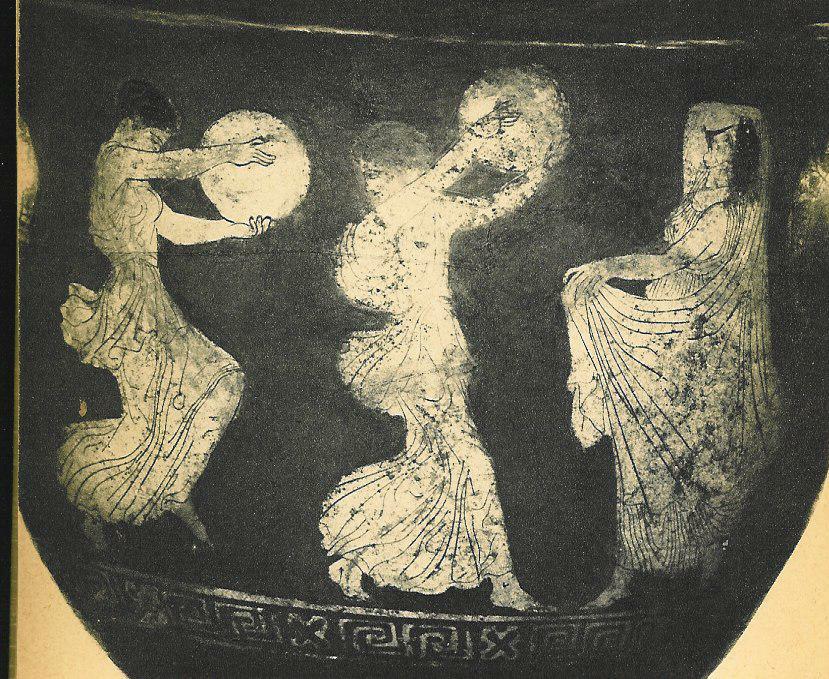
Last night, after reading my post about Berkeley and the spider, A. asked me about the point I was trying to make. I had to respond that honestly, I’m not sure. In one sense, it simply fascinates me that three philosophers who each took a stance against l’esprit geometrique are found in Southern Italy in the early eighteenth century. Vico turns to the ingenium, and Shaftesbury to common sense, as the intellectual force that resists the mechanization of the spirit - Berkeley, by contrast, traces the path of the skeptic and radicalizes l’esprit geometrique, in a way heralded by Pascal and Bayle – who also applied skepticism in the service of faith – but that goes far beyond them in its ontological conclusions. Yet, Berkeley’s response to Locke’s milktoast metaphysics contains an ambiguity, a pull between the ancients and the moderns, a re-constitution of the terms in which l’esprit geometrique is understood, that can be read as according, in the absence of the divine DJ, everything to the moderns.
Or to start again: metaphysics – I think I am trying to say – is anchored in life. When , in the 1790s, Cuoco criticizes the revolutionaries of Naples for favoring abstraction over the concrete interests of the people, he is in a sense echoing a theme we find in Berkeley’s A treatise concerning Human Knowledge, which contrasts abstraction – that fantastic product of the schools – to the mental processes of the great mass of men:
“To be plain, I own my self able to abstract in one Sense, as when I consider some particular Parts or Qualities separated from others, with which though they are united in some Object, yet, it is possible they may really Exist without them. But I deny that I can abstract one from another, or conceive separately, those Qualities which it is impossible should Exist so separated; or that I can frame a General Notion by abstracting from Particulars in the manner aforesaid. Which two last are the proper Acceptations of Abstraction. And there are Grounds to think most Men will acknowledge themselves to be in my Case. The Generality of Men which are Simple and Illiterate never pretend to abstract Notions. It is said they are difficult and not to be attained without Pains and Study. We may therefore reasonably conclude that, if such there be, they are confined only to the Learned.”
Plain speech, and plain people. This is the Berkeley who could share a dish of beans with a group of squatting peasants in a field. He is unafraid of popular contact – and that is one of the fundamental living impulses of democracy.
Berkeley’s preliminary work in countering the absurdities thrust upon us by abstraction – which is a process that never really occurs in any mind whatsoever, has no root in our biological life (ie is never found to occur among children who are acquiring language skills) is meant to prepare us for his self-evident truth:
“Some Truths there are so near and obvious to the Mind, that a Man need only open
his Eyes to see them. Such I take this Important one to be, to wit, that all the Choir of Heaven and Furniture of the Earth, in a word all those Bodies which compose the mighty Frame of the World, have not any Subsistence without a Mind, that their Being is to be perceived or known; that consequently so long as they are not actually perceived by me, or do not exist in my Mind or that of any other created Spirit, they must either have no Existence at all, or else subsist in the Mind of some eternal Spirit: It being perfectly unintelligible and involving all the Absurdity of Abstraction, to attribute to any single part of them an Existence independent of a Spirit. To be convinced of which, the Reader need only reflect and try to separate in his own Thoughts the being of a sensible thing from its being perceived.”
This is a tightly reasoned paragraph, and yet within it the innocent reader feels that somehow, what is happening here is a feint, or an out of bounds punch. A first reading – and one that became common in the 18th century – was that this was a plea for pure solipsism. Diderot, in the Essai sur les règnes de Claude et de Néron, remarks: “The bishop of Cloyne said: if I ascend to the heights of the mountains, or descend into the valleys, it is never anything but me that I apperceive: thus, it is possible that these don’t exist without me. And Berkeley still awaits an answer.” Diderot is a shrewd reader, but we – who can ascend to the heights of Berkeley commentators, or perhaps descend into the valley of their obsessions – have learned to read this paragraph differently, with an emphasis not on the moi – an emphasis that Diderot takes, unconsciously, from the whole French moraliste position – but rather on the tricky passive construction, “that their Being is to be perceived or known,” which leads us not to the imperial subject but to a fact about the choir of heaven that can only be expressed in the passive tense in English: that their very being is not ever to be separated from their being knowable or perceivable. Far from being accidents to which sovereign being submits – as a sort of royal sacrifice – being is essentially knowable or perceivable – the sovereign power is essentially a matter of election and, ultimately, of pressure. Berkeley’s is a world of pressures ultimately emanating, literally, from the hand of God. The combination of pressure and passivity finds its political correlate, perhaps, in the passive obedience Berkeley promoted in an early political pamphlet.
Still, Berkeley goes a long way to divest reality of any magic. The tarantula, its bite, the belief in the tarantalla, the doubts of the country doctor, are all real. “I do not argue against the Existence of any one thing that we can apprehend, either by Sense or Reflexion. That the things I see with mine Eyes and touch with my Hands do exist, really exist, I make not the least Question. The only thing whose Existence we deny, is that which Philosophers call Matter or corporeal Substance. And in doing of this, there is no Damage done to the rest of Mankind, who, I dare say, will never miss it.” Again, one wonders whether this is a feint or an argument – for, with the most beneficient of smiles, here Berkeley slips matter, so much metaphysical waste, into the trashcan. This is not something mankind will miss – it is not part of our common property.
What is the end result of this logic? “But, say you, it sounds very harsh to say we eat and drink Ideas, and are clothed with Ideas. I acknowledge it does so, the word Idea not being used in common Discourse to signify the several Combinations of sensible Qualities, which are called Things: and it is certain that any Expression which varies from the familiar Use of Language, will seem harsh and ridiculous. But this doth not concern the Truth of the Proposition, which in other Words is no more than to say, we are fed and clothed with those Things which we perceive immediately by our Senses. The Hardness or Softness, the Colour, Taste, Warmth, Figure, and such like Qualities, which combined together constitute the several sorts of Victuals and
Apparel, have been shewn to exist only in the Mind that perceives them; and this is all that is meant by calling them Ideas.”
In this way, Berkeley’s thought radically humanizes the world – which is the distinct twist of the emergence of Western, vs. Eastern, idealism. For ideas don’t lead us to illusions – illusions, rather, are easily comprehended within the schema of ideas. The world that Berkeley, at trifling expense (we hardly miss the old terms), reconstitutes is literally the one handed to us – in keeping with the privilege accorded to touch in his system. ”The Ideas of Sight and Touch make two Species, intirely distinct and heterogeneous. The former are Marks and Prognostics of the latter. That the proper Objects of Sight neither exist without the Mind, nor are the Images of external Things, was shewn even in that Treatise. Though throughout the same, the contrary be supposed true of tangible Objects: Not that to suppose that vulgar Error, was necessary for establishing the Notion therein laid down; but because it was beside my Purpose to examine and refute it in a Discourse concerning Vision. So that in strict Truth the Ideas of Sight, when we apprehend by them Distance and Things placed at a Distance, do not suggest or mark out to us Things actually existing
at a Distance, but only admonish us what Ideas of Touch will be imprinted in our Minds at such and such distances of Time, and in consequence of such or such Actions. It is, I say, evident from what has been said in the foregoing Parts of this Treatise, and in Sect. 147, and elsewhere of the Essay concerning Vision, that visible Ideas are the Language whereby the governing Spirit, on whom we depend, informs us what tangible Ideas he is about to imprint upon us, in case we excite this or that Motion in our own Bodies.”
It is this sense in which Berkeley’s idealism, which seems to move us to Diderot’s misrepresentation of it, actually situates us under the new dispensation of the moderns. It does so even while seeming to take the idealistic path of a wholly non-European tradition. Vico and Shaftesbury’s humanism, on the other hand, opens a front that challenges the totality of modernity – a totality that modernity, that epoch of universal-making, can’t do without.
Saturday, October 16, 2010
Berkeley and a spider
It is interesting to contemplate the fact that in the period between 1712-1717, Vico, Shaftesbury and Berkeley were all either living in or visiting Naples. Schaftesbury, who was raised, in a manner of speaking, by Locke, and rejected his tutor unequivocally – Berkeley, who grew to detest Shaftesbury’s philosophy as the very antithesis of religion and a much more poisonous skepticism than that he was accused of promoting; and Vico, whose sense of doing battle with the moderns has much in common with Shaftesbury’s sense that raillery and wit were marks of true intellectual freedom, and conversation the method of wisdom – which is another aspect of Vico’s defense of topoi against mere logic. All, in turn, knew Paolo Doria, into whose salon each man, at various times, ventured.
I wonder if Berkeley spoke to Doria of the tarantella. I wonder if there is any meaning in the fact that this idealist metaphysician – to label him in the classroom way – was so fascinated with both the tarantula and the stories of the effect of its bite. Surely as a clergyman, Berkeley was enrolled, forcibly, in the struggle against popular superstition. But Berkeley did not have Shaftesbury’s Tory contempt for the people - his Italian journal is full of incidents that show Berkeley as something more like an anthropologist than judge, recording the dirtiness of cleanliness of towns, the agricultural prospects of the countryside, the speech of the peasants with a certain tone of equanimity and fairness that surely was his tone, and one of the reasons he could get on with Swift.
But to the theme of this post: the future bishop and the spider.
The first mention of the tarantella in the journal is about a doctor who is met with on the road as Berkeley is going into Calabria. The doctor has cheerful contempt fo the peasant superstition of the tarantella, and attributes it to the peasants almost sexual love for drama. seems fascinate
After this, Berkeley records what a certain “Consul” in Tarentum told him about it:
“Tarantato that we saw dance here, no lookingglass or sword ; stamped, screeched, seemed to smile sometimes; danced in a circle like the others. The Consul,
&c. inform us that all spiders except the long-legged ones bite, causing the usual symptoms, though not so violent as the large ones in the country. He tells me the
tarantula causes pain and blackness to a great space round the bite; thinks there can be no deceit, the dancing is so laborious ; tells me they are feverish mad, and sometimes after dancing throw themselves into the sea, and would drown if not prevented ; that in case the tarantula be killed on biting, the patient dances but one year ; otherwise to the death of the tarantula.”
The next day, passing through a small Italian town, Berkeley talks with an Albanian priest about the spider: “The priest told us the arm, e. g. being bitten by the tarantula swelled, confirmed, as indeed everybody, that common notion of the tarantula's death curing the bite. His house very neat. Everywhere great respect for a knowledge of the English, owing to our commerce, fleets, and armies.” In a stop at Gavina, evidently to his enquiries, Berkeley learns this: “Tarantula not in this country ; he hath seen several bitten with a black swoln mark as large as half-a-crown ; they knew not they were bitten till dancing ; tarantula bites only in the hot months ; a peasant at Canosa laughed at their biting, and said he had often taken them in his hands.” In Ascola, or in the environs of the town, Berkeley and his companion eat beans with some peasants in a field: “They boast of a saint's finger kept in a church of a convent on a hill overlooking the town, which, so far as the church is visible, prevents the bite of the tarantula.” Approaching Vesuvius, Berkeley notes: “Taurasi and La Torella. Fricento belongs to the Principe della Torella ; 25,000 souls [2500. M.J ; July and J August without fires. An image on Monte Virgine protects the country about as far as visible from tarantulas, which, say they, are here likewise.Two bears slain last year in a neighbouring wood.” Berkeley wrote a letter about Vesuvius to John Arbuthnot – one of Berkeley’s set, along with Pope and Swift- in which he recounts its eruption and the horrible noise it makes – a letter that makes one wonder if Swift slyly poked at it in Gulliver’s Travels. He would have known of it not only because letters were passed around in the set, but also because the letter was published by the Royal Society. It was one of the odder gothic habits of 18th century intellectuals – like Wincklemann, in the 1760s – to climb Vesuvius and marvel at the lava flows. Wincklemann and his companions, the rather louche Baron d’Hancarville, tossed down a few bottles of wine on the summit. Berkeley doesn’t mention drinking anything.
After arriving at Naples, Berkeley seems to lose interest in the tarantula, and takes up another custom: the nasty habit of murder that has sprung up among the inhabitants of Southern Italy. In a letter to Pope about the island of Ischia, he writes: “and were they but as much strangers to revenge as they are to avarice and ambition, they
might in fact answer the poetical notions of the golden age. But they have got, as an alloy to their happiness, an ill habit of murdering one another on slight offences. We had an instance of this the second night after our arrival, a youth of eighteen being shot dead by our door : and yet by the sole secret of minding our own business, we found a means of living securely among those dangerous people.”
So: what is one to make of the practices of these people, their mental, or physical, reaction to the bite of the certainly real tarantula? In other words, what is the meaning of the appearance of a certain mentalist imperialism during a period when England is undergoing the tremors of the Great Transformation?
I wonder if Berkeley spoke to Doria of the tarantella. I wonder if there is any meaning in the fact that this idealist metaphysician – to label him in the classroom way – was so fascinated with both the tarantula and the stories of the effect of its bite. Surely as a clergyman, Berkeley was enrolled, forcibly, in the struggle against popular superstition. But Berkeley did not have Shaftesbury’s Tory contempt for the people - his Italian journal is full of incidents that show Berkeley as something more like an anthropologist than judge, recording the dirtiness of cleanliness of towns, the agricultural prospects of the countryside, the speech of the peasants with a certain tone of equanimity and fairness that surely was his tone, and one of the reasons he could get on with Swift.
But to the theme of this post: the future bishop and the spider.
The first mention of the tarantella in the journal is about a doctor who is met with on the road as Berkeley is going into Calabria. The doctor has cheerful contempt fo the peasant superstition of the tarantella, and attributes it to the peasants almost sexual love for drama. seems fascinate
After this, Berkeley records what a certain “Consul” in Tarentum told him about it:
“Tarantato that we saw dance here, no lookingglass or sword ; stamped, screeched, seemed to smile sometimes; danced in a circle like the others. The Consul,
&c. inform us that all spiders except the long-legged ones bite, causing the usual symptoms, though not so violent as the large ones in the country. He tells me the
tarantula causes pain and blackness to a great space round the bite; thinks there can be no deceit, the dancing is so laborious ; tells me they are feverish mad, and sometimes after dancing throw themselves into the sea, and would drown if not prevented ; that in case the tarantula be killed on biting, the patient dances but one year ; otherwise to the death of the tarantula.”
The next day, passing through a small Italian town, Berkeley talks with an Albanian priest about the spider: “The priest told us the arm, e. g. being bitten by the tarantula swelled, confirmed, as indeed everybody, that common notion of the tarantula's death curing the bite. His house very neat. Everywhere great respect for a knowledge of the English, owing to our commerce, fleets, and armies.” In a stop at Gavina, evidently to his enquiries, Berkeley learns this: “Tarantula not in this country ; he hath seen several bitten with a black swoln mark as large as half-a-crown ; they knew not they were bitten till dancing ; tarantula bites only in the hot months ; a peasant at Canosa laughed at their biting, and said he had often taken them in his hands.” In Ascola, or in the environs of the town, Berkeley and his companion eat beans with some peasants in a field: “They boast of a saint's finger kept in a church of a convent on a hill overlooking the town, which, so far as the church is visible, prevents the bite of the tarantula.” Approaching Vesuvius, Berkeley notes: “Taurasi and La Torella. Fricento belongs to the Principe della Torella ; 25,000 souls [2500. M.J ; July and J August without fires. An image on Monte Virgine protects the country about as far as visible from tarantulas, which, say they, are here likewise.Two bears slain last year in a neighbouring wood.” Berkeley wrote a letter about Vesuvius to John Arbuthnot – one of Berkeley’s set, along with Pope and Swift- in which he recounts its eruption and the horrible noise it makes – a letter that makes one wonder if Swift slyly poked at it in Gulliver’s Travels. He would have known of it not only because letters were passed around in the set, but also because the letter was published by the Royal Society. It was one of the odder gothic habits of 18th century intellectuals – like Wincklemann, in the 1760s – to climb Vesuvius and marvel at the lava flows. Wincklemann and his companions, the rather louche Baron d’Hancarville, tossed down a few bottles of wine on the summit. Berkeley doesn’t mention drinking anything.
After arriving at Naples, Berkeley seems to lose interest in the tarantula, and takes up another custom: the nasty habit of murder that has sprung up among the inhabitants of Southern Italy. In a letter to Pope about the island of Ischia, he writes: “and were they but as much strangers to revenge as they are to avarice and ambition, they
might in fact answer the poetical notions of the golden age. But they have got, as an alloy to their happiness, an ill habit of murdering one another on slight offences. We had an instance of this the second night after our arrival, a youth of eighteen being shot dead by our door : and yet by the sole secret of minding our own business, we found a means of living securely among those dangerous people.”
So: what is one to make of the practices of these people, their mental, or physical, reaction to the bite of the certainly real tarantula? In other words, what is the meaning of the appearance of a certain mentalist imperialism during a period when England is undergoing the tremors of the Great Transformation?
Thursday, October 14, 2010
sage-imposter vs. fool-imposter

“But to imagine a plan for a republican constitution and to found a republic are two very different things. In a government where the public will, or the law, has not and ought not to have any other support, other guarantee, other ministry than the particular will, one cannot establish liberty but in making free men. Before elevating the edifice of liberty in Naples, there was in the ancient constitutions, in the customs, in the inveterate prejudices of the people, and in the interests of the moment, a thousand obstacles that it was urgent to know and indispensable to remove.”
Thus Cuoco, pointing to the republican dilemma when a foreign army, the French, took the city and most of the kingdom.
A story.
Four Corsicans are caught in Apulia when the French army took Naples. One is a former servant, Cesare, and one is a former artillery officer and deserter, Boccheciampe. Their other two companions are, by all accounts, unemployed vagabonds. According to Cuoco, the four were fleeing to Brindisi when the came to Monteasi, a small village, and took lodgings with an old woman, to whom they told the story that they were actually fleeing nobles – Boccheciampe was the brother of the king, and Cesare (this is not in the Cuoco account, but in Pietro Colleta’s History) for the duke of Saxony. Actually, the old woman was related to the royal intendant in the village, one Girunda. According to Colleta, Girunda was taken into the secret – according to Cuoco, Girunda went to the old woman’s house, knelt before Boccheciampe, and swore his allegiance. When the four got to Brindisi, they began to issue orders and raised an army of insurgents – Boccheciampe invested the province of Leuca, and Cesare marched on Barri. The men under their command, according to Cuoco, were ‘baron’s men’, criminals, and miscreants who had escaped from one prison or another. According to Colletta, the four Corsicans were soon busy firing and hiring magistrates and emptying the treasuries of various towns and villages, while imposing fines on the “rebels” to the King.
Not only did the people rejoice in this pillage of the “patriots” – they were encouraged by the clergy, who, knowing the men were imposters, nevertheless seized the chance to proclaim them legitimate in order to set going a countryside insurgency. Even the Bourbon nobility, well aware that the King’s brother was not a rude artilleryman with a Corse accent, played along with the imposters.
And so the revolt in the countryside begins not in support of the patriots who have overthrown the barbaric remnants of feudalism in Naples, when the Republic was proclaimed, but is conducted by the people for the feudal regime, under the banner of four imposters, against Republicanism, as it is understood, itself.
…
Since Naples was the home of Vico and Bruno, there is much here for the Gnostic historian, avid for intersignes, to contemplate, especially as the glosses are supplied by an intelligence like Cuoco’s, whose form of enlightenment materialism (for instance, he attributes the heterogeneity of customs and tempers in the Kingdom of Naples to the heterogeneity of the property arrangements instituted by feodalism: “… and the feudal system, which, in the centuries which followed barbarism and preceded civilization, always varied according to places and circumstances, rendering property diverse throughout; and that diversity necessarily passed into the moeurs, which are always analogous to the nature of property and the means of subsistence”) is lit up, as well, by the darker torches held aloft by Machiavelli and Vico.
The problem of “removing” these impediments to create a new connection between the state and the people – that organic connection of happiness – seems, in the chaos of 1799, to have reached a moment of dream tension in which parts of the fabric of legitimacy – as if will later be called – peel off to reveal the form of the variable that takes the sovereign position. I want to intervene in this dream to recall a typology I explored years ago, at the beginning of the Human Limit project: that of the sage and the fool.
For underneath Cuoco’s distinction between a revolution from above – a revolution for abstractions, imposed upon the public, which receives it passively – and a revolution from below – a revolution of the people, struggling to achieve their interests, actively – is something like the trace of the odd necessity that yoked the fool and the sage together.
Oh that counter-enlightenment crewe! From Vico onward – and actually, from the witch onward, from the tales in the forest onward – there is a program, or at least a programmatic stance, even if there is no system, or even if the systems are crackpot, deviant, ad hoc – which consists in the rejection of the power of the will to truth. One finds (inevitably?) that the opposition between sage and philosopher that structures Francois Jullien’s argument in A Sage is Without Ideas eventually crystalizes about this matter, our matter, the will to truth. The sage, in Jullien’s account, does not develop a neurosis about the truth – and thus a whole intellectual culture slips the bonds and knots of a certain mastering cognitive passion, orienting itself instead with relation to the road, or way.
Jullien does not ask if the Dao is the path of pins or the path of needles – little red riding hood does not figure in his story. More curiously, neither does the fool. Unless – and here one feels Jullien’s grasp of the theme loosen a bit – that role is taken by the Daoist.
I have emphasized the role of the adventurer in the Great Transformation – and surely it is in the wake of the adventurer that the fool and the sage, a couple we saw come apart in Le Neveau de Rameau, recommence their adventures.
The question I am posing here is this: how does the sage-imposter differ from the fool-imposter?
Tuesday, October 12, 2010
wrestling vs. boxing
I was reading an essay by Eco about Barthes’ Mythologies when I was struck by a citation from the essay on ‘Catch”, or wrestling. In fact, floating past the citation, I had the same feeling course down my spine that must be activated in the trout when confronted with a bright fly pierced by a hook. I had to swallow it.
I had to swallow it because it turns out that what Barthes writes about wrestling applies with an almost diabolical pertinence to politics in the age of mock democracy.
Mock democracy is defined as an electoral system in which both parties are concerned with aid and comfort of the minority of the wealthy, to the exclusion of anything else. This is a fact known to the electorate. It is known to the commentariat. All issues are shaped exclusively for the wealthiest, by their instruments, who have, in turn, got wealthy in the business of message management. This reality –which is easily confirmed simply by going through the bills passed by Congress and signed by the President for the past thirty years – is turned upside down during the elections, when the promises of both parties are directed at the concerns (economic and cultural) of an electorate that will be totally ignored after the election. Larry Bartels has a rather nice paper concerning whose concerns count with congress here.
From Bartels: “For incidental reasons of data availability, my research focuses on representation by U.S. senators in the late 1980s and early 1990s. Using both summary measures of senators’ voting patterns and specific roll call votes on the minimum wage, civil rights, government spending, and abortion, I find that senators in this period were vastly more responsive to the views of affluent constituents than to constituents of modest means. Indeed, my analyses suggest that the views of constituents in the upper third of the income distribution received about 50% more weight than those in the middle third (with even larger disparities on specific salient roll call votes), while the views of constituents in the bottom third of the income distribution received no weight at all in the voting decisions of their senators.”
Given this situation, the election becomes a more interesting event. Why does the electorate participate in it?
The clue, I think, is given in Barthes analysis of wrestling, which, he is quick to say, is not a sport, but a spectacle. And a spectacle of a particular type:
Le public se moque complètement de savoir si le combat est truqué ou non, et il a raison; il se confie à la première vertu du spectacle, qui est d’abolir tout mobile et toute conséquence: ce qui lui importe, ce n’est pas ce qu’il croit, c’est ce qu’il voit.
(The public could completely care less about knowing if the combat is faked or not, and it is right; it trusts in the first virtue of the spectacle, which is to abolish every motive and every consequence: what matters to it is not what it believes, but what it sees.)
One of the great commonplaces is that seeing is believing. But in the world of commonplaces, I go with St. Paul: we see now as in a mirror, darkly. The inverse is really the sublunar true: believing is seeing. What we believe, we will see.
Of course, we have been saturated for years with advertisements that mock seeing and believing. In the culture of the mock democracy, it has become a sort of official dogma that what occurs and what is believed – or at least what is believed about the belief of the ‘public’ – exist on separate continuums. The cynical manipulation of the latent violence of the public feeds the educated stance of permanent irony, peppered of course with fetishistic and bizarre attachments to random phenomena in popular culture. Where once one could be assured that the Marxist you know was going to tell you about the inevitable victory of the working class, now he or she is more likely to tell you of the subversive potential of Lady Gaga.
Thus, the election has shifted as it becomes meaningful only for the upper class. The upper class, of course, well knows how to monetize nuances. The Democratic Party candidate (usually an upper class type with good intentions) will differ radically with the Republican Party type on the margins. But both are content with, for instance, the thirty year slump in medium incomes. In fact, both have simply stopped imaging the bottom thirty percent – and have only a dim, Hollywood lit sense of the very middle. Of course, the Hollywood scenario endows the 50 000 dollar household with the accoutrements of the 500 000 dollar one, and never notices – because once you are inside the Gated City, noticing becomes too hard. In the hinterlands, the Yahoos aspire themselves – in the vacant moment - to the image of their lifestyle as presented by the media message benders, but in the end they can’t really think about. They have no power to change anything even if they wanted to. Unlike, say, the French or Italan peasant at the end of the feudal period, they are pathetically docile. What castle would they burn even if they could find it?
Thus, the odd asymmetry that governs this thing called an election. On the one hand, it is taken seriously by those who know they will gain or lose on the result. On the other hand, it has to be taken as a passion play by those who will lose no matter what the result. Thus, the latter have come increasingly to seek catharsis and madness – qualities proper to wrestling, as well.
This disparity is also mirrored in Barthes’ essay, when he compares boxing and wrestling. For my comparison’s sake, the interest taken by the upper class in the election parallels, boxing, while for the loser classes, it is wrestling all the way.
“This public know very well how to distinguish wrestling from boxing. It knows that boxing is a jansenist sport, founded on the demonstration of an excellence; one can bet on the issue of a boxing combat: with wrestling, that has no sense.The boxing match is a history that is constructed under the eyes of the spectator; in wrestling, it is very much the contrary, it is each moment which is intelligible, not the whole duration. The spectator doesn’t interest himself in the mounting of a fortune, he waits the live image of certain passions. Wrestling demands thus an immediate reading of the juxtaposed senses, without it being necessary to connect them. The rational future of combat doesn’t interest the amateur of wrestling, while on the contrary, a boxing match always implies a science of the future.”
I will end this with a passage from the NYT story about the election campaign of Patrick Murphey, a Democratic representative running for re-election in Pennsylvania. He is a quintessential Obama Democrat – moderate, well intentioned, a man who wants to do what is right – as long as this is politically possible.
"Marge Reed, 75, opened her screen door and before he could complete a sentence said, “You know what, Mr. Murphy, I don’t believe anything anybody tells me anymore.” She apologized for her frankness but said it was to be expected because of her Irish heritage. “I’m Irish, too,” Mr. Murphy said, as if she might not know that. “So is your opponent,” she said, and they both laughed. She told Mr. Murphy that she planned to vote for him, then continued giving him a piece of her mind.
Little of the anger Mr. Murphy encountered was aimed directly at him or even at President Obama. Mr. Murphy never once mentioned the president’s name, and, oddly, over the course of three hours, neither did any of the Levittown residents. People just did not like their situation or the general drift of the country, and seemed to hold everyone in a position of power — locally and in Washington — responsible.
I called Marge Reed the next day. She had worked for the Spiegel catalog company at a store in Levittown where people picked up their orders. She said she had lost much of her retirement nest egg in the stock market and was living on $13,750 a year and having a hard time paying for her prescriptions. Her husband died in 1993. “I don’t feel like anybody cares about people like me,” she said. “I remember President Obama talking about how he worried about his mother paying her health bills when she had cancer. Well, I’m somebody’s mother, too.”
I had to swallow it because it turns out that what Barthes writes about wrestling applies with an almost diabolical pertinence to politics in the age of mock democracy.
Mock democracy is defined as an electoral system in which both parties are concerned with aid and comfort of the minority of the wealthy, to the exclusion of anything else. This is a fact known to the electorate. It is known to the commentariat. All issues are shaped exclusively for the wealthiest, by their instruments, who have, in turn, got wealthy in the business of message management. This reality –which is easily confirmed simply by going through the bills passed by Congress and signed by the President for the past thirty years – is turned upside down during the elections, when the promises of both parties are directed at the concerns (economic and cultural) of an electorate that will be totally ignored after the election. Larry Bartels has a rather nice paper concerning whose concerns count with congress here.
From Bartels: “For incidental reasons of data availability, my research focuses on representation by U.S. senators in the late 1980s and early 1990s. Using both summary measures of senators’ voting patterns and specific roll call votes on the minimum wage, civil rights, government spending, and abortion, I find that senators in this period were vastly more responsive to the views of affluent constituents than to constituents of modest means. Indeed, my analyses suggest that the views of constituents in the upper third of the income distribution received about 50% more weight than those in the middle third (with even larger disparities on specific salient roll call votes), while the views of constituents in the bottom third of the income distribution received no weight at all in the voting decisions of their senators.”
Given this situation, the election becomes a more interesting event. Why does the electorate participate in it?
The clue, I think, is given in Barthes analysis of wrestling, which, he is quick to say, is not a sport, but a spectacle. And a spectacle of a particular type:
Le public se moque complètement de savoir si le combat est truqué ou non, et il a raison; il se confie à la première vertu du spectacle, qui est d’abolir tout mobile et toute conséquence: ce qui lui importe, ce n’est pas ce qu’il croit, c’est ce qu’il voit.
(The public could completely care less about knowing if the combat is faked or not, and it is right; it trusts in the first virtue of the spectacle, which is to abolish every motive and every consequence: what matters to it is not what it believes, but what it sees.)
One of the great commonplaces is that seeing is believing. But in the world of commonplaces, I go with St. Paul: we see now as in a mirror, darkly. The inverse is really the sublunar true: believing is seeing. What we believe, we will see.
Of course, we have been saturated for years with advertisements that mock seeing and believing. In the culture of the mock democracy, it has become a sort of official dogma that what occurs and what is believed – or at least what is believed about the belief of the ‘public’ – exist on separate continuums. The cynical manipulation of the latent violence of the public feeds the educated stance of permanent irony, peppered of course with fetishistic and bizarre attachments to random phenomena in popular culture. Where once one could be assured that the Marxist you know was going to tell you about the inevitable victory of the working class, now he or she is more likely to tell you of the subversive potential of Lady Gaga.
Thus, the election has shifted as it becomes meaningful only for the upper class. The upper class, of course, well knows how to monetize nuances. The Democratic Party candidate (usually an upper class type with good intentions) will differ radically with the Republican Party type on the margins. But both are content with, for instance, the thirty year slump in medium incomes. In fact, both have simply stopped imaging the bottom thirty percent – and have only a dim, Hollywood lit sense of the very middle. Of course, the Hollywood scenario endows the 50 000 dollar household with the accoutrements of the 500 000 dollar one, and never notices – because once you are inside the Gated City, noticing becomes too hard. In the hinterlands, the Yahoos aspire themselves – in the vacant moment - to the image of their lifestyle as presented by the media message benders, but in the end they can’t really think about. They have no power to change anything even if they wanted to. Unlike, say, the French or Italan peasant at the end of the feudal period, they are pathetically docile. What castle would they burn even if they could find it?
Thus, the odd asymmetry that governs this thing called an election. On the one hand, it is taken seriously by those who know they will gain or lose on the result. On the other hand, it has to be taken as a passion play by those who will lose no matter what the result. Thus, the latter have come increasingly to seek catharsis and madness – qualities proper to wrestling, as well.
This disparity is also mirrored in Barthes’ essay, when he compares boxing and wrestling. For my comparison’s sake, the interest taken by the upper class in the election parallels, boxing, while for the loser classes, it is wrestling all the way.
“This public know very well how to distinguish wrestling from boxing. It knows that boxing is a jansenist sport, founded on the demonstration of an excellence; one can bet on the issue of a boxing combat: with wrestling, that has no sense.The boxing match is a history that is constructed under the eyes of the spectator; in wrestling, it is very much the contrary, it is each moment which is intelligible, not the whole duration. The spectator doesn’t interest himself in the mounting of a fortune, he waits the live image of certain passions. Wrestling demands thus an immediate reading of the juxtaposed senses, without it being necessary to connect them. The rational future of combat doesn’t interest the amateur of wrestling, while on the contrary, a boxing match always implies a science of the future.”
I will end this with a passage from the NYT story about the election campaign of Patrick Murphey, a Democratic representative running for re-election in Pennsylvania. He is a quintessential Obama Democrat – moderate, well intentioned, a man who wants to do what is right – as long as this is politically possible.
"Marge Reed, 75, opened her screen door and before he could complete a sentence said, “You know what, Mr. Murphy, I don’t believe anything anybody tells me anymore.” She apologized for her frankness but said it was to be expected because of her Irish heritage. “I’m Irish, too,” Mr. Murphy said, as if she might not know that. “So is your opponent,” she said, and they both laughed. She told Mr. Murphy that she planned to vote for him, then continued giving him a piece of her mind.
Little of the anger Mr. Murphy encountered was aimed directly at him or even at President Obama. Mr. Murphy never once mentioned the president’s name, and, oddly, over the course of three hours, neither did any of the Levittown residents. People just did not like their situation or the general drift of the country, and seemed to hold everyone in a position of power — locally and in Washington — responsible.
I called Marge Reed the next day. She had worked for the Spiegel catalog company at a store in Levittown where people picked up their orders. She said she had lost much of her retirement nest egg in the stock market and was living on $13,750 a year and having a hard time paying for her prescriptions. Her husband died in 1993. “I don’t feel like anybody cares about people like me,” she said. “I remember President Obama talking about how he worried about his mother paying her health bills when she had cancer. Well, I’m somebody’s mother, too.”
Sunday, October 10, 2010
active and passive revolution 2
The revolution for happiness, by 1799, had memorized the shape of its own ashy shadow. After 1793, the Italian intellectuals of the era must have thought, never such innocence.
But innocence is an ever renewed political quality. It never ceases to flow.
The importance of Cuoco’s meditations about the passive and active revolution derive from their relation to two revolutions: the French and the Neapolitan. The Neapolitan intelligentsia had seemingly understood the French, and recognized its errors. Or so such people as Mario Pagano thought. In his memoirs, Count Orlov, a sympathetic observer, wrote: “ The scond edition of his Saggi Politici (Essais Politiques) appeared during that fatal period [1790] and made a sensation in a city where one almost didn’t read, where meditation is a form of fatigue. The system that he developed there, I will confess, discovered many contradictors, and had few partisans. One reproached him, with some reason, to have given himself up too much to his imagination, to have taken his authorities in inconclusive passages from ancient authors. ‘In quest’opera,’ one of his friends wrote me, ‘la fantasia supera il Giudizio.’
To bleed the trace of fantasia from politics is, perhaps, the greatest fantasy of all.
There is no reason to think that Orlov’s correspondent is Vincenzo Cuoco. But certainly the balance between fantasia and judgment is a theme that obsessed him – that followed him like the sounds of the waterfall in the glenn followed Wordsworth - in his observations on the revolution in action, which, he understood, was also the reaction, too, in action. In Chapter 7 of his essay on the revolution in Naples, he stops the plot after having portrayed the royal court, in the sway of the Bourbon queen Maria-Caroline and her sinister advisors, exerting itself to extinguish ‘revolutionary’ forces in Naples in a prevision of the white terror to come. The fact, Cuoco says, is that the revolutionary forces existed as mere salon opinion, or the casual remarks of the young bucks down at the race track. What was once merely the skeptical banter of 18th century rococo suddenly found itself transformed into deep politics.
In this chapter, Cuoco asks why the French revolution crystallized reaction in Europe, for, as he rightly points out, it is surely not the first time a kingdom has been shaken by an internal revolution in Europe. The reaction of the European kingdoms must itself be seen as different – that is, there were two distinctly novel phenomenon that emerged in the 1790s – the revolution and the reaction.
But innocence is an ever renewed political quality. It never ceases to flow.
The importance of Cuoco’s meditations about the passive and active revolution derive from their relation to two revolutions: the French and the Neapolitan. The Neapolitan intelligentsia had seemingly understood the French, and recognized its errors. Or so such people as Mario Pagano thought. In his memoirs, Count Orlov, a sympathetic observer, wrote: “ The scond edition of his Saggi Politici (Essais Politiques) appeared during that fatal period [1790] and made a sensation in a city where one almost didn’t read, where meditation is a form of fatigue. The system that he developed there, I will confess, discovered many contradictors, and had few partisans. One reproached him, with some reason, to have given himself up too much to his imagination, to have taken his authorities in inconclusive passages from ancient authors. ‘In quest’opera,’ one of his friends wrote me, ‘la fantasia supera il Giudizio.’
To bleed the trace of fantasia from politics is, perhaps, the greatest fantasy of all.
There is no reason to think that Orlov’s correspondent is Vincenzo Cuoco. But certainly the balance between fantasia and judgment is a theme that obsessed him – that followed him like the sounds of the waterfall in the glenn followed Wordsworth - in his observations on the revolution in action, which, he understood, was also the reaction, too, in action. In Chapter 7 of his essay on the revolution in Naples, he stops the plot after having portrayed the royal court, in the sway of the Bourbon queen Maria-Caroline and her sinister advisors, exerting itself to extinguish ‘revolutionary’ forces in Naples in a prevision of the white terror to come. The fact, Cuoco says, is that the revolutionary forces existed as mere salon opinion, or the casual remarks of the young bucks down at the race track. What was once merely the skeptical banter of 18th century rococo suddenly found itself transformed into deep politics.
In this chapter, Cuoco asks why the French revolution crystallized reaction in Europe, for, as he rightly points out, it is surely not the first time a kingdom has been shaken by an internal revolution in Europe. The reaction of the European kingdoms must itself be seen as different – that is, there were two distinctly novel phenomenon that emerged in the 1790s – the revolution and the reaction.
Tuesday, October 05, 2010
active and passive revolution
The ideological hypothesis could be posed in the following terms: "The ideological hypothesis could be presented in the following terms: that there is a passive revolution involved in the fact that -- through legislative intervention by the State and by means of the corporative organization -- relatively far-reaching modifications are being introduced into the country's economic structure in order to accentuate the 'plan of production' element; in other words, that socialisation and co-operation in the sphere of production are being increased, without however touching (or at least not going beyond the regulation and control of) individual and group appropriation of profit." –Gramsci, Prison Notebooks
There are few references or essays about Neapolitan historian Vincenzo Cuoco in English. He is known, by a small minority, for having originated the distinction between passive and active revolution that Gramsci took up in the twentieth century and used in a sense that, to an extent, seems to call out to Karl Polanyi’s hypothesis of the double movement – first the movement towards the free market, then the movement towards state intervention to preserve the private sphere from the stresses the profit taking activity had caused - within the Great Transformation to capitalism.
Cuoco (1770-1823) was the sort of figure who could easily have been cast by Stendhal in La Chartreuse de Parme. He was also the sort of figure that was easy to lose sight of, since the nuances he stood for were, in a sense, drowned in the blood of his epoch. In this sense, there is something of Benjamin Constant’s sense of the need to reintroduce Nemesis into politics, in the form of limits that would work against ‘usurpation’ and conquest. Constant’s pamphlets didn’t stop Napoleon, and Cuoco ended up, by all accounts, on the side of legitimacy after the great fading of collective energy in 1815.
He was not from Naples, but from the Molise region. By training he was another lawyer – or rather, his training as a lawyer was just part of a vaster training in the vaguer career of a philosophe, that career that is not, like that of law, institutionally recognized, and seems like no career at all to people who have short views of the amplitudes of the human soul.
He was, like all Italian philosophes, keenly aware of what was going on in Paris in the 1790s, and had, to frame his observations of these distant events, a fund of sources that included Vico. When the revolution came to Naples, his friends, like Pagano, participated in it and even tried to lead it. Cuoco took a discreter role, but even so fled the collapse and subsequent repression that put Pagano’s neck in a rope. In Milan, he published his essay on the rise and fall of the brief Parthenopeen Republic, under the guise of a philosophical history:
“In history, the custom of reporting names does more to flatter the vanity of those so named than it serves to instruct the reader. Few men know how to master events; the greatest number is its slave; he is what the time, the ideas, the moeurs and the events want him to be; when one has painted the first, what is the point of naming the others? I am firmly persuaded that if in the greatest part of history, one substituted for the proper names the letters of the alphabet, the instruction one would draw from it would be the same.”
In the event, the philosophic dislike for the personal was quickly disgarded in a history that was filled with personalities. And yet, in a sense, those personalities are as unreal in their reality as the characters of La Bruyere. Or they are real, rather, as calculators the combinations they are made of – which is to say, of that time, those moeurs, those events to which they reacted as though they had the choice to be outside of them.
Wednesday, September 29, 2010
The vital center and the sage
The longing for the center has been a desire in the collective political consciousness at least since the age of the Atlantic revolutions. It is a desire that, at last, we discover the missing ‘no’ in the political unconscious. Although the desire for revolution has been tracked and interpreted and over-interpreted in political philosophy, the desire for the center, for ‘moderation’, has not been considered in itself. Rather, it is, mostly, considered parasitic on other forces – reactionary or revolutionary forces, in which the face of desire is not masked, even if the face itself, we discover sooner or later, is indeed a mask – there is no face behind it. Moderation, on this reading, is simply the desire that we not go so far, so quick, and above all that we avoid pain, instead of welcoming it – admittedly, usually the welcoming has to do with imposing it on others. And as the hastiest reading of history will show, the center almost always ends up finding its own targets to impose pain upon, often, o so often, on a large scale. But the thing is to normalize that imposition of pain as quickly as possible so that we can “get on with it.” It is, of course, that long digestion called life. This, for the moderate, is the best political use of speed – to entrench our social relations so that they can work by themselves, surround us with their workings, provide that artificial paradise, that womb, that isle of Synthetica which is our true and only utopia.
This desire for the center – the vital center, as Arthur Schlesinger called it back in 1950, rallying liberalism against the communist threat – has a philosophical correlate in the desire for the golden mean, the juste milieu. In Un sage est sans idée, Francois Jullien discusses the juste milieu in terms of two histories – one of the philosopher, one of the sage. Except that the latter, he claims, has no real history. In that sense, the sage could be seen as just another escapee, like the quicksilver cogito.
However, I will bracket my criticism of that claim – what interests me is Jullien’s contrast between the juste milieu and the demi-mesure. The half and half notion of the center – which, in this second year of the great Recession, has become the desire of so many, and seems to be the structural principle to which that demi-sage in the White House, Obama, has given all his heart.
Jullien, in this chapter as well as the book as a whole, shuttles between two registers – Ancient China and Ancient Greece. He begins with a history of the reputation of the sage, through the lens of philosophy: “For philosophy matured [after Plato], it could well vaunt itself for having a history, while the other didn’t. In consequence, wisdom was treated to an inversion, no longer above, as super- but as sub-philosophy: it would thenceforward be a thought that dared not risk itself (to attain the absolute, the truth), or rather which had renounced it – a soft thought, boneless, dulled, tempered. Flat thought, to put it bluntly, and purely residual (the commonplace), stagnating far from the fascinating flight of ideas: it will be the thought of the aging of desire – but does it even think any more? – at best resigned thought.”
At the center of this image is the notion of the just mean, the golden mean – something like Schlesinger’s vital center. Here we will measure our actions like good shopkeepers, matching advantage to the trade offs. Here the passions are purified until only one is left – the passion for being in the middle. In the middle, we are not too high (with all the risks and the vast energy that it takes to get too high) nor on the level of the slave – abject.
Jullien traces the notion of the juste milieu from Aristotle to that common place in a brief passage:
But more is necessary for establishing virtue, it is necessary to have a definition. To which Aristotle applies himself in distinguishing the medium (moyen) in the thing and that relative to us: the virtue will be the ‘equal’, understood as the just milieu between excess and default (thus, at the half way point between fear and temerity is courage, of prodigality and parcimony is liberality, etc.) With Aristotle, this medium still possesses a theoretical status, tied as it is to the nature of the continuum, and by consequence divisible, and communicating structurally with the totality of his thought, the knots of reasoning in logic as well as the mixtures in physics. But, successively, with the vulgarization of aristotelianism, the notion looses its vigor and wilts, it flattens into a counsel of prudence rejoining the ‘not too much’ of common opinion. The juste milieu becomes the demi-measure. Witness the Horace of the Satires, est modus in rebus (there’s a middle in things), etc. Still, the subtle Horace did not reduce it to this timorous juste milieu, he had too much of an Epicurean in him. But the tradition that referenced him approvingly has never stopped praising that wisdom of the middle – the aurea mediocritas (the Latins having that concrete mindset…) fleeing the extreme, fearing excess. A medium fearful enough to nauseate – “wisdom” to throw off.”
This may well be the story of the liberalism of the vital center. The alliance with the working class, welded in the New Deal; the alliance with civil rights movements, welded in the sixties and seventies; and the alliance with the new class of academics and symbol workers, welded in the eighties, has entered the age of extremes with the desire to find half measures not because these half measures work – who thinks, for instance, that Obama’s preservation of the complex system of medical insurance company rents would work better than raw socialized medicine? But because the solutions are “politically real.” Politics, for the once vital center, is now a fearful domain, populated by extremist lunatics, and it is best to tranquilize them by demi-measures. We no longer end wars – for to end a war is to operate fully and decisively, it is extreme – but we let them sink softly under the headlines. In the same way, huge bankrupt banks don’t go bankrupt, nor do shadow financial sectors, chock full of bad bets, go to the window and expose their losing tickets.
Jullien opposes this notion of golden mediocracy with what he takes to be the original Confucian impulse of the sage in China.
“1. while, on the greek side, the medium proper to virtue is envisioned under the aegis of action (ergon), which is conceived in a technical manner and according to a model posed as an end (of the mathematical type: by divisibility, equality, proportion – it is one, error is multiple – in the background is the cosmos, as already in the Gorgias 504a), the Chinese conception is inscribed in a logic of unfolding (deroulement), the real being conceived according to the category of process: this medium is the medium because, being able to vary from one extreme to another, regulation is continuous; 2. Aristotle has very much the idea of a variable medium, which is not only arithmetic (like 6 between 2 and 10) but relative to each (for instance, the amount of food is a lot for one and not very much for another), and proceeds by circumstantial adaptation (at the moment it is necessary in the case and in regard to what is necessary, etc.), but he does not have the idea of a medium by variation from one extreme to another, equally possible, as in the Chinese idea of two mediums; [Jullien is referring here to the idea that there is a “milieu” relative to each pole, the ying and the yang] 3. the Aristotelian just milieu concerns only the ethical virtue (and still there is no just milieu of moderation), while the juste milieu in the Chinese case corresponds to the logic of every process(which, in as much as it is continuous, must be regulated). There is not, in the Chinese case, on one side the real, and on the other side the good. But that from whence proceeds the real, and which is the condition of its emergence, as the just milieu of regulation, is also the norm of the good. Or, rather, it is not a norm, but only a way, by which the real is liveable – the tao.”
Notice how this applies to the current political atmosphere, in which solutions are not related to the real, but to the ‘good’ – that is, to the norms of the opinion-makers. The looseness at the heart of the decaying American empire is all in this suspended animation, this reign of postponement. It is the exhaustion of a centrism that is sure that the real can be dickered with, smoothed over, or, if nothing works, postponed for another couple of years.
But in reality, America is like a man who has leaped from the top of a tower- it has run out of postponements.
This desire for the center – the vital center, as Arthur Schlesinger called it back in 1950, rallying liberalism against the communist threat – has a philosophical correlate in the desire for the golden mean, the juste milieu. In Un sage est sans idée, Francois Jullien discusses the juste milieu in terms of two histories – one of the philosopher, one of the sage. Except that the latter, he claims, has no real history. In that sense, the sage could be seen as just another escapee, like the quicksilver cogito.
However, I will bracket my criticism of that claim – what interests me is Jullien’s contrast between the juste milieu and the demi-mesure. The half and half notion of the center – which, in this second year of the great Recession, has become the desire of so many, and seems to be the structural principle to which that demi-sage in the White House, Obama, has given all his heart.
Jullien, in this chapter as well as the book as a whole, shuttles between two registers – Ancient China and Ancient Greece. He begins with a history of the reputation of the sage, through the lens of philosophy: “For philosophy matured [after Plato], it could well vaunt itself for having a history, while the other didn’t. In consequence, wisdom was treated to an inversion, no longer above, as super- but as sub-philosophy: it would thenceforward be a thought that dared not risk itself (to attain the absolute, the truth), or rather which had renounced it – a soft thought, boneless, dulled, tempered. Flat thought, to put it bluntly, and purely residual (the commonplace), stagnating far from the fascinating flight of ideas: it will be the thought of the aging of desire – but does it even think any more? – at best resigned thought.”
At the center of this image is the notion of the just mean, the golden mean – something like Schlesinger’s vital center. Here we will measure our actions like good shopkeepers, matching advantage to the trade offs. Here the passions are purified until only one is left – the passion for being in the middle. In the middle, we are not too high (with all the risks and the vast energy that it takes to get too high) nor on the level of the slave – abject.
Jullien traces the notion of the juste milieu from Aristotle to that common place in a brief passage:
But more is necessary for establishing virtue, it is necessary to have a definition. To which Aristotle applies himself in distinguishing the medium (moyen) in the thing and that relative to us: the virtue will be the ‘equal’, understood as the just milieu between excess and default (thus, at the half way point between fear and temerity is courage, of prodigality and parcimony is liberality, etc.) With Aristotle, this medium still possesses a theoretical status, tied as it is to the nature of the continuum, and by consequence divisible, and communicating structurally with the totality of his thought, the knots of reasoning in logic as well as the mixtures in physics. But, successively, with the vulgarization of aristotelianism, the notion looses its vigor and wilts, it flattens into a counsel of prudence rejoining the ‘not too much’ of common opinion. The juste milieu becomes the demi-measure. Witness the Horace of the Satires, est modus in rebus (there’s a middle in things), etc. Still, the subtle Horace did not reduce it to this timorous juste milieu, he had too much of an Epicurean in him. But the tradition that referenced him approvingly has never stopped praising that wisdom of the middle – the aurea mediocritas (the Latins having that concrete mindset…) fleeing the extreme, fearing excess. A medium fearful enough to nauseate – “wisdom” to throw off.”
This may well be the story of the liberalism of the vital center. The alliance with the working class, welded in the New Deal; the alliance with civil rights movements, welded in the sixties and seventies; and the alliance with the new class of academics and symbol workers, welded in the eighties, has entered the age of extremes with the desire to find half measures not because these half measures work – who thinks, for instance, that Obama’s preservation of the complex system of medical insurance company rents would work better than raw socialized medicine? But because the solutions are “politically real.” Politics, for the once vital center, is now a fearful domain, populated by extremist lunatics, and it is best to tranquilize them by demi-measures. We no longer end wars – for to end a war is to operate fully and decisively, it is extreme – but we let them sink softly under the headlines. In the same way, huge bankrupt banks don’t go bankrupt, nor do shadow financial sectors, chock full of bad bets, go to the window and expose their losing tickets.
Jullien opposes this notion of golden mediocracy with what he takes to be the original Confucian impulse of the sage in China.
“1. while, on the greek side, the medium proper to virtue is envisioned under the aegis of action (ergon), which is conceived in a technical manner and according to a model posed as an end (of the mathematical type: by divisibility, equality, proportion – it is one, error is multiple – in the background is the cosmos, as already in the Gorgias 504a), the Chinese conception is inscribed in a logic of unfolding (deroulement), the real being conceived according to the category of process: this medium is the medium because, being able to vary from one extreme to another, regulation is continuous; 2. Aristotle has very much the idea of a variable medium, which is not only arithmetic (like 6 between 2 and 10) but relative to each (for instance, the amount of food is a lot for one and not very much for another), and proceeds by circumstantial adaptation (at the moment it is necessary in the case and in regard to what is necessary, etc.), but he does not have the idea of a medium by variation from one extreme to another, equally possible, as in the Chinese idea of two mediums; [Jullien is referring here to the idea that there is a “milieu” relative to each pole, the ying and the yang] 3. the Aristotelian just milieu concerns only the ethical virtue (and still there is no just milieu of moderation), while the juste milieu in the Chinese case corresponds to the logic of every process(which, in as much as it is continuous, must be regulated). There is not, in the Chinese case, on one side the real, and on the other side the good. But that from whence proceeds the real, and which is the condition of its emergence, as the just milieu of regulation, is also the norm of the good. Or, rather, it is not a norm, but only a way, by which the real is liveable – the tao.”
Notice how this applies to the current political atmosphere, in which solutions are not related to the real, but to the ‘good’ – that is, to the norms of the opinion-makers. The looseness at the heart of the decaying American empire is all in this suspended animation, this reign of postponement. It is the exhaustion of a centrism that is sure that the real can be dickered with, smoothed over, or, if nothing works, postponed for another couple of years.
But in reality, America is like a man who has leaped from the top of a tower- it has run out of postponements.
Friday, September 24, 2010
the myth of the creator

According to Francois Jullian, the system of classical Chinese thought, in contrast to the Greeks and the Hebrews, did not concern itself with the creation of the world – did not answer the question, why does the world exist, with a story of divine making. “…it is rather the question of the “separation’ of the heaven and the earth: a putting in place that is a putting in order.”
‘The question posed in China would thus be a different kind. As the notion of Tao (dao) expresses it, it is that of the “Way”, which is to say, of the viability of things. In posing the question of how – how does reality ‘march’ [work] – Chinese thought hardly encounters the question of an original why. What I mean is, it didn’t need to regroup or put into form mythical elements that it found here and there, since at the bottom the question which carried it was not this one. Chinese thought sought to give an account of the march of the world, and it did so starting with the idea that the world always functions by polarity – yin and yang…
To sum up, from the moment where it is a question of the march of things that predominates, and that one accounts for starting with a polarity (and not one, but two instances), one no longer meets with the question of a first moment – nor of a last one besides.” (Francois Jullien, interview, Communication, 1997)
Vico, that opponent of the secularizing and mechanizing l’esprit geometrique as a distorter of the human portion (which is fated to exist, as a thing in its essence created, among probabilities, and never among certainties), shared with the moderns a certain conception of making – of the made – that is so embedded in modern culture – and perhaps that of the premodern era in what became the “West” – that the thought of some original polarity – a polarity that always defers the question of origin – is almost impossible to absorb. Zero points, ground zeros, the seed and the target, these are the symbols that swim in the dreamlife of the White Mythology. That the maker does not know the made from the inside – the terrifying discovery of Dr. Frankenstein and Dr. Freud – is a side thought, a nightmare.
Tuesday, September 21, 2010
Our escapee, the cogito
Trip like I do...
Vico’s New Science seeks the route to universal history – path of needles, path of pins - through reconstituting the trajectory of thought from the era when men ‘thought humanly’ for the first time to the moment when there comes a time to man and nation that thought dims, declines. Vico’s famous corsi and recorsi, that fatal consort of the society of the limited good, cyclical time, ruled over by nemesis. To be replaced, of course, by happy time, the time of Jack’s beanstalk, always growing, growing up to the sky, and troubled only intermittently by business cycles – the general equilibrium being the last faint gasp of an older temporal framework.
Vico does not suppose – heady thought of his contemporary, George Berkeley - that thought was disembodied, a free range agent. On the contrary, in keeping with his dictum that the true is the made, he clings to the fact that “that this world of nations has certainly been made by men, and its guise must therefore be found within the modifications of our own human mind.” But Vico is far from accepting that the world itself is made by men – not for him Descartes’ heroic cogito, the persevering captive of the genie malin, whose escape into the world out of the dark night of the logical soul proves that the world exists – for the whole logic of escape is escaping from something, n’est-ce pas? Vico, who in his previous discourses had pointed to the erroneous goal of certainty as the ruling purpose by which Cartesians and materialists thought they could grasp and advance philosophy and physics, is not averse to geometry himself – after all, like Spinoza, Vico seeds the New Science with axioms. Axiom enigmas. But these are not to serve us a models of deduction. Rather, in Vico’s eyes, the geometric method, properly applied, lends itself to the New Science as a model of construction. “Thus our Science proceeds exactly as docs geometry, which, while it constructs out of its elements or contemplates the world of quantity, itself creates it; but with a reality greater in proportion to that of the orders having to do with human affairs, in which there are neither points, lines, surfaces, nor figures. And this very fact is an argument, O reader, that these proofs are of a kind divine, and should give thee a divine pleasure, since in God knowledge and creation are one and the same thing.”
Here we strike upon a pleasure we are inclined to ignore – for in the culture of happiness, science is neither gay nor sad, but our neutral eye. Thus, we greet our proofs with the satisfaction felt by the escaping cogito – the satisfaction that attends opening and closing a door. But the divine pleasure of the New Science is, indeed, a cognitive pleasure of a different kind – it is Daedelian, the pleasure of an artisan or artist.
And in this, it too is rapt up with the ingenuity that Fontenelle, as well, astutely remarked as a hallmark of the modern. Subordinate to the escapee’s preference for the exterior – ever more exterior - that set the stage for the love affair between the positivist and the machine is the idea that the maker has a knowledge, a power over the made.
Vico’s New Science seeks the route to universal history – path of needles, path of pins - through reconstituting the trajectory of thought from the era when men ‘thought humanly’ for the first time to the moment when there comes a time to man and nation that thought dims, declines. Vico’s famous corsi and recorsi, that fatal consort of the society of the limited good, cyclical time, ruled over by nemesis. To be replaced, of course, by happy time, the time of Jack’s beanstalk, always growing, growing up to the sky, and troubled only intermittently by business cycles – the general equilibrium being the last faint gasp of an older temporal framework.
Vico does not suppose – heady thought of his contemporary, George Berkeley - that thought was disembodied, a free range agent. On the contrary, in keeping with his dictum that the true is the made, he clings to the fact that “that this world of nations has certainly been made by men, and its guise must therefore be found within the modifications of our own human mind.” But Vico is far from accepting that the world itself is made by men – not for him Descartes’ heroic cogito, the persevering captive of the genie malin, whose escape into the world out of the dark night of the logical soul proves that the world exists – for the whole logic of escape is escaping from something, n’est-ce pas? Vico, who in his previous discourses had pointed to the erroneous goal of certainty as the ruling purpose by which Cartesians and materialists thought they could grasp and advance philosophy and physics, is not averse to geometry himself – after all, like Spinoza, Vico seeds the New Science with axioms. Axiom enigmas. But these are not to serve us a models of deduction. Rather, in Vico’s eyes, the geometric method, properly applied, lends itself to the New Science as a model of construction. “Thus our Science proceeds exactly as docs geometry, which, while it constructs out of its elements or contemplates the world of quantity, itself creates it; but with a reality greater in proportion to that of the orders having to do with human affairs, in which there are neither points, lines, surfaces, nor figures. And this very fact is an argument, O reader, that these proofs are of a kind divine, and should give thee a divine pleasure, since in God knowledge and creation are one and the same thing.”
Here we strike upon a pleasure we are inclined to ignore – for in the culture of happiness, science is neither gay nor sad, but our neutral eye. Thus, we greet our proofs with the satisfaction felt by the escaping cogito – the satisfaction that attends opening and closing a door. But the divine pleasure of the New Science is, indeed, a cognitive pleasure of a different kind – it is Daedelian, the pleasure of an artisan or artist.
And in this, it too is rapt up with the ingenuity that Fontenelle, as well, astutely remarked as a hallmark of the modern. Subordinate to the escapee’s preference for the exterior – ever more exterior - that set the stage for the love affair between the positivist and the machine is the idea that the maker has a knowledge, a power over the made.
Saturday, September 18, 2010
on belief and practice

In the History of Oracles, Fontenelle – with his native deadpan delivery, a style that had more in common with Defoe than with the salon - describes Cicero’s criticism of the theory of sacrifice propounded by some of the stoic philosophers: that in the moment of sacrifice, the oracular portion – the heart, the liver, etc. – was changed by the god, depending on the sanctity of the sacrificer, or the favor a particular priest had with the gods. Of course, this passage contains a muffled echo of Fontenelle’s own times – it is the choked laugh that makes for the deadest of deadpan styles. Fontenelle indirectly acknowledges the obvious parallel between the stoic theory and the theory of the transmutation of the host only by making a point about Cicero’s ability to get away with criticizing the terms of sacrifice without being regarded ‘with horror’ by the people. “There is reason to believe that, among the pagans, religion was only a practice, to which speculation was indifferent. Act like the others, and believe what you wish. This is a very extravagant principle, but the people, who did not recognize its impertinence, were happy with it, and the gens d’esprit submitted to it easily, because it barely restrained them.”
Oh the deadpan regard that marks the witticism. Fontenelle, France’s most ardent propagandist of the new science, was aware – was more aware than perhaps he wanted to be, as Nietzsche later astutely understood – that the spirit of enterprise and science for which he stood was slowly but surely diverging from the croyance in the tenets of religion. The instant of their separation had suddenly become a speck, a distinct speck, a very distant point, on the horizon.
Yet, more than a polemical irony can be extracted from under the impenetrable mask. Fontenelle is making a real historical point, in line with his ambition to read history as the philosopher would read the results of an experiment. When a social fact presents itself that does not elicit the social reaction that the presence of such a social fact would cause in the historian’s own society, one can trace a certain lack – as Sherlock Holmes would put it, the significant fact is that the dog did not bark. And that lack of an expected fact must, itself, be subject to the same causal inquisition – the non-lieu is an effect in its own right.
Of course, the presupposition here – the White Mythology – is that the historian’s own society is, as it were, full – it is the most ‘advanced’ society. It would be easy, though, to turn around the historian’s assumption and ask about the lacks in that advanced society.
The lack of a certain collective passion, then, one that led, in Christian Europe, to the burning of Bruno, allows us to retrospectively suppose a certain tolerance. The indifference of the people that he condemns might, actually, be something he works towards.
But such is the dead weight of the masked language that this has to remain speculation.
Still, it is easy to assimilate Fontenelle’s remark to the coming program of the Enlightenment without really looking at its paradoxical nature. Surely, the idea that a collective practice does not reflect a collective belief is a startling anthropological speculation. It might have been devised precisely to counter, or at least question, the passage about divination in Vico’s New Science.
From Fontenelle again: “Thus we can see that the entire pagan religion only asked for ceremonies, and no sentiments of the heart. The gods are irritated, all of their lightning bolts are about to fall: how will we appease them? Do we need to repent of the crimes that we have committed? Is it necessary to return to the paths of natural justice, which ought to be among all men? Not at all: we need only to take a calf of such and such a color, born in such a such a season, cut its throat with a knife, and this will disarm the gods. And still you are permitted to mock the sacrifice inside yourself, if you wish. It won’t make anything worse. Apparently, it was the same with the oracles; let he who wished to believe do so; but one does not give up consulting them. The custom had such force on people that it had no need to be supported by reason.” [Chapter 7, my translations]
Tuesday, September 14, 2010
superstition and its trace

“D.C. who, in his village in Romania, wrote his reminiscences of his childhood, having told his neighbor, a peasant named Coman, that he would not be forgotten in his book, the latter came to see him early the next day and said: “I know that I am not worth much, but even so I don’t think I have sunk so low as to be talked about in a book!”
The oral world, how superior it was to our own! Beings (I mean, the people) only lived in the true as long as they had a horror of writing. As soon as they caught the prejudice, they entered into the false, they lost their ancient superstitions in order to acquire a new one, worse than all the other ones combined.” - Cioran
LI has been madly pursuing a small point in Vico, from which we would like to grow a larger point about the belief system of the culture of the limited good. But we don’t ourselves quite understand our point, since it concerns a separation between the significance of ‘creation’ and that of ‘nature’ that may seem too thread subtle to make a real difference, or too idealistic to describe the real change in the routines of work and passion that lead us ever onward towards the Eldorado of all the young dudes, Synthetica.
Changes in the weave, changes in the sewing. We pick up our pins and needles from their allotted paths in the forest, we set to work.
In a 1971 article about the tense of popular belief by Nicole Belmont, The Function of Belief, Belmont remarks about a persistent connection in stories about popular belief between belief, practice, and the authority of the past. Often, when asked about the truth of this or that belief, the anthropologist is given a story about the past – either embodied in old people (the old people know about such and such a belief and its expression in practice) or in a story about some founding hero or god. It is in relation to this theme that Belmont cites a passage in Emile Beneveniste concerning superstition that I want to translate here, and comment upon in another post:
Beliefs are often given the pejorative name of superstitions which, curiously, leads etymologically to this question of projection (rejet) into the past. It has been studied by E. Benveniste, who sees in superstitio the abstract correspondent to superstes, “survivor”, and which thus signifies survival: “Superstitio indicated thus a ‘remnant’ of an old belief which, in the age in which is it envisioned, appears superfluous.” Benveniste sees there a historical countersense: we loan to the ancients an attitude taken from the modern mindset and the capacity to discern in religion the survivals of a distant epoch. But this is not a very credible objection: the ancient Romans could very well distinguish, in their religion, diverse strata of belief and ritual. The proof is in the existence of the terms religio and superstitio.
“Super” – Beneviste notes – “signifies not only above, but also beyond: superstare is to keep oneself beyond, subsist above… he who has gone through a danger, a test, a difficult period, who has survived it, is superstes. Another sense thus branches out: he who has subsisted beyond an event and become the witness of it.”
One thus sees clearly the double character attributed to popular beliefs: they are present, but in the guise of witnesses of a past. Why this ambivalence?”
Monday, September 13, 2010
a small displacement...
And so LI moved to Paris…
Lucretius might have been a hard taskmaster when it came to superstition, calling upon man to surpass the “flaming limits of the world” and not to piss himself before the vain phantom of the angry gods – but he did have a fearful appreciation of the power of love, with its invisible, hounding movement. “Hence into the heart distilled the drop/Of Venus’ sweetness, and numbing heartache followed./For if what you love is absent, none the less/ Its images are there, and the sweet name/Sounds in your ears.”
Amen to that! Lucretius, drawing an ascetic’s conclusion from the naturalist stance, taught us to resist the drop of Venus’ sweetness – or so some claim. LI, however, drew the opposite conclusion – we have had more than enough of numbing heartache in our life, and so we didn’t hesitate to follow A. to Paris, merrily throwing away clothes and books, giving away our paltry possessions, and in general reducing the hurly burly of our, shall we say, middle aged existence to the order of two packed suitcases, plus a laptop in a knapsack purchased from Target for thirty nine dollars.
And so the city I have imagined, the exemplum of the artificial paradise, Baudelaire’s cite des reves en plein jour, is a place I casually get ripped off in, purchasing meatballs from the Italian deli down the street.
It is here, I hope, that I will get much more done on the Human Limit, as well as making a superhuman effort to edit many many more papers and books – for the prices of Paris truly are beyond the flaming limits of the world.
On the other hand, what price could possibly be attached to biking, on a lovely autumn afternoon, with my love through the streets up to Paris-Bercy and the BN – observing the absurd names that are attached to things (Simone de Beauvoir’s passerelle, Josephine Baker’s piscine – heartbreakingly, some restaurant that calls itself Jules et Jim (o the exploitation!) in a complex of cinemas, MK2.
And so I have arrived...
Lucretius might have been a hard taskmaster when it came to superstition, calling upon man to surpass the “flaming limits of the world” and not to piss himself before the vain phantom of the angry gods – but he did have a fearful appreciation of the power of love, with its invisible, hounding movement. “Hence into the heart distilled the drop/Of Venus’ sweetness, and numbing heartache followed./For if what you love is absent, none the less/ Its images are there, and the sweet name/Sounds in your ears.”
Amen to that! Lucretius, drawing an ascetic’s conclusion from the naturalist stance, taught us to resist the drop of Venus’ sweetness – or so some claim. LI, however, drew the opposite conclusion – we have had more than enough of numbing heartache in our life, and so we didn’t hesitate to follow A. to Paris, merrily throwing away clothes and books, giving away our paltry possessions, and in general reducing the hurly burly of our, shall we say, middle aged existence to the order of two packed suitcases, plus a laptop in a knapsack purchased from Target for thirty nine dollars.
And so the city I have imagined, the exemplum of the artificial paradise, Baudelaire’s cite des reves en plein jour, is a place I casually get ripped off in, purchasing meatballs from the Italian deli down the street.
It is here, I hope, that I will get much more done on the Human Limit, as well as making a superhuman effort to edit many many more papers and books – for the prices of Paris truly are beyond the flaming limits of the world.
On the other hand, what price could possibly be attached to biking, on a lovely autumn afternoon, with my love through the streets up to Paris-Bercy and the BN – observing the absurd names that are attached to things (Simone de Beauvoir’s passerelle, Josephine Baker’s piscine – heartbreakingly, some restaurant that calls itself Jules et Jim (o the exploitation!) in a complex of cinemas, MK2.
And so I have arrived...
Friday, September 03, 2010
Our logical leaps: monkey shines in the artificial paradise
The Lynn White thesis, advanced in his 1967 article, The Historical roots of our Ecological Crisis, is that Christianity provided a paradigm that allowed the “West” to develop the kind of mechanical technologies that subordinated the whole of nature to man. This isn’t an original thesis, nor does White claim it as such. The young Hegelians present a similar picture of the historical meaning of Christianity. What was original with White is the thesis that this subordination is at the root of our present ecological crisis.
LI has already put his fork and knife into this article, as it doesn’t accord with our sense of before and after. We locate the shift of the human limit in the early modern era. And we maintain that the ‘subordination’ of creation to man and is different in kind from the subordination of nature to man.
Here is Lynn White:
Especially in its Western form, Christianity is the most anthropocentric religion the world has seen. As early as the 2nd century both Tertullian and Saint Irenaeus of Lyons were insisting that when God shaped Adam he was foreshadowing the image of the incarnate Christ, the Second Adam. Man shares, in great measure, God's transcendence of nature. Christianity, in absolute contrast to ancient paganism and Asia's religions (except, perhaps, Zorastrianism), not only established a dualism of man and nature but also insisted that it is God's will that man exploit nature for his proper ends.
At the level of the common people this worked out in an interesting way. In Antiquity every tree, every spring, every stream, every hill had its own genius loci, its guardian spirit. These spirits were accessible
to men, but were very unlike men; centaurs, fauns, and mermaids show their
ambivalence. Before one cut a tree, mined a mountain, or dammed a brook,
it was important to placate the spirit in charge of that particular situation,
and to keep it placated. By destroying pagan animism, Christianity made it
possible to exploit nature in a mood of indifference to the feelings of natural
objects.”
LI’s discussion of Vico’s doctrine that verum est factum gives us a hold on what is missing in Lynn White’s rather romantic historiography. For Vico’s modern anti-modernism is precisely concerned with the conflation between mechanical and real understanding. Now, this may seem like almost nothing, but it has roots in a much greater thing, the main thing, the thing so casually overlooked in White’s hedging phrase that man shares “in great measure’ God’s transcendence of nature. In fact, the word "nature" avoids the word, the non-scholarly word, ‘creation” – which is the historically interesting word, here. It is part of the creation of the non-Western other that the West is the home of the nature/culture divide, and the other is the home of a groovier monism. Philippe Descola, for instance, has made much of the idea that there is no divide between society and nature for the Jivaro among whom he did his fieldwork. That, instead, the Jivaro “consider the plants and the animals like persons with whom one can communicate in certain circumstances.” And this simple insight has led to further insights about the lack of a certain structure – totemism – in the Western world.
This is, on one level, true. On another level, however, it fails to penetrate the sheath of the modern, the womb of the artificial paradise in which our ethnographic fieldworkers have their breathe and bodies. LI would contend that the famed modern ideology critic – that God is made by man in his image, in some unconscious moment of ilynx that occurs throughout the premodern era in universal history – imports into that era an idea of the made, the mechanically made, that significantly distorts the idea of creation. It might seem that Vico’s idea that there is a special, interior understanding in making is part of the White mythology – that man takes, once again, a transcendental distance from nature in a symmetry that can never really be sustained, and produces, infinitely, its supplements. But I think this ignores the way in which Vico’s critique of the geometric method and the appeal to God the maker go together. Vico is not urging their synthesis – not leading us to the world of models and bullet pointed instruction sheets. Rather, he is pointing to the transcendental blind spot that makes man’s participation in making essentially different from God’s, not quantitatively – we just need better science and tools – but qualitatively. Dominion is not and can never be making, and the creatures made by man – fire, wheel, telescope and automaton – are not made in the same way, with the same gesture, as is inherent in divine making.
LI has already put his fork and knife into this article, as it doesn’t accord with our sense of before and after. We locate the shift of the human limit in the early modern era. And we maintain that the ‘subordination’ of creation to man and is different in kind from the subordination of nature to man.
Here is Lynn White:
Especially in its Western form, Christianity is the most anthropocentric religion the world has seen. As early as the 2nd century both Tertullian and Saint Irenaeus of Lyons were insisting that when God shaped Adam he was foreshadowing the image of the incarnate Christ, the Second Adam. Man shares, in great measure, God's transcendence of nature. Christianity, in absolute contrast to ancient paganism and Asia's religions (except, perhaps, Zorastrianism), not only established a dualism of man and nature but also insisted that it is God's will that man exploit nature for his proper ends.
At the level of the common people this worked out in an interesting way. In Antiquity every tree, every spring, every stream, every hill had its own genius loci, its guardian spirit. These spirits were accessible
to men, but were very unlike men; centaurs, fauns, and mermaids show their
ambivalence. Before one cut a tree, mined a mountain, or dammed a brook,
it was important to placate the spirit in charge of that particular situation,
and to keep it placated. By destroying pagan animism, Christianity made it
possible to exploit nature in a mood of indifference to the feelings of natural
objects.”
LI’s discussion of Vico’s doctrine that verum est factum gives us a hold on what is missing in Lynn White’s rather romantic historiography. For Vico’s modern anti-modernism is precisely concerned with the conflation between mechanical and real understanding. Now, this may seem like almost nothing, but it has roots in a much greater thing, the main thing, the thing so casually overlooked in White’s hedging phrase that man shares “in great measure’ God’s transcendence of nature. In fact, the word "nature" avoids the word, the non-scholarly word, ‘creation” – which is the historically interesting word, here. It is part of the creation of the non-Western other that the West is the home of the nature/culture divide, and the other is the home of a groovier monism. Philippe Descola, for instance, has made much of the idea that there is no divide between society and nature for the Jivaro among whom he did his fieldwork. That, instead, the Jivaro “consider the plants and the animals like persons with whom one can communicate in certain circumstances.” And this simple insight has led to further insights about the lack of a certain structure – totemism – in the Western world.
This is, on one level, true. On another level, however, it fails to penetrate the sheath of the modern, the womb of the artificial paradise in which our ethnographic fieldworkers have their breathe and bodies. LI would contend that the famed modern ideology critic – that God is made by man in his image, in some unconscious moment of ilynx that occurs throughout the premodern era in universal history – imports into that era an idea of the made, the mechanically made, that significantly distorts the idea of creation. It might seem that Vico’s idea that there is a special, interior understanding in making is part of the White mythology – that man takes, once again, a transcendental distance from nature in a symmetry that can never really be sustained, and produces, infinitely, its supplements. But I think this ignores the way in which Vico’s critique of the geometric method and the appeal to God the maker go together. Vico is not urging their synthesis – not leading us to the world of models and bullet pointed instruction sheets. Rather, he is pointing to the transcendental blind spot that makes man’s participation in making essentially different from God’s, not quantitatively – we just need better science and tools – but qualitatively. Dominion is not and can never be making, and the creatures made by man – fire, wheel, telescope and automaton – are not made in the same way, with the same gesture, as is inherent in divine making.
Monday, August 30, 2010
verum and factum

LI lept, in our last post, upon Vico’s passage concerning the material transmission of the masterpieces. As I pointed out, it is an odder passage than it might at first appear. Consider – it sounds themes – notably, the warning that mechanization works against authenticity – which are distinctly post-revolutionary. Furthermore, the man writing this is the son of a bookstore owner, who – one can say, literally – owes his bodily being to the printing press. Furthermore, the chance to study came to him from a chance conversation in a bookstore with a Bishop, carefully recorded and placed in the autobiography.
The ancients versus the moderns was a battle of the books, as Swift puts it (at about the same time as Vico), but it is the making of books as well as their content that concern our man. While it may seem that the analysis of mechanization is far removed from Vico’s protest against the geometric method, in fact, it is part of the same problem of exteriority. Just as the deductive method, in philosophy and physics, is nothing more than a baroque ornament, expressing no intrinsic truth about philosophy or physics, the printing press is the extrinsic mechanism that gives us no information about the quality of the rhetoric and themes of the books it produces, as it deviates from the track of the word – the special art of Hermes. To put oneself, by copying, in the track of the writer is a form of ‘magical’ materialism, one that is hard – and perhaps impossible? – to entirely give up. LI, ever your man for tracks and paths, backwards and forwards, would link Vico’s words about copying with a more famous Viconian theme that is given to us a year later in his essay, “The wisdom of the ancient Italians. This is a passage translated from Michelet’s French translation:
The words verum and facturm, the true and the fact, are put in a relation one for the other by the Latins as inter-convertible, as the schoolmen say. For the latins, intelligere, understand, is the same thing as to read clearly and to know with evidence. They call cogitare what, in Italian, is called pensare et andar raccogliendo (ratio reason) designating among them a collection of numeric elements, and this gift proper to the human, distinguishing him from the beasts and constituting his superiority, which is why they call man an animal who participates in reason - rationis particeps – and who, consequently, doesn’t possess it entirely. Just as words are the signs of ideas, ideas are the signs and representations of things. Thus, as to read, legere, is to gather together the elements of writing out of which words are formed, intelligence, intelligere, consists in assembling all the elements of a thing from out of which emerges the perfect idea.
One is able thus to conjecture that the ancient Italians admitted the following doctrine on the true: the true is the fact (the made) itself, and by consequence God is the first truth because he is the first maker (factor), the infinite truth because he made all things and the absolute truth because he represents all the elements of things, external as well as internal, for he contains them. To know is to assemble the elements of things, from which it follows that the thought cogitatio is proper to the human spirit and intelligence to the divine spirit, for God unites all the elements of things, external as well as internal, since he contains them, and he disposes of them, while the human spirit is limited as it is, and outside of all of what is not of it can relate to the external points, but can never unite everything in such a way that it can think about things, but not understand them – this is why he participates in reason, but does not possess it.”
In the background, outside of the window of a bookstore in Naples, on the branch of a figtree, two birds have settled from the Rg Veda, “one of the twain eats the sweet Figtree’s fruitage; the other eating not regardeth only.”
Tuesday, August 24, 2010
the gay science

Thanks to printing, books are published everywhere; this is why, with the moderns, those are so numerous who, not content to know one or two authors, have an erudition which depends upon abundant, varied, and almost infinite reading. And finally we have universities, which are institutions organized in view of the study of all kinds of sciences and arts, thanks to which intelligence, esprit and language are carried to their perfection. And in almost all these studies a single end is aimed at today: the truth. To the point that if I undertook to make a speech in praise of the truth, I would deserve the fact that one would respond to me, with stupor: But who has ever thought to dispraise it? - Vico.
Foucault revivied Nietzsche’s diagnosis of the cultural causes and consequences of the Will to Truth in the sixties; the diagnosis has rapidly penetrated to every sphere of the discourses devoted to the social sciences, and to the humanities. One hundred fifty years before Nietzsche, Vico was expressing his own discomfort with truth as the ‘single end’ of study, for reasons that reappear in Nietzsche’s account. It is a protest, on Vico’s part, that is almost wholly prophetic – for though, as Fontenelle wrote, the new mechanical ingenuity was appearing under the very noses of the poets and philosophers, in trades and shops, without the poets and the philosophers being aware of it, certainly the great European metropoles – London, Paris, Naples – had not yet been wholly caught up in the great transformation that instituted monetized commodity markets and industry on a mass scale, the concomitants of the artificial paradise. Fontenelle, Nietzsche justly wrote in a passage in The gay science (a Viconian book), ‘grew after death” – ‘Those small, bold words over moral things, that Fontenelle threw out in his immortal eloges, seemed to his time to be paradoxes and games of a not inoffensive wit; even the highest judges of taste and reason didn’t see anything else in them – yes, including Fontenelle himself, perhaps. Now something unbelievable has happened: these thoughts become truths! Science proves them! The game becomes serious! And we read these dialogues with another feeling than that with which Voltaire and Helvetius read them, and lift their progenitor into another and highter rank of intellects, as these did – justly? Unjustly?”
Vico’s examination of the “method” of the ancients versus the moderns is, on its face, an examination of the most modern of methods, that of science- as we find it in Descartes – with the ancients. But there is another face of his essay. Perhaps the best way to approach it is to look at what Vico says about printing. Remember that Vico, in the smallest of parentheses in his autobiography, tells us that his father owned a bookshop. Remember that the great encounter in Vico’s life – with the Bishop of Ischia – occurred in another bookshop (Michelet mistranslates this as a ‘library”), where Vico seemed to charm the Bishop with his knowledge of canon law, and his latin. Vico’s autobiography mentions several incidences concerning finding books, which was of course the bookseller’s trade. LI could, if you like, find something a bit Oedipal, then, in Vico’s remarks about printing, and the preference for the quill – for copying.
At the same time, it is important to note the conjunction of the intellectual and the material here. Vico sees that matter is a matter of routine.
A long citation, and then to bed.
In fact, when books were written by hand, the copyists, in order to make their labors worth the pain, only transcribed authors who had a well established reputation, and, as they sold their copies dearly, the amateurs were sometimes constrained to copy them with their own hand. What admirable profit one takes from this kind of exercise! We better meditate a text that we write, and chiefly that we write in calmness, without precipitation, peacefully, and in always following the order. Thus is established between us and the authors not a tie of superficial acquaintance, but a long habit by which we finish purely and simply by identifying with them. It is for this reason that the bad authors, when one copied them by hand, knew disfavor, and the goood saw their works diffused for the great benefit of all. Bacon made proof of more cleverness than good sense when he remarked that, in the influx of barbarians, the authors with the most weight sank to the bottom, while the light ones swam on the surface. In all genres, the most important, the best authors have come down to us, thanks to writing, and if this or that author has disappeared, one must attribute it to chance. When I question my memory (I wrote this when I was still not an old man) I perceive that I have seen writers who enjoyed while alive such glory that their works had been printed twelve times or more, and who are now disdained and even held in contempt. Others, remaining too long in obscurity and indifference, now see their name celebrated by a change in circumstance by the greatest experts.”
Saturday, August 21, 2010
Vico and the failure of the revolution of 1799

The Gnostic historian, like the universal historian, has a strong sense of epochs – which, as Bossuet pointed out in his essay on universal history, are stopping points, still moments that frame a sequence. They are in history and not in history. They are signaled by royal deaths, falls of empires, the rising of the son of god from the clutches of death, etc. Instead of the grand events that punctuate the march of universal history, however, the gnostic’s epochs happen in corner conversations, or in a glance at a sign in a window, or in the lyrics of a popular song. Herzen had a nose for these things – in his writing, one finds moments in which suddenly, the forces at dialectical play, usually disguised in a thousand blind intentions, suddenly become naked and twofold, under a harsh and unforgiving stage light. In his beautiful essay on Owen, the proto-socialist English radical, Herzen reports on a conversation Owen had with Gentz, in Herzen’s words, “the literary sycophant of Metternich”, who said to him, about his scheme for a socialist utopia at New Lanark:
“Suppose you had been successful, what would have been the outcome of it?”
“It’s very simple,’ Owen answered. ‘The outcome would have been that every man would have had enough to eat, would have been properly clothed, and would have been given a sensible education.”
“But that’s just what we don’t want,’ observed the Cicero of the Congress of Vienna. Gentz was frank, if nothing else.”
In one sense, this has a satisfying Voltarian sound – in the struggle of the ancients and the moderns, the ancients – representing the ancien regime – want to impose poverty and ignorance on the masses to uphold their hierarchy, and the moderns want to burst through these tired integuments, made of superstition and irrationality, to produce dignity and culture for every man – plus dinner.
In another sense, though, dinner and high culture are not really correlates. Herzen, in his letters to Turgenev, emphasized this point. Raymond Williams, in contrasting Burke and Cobbett in Culture and Society, makes the point that judging our usual political dualities (left or right, ancien regime or modernity) under the Enlightenment program is a more difficult game than it seems when we approach the matter simply by letting certain books talk. The books talk and talk, a cartoon bubble forms, and it fills with theory. Meanwhile, cartoon bubbles were everywhere coming out of the mouths of speculators in drained Fenland and alehouse keepers, lazzaroni and dairy maids. The moderns were of course busy imposing the benefits of a beneficient system on the people, and tearing up the texture of popular belief, for good and ill. This is really a post about Vico and his consideration of the competition between the ancients and the moderns, or rather, as is the way of LI, a flirtation with a topic that always seems to recede from out of the clumsy grasp of my paragraphs, but I want to get to him via these nineteenth century anecdotes – and, for instance, via his radical/conservative reader, Vincenzo Cuoco, who, in exile from the collapse of the revolutionary Parthenopean Republic of Naples, looked back at the mistakes of the Jacobins of 1799 and stressed their disconnect from the people. Cuoco’s history – about which I will have more to say later – has often been linked to the reaction in Europe – to Burke, or to Gentz. About the leader of the Jacobins, the Neapolitan radical Pagano, for instance, Cucio writes:
You wouldn’t say that the families of the Serras, the Colonnes, and of the Pignatellis were obscure, or that Pagano, Cirillo, Conforti were men without a name, but they had a name among the wise who do not make revolutions, and they were unknown to the people, without whom they are not made, because they were too superior. Paggio, the head of the Lazzaroni of the market, was without doubt a contemptible man in all respects, yet however it was Paggio and not Pagano who was loved by the people – the people who always insult those who are above their intelligence.”
But what looks like a standard, Gentzian account of the mob is, in fact, a more subtle critique of the men of theory who do not come out of the crowd – and who, out of an ignorance deriving from that part of knowledge that William James named acquaintance, are all the more ready to reduce all knowledge to what is demonstrable and can be driven to the sole standard of the true or the false. A standard that requires the atomization of culture to a vast mass of independent decision pairs.
But I’ll leave Cuoco and start with Vico – in the next post.
Wednesday, August 18, 2010
Vico and l'esprit geometrique
In the preface to his translation of Vico’s Le Méthode des études de notre temps, Alain Pons notices that Vico, in contrast to his opponent Descartes, recognizes the distinct cognitive and cultural and philosophical status of childhood and youth.
“. It is doubtlessly in their respective attitude to childhood that best reveals the depths that separate Vico from Descartes. Descartes could not console himself from the fact that “we have all been children before being men, from which it is almost impossible that our judgments are as pure and solid as they could have been, if we had had the entire use of our reason from the instant of our birth and had never been led but by it. The Research of the Truth is even more explicit: “One of the principle causes why we have so much pain in knowing” is that, with the child, “the best comes last, which is understanding”, and that before this, for years, we remain given to the senses, “which see nothing beyond the most vulgar and common of things,” to our natural inclination, which is “completely corrupted”, and to “impertinent nurses”. Vico, on the contrary, could be defined as the philosopher of childhood, of the world of the child as the childhood of the world. From his first inaugural discourse, he declares to the students, “Quivis vestrum puer maximo praelusit philosopho” – every child is the prelude to a great philosopher, because in him is spontaneously amassed a treasury of theoretical and practical wisdom that the speculative knowledge would have to “explain”, to deploy rationally. The child is not infans, he speaks, one must know how to listen to him. Vico reports, in the De Constantia philologiae, the phrase of one of his sons: My heart is always talking to me, and what a lot of things it tells me!” “
Pons is right to elevate the child – that evidence that maturity is, itself, but a phase – to the emblem of what Vico saw as the cultural decadence spread by the geometric spirit. He wrote his small tract on method at almost the same time Fontenelle was writing his on the utility of mathematics. It is a good contrast, since Fontenelle was resolutely on the side of the moderns, and Vico wanted to have his say about this quarrel. LI sees him as one of the primogenitive advocates of the imagination – leading the power of ingenium against a fundamental shift in the human limit. A shift that leads us, in the 19th century, into the building of the artificial paradise.
Pons quotes a letter Vico wrote to a friend concerning the education of the young man of his time: “It [Cartesianism] has filled their heads, Vico will say in a letter of 1729, “with such great words as ‘demonstrations’, ‘evidences’, ‘demonstrated truths’, thus preparing them to enter in a world of men who are composed of lines, of numbers, and of algebraic signs.”
That is our world now, of course, and we are ruled by those men.
“. It is doubtlessly in their respective attitude to childhood that best reveals the depths that separate Vico from Descartes. Descartes could not console himself from the fact that “we have all been children before being men, from which it is almost impossible that our judgments are as pure and solid as they could have been, if we had had the entire use of our reason from the instant of our birth and had never been led but by it. The Research of the Truth is even more explicit: “One of the principle causes why we have so much pain in knowing” is that, with the child, “the best comes last, which is understanding”, and that before this, for years, we remain given to the senses, “which see nothing beyond the most vulgar and common of things,” to our natural inclination, which is “completely corrupted”, and to “impertinent nurses”. Vico, on the contrary, could be defined as the philosopher of childhood, of the world of the child as the childhood of the world. From his first inaugural discourse, he declares to the students, “Quivis vestrum puer maximo praelusit philosopho” – every child is the prelude to a great philosopher, because in him is spontaneously amassed a treasury of theoretical and practical wisdom that the speculative knowledge would have to “explain”, to deploy rationally. The child is not infans, he speaks, one must know how to listen to him. Vico reports, in the De Constantia philologiae, the phrase of one of his sons: My heart is always talking to me, and what a lot of things it tells me!” “
Pons is right to elevate the child – that evidence that maturity is, itself, but a phase – to the emblem of what Vico saw as the cultural decadence spread by the geometric spirit. He wrote his small tract on method at almost the same time Fontenelle was writing his on the utility of mathematics. It is a good contrast, since Fontenelle was resolutely on the side of the moderns, and Vico wanted to have his say about this quarrel. LI sees him as one of the primogenitive advocates of the imagination – leading the power of ingenium against a fundamental shift in the human limit. A shift that leads us, in the 19th century, into the building of the artificial paradise.
Pons quotes a letter Vico wrote to a friend concerning the education of the young man of his time: “It [Cartesianism] has filled their heads, Vico will say in a letter of 1729, “with such great words as ‘demonstrations’, ‘evidences’, ‘demonstrated truths’, thus preparing them to enter in a world of men who are composed of lines, of numbers, and of algebraic signs.”
That is our world now, of course, and we are ruled by those men.
Sunday, August 08, 2010
Seeing the forest
I’m sorry for not blogging for a week, but I am overwhelmed with work and love at the moment.
However, I want to make a post continuing my forest thematic – or obsession.
In Language and Sensibility in the seventeenth century (1975), Pierre Dumonceaux points out that even as the French government rationalized its operations under Louis XIV, the texts of that rationalization were shot through with irrationality. Take, for instance, Colbert’s radical reconstruction of the system of forest maintenance. His order of 1669 not only contains prescriptions concerning the cutting and use of trees, according to a new categorization that recognized different kinds of timber trees and their biological life cycle, but it also contained this sentence: Défendons à toutes personnes de charmer our brûler les arbres, ni d’en enlever l’écorce, sous peine de punition corporelle.” Dumonceaux remarks: “In this phrase, the three terms charmer, brûler, enlever are situated on the same semantic level; each time, it is a purely natural action, punished in the same fashion, the crime being of the same nature. Besides, a commentary for water and forest masters of the 18th century makes not the least allusion to sorcery or to the memory of sorcery, it declares, simply, that it is a grave crime committed with the intent to make the tree perish, and to be able, subsequently, to appropriate it as dead wood. Basically, that use of “charmer” rejoins those which will be studied further on under the general name of invisible metaphors.”
That the invisible and the charm are linked here with the utmost rational blindness to their subliminal provinence is, well, charming – as though the Derridean demon were unloosed, here, quietly, and all unawares, to wreck the careful linearity that so confidently beckons us to what we will study ‘further on’ – plus loin. As if the charm, or witchcraft, had no economic effect or motive at all. But what if what is happening here is not just the instance of an invisible metaphor, but an instance of invisible metaphorization, a retrospective projection of rationality upon a document that carries a rather damning and to-be-explained term for an offense that, as Dumonceaux himself concedes, might have once occurred in a more superstitious era. A rationality shored up by a lacuna in a commentary from the 18th century, a charm – the charm of bureaucratic rationality – against the charm.
In a footnote, Dumonceaux refers to a certain maitre des eaux et forets, Lafontaine – but in his capacity as a poet. In Le gageur de trois commeres, a story taken from Bocaccio, a valet, who wishes to inspire in the husband the belief that a pear tree in their yard is ‘charmed’ – that is, that certain visions occur under it – in order to make love to the wife under the pear tree at his ease, with the husband looking on, thinking that he is not seeing what he is seeing.
Under the auspices of cuckoldry, the tree is disenchanted. Or, rather, there is a thematic of deceit – as though charms were the tools of scoundrels or, in the Enlightenment critique, of priests to deceive the populace – that shows its face here. With the promise that we do see what we see, every tree and branch, in the forest.
However, I want to make a post continuing my forest thematic – or obsession.
In Language and Sensibility in the seventeenth century (1975), Pierre Dumonceaux points out that even as the French government rationalized its operations under Louis XIV, the texts of that rationalization were shot through with irrationality. Take, for instance, Colbert’s radical reconstruction of the system of forest maintenance. His order of 1669 not only contains prescriptions concerning the cutting and use of trees, according to a new categorization that recognized different kinds of timber trees and their biological life cycle, but it also contained this sentence: Défendons à toutes personnes de charmer our brûler les arbres, ni d’en enlever l’écorce, sous peine de punition corporelle.” Dumonceaux remarks: “In this phrase, the three terms charmer, brûler, enlever are situated on the same semantic level; each time, it is a purely natural action, punished in the same fashion, the crime being of the same nature. Besides, a commentary for water and forest masters of the 18th century makes not the least allusion to sorcery or to the memory of sorcery, it declares, simply, that it is a grave crime committed with the intent to make the tree perish, and to be able, subsequently, to appropriate it as dead wood. Basically, that use of “charmer” rejoins those which will be studied further on under the general name of invisible metaphors.”
That the invisible and the charm are linked here with the utmost rational blindness to their subliminal provinence is, well, charming – as though the Derridean demon were unloosed, here, quietly, and all unawares, to wreck the careful linearity that so confidently beckons us to what we will study ‘further on’ – plus loin. As if the charm, or witchcraft, had no economic effect or motive at all. But what if what is happening here is not just the instance of an invisible metaphor, but an instance of invisible metaphorization, a retrospective projection of rationality upon a document that carries a rather damning and to-be-explained term for an offense that, as Dumonceaux himself concedes, might have once occurred in a more superstitious era. A rationality shored up by a lacuna in a commentary from the 18th century, a charm – the charm of bureaucratic rationality – against the charm.
In a footnote, Dumonceaux refers to a certain maitre des eaux et forets, Lafontaine – but in his capacity as a poet. In Le gageur de trois commeres, a story taken from Bocaccio, a valet, who wishes to inspire in the husband the belief that a pear tree in their yard is ‘charmed’ – that is, that certain visions occur under it – in order to make love to the wife under the pear tree at his ease, with the husband looking on, thinking that he is not seeing what he is seeing.
Under the auspices of cuckoldry, the tree is disenchanted. Or, rather, there is a thematic of deceit – as though charms were the tools of scoundrels or, in the Enlightenment critique, of priests to deceive the populace – that shows its face here. With the promise that we do see what we see, every tree and branch, in the forest.
Thursday, July 29, 2010
The woods
If I wereeeee kinggg of the foreeeesssst
A post that I will expand later:
The Europeans were amazed that Indians seemed to have no rules to limit the persons who could hunt. They believed that there was no order among the savage nations, and that a sing of this was that all males could hunt regardless of station. In Europe, of course, hunting had long been a militarized zone between the notables and the obscure – the rustic could not, legally, hunt. But such laws were as good as their enforcement, which was often ad hoc, and always corruptible.
My sense of the numerous small, seemingly discrete shifts in attitude and use that made the world, or nature, an object of use for “man” is not backgrounded by a nostalgic attitude attached to medieval common lands or the like. It is backgrounded, mostly, by the dream of Carpenter Shih, and similar moments in which the tears and breaks in the historical picture – in the canvas we think we know – let in unexepected lights, a steady small time dazzle. The knowledge that the intellectual history of the pre-modern is found as much in the thick underbrush of superstition, story and custom, protests to authority, letters, drawings, songs, as in philosophy or the writings of the Great Tradition.
When Marx saw that the forest laws around Koln were changing due to the pressure generated not within the state, but of powerful economic actors, he had the insight that this was a clue – a clue in a forest, a very Maerchen clue – to the changes wrought by the system of capitalism.
A similar change in forest customs swept through France in 1669, when Colbert reformed the laws on Eaux et Forets.
La Fontaine’s father had made his fortune, such as it was, as the superintendent of Eaux et Forets in Château-Thierry. Between the time of Francis I and King Louis XIV, the system of the masters of the forest – which rewarded the masters with a portion of the chopped down timber, as well as other lucrative rights – and regulations that had allowed for clearcutting regardless of the nature of the forest – had brought the forests of France into a sad state. Colbert, Louis’s minister, wanted oaks for the navy and reorganized the system. In this reorganization, communities and peasants lost out – as did the old, Falstaffian core of masters of the waters and woods. La Fontaine was one of them. By this time he was in his father’s post as Master of the waters and woods. In this position, he received a severe letter from Colbert on August 7, 1666, asking for an account of the wood being taken out of the wood for fuel and the ‘infinity of malversations’ happening in the forest. The tone was peremptory, and showed no sense at all that La Fontaine was anything more than a lazy, stupid, wayward servant of the King. And on all accounts, La Fontaine sold wood and took his share without much regard for the forest. Plus, like a good poet, he was perpetually on the run from creditors.
TBC
A post that I will expand later:
The Europeans were amazed that Indians seemed to have no rules to limit the persons who could hunt. They believed that there was no order among the savage nations, and that a sing of this was that all males could hunt regardless of station. In Europe, of course, hunting had long been a militarized zone between the notables and the obscure – the rustic could not, legally, hunt. But such laws were as good as their enforcement, which was often ad hoc, and always corruptible.
My sense of the numerous small, seemingly discrete shifts in attitude and use that made the world, or nature, an object of use for “man” is not backgrounded by a nostalgic attitude attached to medieval common lands or the like. It is backgrounded, mostly, by the dream of Carpenter Shih, and similar moments in which the tears and breaks in the historical picture – in the canvas we think we know – let in unexepected lights, a steady small time dazzle. The knowledge that the intellectual history of the pre-modern is found as much in the thick underbrush of superstition, story and custom, protests to authority, letters, drawings, songs, as in philosophy or the writings of the Great Tradition.
When Marx saw that the forest laws around Koln were changing due to the pressure generated not within the state, but of powerful economic actors, he had the insight that this was a clue – a clue in a forest, a very Maerchen clue – to the changes wrought by the system of capitalism.
A similar change in forest customs swept through France in 1669, when Colbert reformed the laws on Eaux et Forets.
La Fontaine’s father had made his fortune, such as it was, as the superintendent of Eaux et Forets in Château-Thierry. Between the time of Francis I and King Louis XIV, the system of the masters of the forest – which rewarded the masters with a portion of the chopped down timber, as well as other lucrative rights – and regulations that had allowed for clearcutting regardless of the nature of the forest – had brought the forests of France into a sad state. Colbert, Louis’s minister, wanted oaks for the navy and reorganized the system. In this reorganization, communities and peasants lost out – as did the old, Falstaffian core of masters of the waters and woods. La Fontaine was one of them. By this time he was in his father’s post as Master of the waters and woods. In this position, he received a severe letter from Colbert on August 7, 1666, asking for an account of the wood being taken out of the wood for fuel and the ‘infinity of malversations’ happening in the forest. The tone was peremptory, and showed no sense at all that La Fontaine was anything more than a lazy, stupid, wayward servant of the King. And on all accounts, La Fontaine sold wood and took his share without much regard for the forest. Plus, like a good poet, he was perpetually on the run from creditors.
TBC
Subscribe to:
Posts (Atom)
-
 You can skip this boring part ... LI has not been able to keep up with Chabert in her multi-entry assault on Derrida. As in a proper duel, t...
 -
 Ladies and Gentlemen... the moment you have all been waiting for! An adventure beyond your wildest dreams! An adrenaline rush from start to...
 -
LI feels like a little note on politics is called for. The comments thread following the dialectics of diddling post made me realize that, ...